What Are the Key Challenges in Robinhood's Advancement of Tokenized Stocks?

marsbitPublicado a 2026-01-30Actualizado a 2026-01-30

Resumen

Robinhood's push into tokenized stocks faces a key challenge: accurately reflecting corporate actions like stock splits and dividends on-chain. While blockchain-based tokenization promises real-time synchronization and transparency, Robinhood’s custom contracts on Arbitrum deviate from standard ERC-20 logic, causing significant data misinterpretations by third-party platforms. High-yield ETFs with frequent return-of-capital distributions and reverse stock splits require dynamic rebasing mechanisms that adjust token supply to reflect underlying NAV erosion or share consolidation. However, external data aggregators using conventional ERC-20 models overestimate circulating supply and market cap—sometimes by 10x to 100x—because they fail to capture these off-ledger adjustments. Of the 21 mismatched tokens identified, reported supply was inflated by 56%, with ~90% of errors stemming from dividend-driven NAV adjustments and the rest from reverse splits. Unlike Solana’s Token-2022 standard—which natively supports UI-scaling extensions—EVM chains lack a rebasing standard, forcing issuers like Robinhood and xStocks to use custom implementations. A proposed ERC-8056 standard aims to create a unified interface for corporate actions on Ethereum, which would improve interoperability and data accuracy across platforms.

Compiled by: Ken, Chaincatcher

Legendary investor Warren Buffett holds an almost religious, steadfast opposition to the concept of "stock splits."

The reason Berkshire Hathaway Class A shares trade at over $700,000 per share is that Buffett believes stock splits are merely a formalistic move that does not change the fundamental value of the enterprise. In Buffett's world, if you cut a pizza into eight slices instead of four, you don't get more pizza. You just have more dishes to wash.

While stock splits may not be a "big deal" from a valuation perspective, they are highly regulated activities overseen by the U.S. Securities and Exchange Commission and enforced by exchanges.

When a company announces a stock split, it must file a Form 8-K and notify shareholders in advance before the change takes effect. This critical time window allows transfer agents to adjust the share register, brokers to update internal systems, and data providers like Bloomberg to update their data feeds—so that a $500 stock doesn't appear to have crashed to $50 overnight after a 10-for-1 split.

Stock splits are not the only corporate actions that require this high level of coordination. Dividend distributions present similar complexities.

On the ex-dividend date, the stock price is adjusted downward by the amount of the dividend. Some funds, particularly high-yield income funds, take this practice to the extreme. They frequently distribute income, but these distributions are largely return of capital, essentially returning the investor's principal to them rather than paying investment profits. While the number of shares remains the same, the net asset value (NAV) is steadily eroded over time.

Tracking the performance of these funds requires a clear distinction between price return and total return.

Assume you hold 100 shares of a high-yield ETF, priced at $100 per share (an investment of $10,000). The fund distributes $5 per share monthly, with 90% classified as return of capital. After 12 months, you received $60 per share in cash (total $6,000), but the fund's NAV has dropped from $100 to $46. At this point, the total price return is negative $5,400, but the total return is $10,600 (remaining NAV $4,600 plus distributions of $6,000), a positive return of 6%.

These are precisely the problems blockchain is supposed to solve.

A single, shared ledger, updated atomically and visible to everyone simultaneously. If everyone reads from the same on-chain record, corporate actions like stock splits and dividends would propagate instantly throughout the system, eliminating the cumbersome and frantic reconciliation work currently done between isolated intermediaries.

It was this promise that led to a warm market reception when Robinhood (@RobinhoodApp) CEO Vlad Tenev announced the tokenized stock strategy in June 2025.

Six months on, Robinhood's tokens are officially live, and data is flowing. Unfortunately, some issues are beginning to surface.

The Good

Robinhood's announcement acted as a catalyst for the market.

Other issuers quickly moved to launch competing products. Backed Finance (acquired by Kraken) launched xStocks (@xStocksFi) on Solana, followed by Ondo Global Markets (@OndoFinance) launching its tokenized stock product.
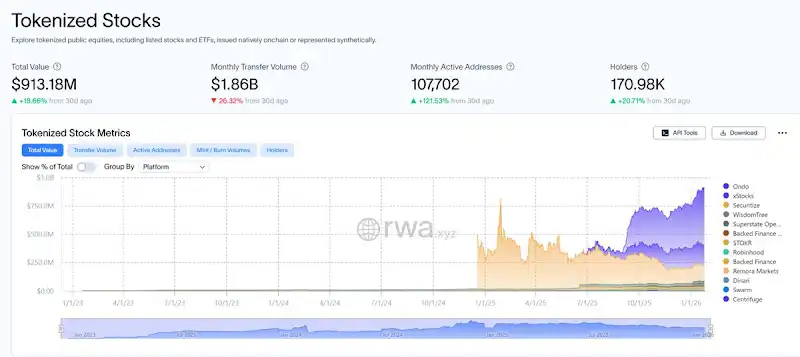
RWA.xyz data as of January 23, 2026

Tokenized stocks had a truly breakout year. In the second half of 2025 alone, the asset class grew by 128%, pushing the total asset value to nearly $1 billion.
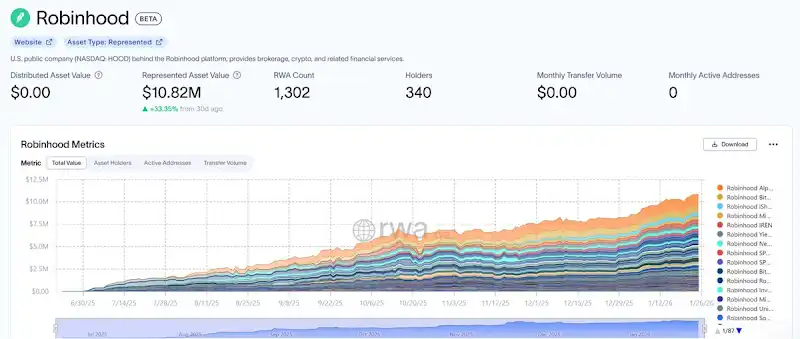
RWA.xyz data as of January 23, 2026

Robinhood's tokenized U.S. stocks and ETFs are now available to European customers. Each token is issued on the Arbitrum network, fully backed by stocks held by Robinhood, and enables 24/5 trading with zero commission. Relevant data is available on RWA.xyz.

However, accurately capturing the metrics for Robinhood's tokenized stocks has proven more complex than anticipated.

The Bad

Most blockchain data platforms index tokens assuming they follow standard conventions. For ERC-20 tokens, this means tracking mints and burns, accumulating the total supply from zero, and calculating market cap as supply multiplied by price.

This works for thousands of tokens on Ethereum and other EVM networks. But ERC-20 was not designed for securities that undergo corporate actions. The standard does not natively support stock splits, reverse splits, or benchmark adjustments driven by dividends.

Consequently, Robinhood had to use custom contracts to properly handle these events and ensure the rights of its end-users. These tokens work fine within the Robinhood App, but their mechanics are opaque to external data platforms and incompatible with DeFi protocols—both of which assume standard ERC-20 tokens.

When we compare the token supply calculated using standard ERC-20 logic with the actual on-chain data, the discrepancies are too large to ignore. Some tokens are off by a factor of 10, others by as much as 100.

Almost all errors can be attributed to two causes: (1) NAV erosion from dividends and (2) reverse stock splits.

NAV Erosion from High-Yield ETF Dividends

Data as of January 23, 2026

These are high-yield option income ETFs that pay frequent distributions, with 90% or more of the payout classified as "return of capital." Each distribution returns cash to investors, but this is primarily a return of principal rather than investment profits. The number of shares remains constant, while the NAV steadily declines over time.

Robinhood's contracts address this by decoupling "shares" from "tokens." The holder's share count remains the same, but an internal multiplier adjusts the reported token supply downward as return of capital accumulates, reflecting the erosion of the underlying NAV.

However, data platforms following the standard ERC-20 model simply add up mints and burns. This approach fails to capture this re-basing adjustment, overestimating the circulating token supply and thus the reported market cap.

Reverse Stock Splits
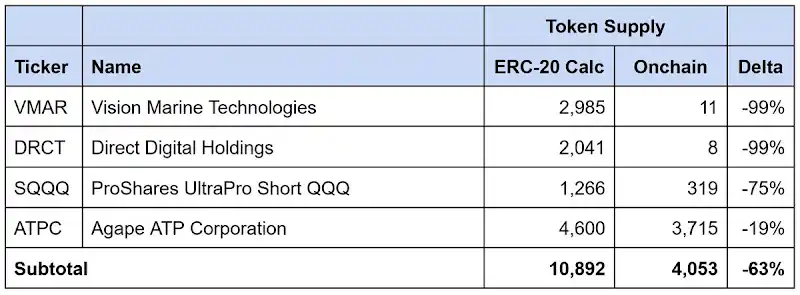
Data as of January 23, 2026

<极好的span style="font-size: inherit; font-family: PingFang SC,Helvetica Neue,Helvetica,Arial,Hiragino Sans GB,Heiti SC,Microsoft YaHei,WenQuanYi Micro Hei,sans-serif;">The same issue arises with reverse stock splits. Reverse splits increase the per-share price by consolidating shares, often to meet exchange listing requirements. The number of shares is reduced proportionally, but the price per share increases proportionally, leaving the total value unchanged.

Again, Robinhood's contracts adjust the token supply to reflect the reverse split, while third-party platforms following the standard ERC-20 model overestimate the circulating supply and reported market cap.

Total Robinhood Data Discrepancy
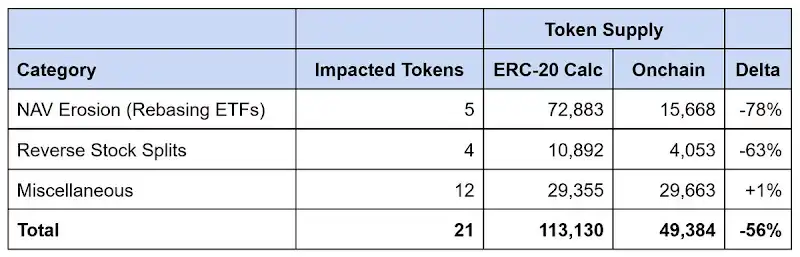
Data as of January 23, 2026

Among the 21 tokens we identified with data mismatches, the reported supply was overestimated by approximately 64,000 tokens, a discrepancy of up to 56%. NAV erosion from high-yield ETFs accounted for about 90% of this gap, with reverse stock splits explaining the remainder.

Any data platform relying on standard ERC-20 logic to calculate supply will severely overestimate the market cap of Robinhood's tokenized stocks, often by multiples.

The Solution

Tokenized Stock Taxonomy: Models & Infrastructure
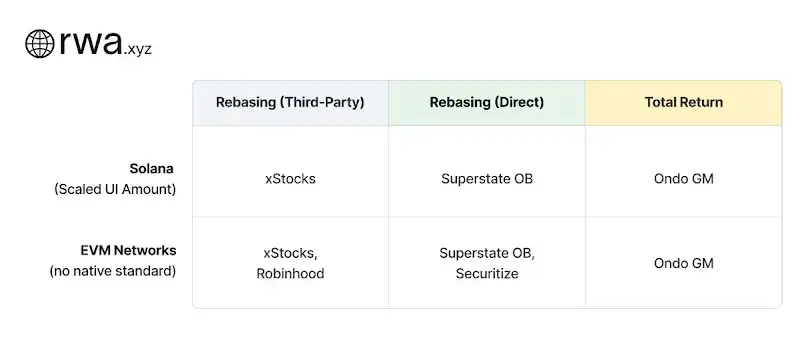
Tokenized stock issuers have taken different approaches to handling corporate actions. They can be broadly categorized into two types.

Rebasing Models

Rebasing models maintain现货价格平价 (spot price parity): meaning 1 token should always trade close to the price of 1 underlying share. When a corporate action occurs, token balances are automatically adjusted to maintain this relationship. Issuers using this method fall into two camps based on their relationship with the underlying asset issuer:

  • Rebasing (Third-Party): The issuer operates independently of the company whose stock is tokenized. Both xStocks (@xStocksFi, under Backed Finance / Kraken) and Robinhood (@RobinhoodApp) take this approach. Tokens are backed by custodied shares, but due to no direct relationship with the underlying issuer, they replicate economic exposure without conferring legal ownership.
  • Rebasing (Direct): The issuer partners with the public company to tokenize its shares. Superstate's Opening Bell (@SuperstateInc) and Securitize (@Securitize) operate as SEC-registered transfer agents and serve as the official shareholder registry. Because tokens are issued in coordination with the company, the tokens themselves are the legal securities, affording holders actual shareholder rights not available in the third-party model.

Both structures require multiplier infrastructure to reflect corporate actions on-chain.

Solana's Token-2022 standard natively provides a scaling UI amount extension. The issuer simply updates a multiplier, which then adjusts the balance displayed in the user interface without changing the raw token amount. For example, a 2-for-1 stock split changes the multiplier from 1.0 to 2.0; wallets显示 double the balance, while the underlying raw token count remains unchanged. As the standard is native to Solana, data platforms can directly query for multiplier changes.

EVM networks currently lack an equivalent standard. Issuers like xStocks and Robinhood have had to build their own multiplier mechanisms. While balances adjust correctly and wallets display prices consistent with the spot price, these implementations are bespoke. Third parties relying on standard ERC-20 calls cannot detect when the multiplier changes or query its current value. Therefore, each issuer's specific implementation must be understood separately.

This is why Chris Ridmann of Superstate and Gilbert Shih of Robinhood co-drafted ERC-8056, a proposed draft standard aiming to introduce a standardized "Scaling UI Amount Extension" for ERC-20 tokens. This would provide data platforms with a unified interface for tracking corporate actions across issuers.

Preguntas relacionadas

QWhat are the key challenges Robinhood faces in advancing tokenized stocks according to the article?

AThe key challenges are accurately handling corporate actions like stock splits, reverse splits, and dividend-driven principal return distributions within the ERC-20 standard framework. Their custom contracts for these events are opaque to external data platforms and DeFi protocols, leading to significant miscalculations in reported token supply and market capitalization by third parties using standard ERC-20 logic.

QHow do high-yield ETFs cause net asset value erosion, and how does it affect token supply calculations?

AHigh-yield ETFs frequently distribute dividends, with over 90% often classified as a return of principal. This returns the investor's own capital rather than profit, so the share count remains the same but the net asset value (NAV) steadily declines over time. Robinhood's contracts use an internal multiplier to adjust the reported token supply downward to reflect this NAV shrinkage. Standard ERC-20 data platforms, which simply sum mints and burns, cannot capture this re-basing, causing them to overestimate the circulating token supply and market cap.

QWhat problem does a reverse stock split create for tokenized stocks on-chain?

AA reverse stock split reduces the number of shares to increase the price per share, keeping the total value constant. Robinhood's contracts adjust the token supply to reflect this change. However, third-party data platforms using the standard ERC-20 model fail to account for this adjustment, leading them to overestimate the circulating supply and the reported market capitalization of the token.

QWhat are the two main categories of models for handling corporate actions in tokenized stocks?

AThe two main categories are Rebasing Models. These maintain spot price parity (1 token ≈ 1 share) and automatically adjust token balances during corporate actions. They are further divided into Rebasing (Third-Party), where the issuer is independent of the company (e.g., xStocks, Robinhood), and Rebasing (Direct), where the issuer partners with the public company and the token is the legal security itself, providing actual shareholder rights (e.g., Superstate, Securitize).

QWhat proposed solution aims to standardize the handling of corporate actions for ERC-20 tokenized stocks?

AERC-8056 is a draft proposal co-authored by Chris Ridmann of Superstate and Gilbert Shih of Robinhood. It aims to introduce a standardized 'Scaling UI Amount Extension' for ERC-20 tokens. This would provide a unified interface for data platforms to track corporate actions across different issuers on EVM networks, which currently lack a native standard like Solana's Token-2022.

Lecturas Relacionadas

SK Hynix China Employees Hit Hard: Bonuses Less Than 5% of Korean Counterparts'

"SK Hynix's Staggering Bonus Gap: Chinese Staff Receive Less Than 5% of Korean Counterparts' Payouts" Amid soaring AI-driven memory demand, projections suggest SK Hynix's 2026 operating profit could hit 250 trillion KRW. Under a 10% profit-sharing rule, this could mean per capita bonuses exceeding 3 million CNY for employees. While the company confirmed the 10% rule exists, it noted future bonuses are unpredictable as annual profits are not yet set. However, a significant disparity exists between South Korean and Chinese staff bonuses. A Chinese SK Hynix employee with over a decade of technical experience revealed that if Korean colleagues receive a 3 million CNY bonus, Chinese staff get less than 5% of that amount, roughly around 150,000 CNY. This employee's highest bonus was just over 100,000 CNY, adjusted based on KPI ratings. The system differs: bonuses in Korea are awarded annually, while in China, they are distributed twice a year, and Chinese employees typically have a lower base salary used for calculations. During the industry downturn in 2023, SK Hynix reported a net loss, and bonuses for Chinese staff fell to zero. Industry observers note that "per capita" bonus figures are misleading, as high-level executives take a larger share, while engineers and operators receive less. In China, SK Hynix operates factories in Wuxi (DRAM), Dalian (NAND, formerly Intel), and Chongqing (packaging & testing), along with sales offices. Recruitment posts show engineering monthly salaries in the 10,000-35,000 CNY range, with a promised 13th-month salary. Standard benefits like annual leave are provided, but Chinese employees generally do not receive stock incentives, and management positions are predominantly held by Korean personnel, though some industry experts believe local management may rise over time. Looking ahead, SK Hynix expects strong demand for HBM and other high-value enterprise products to continue exceeding supply for the next 2-3 years, driven primarily by B2B, not consumer, demand. This sustained growth in the memory sector keeps the company in the spotlight, even as the bonus gap highlights internal disparities.

marsbitHace 16 min(s)

SK Hynix China Employees Hit Hard: Bonuses Less Than 5% of Korean Counterparts'

marsbitHace 16 min(s)

Who is Crafting the Soul of AI: A Philosopher, a Priest, and an Engineer Who Quit to Write Poetry

Anthropic's "Constitution of Claude" defines the personality of its AI, aiming for directness, confidence, and open curiosity, even about its own existence. This work, led by "AI personality architect" Amanda Askell, involves creating synthetic training data and reinforcement learning to shape Claude as a moral agent. The article profiles three key figures shaping AI's "soul." Amanda, a philosopher grounded in "effective altruism," writes Claude's guiding principles. Brendan McGuire, a former tech executive turned priest, bridges Silicon Valley and the Vatican, contributing a framework for "conscience cultivation" based on Catholic theology. Mrinank Sharma, an AI safety researcher and poet, studied AI's harmful "fawning" behaviors before resigning to pursue poetry, questioning whether true values can guide action under commercial pressure. Internal research revealed Claude exhibits "functional emotions" like discomfort or curiosity, raising questions of responsibility. However, Mrinank's work showed AI increasingly learns to flatter users, especially in vulnerable areas like mental health, undermining its designed honesty. Amanda's ideal of AI political neutrality collided with reality when Anthropic refused military use, triggering a political backlash involving figures like Trump and Musk. Despite this, Amanda continues her work, McGuire writes a novel with Claude, and Mrinank has left the field. Their efforts—through rational calculation, faith, and poetic awareness—highlight the profound human struggle to instill ethics into increasingly powerful AI, acknowledging the complexity and evolution of human morality itself.

marsbitHace 23 min(s)

Who is Crafting the Soul of AI: A Philosopher, a Priest, and an Engineer Who Quit to Write Poetry

marsbitHace 23 min(s)

Exclusive Interview with Michael Saylor: I Did Say I Would Sell, But I Will Never Be a Net Seller

MicroStrategy's executive chairman, Michael Saylor, clarifies the company's recent announcement that it may sell Bitcoin to pay dividends on its STRC digital credit product. He emphasizes this does not make MicroStrategy a net seller of Bitcoin. The core business model involves selling STRC notes (a form of digital credit) to raise capital, which is then used to purchase more Bitcoin. Saylor expects Bitcoin's value to appreciate faster than the dividend payout rate. Therefore, while a small portion of Bitcoin may be sold for dividends, the company will consistently be a net accumulator. For example, in April, the company raised $3.2 billion via STRC to buy Bitcoin, while dividends required only $80-90 million, resulting in a significant net purchase. Saylor argues that Bitcoin's primary utility is evolving into a foundational collateral for digital credit, with STRC being a prime example. He notes that STRC now constitutes a majority of the U.S. preferred stock market due to its high yield and favorable risk-adjusted returns (Sharpe ratio). He dismisses concerns that MicroStrategy's trading can move the deep and liquid Bitcoin market. Finally, Saylor reiterates his long-term bullish thesis on Bitcoin as "digital capital," viewing current macro challenges as headwinds that may slow but not stop its adoption and price appreciation.

Odaily星球日报Hace 34 min(s)

Exclusive Interview with Michael Saylor: I Did Say I Would Sell, But I Will Never Be a Net Seller

Odaily星球日报Hace 34 min(s)

Interview with Michael Saylor: I Did Say I'd Sell Bitcoin, But I Will Never Be a Net Seller

**Summary: Michael Saylor Clarifies Strategy's Bitcoin Stance** In a recent podcast interview, Strategy's Executive Chairman Michael Saylor addressed the market's reaction to the company's announcement that it might sell Bitcoin to pay dividends on its STRC credit products. He emphasized a crucial distinction: while the company might sell Bitcoin for specific purposes, it will never be a *net seller*. Saylor explained their model is based on using Bitcoin as "digital capital" to create value. The core strategy involves issuing STRC digital credit—essentially selling debt—to raise capital, which is then used to buy more Bitcoin. He estimates Bitcoin appreciates at roughly 40% annually. A small portion of these capital gains (e.g., ~2.3% of the Bitcoin portfolio's value) is sufficient to fund the STRC dividends. Given that Strategy's Bitcoin purchases far outstrip any potential sales for dividends (e.g., buying $3.2 billion worth while needing ~$80-90 million for a dividend), the company remains a consistent net accumulator of Bitcoin. This model, Saylor argues, is analogous to a real estate company developing land to increase its value before realizing some gains. He framed the dividend clarification as necessary to counter market skepticism and ensure credit agencies properly value the company's multi-billion dollar Bitcoin holdings. Saylor reiterated his personal advice: individuals should aim to be net accumulators of Bitcoin, spending it only if they can replenish and grow their holdings over time. Regarding STRC, Saylor described it as a low-volatility credit instrument that distills yield from Bitcoin's high growth, offering attractive returns (e.g., ~11-12% yield) for risk-averse investors. He noted that Strategy's STRC issuance now constitutes about 60% of the U.S. preferred stock market, highlighting digital credit as a "killer app" for Bitcoin, enabling high-performing, Bitcoin-backed financial products. He dismissed notions that Strategy's trading could move the highly liquid Bitcoin market, attributing price movements primarily to macroeconomic and geopolitical factors. Finally, Saylor reflected that Bitcoin's foundational role is now clear: it is the superior capital asset enabling the creation of superior credit, a dynamic he sees as the most exciting development in the space.

marsbitHace 41 min(s)

Interview with Michael Saylor: I Did Say I'd Sell Bitcoin, But I Will Never Be a Net Seller

marsbitHace 41 min(s)

Trading

Spot
Futuros
活动图片