WEEX Labs: The Next Script for Memecoins, The Era of Flash Trends

marsbitPublicado a 2025-12-15Actualizado a 2025-12-15

Resumen

WEEX Labs: The Next Act of Memecoin—The Era of Flash Trends Despite a cooling market, memecoins remain a key arena for attention-based economic games. The memecoin landscape has evolved significantly in 2025, shifting from the earlier dominance of large-cap tokens like DOGE and SHIB to smaller, faster-cycling assets. Key shifts include a migration beyond Solana to chains like Base and BNB Chain, where Solana’s share of new token launches has dropped from 90% to 57%. Memecoin market caps are shrinking, with mid-to-small cap tokens such as BRETT and TOSHI becoming more common. Market cycles have accelerated from weeks to hours, driven by AI tools and social media algorithms that speed up both hype and fade-out. Recent trending memecoins illustrate these changes: - $Franklin (FDV peak: $24M), inspired by a politicized meme. - $DOYR (FDV peak: $31M), born from a typo and community reaction. - Horse Success (FDV peak: $5M), a Chinese-language meme. - $jesse (FDV peak: $28M), created by Base co-founder Jesse Pollak. Memecoins are maturing from internet jokes into cultural indicators. While established tokens like BONK are building utility, new tokens are increasingly driven by social momentum and data. This structural shift offers more opportunities but demands deeper research (DYOR) amid higher risks. In the flash trend era, memecoins reflect real-time social sentiment—volatile, fast, and ever-evolving.

Against a backdrop of a somewhat fatigued market, Memecoins, though no longer frenzied, remain a battleground in the attention economy.

Memecoins Haven't Reached the End, They've Just Changed Direction

Compared to the scene in 2024 where Memecoins stole the show, this year's Memecoin activity has indeed quieted down significantly after $TRUMP, but this is not the end; rather, the market has evolved to the next stage.

• From Solana to Base, BNB Chain: Initially, Solana monopolized 90% of new token issuance with its low fees and high speed, especially with the launch of Pump.fun, which significantly decentralized token issuance rights and spurred a full year of Meme mania in 2024. However, with multi-chain expansion and the continuous efforts of other public chains, Solana's share has now dropped to 57%, with BNB Chain, Base Chain, and others continually grabbing on-chain market share.
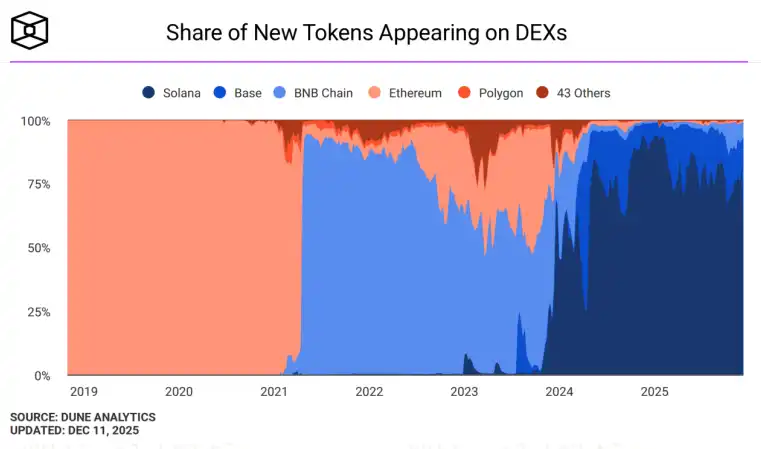
• Small to Medium-Sized Memes Become Mainstream: The Memecoin market narrative has shifted from being dominated by Ethereum chain tokens like DOGE, SHIB, PEPE with billion-dollar market caps, to Solana chain spawning large Memecoins with multi-billion dollar market caps like BONK, WIF, FARTCOIN, TRUMP, and now to small and medium-cap Memecoins with million-dollar market caps emerging on various chains, such as BRETT and TOSHI on Base chain, and Binance Life, BROCCOLI on BNB Chain. This indicates the market cap ceiling for Memecoins is continuously lowering, and the market is maturing.

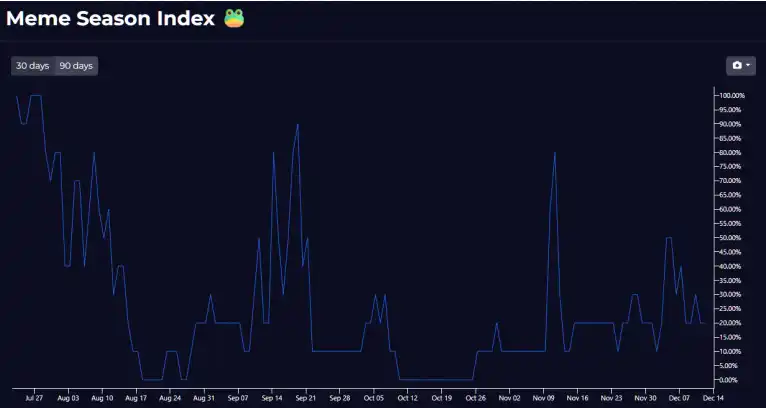
• Accelerated Rotation Rhythm: With limited liquidity growth and an accelerating trend in the number of Memecoins, the market rotation rhythm has shifted from "weeks" to "hours." Particularly thanks to the proliferation of AI tools and upgrades in social media algorithms, the speed of viral spread and decay has increased dramatically. This results in a large number of new coins reaching their peak within just 24-48 hours of launch, with a lifecycle far shorter than the previous weekly cycles.

Recent Hot Memecoins: Social Media Hype + Small to Medium Market Cap

Browsing recent hot Memecoins undoubtedly confirms the above changes.

$Franklin: Franklin The Turtle was originally a classic children's character from a series of books and TV shows in Canada in the 1980s and 90s. The current U.S. Secretary of Defense recently posted a politically satirical image on X, expressing a tough stance on U.S. cross-border military anti-drug operations. Subsequently, the同名 Memecoin portrayed Franklin the Turtle as a satirical, militarized anti-drug warrior. The coin launched on December 1st, reached a peak FDV of $24.36M by the 10th, and has currently retraced to $5.4M.

$DOYR: The起因 was DYOR being misspelled as DOYR. Then, spurred by a reply post saying "DOYR = DO YouR meme?", the BNB Chain community quickly launched a同名 Memecoin. The coin launched on December 6th, reached a peak FDV of $31.34M the next day, and has currently retraced to $3.4M.

$马到成功 (Horse Success): Originating from the Chinese blessing phrase "马到成功" (meaning immediate success) leveraged by the community, it is a popular Chinese Memecoin following others like "Binance Life" and "Vulgar Penguin". The coin launched on November 15th, reached a peak FDV of $5.03M on December 2nd, and has currently retraced to $2.6M.

$jesse: A personal Memecoin issued by Base co-founder Jesse in November. The coin launched on November 21st, reached a peak FDV of $28.08M on the same day, and has currently retraced to $10M.

Opportunities in the Structural Changes of Memecoins

Starting from DOGE's dog meme to today's complex ecosystem where any topic can become a coin, Memecoins are no longer just simple internet jokes but a perfect fusion of community narrative, attention propagation, and speculative frenzy.

This year's Memecoin market has been as thrilling as a roller coaster: accelerated rotation, smaller scale, multi-chain expansion—all marking a transition from狂欢 (carnival) to maturity.
It is foreseeable that, regardless of bull or bear markets, the Memecoin market will not fall silent, because wherever there is attention, someone will go all-in on a dog picture to spread emotion.

However, in the era of flash trends, Memecoins are beginning to transform from "jokes" into "cultural indices." For example, older tokens like DOGE, SHIB, and BONK are shedding their religious constraints, continuously undergoing technical upgrades, and applications are empowering the Meme. Meanwhile, more newly produced small and medium Memecoins are turning to "social media heat + data-driven," which carries higher risks but offers more refined opportunities. The rises and falls of these Memecoins also represent the热度变迁 (heat变迁 - heat changes/evolution) of certain social topics.

No matter how you look at it, this structural change will reshape investment logic, bringing more opportunities for participants while also demanding more DYOR.


Criptos en tendencia

Preguntas relacionadas

QWhat is the main shift in the Memecoin market as described in the article?

AThe main shift is that the Memecoin market has evolved from large-cap, long-cycle coins to smaller-cap, faster-rotating coins, with accelerated rotation speeds, multi-chain expansion, and a focus on social media virality and data-driven opportunities.

QWhich blockchain initially dominated new token issuance for Memecoins, and what caused its market share to decrease?

ASolana initially dominated with 90% of new token issuance, largely due to Pump.fun lowering the barrier for token creation. Its share has decreased to 57% due to multi-chain expansion and competition from other chains like BNB Chain and Base.

QWhat are some examples of recent popular Memecoins mentioned, and what were their peak FDV valuations?

AExamples include $Franklin (peak FDV $24.36M), $DOYR (peak FDV $31.34M), $Horse Success (peak FDV $5.03M), and $jesse (peak FDV $28.08M).

QHow has the lifecycle of new Memecoins changed in the current market?

AThe lifecycle has accelerated significantly, with new coins often reaching their peak valuation within 24-48 hours after launch, much faster than the previous weekly cycles, due to AI tools and social media algorithms.

QAccording to the article, what are Memecoins transforming into in this 'fast-flash era'?

AMemecoins are transforming from simple jokes into 'cultural indices,' where older memes are gaining utility through technical upgrades, while newer ones act as indicators of social media trend热度 and data-driven speculative opportunities.

Lecturas Relacionadas

Misjudged A-Shares: Resilience, Expectations, and Confidence

China's A-share market recently faced selling pressure, especially in tech sectors, initially triggered by a global tech sell-off that began in South Korea. However, the article argues this is a case of "mistaken injury" and highlights the market's underlying resilience. This resilience stems from three main pillars: **1) Tech Sector Fundamentals:** Unlike Korea's market dominated by a few memory chip stocks, China's tech sector is diversified across computing, communications, electronics, and semiconductors, supported by dual narratives of global AI supply chains and domestic substitution. Core areas like optical modules and fiber optics continue to show strong earnings growth. **2) "National Team" Support:** State-backed institutions and large corporations have made significant market purchases and announced buybacks, providing liquidity and signaling confidence. This is seen as a stabilizing policy signal, often associated with market bottoms. **3) Broader Market Pillars:** Other major sectors are showing endogenous recovery momentum. Consumer stocks benefit from stabilizing CPI and signs of sector recovery (e.g., liquor price hikes). Cyclical sectors like aluminum have high earnings, potential price increases due to tight supply, and low valuations. The financial sector offers stable dividends and low valuations. The conclusion is that the sell-off was driven by external contagion, not a collapse in fundamentals. With strong policy support and recovering momentum across key sectors, the A-share market possesses the toughness to regain stability.

marsbitHace 25 min(s)

Misjudged A-Shares: Resilience, Expectations, and Confidence

marsbitHace 25 min(s)

The Clarity Act's Journey Through Congress: The Thorny Path of Bipartisan Compromise in the U.S.

The U.S. Congress is struggling to advance the crypto market structure bill known as the Clarity Act, with bipartisan compromise proving difficult. Key hurdles include unresolved disputes over "yield" products and, more critically, the inclusion of strong ethics provisions for elected officials—a non-negotiable demand for many Democrats. While a compromise on yield was reached in May, securing only limited Democratic support in committee, the separate Senate Agriculture Committee version later passed with no Democratic votes due to the ethics impasse. As Republicans push for a full Senate vote in July, demands for ethics rules have expanded, and other contentious issues like developer protections and concerns from law enforcement and large banks further complicate negotiations. Despite consensus on the need for legislation, the path forward is unclear. Recent discussions between senators and White House officials aim to find acceptable ethics language. Some lawmakers question whether a compromise text can garner enough bipartisan support, with one Democrat stating the current proposal lacks the strong ethics provisions required for their vote. Potential short-term goals for the crypto community include symbolic Senate action before the August recess, a longer-term aim for passage by 2026, or establishing a detailed framework that addresses ethics and other compromises. The process remains arduous, relying on the traditional, vote-by-vote effort to build bipartisan support.

marsbitHace 44 min(s)

The Clarity Act's Journey Through Congress: The Thorny Path of Bipartisan Compromise in the U.S.

marsbitHace 44 min(s)

Are Kalshi and Polymarket Founders at Odds? This Business Rivalry Is More Brutal Than You Think

"The Rivalry Between Kalshi and Polymarket Founders Turns Bitter and Litigious" The intense feud between Tarek Mansour, CEO of Kalshi, and Shayne Coplan, founder of Polymarket, has escalated far beyond typical business competition into personal animosity and regulatory battles. Both lead billion-dollar prediction market platforms, but their approaches differ sharply. Kalshi positions itself as the compliant operator, securing U.S. regulatory approval before launching. In contrast, Polymarket initially operated offshore, allowing U.S. users to access its platform via VPN, which drew regulatory scrutiny. The conflict reached a peak in November 2024 when FBI agents raided Coplan's New York apartment. While Coplan publicly blamed political motives, his team privately suspected Kalshi was involved. According to sources, Kalshi's lawyers had previously reported Polymarket's operations to federal prosecutors, highlighting its accessibility to U.S. users despite a ban. This incident fueled mutual accusations and underhanded tactics, including social media smear campaigns and attempts to sabotage each other's major business deals. Their rivalry also played out in Washington, influencing regulatory debates. Kalshi actively lobbied against Polymarket's practices, framing them as illegal and unethical. Polymarket, after facing a CFTC fine and investigation, later acquired a licensed U.S. firm to launch a domestic app, regaining a foothold. Despite the hostility, both companies have seen massive growth, with combined trading volumes soaring. However, increased regulatory scrutiny, particularly around insider trading on Polymarket's platform, continues to pose challenges. The founders' deep-seated mutual disdain ensures their battle for market dominance remains as much a personal vendetta as a commercial one.

marsbitHace 53 min(s)

Are Kalshi and Polymarket Founders at Odds? This Business Rivalry Is More Brutal Than You Think

marsbitHace 53 min(s)

Trading

Spot

Artículos destacados

Cómo comprar ERA

¡Bienvenido a HTX.com! Hemos hecho que comprar Caldera (ERA) sea simple y conveniente. Sigue nuestra guía paso a paso para iniciar tu viaje de criptos.Paso 1: crea tu cuenta HTXUtiliza tu correo electrónico o número de teléfono para registrarte y obtener una cuenta gratuita en HTX. Experimenta un proceso de registro sin complicaciones y desbloquea todas las funciones.Obtener mi cuentaPaso 2: ve a Comprar cripto y elige tu método de pagoTarjeta de crédito/débito: usa tu Visa o Mastercard para comprar Caldera (ERA) al instante.Saldo: utiliza fondos del saldo de tu cuenta HTX para tradear sin problemas.Terceros: hemos agregado métodos de pago populares como Google Pay y Apple Pay para mejorar la comodidad.P2P: tradear directamente con otros usuarios en HTX.Over-the-Counter (OTC): ofrecemos servicios personalizados y tipos de cambio competitivos para los traders.Paso 3: guarda tu Caldera (ERA)Después de comprar tu Caldera (ERA), guárdalo en tu cuenta HTX. Alternativamente, puedes enviarlo a otro lugar mediante transferencia blockchain o utilizarlo para tradear otras criptomonedas.Paso 4: tradear Caldera (ERA)Tradear fácilmente con Caldera (ERA) en HTX's mercado spot. Simplemente accede a tu cuenta, selecciona tu par de trading, ejecuta tus trades y monitorea en tiempo real. Ofrecemos una experiencia fácil de usar tanto para principiantes como para traders experimentados.

421 Vistas totalesPublicado en 2025.07.17Actualizado en 2026.06.02

Cómo comprar ERA

Discusiones

Bienvenido a la comunidad de HTX. Aquí puedes mantenerte informado sobre los últimos desarrollos de la plataforma y acceder a análisis profesionales del mercado. A continuación se presentan las opiniones de los usuarios sobre el precio de ERA (ERA).

活动图片












