WEEX Completes $2 Million WXT Buyback, Rewarding User Support for 'Futures Mining'

marsbitPublicado a 2025-12-16Actualizado a 2025-12-16

Resumen

Global cryptocurrency exchange WEEX has completed a $2 million buyback of its native token WXT, repurchasing 72,571,028 WXT tokens. The move is part of the platform’s effort to reward users for their participation in the "Futures Mining" campaign, which offers up to 30% trading fee rebates in WXT. The campaign, originally scheduled to end on December 15, has been extended by 10 days to December 25 due to high user demand. Participants receive real-time WXT rewards for each futures trade, with higher trading volumes unlocking greater rebate tiers, ranging from Bronze to King Miner levels. To prevent inflation and support token value, WEEX used its own funds for the buyback, maintaining WXT’s scarcity. Since its launch in July 2024, WXT has seen significant growth, with year-to-date gains of around 70%, making it one of the top-performing exchange tokens. WEEX has conducted four buybacks to date, burning 41.24% of WXT’s total supply. Additional token utility includes fee discounts, airdrops, and membership benefits, offering holders an estimated annualized return of 660.61%.

On December 16, globally leading cryptocurrency trading platform WEEX announced the completion of a new round of WXT buyback worth $2 million, totaling 72,571,028 WXT tokens repurchased.

This WXT buyback aims to reward global users for their support of WEEX's 'Futures Mining' campaign. The event offers up to 30% trading fee rebate rewards for users participating in futures trading, with rewards distributed in real-time via WXT tokens.

In other words, 'Futures Mining' transforms users' daily futures trading into a novel, fully trading volume-driven 'mining' model—the higher the trading volume, the higher the fee rebate ratio, with all WXT rewards credited instantly.

'Futures Mining' Continues to Boom, Event Extended by 10 Days

WEEX 'Futures Mining' aims to return platform growth dividends to users through the innovative incentive model of 'trading is mining'. During the event, users receive real-time WXT-based fee rebates for each futures open/close order, with rebates up to 30%.

Since its launch on November 26, the event has attracted active participation from global users, with trading heat continuously rising. According to WEEX official data, as of 18:00 on December 16 (UTC+8), the top 100 users on the 'Futures Mining' leaderboard have accumulated a total futures trading volume of $9.172 billion, with total mining rewards of 3,015,047.7 WXT (data updating in real-time).
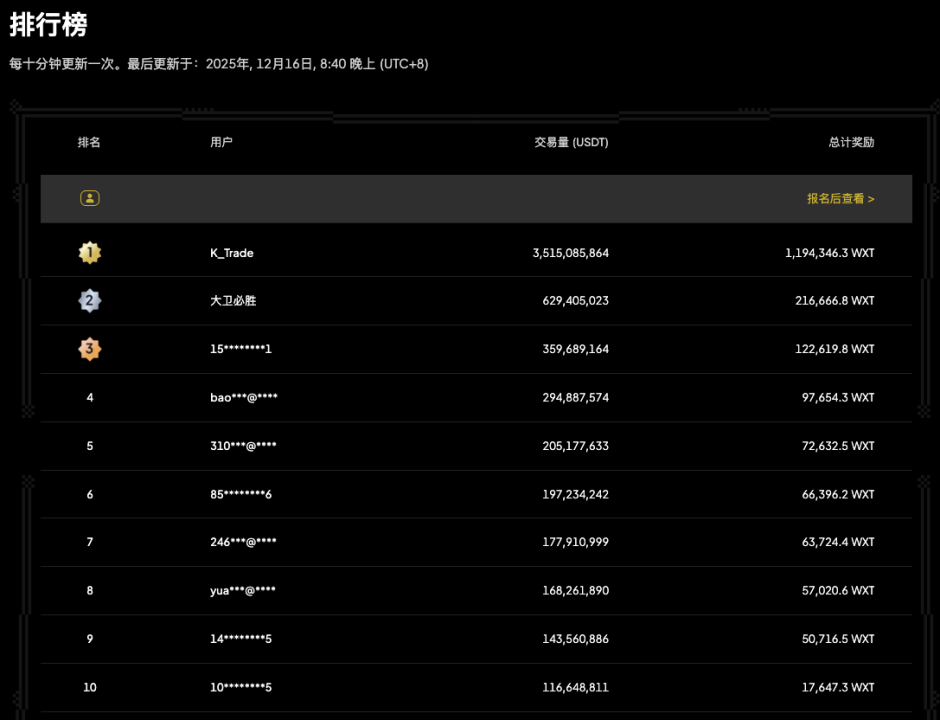
Due to the novel mechanism, generous rewards, and support for second-level settlement with instant rewards, the event has seen daily new participants and trading volumes repeatedly hit record highs after launch, with many users requesting an extension. Therefore, WEEX has extended the event by 10 days, moving the deadline from the original December 15 to December 25, allowing more users sufficient time to participate and continue enjoying mining rebate benefits.

This adjustment only extends the event duration; the rules remain unchanged: users click to register and participate in futures trading to receive WXT-based fee rebates, with WXT rewards credited in real-time after each open/close order.

Based on the miner tier mechanism of the 'Futures Mining' event, users start at the 'Copper Miner' tier. After trading begins, they can unlock Copper, Silver, Gold, Platinum, Diamond, and King tiers sequentially based on cumulative trading volume. The higher the trading volume, the higher the miner tier and fee rebate ratio, up to 30%. After the extension, users' unlocked miner tiers and rebate ratios remain effective. Trading fees generated during the extension will still be rebated in real-time at the corresponding ratio. Users can check their reward amounts and status in real-time via the WEEX App or official website.

72.57 Million WXT Buyback Completed, Ensuring Deflationary Effect

Unlike the token inflation issues faced by trading mining launched by other CEXs or liquidity mining on DeFi platforms, WEEX 'Futures Mining' not only maintains WXT's deflation but also genuinely demonstrates 'user rewards' sincerity through the $2 million WXT buyback supporting mechanism.

As previously announced, WEEX used platform funds to conduct a WXT buyback on the open market on December 16. By 17:00 (UTC) on December 16, the buyback plan was completed as scheduled, totaling 72,571,028 WXT repurchased at an average price of 0.027559 USDT/WXT.

Thus, the circulating supply of WXT will not increase due to the 'Futures Mining' event, maintaining WXT's scarcity and value stability, ensuring users' mining收益. Long-term, as WEEX's user base and trading volume continue to grow, the platform can invest more resources to further empower the WXT ecosystem, enhancing WXT's long-term appreciation potential.

Since its launch in July 2024, WXT has seen a maximum increase of over 358%, with a cumulative increase of over 180% to date. According to CMC data, WXT has risen about 70% year-to-date, ranking among the top 5 CEX platform tokens for yearly gains.

This outstanding performance is attributed to WEEX's long-term empowerment of the WXT ecosystem. To date, WEEX has completed 4 WXT buybacks via open market operations, cumulatively repurchasing 4,196,774,851 WXT tokens. The first three buybacks have been burned, with the burned amount accounting for 41.24% of WXT's total issuance, fully demonstrating WEEX's long-term support and confidence in the WXT token ecosystem.

In addition to buyback and burn, WEEX continues to empower WXT through various mechanisms such as WE-Launch new token listing airdrops, trading fee discounts, and trader权益 upgrades, resulting in a comprehensive annualized yield of up to 660.61% for WXT holders.

As the core of the WEEX ecosystem, WXT is dedicated to incentivizing partners, contributors, and active users of the exchange community. Through the 'Futures Mining' event and WXT buyback mechanism, WEEX not only creates more profit opportunities for users but also further consolidates WXT's market position.

Join WEEX now to experience the new 'Futures Mining' model and easily unlock more profits: https://www.weex.com/zh-CN/events/futures-trading/trade-to-earn


Preguntas relacionadas

QWhat is the total amount and value of WXT tokens repurchased by WEEX in this round?

AWEEX repurchased a total of 72,571,028 WXT tokens, valued at $2 million.

QWhat is the main purpose of the 'Futures Mining' event launched by WEEX?

AThe main purpose of the 'Futures Mining' event is to reward users for their contract trading by providing up to 30% fee rebates, distributed in real-time with WXT tokens.

QHow does the miner ranking system work in the 'Futures Mining' event?

AUsers start as 'Copper Miners' and can unlock higher ranks (Silver, Gold, Platinum, Diamond, King) based on their cumulative trading volume. A higher rank grants a higher fee rebate percentage, up to 30%.

QHow does WEEX ensure the WXT token remains deflationary despite the mining rewards?

AWEEX uses its own funds to repurchase WXT tokens from the open market, which offsets the new tokens issued as mining incentives, thus maintaining the token's scarcity and deflationary nature.

QWhat is the cumulative amount of WXT tokens that WEEX has repurchased and burned to date?

AWEEX has repurchased a cumulative total of 4,196,774,851 WXT tokens, with the first three batches already burned, accounting for 41.24% of the total WXT issuance.

Lecturas Relacionadas

CPU Makes a Comeback to the Table, A $170 Billion "Power Seizure" Drama Begins

A new era is dawning for the server CPU (Central Processing Unit), driven by the shift from AI model training to large-scale reasoning and the rise of Agentic AI. This article explores how the CPU is reclaiming a central role in the AI data center. For years, the focus has been on the GPU (Graphics Processing Unit) for AI training. However, as AI moves to the inference and Agent phase—where tasks involve complex, multi-step reasoning, tool calls, and data management—the workload balance is flipping. Studies show CPUs now handle over 70% of the workload in Agentic AI, up from 10-30% in training. This is because Agent tasks generate massive intermediate data (KV Cache) that exceeds GPU memory, forcing it to be offloaded to the CPU's larger, more scalable memory pools. This increased importance is translating into market changes. Major players are taking note: NVIDIA launched its first standalone CPU line, Vera, based on ARM architecture and optimized for Agent performance. AMD doubled its server CPU market forecast to over $1200 billion by 2030. Analyst reports project the total server CPU market could reach $1700 billion by 2030, with AI-driven demand being a primary driver. Furthermore, the classic ratio of CPUs to GPUs in AI servers is rapidly changing, converging from 1:8 toward 1:1 for Agent deployments. This surge in demand has led to a rare industry-wide price increase of 10-15% for server CPUs from Intel and AMD, breaking a decade-long trend of "more performance for the same price." Demand is bifurcating into high-core-count CPUs for in-rack GPU support and moderate-core CPUs for standalone Agent task orchestration. In China, this global trend presents an opportunity for domestic CPU manufacturers like Hygon (海光信息) and Huawei Kunpeng, who are bolstered by both growing AI infrastructure needs and national policies promoting technological self-reliance ("xin chuang"). The maturity of their software ecosystems is also accelerating, evidenced by faster adaptation to new AI models. In conclusion, the narrative is shifting from a GPU-centric view to one where CPU-GPU synergy is critical. The CPU is no longer a peripheral component but a performance-defining bottleneck and a key growth driver in the AI hardware stack, opening a massive new market estimated in the hundreds of billions of dollars.

marsbitHace 11 hora(s)

CPU Makes a Comeback to the Table, A $170 Billion "Power Seizure" Drama Begins

marsbitHace 11 hora(s)

TechFlow Intelligence: AMD AI Director Publicly Criticizes Claude Code for "Becoming Dumber and Lazier", Trump Claims Full Ceasefire in Hormuz But Strait Still Has 80 Unexploded Mines

TechFlow Intelligence Report: This daily digest covers key developments in AI, crypto, hardware, and geopolitics. In AI, SK Telecom faces US export control scrutiny over its partnership with Anthropic, while a Gemini user reports being misled in a scam scenario, sparking safety debates. China's Z.AI launches the GLM-5.2 model, rivaling Claude Opus without NVIDIA chips. In crypto, Bithumb lists ReProtocol, and Upbit delists KernelDAO. On the hardware front, MIT researchers build a custom OS to study chips, ASML denies US claims its advanced lithography machines are in China, and Amazon considers selling its in-house AI chips. Apple's future A21 Pro chip may use TSMC's latest N2P process. Major tech issues include 10,000 GitHub repositories distributing malware and Apple patching a critical eavesdropping flaw in Beats earbuds. US stocks rise, led by semiconductors, with Intel surging 10.6%, while SpaceX falls 3.5%. Geopolitically, despite a US-Iran deal, the Strait of Hormuz remains risky with ~80 uncleared mines, stalling 80M barrels of oil on standby tankers. Iran postpones Switzerland talks, and Trump calls the agreement an "unconditional surrender." The report highlights a contrast: temporary geopolitical calm versus the ongoing, fundamental restructuring of tech supply chains and chip independence.

marsbitHace 11 hora(s)

TechFlow Intelligence: AMD AI Director Publicly Criticizes Claude Code for "Becoming Dumber and Lazier", Trump Claims Full Ceasefire in Hormuz But Strait Still Has 80 Unexploded Mines

marsbitHace 11 hora(s)

Trading

Spot
Futuros
活动图片