Weekly Token Unlocks: BARD to Unlock 12% of Circulating Supply This Week

marsbitPublicado a 2026-03-14Actualizado a 2026-03-14

Resumen

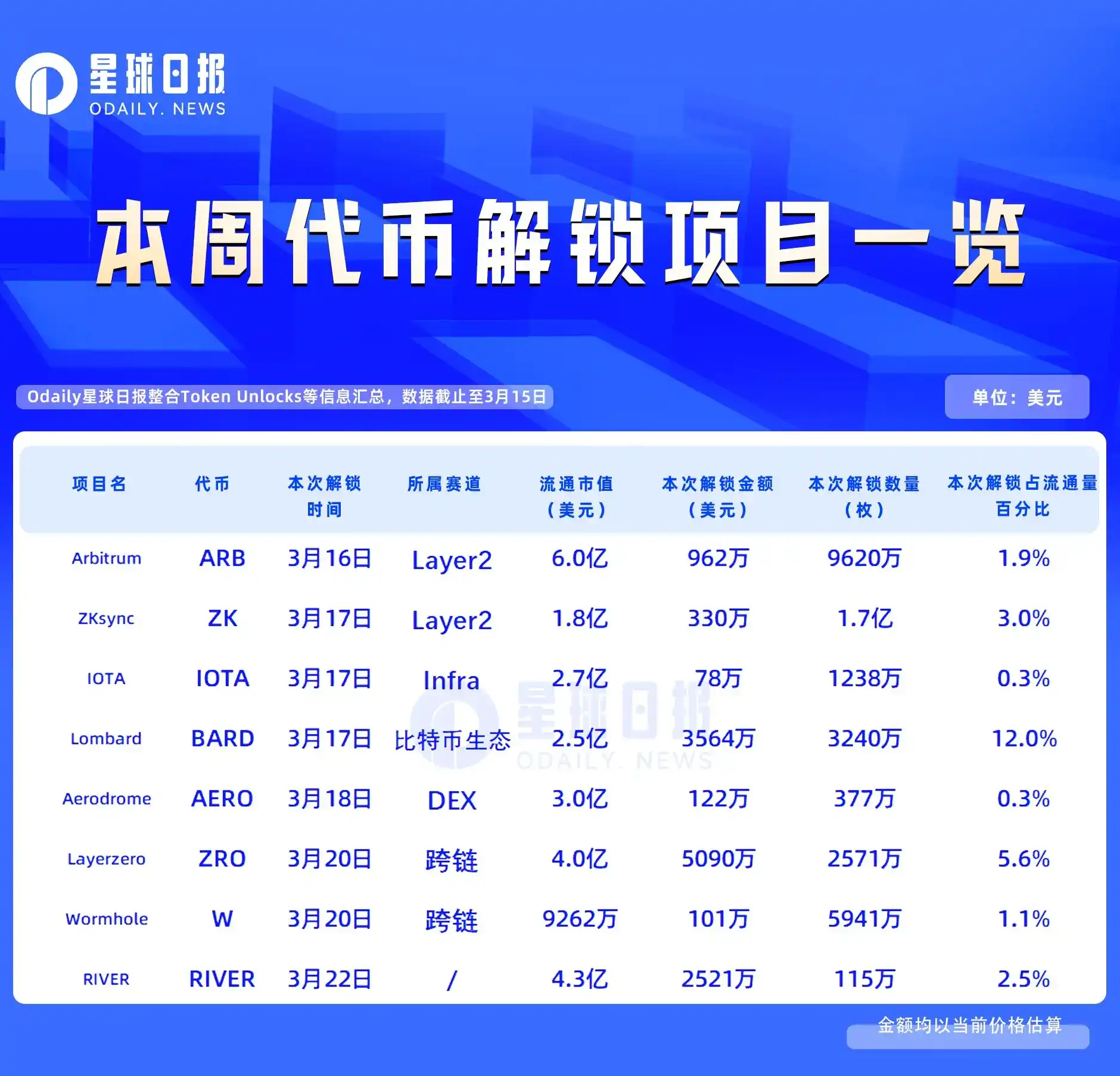
This week's major token unlocks feature significant releases from three projects. Lombard (BARD) leads with an unlock of 32.4 million tokens (approx. $35.64M), representing about 12% of its circulating supply. The project is building an on-chain Bitcoin capital market. LayerZero (ZRO) will unlock 25.71 million tokens (approx. $50.9M) for its omnichain interoperability protocol. zkSync (ZK) has the largest volume unlock at 170 million tokens, though its value is lower at approximately $3.3M. All projects have provided their respective token release schedules.

Lombard

Project Twitter: https://x.com/Lombard_Finance

Project Website: https://www.lombard.finance/

This Unlock Amount: 32.4 million tokens

This Unlock Value: Approximately $35.64 million

Lombard is building an on-chain Bitcoin capital market, aiming to fully unleash the complete potential of this iconic contemporary asset. Lombard's relationship to BTC is analogous to Circle and Tether's relationship to stablecoins. Lombard is vertically integrating the Bitcoin DeFi stack, aiming to support all chains, applications, and developers in seamlessly integrating Bitcoin on-chain.

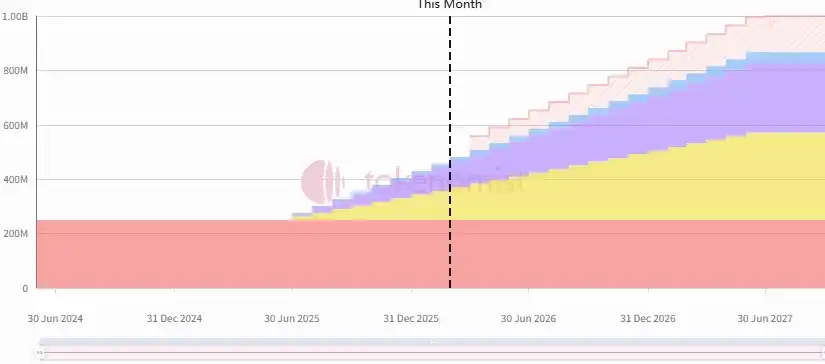
The specific release curve is as follows:

Layerzero

Project Twitter: https://x.com/LayerZero_Core

Project Website: https://layerzero.network/

This Unlock Amount: 25.71 million tokens

This Unlock Value: Approximately $50.9 million

LayerZero is an omnichain interoperability protocol designed for lightweight message passing across chains. LayerZero provides reliable and guaranteed message delivery with configurable trustlessness.

The specific release curve is as follows:
ZKsync

Project Twitter: https://x.com/zksync

Project Website: https://zksync.io/

This Unlock Amount: 170 million tokens

This Unlock Value: Approximately $3.3 million

zkSync is a Layer 2 scaling solution developed by Matter Labs, preserving the underlying blockchain's security properties by leveraging the latest generation of succinct zero-knowledge proofs. All funds in zkSync are held by smart contracts on the main chain, while computation and storage are executed off-chain.

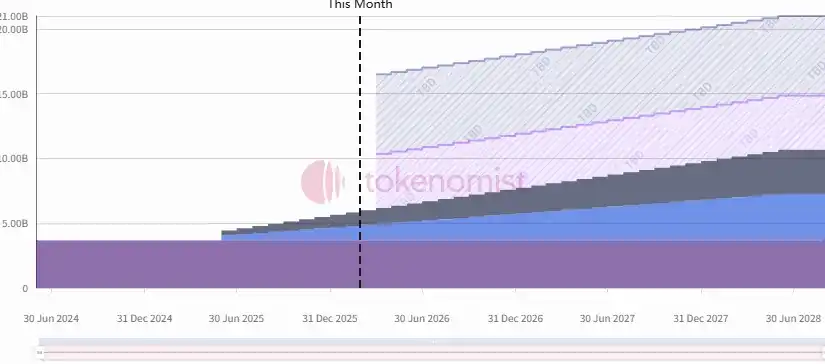
The specific release curve is as follows:
Criptos en tendencia

Preguntas relacionadas

QWhat is the total number of BARD tokens being unlocked this week and what percentage of the circulating supply does it represent?

A32.4 million BARD tokens are being unlocked this week, representing 12% of the circulating supply.

QWhat is the primary goal of the Lombard project as described in the article?

ALombard is building an on-chain Bitcoin capital market, aiming to fully unlock the potential of Bitcoin. It is vertically integrating the Bitcoin DeFi stack to support all chains, applications, and developers in seamlessly integrating Bitcoin on-chain.

QHow many ZKsync tokens are scheduled to be unlocked this week and what is their approximate USD value?

A170 million ZKsync tokens are being unlocked this week, with an approximate value of $3.3 million.

QWhat type of protocol is LayerZero and what is its core function?

ALayerZero is an omnichain interoperability protocol designed for lightweight message passing across chains. It provides reliable and guaranteed message delivery with configurable trustlessness.

QWhich project has the highest USD value of tokens being unlocked this week according to the article?

ALayerZero has the highest USD value of tokens being unlocked this week, at approximately $50.9 million.

Lecturas Relacionadas

New Fire Research Institute: Inflation May Become a Stubborn Problem, Can Cryptocurrencies Achieve Independent Performance in the Short Term?

New Fire Research Institute argues that despite the recent U.S. June CPI decline to 3.5% year-on-year—primarily driven by energy—core goods inflation remains persistent, with core PCE likely showing slight growth. Federal Reserve Chairman Wash has emphasized the Fed's independence and a "zero tolerance" stance on inflation, suggesting a continued hawkish posture that will pressure risk assets, especially if energy prices rise again. Concurrently, the semiconductor memory sector faces structural pressures, as seen in significant sell-offs for Micron and SK Hynix. High leverage in markets like South Korea is triggering deleveraging, amplifying volatility. Investors are also questioning the sustainability of AI-related capital expenditures. In contrast, the crypto market showed relative stability last week, with BTC and ETH gaining slightly. Positive developments include a shift to net inflows for U.S. Bitcoin spot ETFs, a narrowing Coinbase discount, and strong activity on the Robinhood Chain ecosystem. The potential advancement of the U.S. CLARITY Act provides a policy catalyst. Overall, the probability of an independent crypto bull run in the short term is low, given overarching macro pressures. However, fundamentals are improving with ETF inflows and robust on-chain activity, providing solid support. Technically, BTC and ETH show strong support at key moving averages. New Fire Research maintains that Bitcoin around $60,000 represents a high-value allocation zone, with limited downside risk near current levels. The true bull market catalyst awaits a confirmed market bottom combined with a macro policy shift and legislative progress.

marsbitHace 13 min(s)

New Fire Research Institute: Inflation May Become a Stubborn Problem, Can Cryptocurrencies Achieve Independent Performance in the Short Term?

marsbitHace 13 min(s)

Base Under Pressure

**Title: The Pressure Mounts for Base** Base, the Ethereum Layer 2 scaling solution backed by Coinbase, is facing significant pressure and public scrutiny from its leadership following the launch of Robinhood Chain. Base co-founder Jesse Pollak recently acknowledged strategic missteps, admitting that the chain's past focus on social and creator tokens (e.g., through Farcaster, Zora) failed to deliver sustainable adoption. He has refocused on core infrastructure, handing leadership of the Base App back to Coinbase's Cobie. While Base remains a top L2 contender alongside OP Mainnet and Arbitrum, and boasts the highest TVL (nearly $12B), its weaknesses are being highlighted by the new competitor. Key criticisms include its slow progress on decentralization. Base has faced issues with its single sequencer causing block production halts, and L2BEAT is reportedly considering downgrading its decentralization rating from Stage 1 to Stage 0. This contrasts sharply with the rapid initial success of Robinhood Chain, whose DEX quickly entered the top five by volume. The leadership styles of the parent companies are also being compared: Robinhood's CEO actively engages with new projects, while a recent incident where Coinbase's Brian Armstrong briefly changed his profile picture—sparking and then crashing a related meme token—drew community ire and mockery. Pollak stated Base is working with Coinbase on tokenized stocks backed 1:1 by real equity, differentiating it from Robinhood's derivatives model. However, the article argues that Base's most urgent task is to address its long-standing technical and trust issues. With more traditional finance players likely to emulate Robinhood's path, Base must use this competitive pressure to solidify its position as long-term financial infrastructure.

Foresight NewsHace 30 min(s)

Base Under Pressure

Foresight NewsHace 30 min(s)

White House Concession Removes Ethical Hurdle, Clarity Act Races Against Final Window Before Recess?

On July 21st, industry sources reported that the Trump administration has agreed to include an ethics provision in the "Clarity Act" (Digital Asset Market Clarity Act of 2025). This concession addresses the long-standing conflict-of-interest concerns regarding government officials and the crypto industry, potentially removing the final major obstacle to the bill's progress. Additionally, Patrick Witt, the executive director of the White House's Digital Asset Advisory Committee, confirmed he will remain in his role to help finalize the bill, alleviating previous concerns about his potential departure. The Clarity Act aims to establish a unified federal regulatory framework for the U.S. digital asset market. Its core objective is to resolve regulatory ambiguity by defining different types of digital assets (digital commodities, investment contract assets, and permitted payment stablecoins) and clarifying the respective oversight roles of the SEC and CFTC. This would end the long-running jurisdictional dispute between the two agencies and provide clearer compliance paths for the industry. With the ethics issue moving toward resolution, the most urgent challenge now is time. The U.S. Congress is set to begin its August recess in mid-August, leaving only a few working weeks to finalize the text and advance the bill through the Senate. Industry advocates, like the Blockchain Association's Kristin Smith, stress that this is a critical moment. If negotiations conclude successfully in the coming weeks, the Clarity Act could pass a key hurdle before the recess; otherwise, it may face significant delays. If enacted, the Clarity Act could mark a historic turning point in crypto regulation. By providing a clearer and more predictable legal framework, it aims to reduce uncertainty for businesses, developers, and traditional financial institutions looking to enter the digital asset space, potentially setting a global benchmark for market structure regulation.

Odaily星球日报Hace 36 min(s)

White House Concession Removes Ethical Hurdle, Clarity Act Races Against Final Window Before Recess?

Odaily星球日报Hace 36 min(s)

Trading

Spot

Artículos destacados

Cómo comprar BARD

¡Bienvenido a HTX.com! Hemos hecho que comprar Lombard (BARD) sea simple y conveniente. Sigue nuestra guía paso a paso para iniciar tu viaje de criptos.Paso 1: crea tu cuenta HTXUtiliza tu correo electrónico o número de teléfono para registrarte y obtener una cuenta gratuita en HTX. Experimenta un proceso de registro sin complicaciones y desbloquea todas las funciones.Obtener mi cuentaPaso 2: ve a Comprar cripto y elige tu método de pagoTarjeta de crédito/débito: usa tu Visa o Mastercard para comprar Lombard (BARD) al instante.Saldo: utiliza fondos del saldo de tu cuenta HTX para tradear sin problemas.Terceros: hemos agregado métodos de pago populares como Google Pay y Apple Pay para mejorar la comodidad.P2P: tradear directamente con otros usuarios en HTX.Over-the-Counter (OTC): ofrecemos servicios personalizados y tipos de cambio competitivos para los traders.Paso 3: guarda tu Lombard (BARD)Después de comprar tu Lombard (BARD), guárdalo en tu cuenta HTX. Alternativamente, puedes enviarlo a otro lugar mediante transferencia blockchain o utilizarlo para tradear otras criptomonedas.Paso 4: tradear Lombard (BARD)Tradear fácilmente con Lombard (BARD) en HTX's mercado spot. Simplemente accede a tu cuenta, selecciona tu par de trading, ejecuta tus trades y monitorea en tiempo real. Ofrecemos una experiencia fácil de usar tanto para principiantes como para traders experimentados.

601 Vistas totalesPublicado en 2025.09.18Actualizado en 2026.06.02

Cómo comprar BARD

Discusiones

Bienvenido a la comunidad de HTX. Aquí puedes mantenerte informado sobre los últimos desarrollos de la plataforma y acceder a análisis profesionales del mercado. A continuación se presentan las opiniones de los usuarios sobre el precio de BARD (BARD).

活动图片