Web3 Teams, Stop Wasting Your Marketing Budget on Platform X

Odaily星球日报Publicado a 2026-03-12Actualizado a 2026-03-12

Resumen

Web3 marketing teams are wasting budgets on ineffective X platform campaigns, as traditional promotion strategies have become obsolete. The classic model—announcement, followed by coordinated KOL posts—fails due to new paid partnership disclosures that make ads obvious, reducing engagement. X’s algorithm prioritizes drama, memes, and debates over formal announcements. Using Starknet’s recent strkBTC campaign as a case study, the author notes its low organic reach: only 100+ independent posts about Starknet exceeded 10 likes in February. Instead of sparking discussion, paid KOL promotions are easily identified and ignored. The solution is to flip the strategy: start by building narrative momentum through controversial topics (e.g., “Ethereum L2 vs. Bitcoin L2”), encourage creator debates and community content, and only then issue the announcement. For developer outreach, focus on building ecosystem prestige rather than direct promotion. The key is to create talk-worthy moments, not just distribute news.

Original Author / Stacy Muur

Compiled / Odaily Planet Daily Golem(@web 3_golem)

Every month, Green Dots conducts research on KOL promotional campaigns on Platform X to understand the strategies of other Web3 marketing teams and track which strategies and post styles are truly effective. However, due to the new paid partnership policy introduced by X, which has changed the marketing environment on Platform X(related reading:Musk casually overturns the rice bowl of crypto KOLs), most Web3 project promotion strategies are no longer suitable. Stacy Muur reveals in this article the common problems in many recent Web3 promotional activities, using Starknet as the case study for this analysis.

Author's statement: This is not targeting Starknet; their technical strength remains strong. Despite the many doubts and suspicions from the outside world after the airdrop and TGE, the team continues to release and develop products, which deserves respect. But this article focuses only on one aspect: marketing strategy. Starknet's recent new product promotion is just a typical example.

How did Starknet conduct its advertising?

Starknet recently launched strkBTC [₿] and invited some content creators on Platform X to promote this event. They adopted a very classic promotion model:

  1. First, release an announcement with a promotional video;
  2. Within 12-48 hours of the announcement, KOLs publish collaborative promotional posts;
  3. Subsequently, publish articles specifically explaining the advantages of the product.

Even though this promotion was carried out in late February, to comply with Platform X's paid partnership policy, some creators included the paid partnership label when publishing related posts. But the focus of this article is not on the disclosure of payments, but on the effectiveness of the promotion strategy itself.

On February 10th, around another announcement released by Starknet, their marketing team conducted another KOL promotion. Exactly the same routine: first release a video announcement, then promote through KOLs.

Of course, Starknet also had other promotional methods, such as publishing a few long articles and conducting some promotional activities in the Korean language region.
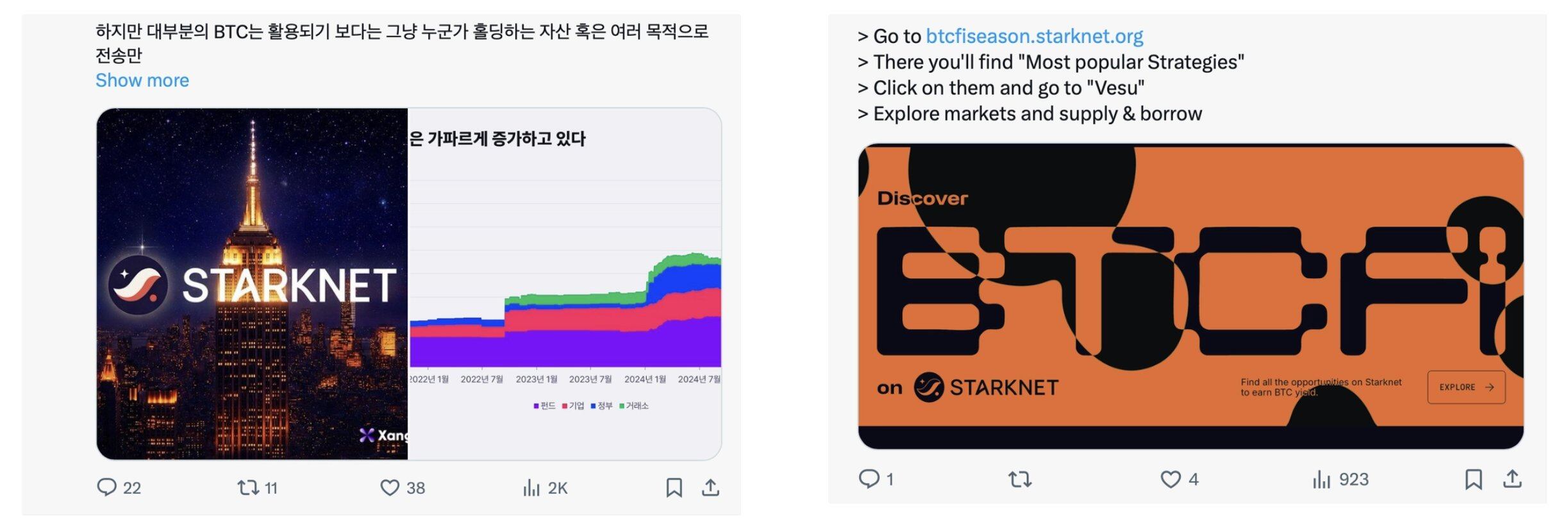
For the record, I don't know who was responsible for managing this campaign or if any agency was involved. I am merely providing some thoughts from an outsider's perspective, from a marketer's point of view.

One problem is obvious throughout the promotion: the screening of creators involved in the promotion is weak.

X is a perception layer. Ideally, creator promotions on X should bring:

  • More discussion about the brand
  • Trigger more voluntary posts from independent creators
  • Drive the production of more community content
  • Stronger ecosystem activation

But is that what we see? Not really.

If you use simple filtering conditions on X to view popular posts mentioning Starknet in February, the results are obvious.
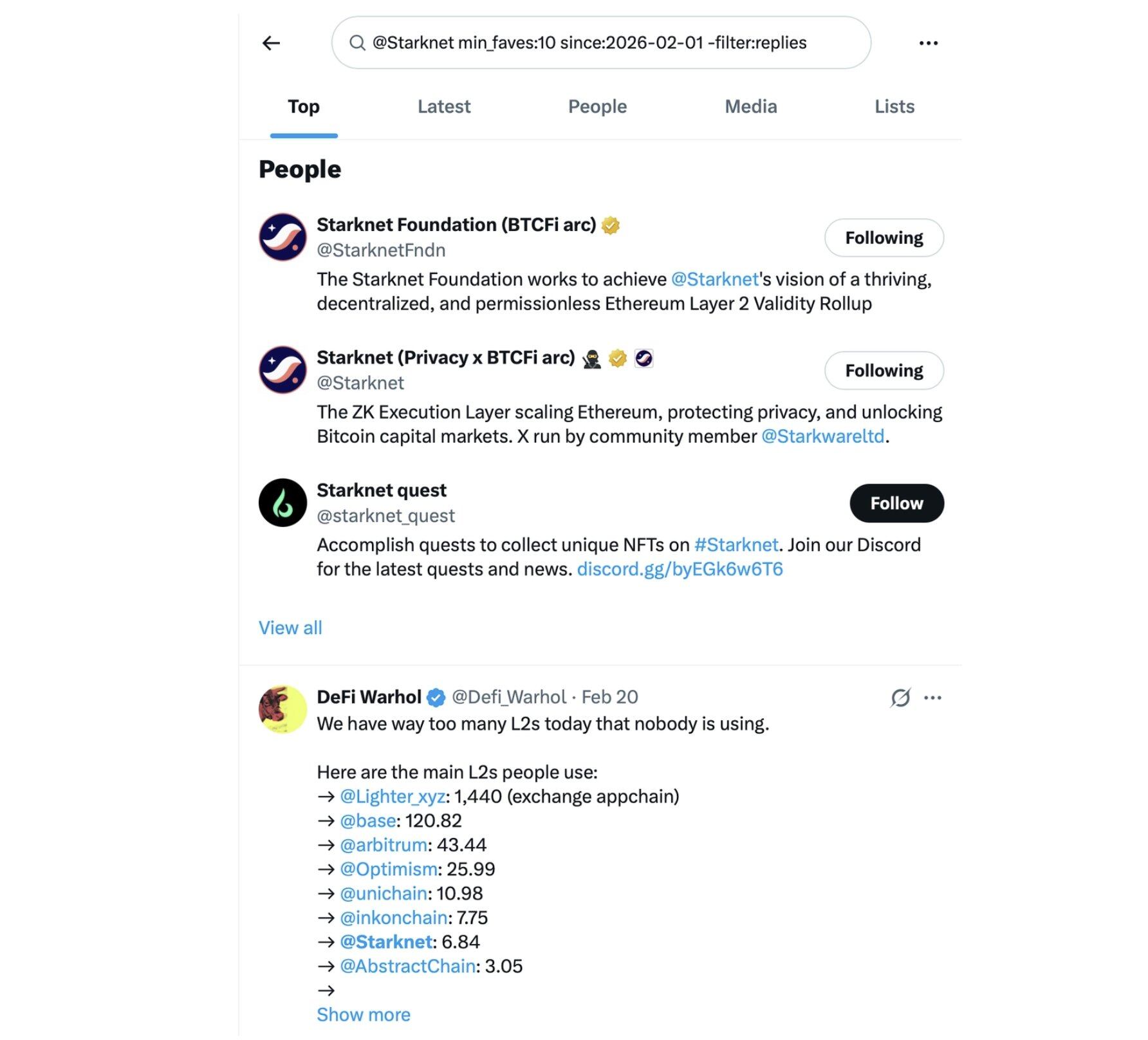
The most mentioned post was actually from Warhol. Overall, there were only a little over 100 independent posts mentioning Starknet in February that received more than 10 likes. For a well-known L2 ecosystem, this number is not high.

Some popular organic mentions of Starknet included:

  • Mookie's post about token unlocks (approx. 10k views)
  • Warhol's post about the best internship brands in the crypto industry (approx. 16k views)
  • Warhol's L2 rating list (approx. 30k views)
  • santiment's post ranking L2s by developer activity (approx. 50k views)
  • mztacat's post about the "Big Four companies" (approx. 82k views)

That's roughly the extent of Starknet's mentions on Platform X in February. This leads to a more important question, not just concerning Starknet, but concerning the fact that the classic Web3 marketing strategy is gradually failing on Platform X.

Why is the classic Web3 advertising strategy failing?

For years, the default mode of Web3 marketing has been: Announcement -> KOL promotion -> Community discussion.

This classic model worked when X's timeline was less crowded, narratives were strong, and most promotions were not easily identifiable as paid promotions. But the following changes have caused this model to fail.

Paid Disclosure Kills Implicit Spread

Once creators start adding paid disclosure information, this promotion model becomes obvious to fans.

First, users see an announcement, then within the next 24 hours, 5-10 similar promotional posts appear, all with largely identical content. Users can immediately recognize this structure. It doesn't trigger community discussion; instead, it sends a signal that "this is an advertising campaign."

In the environment of Crypto Twitter, advertisements rarely spark community discussion; they are usually just scrolled past by users.

KOL Behavior is Now Very Easy to Identify

Crypto Twitter has matured; people understand how KOL marketing works.

When the same group of creators quotes the same announcement with slightly different wording, it is easily interpreted as a coordinated promotional campaign. And once KOL content is clearly identified as a promotion, user engagement rates drop because the audience switches from curiosity mode to ad-filtering mode.

X Rewards Buzz, Not Announcements

X is not a distribution channel; it's a narrative space. Unless a Web3 project's announcement can trigger the following, they rarely become trending topics:

  • Arguments and debates
  • Meme coins
  • Hot takes
  • Competition between KOLs

Without these dynamic factors, dissemination can only bring brief user reach without truly winning users' minds. Therefore, to truly gain buzz, Web3 projects should change the sequence of their marketing campaigns.

The old promotion flow was: Announcement -> KOL promotion -> Community discussion. The new promotion structure should be: First build buzz -> Spark creator debates -> Generate community content -> Finally announce, so the announcement becomes the final confirmation moment, not the starting point.

If the project skips the narrative stage, promotion is out of the question.

How to redesign a promotion campaign for Starknet

Let's get back to reality. Starknet carries heavy baggage. The previous airdrop phase triggered a lot of fear, uncertainty, and doubt. Explanations and promotional videos alone cannot solve this problem; the project needs to control the conversation to resolve it. Different goals require different marketing strategies.

If the goal is to win users' minds

The strategy should be to actively engage in controversy. Don't try to suppress critics; design topics that can spark debate.

For example:

  • "Which L2 is better for developing BTCFi?"
  • "Ethereum L2 vs Bitcoin L2"
  • "Top five ecosystems for BTCFi developers"

Then sponsor posts related to ranking lists, posts comparing Starknet with other projects, and posts with debates. Maybe half the timeline will support Starknet, and the other half will attack Starknet, but both sides increase exposure. Creating drama is not bad marketing; marketing that goes unnoticed is bad.

If the goal is to dominate public opinion

Then stop publishing lengthy PR articles; few people read them. Instead, publish visual infographics, ecosystem maps, competitor comparisons, and short frameworks that KOLs can reuse. Giving creators space to remix content is far more powerful than content they can only quote.

The goal of dominating public opinion is not one good article, but dozens of derivative articles. This is how narratives spread.

If the goal is to attract developers

Then remember that developer acquisition is a B2B model. Publishing announcements on X is not effective for developer onboarding. What projects should do is:

  • Build topic momentum
  • Build ecosystem prestige
  • Show that developers have already succeeded there

Once this trend forms, onboarding developers becomes much easier. Because developers also chase hotspots.

Conclusion

The traditional Web3 promotion model (Release announcement -> KOL promotion) is dying on X. The new model is more like: Design topics -> Spark creator interest -> Trigger discussion -> Let the community take it from there.

The project's announcement is still important, but it should no longer be the beginning of the promotion campaign; it should be the end point.


Preguntas relacionadas

QAccording to the article, why is the classic Web3 marketing strategy of 'announcement → KOL promotion' no longer effective on X?

AThe strategy is no longer effective due to three main reasons: 1. Paid disclosure labels kill organic spread by making the promotional nature obvious to users. 2. KOL coordinated promotion is now easily identifiable by the mature crypto Twitter audience, causing them to switch to 'ad-filtering mode'. 3. The X platform rewards hot topics, drama, and narratives, not simple announcements, which rarely go viral without these elements.

QWhat does the author propose as the new, more effective structure for a Web3 marketing campaign on X?

AThe author proposes a new structure: Build the narrative first → Spark creator debate → Generate community content → Finally, publish the official announcement. The announcement should be the final confirmation moment, not the starting point.

QWhat was a key problem identified in Starknet's recent promotional campaign, as cited in the case study?

AA key problem was the weak vetting of the creators participating in the promotion, which failed to generate significant independent discussion, voluntary posts from other creators, community content, or stronger ecosystem activation.

QFor the goal of 'winning mindshare', what type of content does the author suggest a project like Starknet should sponsor instead of long articles?

AThe author suggests sponsoring content that creates debate and drama, such as rankings, comparison posts pitting Starknet against other projects, and posts with arguments. Examples include 'Which L2 is better for BTCFi development?' or 'Ethereum L2 vs Bitcoin L2'.

QWhat does the author state is the fundamental difference in how the X platform should be viewed for marketing, as opposed to being a distribution channel?

AThe author states that X is not a distribution channel but a 'narrative venue' or a 'perception layer'. It is a place for narratives, hot takes, memes, and debates, not just for broadcasting announcements.

Lecturas Relacionadas

Annual Salary of Millions Competing for Electricians, Meta Rushes to Open Its Own Technical School

The AI boom is facing an unexpected bottleneck: a severe shortage of skilled construction workers and electricians. As tech giants like Meta, OpenAI, and Alphabet race to build massive data centers—such as OpenAI's $16 billion "Stargate" project—they are hitting a critical labor wall. The U.S. needs an estimated 130,000 more electricians, 240,000 construction workers, and 150,000 supervisors by 2030 for AI infrastructure alone, but tens of thousands of electrician jobs go unfilled each year. While AI companies offer high premiums, with electricians earning up to $280,000 annually, worker scarcity still causes massive losses—delays on a single project can cost $14.2 million per month. The complexity of building AI data centers, which require immense power (equivalent to powering hundreds of thousands of homes), sophisticated electrical systems, and advanced liquid cooling solutions, demands highly skilled technicians who are in short supply. To combat this, companies are investing heavily in training. Meta has committed $115 million to a free training school offering tuition, housing, and stipends, targeting 5,000 new workers. OpenAI is partnering with unions to secure skilled labor. These efforts are paying off, with a significant rise in Gen Z interest in trade schools over college. However, the power demands are staggering. AI data centers are driving a rapid surge in electricity consumption, projected to account for up to 12% of U.S. power use by 2028 and raising costs for consumers. Furthermore, the construction boom is project-based, leading to a potential future glut of trained workers once building peaks, which could depress wages industry-wide. The race for AI supremacy now depends as much on skilled hands as on advanced chips.

marsbitHace 8 min(s)

Annual Salary of Millions Competing for Electricians, Meta Rushes to Open Its Own Technical School

marsbitHace 8 min(s)

OpenAI No Longer Sells Its Most Expensive Model for Profit

OpenAI is shifting its business strategy away from promoting its most expensive, flagship models for every task. Recent price cuts—80% for GPT-5.6 Luna and 20% for Terra—signal a deeper change: the company now actively advises users that many tasks don't require the most powerful model. Instead, OpenAI recommends a tiered approach: use the high-end GPT-5.6 Sol for complex planning and analysis, then delegate execution to cheaper models like Luna. This mirrors moves by Anthropic, which recently launched Claude Opus 5 at half the price of its top model, Fable 5. Both companies are de-emphasizing flagship models as primary revenue drivers, using them instead for brand prestige and technological showcases. The industry is entering a "mass-market" phase, similar to automotive, where high-volume, cost-effective models handle daily operations and drive scale. OpenAI's price reductions are partly enabled by AI models themselves optimizing underlying code and infrastructure, creating a self-reinforcing cycle of efficiency gains and cost reduction. Competition is shifting from "who is smartest" to "who offers the best value." The goal is no longer selling individual models but fostering widespread API adoption and ecosystem lock-in. By making AI calls cheap and ubiquitous, companies like OpenAI aim to become the indispensable, utility-like infrastructure powering automated workflows—the "water and electricity" of software, quietly embedded everywhere.

marsbitHace 8 min(s)

OpenAI No Longer Sells Its Most Expensive Model for Profit

marsbitHace 8 min(s)

Will the Fed Definitely Raise Interest Rates in September? How Will Crypto and U.S. Stocks Withstand the Pressure?

The market's expectation for a September Fed rate hike surged dramatically in early August, jumping from under 50% to over 80% within a week. This shift followed a contentious July FOMC meeting, where a 9-3 vote to hold rates revealed growing dissent from hawkish members advocating for an immediate hike to combat persistent inflation. The primary catalyst for this repricing is rising oil prices, driven by renewed geopolitical tensions around the Strait of Hormuz, which threaten global supply. Energy costs directly influence inflation metrics, making the upcoming July CPI report (due August 12th) a critical data point. If it shows inflation reaccelerating, the probability of a September hike will solidify. For Bitcoin and crypto assets, this is typically bearish news. Bitcoin continues to behave as a high-beta, liquidity-sensitive risk asset. A rate hike raises the opportunity cost of holding non-yielding assets and could drive capital toward money markets, pressuring crypto prices in the short term. However, historical patterns suggest that if a hike is perceived as the end of a tightening cycle rather than the start, any negative price impact may be brief. U.S. stocks, particularly crypto-linked equities like Coinbase and growth-oriented tech stocks, are also vulnerable. Higher rates increase discount rates in valuation models, putting pressure on high-multiple companies. This coincides with a pivotal tech earnings season where investor focus has shifted from massive AI capital expenditure to tangible revenue and cash flow generation. Companies with negative cash flow and weak growth narratives could face heightened volatility if borrowing costs rise in September. In summary, a September Fed hike has evolved into a mainstream market scenario. Key factors to watch are oil prices, the July CPI report, and Fed communications, which will determine the final decision and its impact on volatile crypto and equity markets.

marsbitHace 19 min(s)

Will the Fed Definitely Raise Interest Rates in September? How Will Crypto and U.S. Stocks Withstand the Pressure?

marsbitHace 19 min(s)

Trading

Spot
活动图片




