Written by: Andjela Radmilac
Compiled by: Saoirse, Foresight News
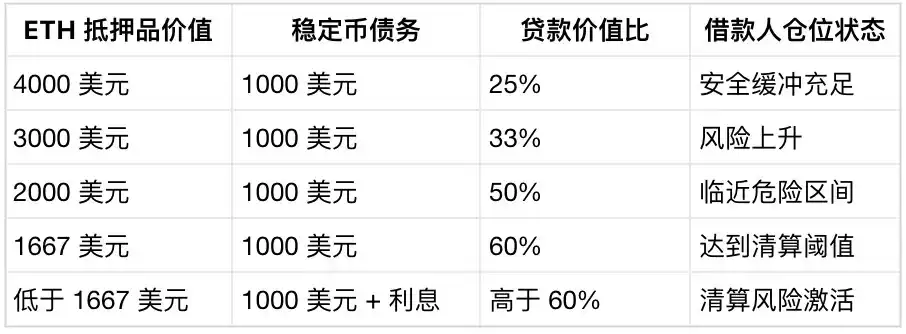
Imagine an investor who bought Ethereum for $1,000. The price later rises to $4,000, and now they want to cash out $1,000. If they sell a quarter of their Ethereum, they get the cash but incur a $750 capital gain under U.S. tax rules for investment-grade digital assets.
However, DeFi offers an alternative. The holder can deposit all their Ethereum as collateral into a lending protocol and borrow $1,000 worth of a U.S. dollar-pegged stablecoin.
This loan is not taxable income, and the Ethereum continues to benefit from any future price appreciation; the holder obtains spendable, fiat-convertible funds without selling the original asset.

While this method can save the holder a significant amount in taxes, it also creates a fragile risk. The initial collateral ratio for this $1,000 debt is 25% (collateral value $4,000); if the Ethereum price drops to $2,000, the loan-to-value (LTV) ratio doubles to 50%, and with ongoing interest accrual, this ratio will climb even higher.
When the ratio exceeds the protocol's set limit, the code triggers a collateral liquidation: external traders can repay part of the loan and take some Ethereum at a discount.
The borrower has deferred a taxable sale, but the lending pool bears the risk from collateral price volatility, debt size, and whether the borrower is willing to proactively manage their position before liquidation.
An individual's tax decision effectively becomes part of a shared credit market funded by other users, most of whom see only a string of wallet addresses.
Lisa De Simone of the University of Texas at Austin, Peiyi Jin of the National University of Singapore, and Daniel Rabetti of the National University of Singapore explore this connection in a working paper on tax planning and DeFi credit risk.
The study focuses on the DeFi lending protocol Venus on the BNB Smart Chain, which uses smart contracts to execute rules, allowing users to stake crypto assets and borrow other tokens.
Sample period: November 12, 2020, to July 31, 2022, covering 15 major tokens on the Venus platform. The research analyzed approximately 13 million transactions, generating 1.36 million borrower-day observations (one record per active wallet per day), with about 3% of traders experiencing default as defined in the paper.
It's important to note that default in the DeFi context differs from mortgage delinquency. The paper defines default as a loan whose LTV ratio remains above Venus's 60% threshold for at least 7 consecutive days, during which the borrower neither makes additional deposits nor takes on new borrowing; the cumulative default debt exposure totals $133.34 million. A loan at risk is counted on multiple statistical dates, so this total represents cumulative daily risk exposure, not the principal actually lost in a single event.
Billionaire Strategy Enters Ordinary Wallets
The traditional version of this strategy is called "Buy, Borrow, Die." An investor buys an asset, waits for it to appreciate, then uses it as collateral for loans to fund living expenses, all without selling the asset or realizing gains.
Continuous borrowing can defer capital gains taxes for years; U.S. estate rules allow heirs to reset the asset's cost basis upon inheritance, wiping out most of the accumulated gains tax liability from the original holder.
This was once an exclusive operation for the wealthy: private banks only served high-net-worth clients with sufficient collateral and strong downside resilience. Banks could review a client's overall financial health, determine loan amounts, negotiate terms, and work with the client to mitigate risks before collateral had to be sold.
DeFi transforms this heavily human-dependent due diligence business entirely into code. Software doesn't need to assess a client's comprehensive qualifications; it only reads assets in the wallet and applies the same collateral rules to all users.
The barrier to entry drops dramatically, but the cost is a system built on over-collateralization: borrowers must initially pledge assets worth more than the loan.
According to the Venus parameters described in the paper: $10,000 worth of eligible collateral can borrow up to $6,000 in debt. Borrowing the full amount leaves almost no buffer for price drops; borrowing only $2,000 provides a thick safety cushion. Both accounts are continuously monitored by code accessing oracle market prices.
When collateral depreciation breaches the threshold, liquidators can repay part of the debt, acquire collateral at a discount, restore the account's health, and earn a reward. This mechanism is intended to protect the pool before collateral value falls below the debt. However, rapid asset sell-offs, insufficient market liquidity, or blockchain network congestion can hinder the effectiveness of liquidations.
Tax motives further complicate risk on the borrower's side: reducing risk requires trading operations, repaying debt, or selling some of the appreciated holdings.
Borrowers who take loans to postpone taxable transactions often delay position adjustments; this procrastination tendency is stronger when paper profits are higher or when holding periods are nearing the threshold for lower long-term capital gains tax rates.
Stablecoins significantly enhance the appeal of this model. Dollar-pegged tokens convert volatile collateral assets into directly usable dollar purchasing power. Traders can continue staking assets like Ethereum, borrow USDT or USDC, and use the funds for other purposes.
A significant number of large holders are using crypto assets as collateral to borrow stablecoins, accessing funds while retaining price exposure to the underlying assets.
At loan inception, the protocol sees a normal collateral ratio. But the protocol has no way of knowing: the borrower bought Ethereum at an extremely low cost, selling would realize massive gains, or holding for a few more months could yield substantial tax savings. These factors all influence the borrower's choices when a loan becomes risky.
IRS: Venus Becomes a Natural Experiment
The researchers needed to separate tax-driven behavior from the inherent turbulence of the crypto market. The enactment of the Infrastructure Investment and Jobs Act on November 15, 2021, provided a research opportunity.
Section 80603 of the Act expands information reporting obligations for digital asset brokers. Traders anticipated that a large portion of their on-chain activities would be reported to the Internal Revenue Service (IRS) in the future.
This Act changed traders' expectations about third-party tax reporting, constituting an external shock event: the behavior of potential U.S. taxpayers would be affected, while international users remained unaffected by this policy change.
Implementing this reporting system took a long time. Custodial brokers began using Form 1099-DA to report gross proceeds from corresponding sales and exchanges starting January 1, 2025; subsequent IRS rules further require reporting of asset cost basis for certain transactions starting January 1, 2026.
These regulations only apply to institutions that actually custody user assets; non-custodial DeFi services are currently not within the regulatory scope.
However, the research value of this paper stems from market participants' expectations at the moment the Act was passed in November 2021—people anticipated future transaction records would be reported, not from reactions after the official tax forms were implemented.
The researchers compared data before and after the passage of the Act (well before formal regulation took effect), capturing the market's reaction to the expectation that "future transactions will be seen by regulators," rather than passive responses to already-implemented reporting forms.
The blockchain itself does not reveal user nationality or tax residency. Researchers could only infer which wallets likely belonged to U.S. users based on characteristics: wallets with trading concentrated during U.S. working hours, exhibiting anomalous behavior on U.S.-specific holidays, and holding U.S.-regulated dollar stablecoins.
Each inference dimension carries the possibility of misjudgment, so the paper presents multiple calculation methods and also uses stricter criteria combining multiple conditions.
The overall research logic is equivalent to: the same financial system experiences a policy shock event. Two user groups face the same token market conditions and the same Venus protocol rules; only the presumed U.S. user group is highly attentive to this new reporting rule. This separates behavior changes driven by taxes from overall market turbulence.
Main model calculation results: after the Act took effect, presumed U.S.-associated borrowers saw a 24.5% decrease in the probability of asset transactions compared to international users. Borrowers using stablecoin liabilities saw an additional 23% decrease in trading activity. This aligns with the paper's logic: using stablecoins to obtain cash while keeping the appreciated collateral staked.
In this article, "liquidity" is defined narrowly at the wallet level: the probability of a borrower conducting any asset transaction on a given day. Common perception of liquidity often refers to exchange depth, bid-ask spread, and cost of large sell-offs; this study measures user portfolio trading activity and whether appreciated assets are "locked."
These behavioral characteristics are more pronounced among borrowers with higher paper profits and higher LTV ratios. In December each year (especially the last week), when investors typically defer gains to the next tax year, trading activity declines; when holdings reach the one-year mark, qualifying for the U.S. lower long-term capital gains tax rate, trading activity picks up again. This behavior corroborates that the observed changes indeed stem from tax motives, not just coincidental phenomena around the Act's timeline.
The researchers estimate that, on average, U.S. borrowers in the sample deferred $3,357.42 in capital gains taxes annually, accounting for about 17% of their contemporaneous portfolio size. This estimate is based on the assumption that the wallets belong to U.S. taxpayers, reconstructing holdings from on-chain data and applying corresponding tax rates, representing only a rough magnitude for the overall sample.
The Cost Shifts Inside the Pool
The final part of the research analyzes how decreased trading activity affects loan quality. Borrowers with lower transaction frequency maintain risky positions longer, miss opportunities to repay, and fail to top up collateral before hitting the ratio limit. Tax preferences originally existing outside Venus ultimately transform into unresolved debt within the protocol.
There is a risk of reverse causality: default itself can cause users to abandon wallets and stop trading.
The researchers use an instrumental variable approach, extracting the decrease in trading activity caused by the Act shock (an external shock independent of the protocol itself), to exclude reverse causality interference.
Model calculations: a 1% increase in illiquidity caused by tax factors leads to an 11.2% increase in the number of defaulting accounts and a 39.6% increase in the size of defaulting loans. A one standard deviation increase in illiquidity corresponds to an increase of about $350 in default debt per borrower, 2.7 times the model's baseline value.
The percentage figures appear high, but this is a statistical qualification: the results apply only to the portion of the sample affected by this policy event and sensitive to taxes, not as a universal multiplier for all DeFi loans, only to explain how motives affect credit outcomes.

This exposes an inherent blind spot in automated lending. Smart contracts read collateral price, debt balance, accrued interest, and liquidation thresholds, but the borrower's cost basis and tax motives are completely excluded from the calculation.
Two wallets, with identical Ethereum collateral and loan terms, look exactly the same risk-wise to the Venus system; but one is willing to sell to reduce risk, the other tries everything to avoid selling. This creates a borrower selection bias problem.
Over-collateralization can withstand ordinary price fluctuations; but borrowers who are extremely reluctant to dispose of appreciated assets will maintain debt and reduce trading even as the safety cushion thins, concentrating risk in a group whose motives the protocol cannot discern.
When liquidations execute smoothly, external participants repay debt and dispose of collateral, and lenders suffer no loss. Once liquidation fails, losses are borne collectively by the protocol reserve, token holders, and liquidity providers according to the protocol's loss distribution mechanism. Individual tax preferences ultimately become financial consequences shared by all participants in the pool.
The paper also notes that taxes are just one of many risk sources.
This study only focuses on a single protocol during the 2020-2022 bull-bear cycle; U.S. user identity is inferred from behavior; default uses a specific definition, counting only accounts with persistently high LTV ratios. The research also confirms: sharp collateral price volatility and deficiencies in the liquidation mechanism also cause problems for Venus loans.
Results would differ for other protocols with stronger liquidity or different collateral parameters; market environments with more sophisticated liquidation bots would also perform differently from Venus during the sample period.
Nevertheless, this paper provides a perspective difficult to achieve with traditional lending data: observing the entire lifecycle of collateral, debt, user behavior, liquidation, and abandonment at the granularity of a single wallet.
DeFi brings lending strategies that once belonged to private banks onto public blockchains, opening them to the general public. But automating away credit officers does not erase human subjective motives. Tax considerations, attachment to appreciated assets, and reluctance to sell can penetrate through layers of code, ultimately being paid for by everyone providing funds to the pool.