Was the Prediction Market the Biggest Winner of This Year's Super Bowl?

比推Publicado a 2026-02-10Actualizado a 2026-02-10

Resumen

This year's Super Bowl marked a potential turning point, with prediction markets emerging as a serious competitor to traditional sports betting. Platforms Kalshi and Polymarket offered markets on the game, halftime show, and ads. While the American Gaming Association projected a record $1.76 billion in traditional sports bets, an analyst estimated prediction markets could capture 80% of the year-over-year growth, with a forecast of $630 million in volume for the event. However, available data suggests prediction markets fell short of this forecast. Kalshi's top Super Bowl-specific markets saw a combined volume of approximately $233 million. Its season-long "Who will win the Super Bowl" contract accumulated over $500 million in volume, but this was spread over the entire NFL season. Kalshi's significant growth is aided by its CFTC regulatory status, allowing a US mobile app, leading to 1.9 million downloads in January alone. Polymarket, lacking direct US app access for most users, saw about $76 million in volume across its top three Super Bowl markets. Its strength was demonstrated in information discovery, as its market accurately predicted Lady Gaga's surprise halftime show appearance days in advance. The activity occurs amidst an unresolved regulatory conflict, with Kalshi operating under federal CFTC oversight while state gaming regulators challenge it in court. Although prediction markets did not meet the $630 million hype for the Super Bowl weekend, their rapid user g...

Source: Bankless

Author: David Christopher

Original Title: Did Prediction Markets Win the Super Bowl?

Compiled and Edited by: BitpushNews


This year's Super Bowl—Seattle Seahawks vs. New England Patriots—though lacking the star power of last year's Chiefs vs. Eagles matchup with Taylor Swift's presence, marked a turning point: prediction markets were explicitly recognized as genuine competitors to traditional sports betting for the first time.

Two major prediction market platforms, Kalshi and Polymarket, both set up markets around the game, the halftime show, advertisements, and more. Preliminary data paints an interesting and complex picture.

A quick note before we begin: Sportsbooks have not yet aggregated and reported their total betting volume—this will take a few days. Therefore, this analysis is based on predicted data from the sports betting side versus the trading volume on prediction markets.

Sports Betting Predictions: Another Record High, But Growth Slows

The American Gaming Association estimates that U.S. sportsbooks will handle approximately $1.76 billion in bets on Super Bowl LX, setting a new record and representing a year-over-year increase of about 27%. Although specific figures vary slightly depending on the source, most predictions point in the same direction: another record high, continuing the eight-year growth trend since the Supreme Court allowed states to legalize sports betting in 2018.

But the growth rate is clearly slowing. Sports betting is now legal in 39 states and Washington D.C., with only Missouri joining this cycle as a new market—meaning the explosive growth driven by market expansion in previous years is giving way to incremental growth. Against this backdrop, prediction markets have become another factor curbing growth. Ed Birkin of H2 Gambling Capital told Fortune that he estimates prediction markets will account for 80% of the year-on-year increase in betting activity, predicting that trading volume on prediction markets during the entire event will reach $630 million.

Based on currently available data, the performance of prediction markets seems far below that figure.
Kalshi

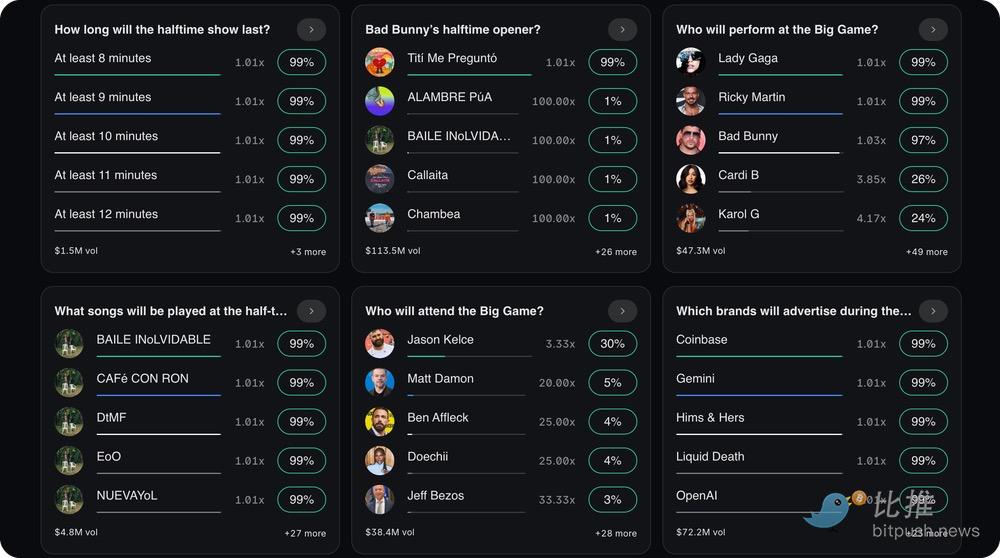
Kalshi's markets specifically created for the Super Bowl (i.e., contracts directly tied to the game, halftime show, and broadcast) generated significant, but not predicted, trading volume:

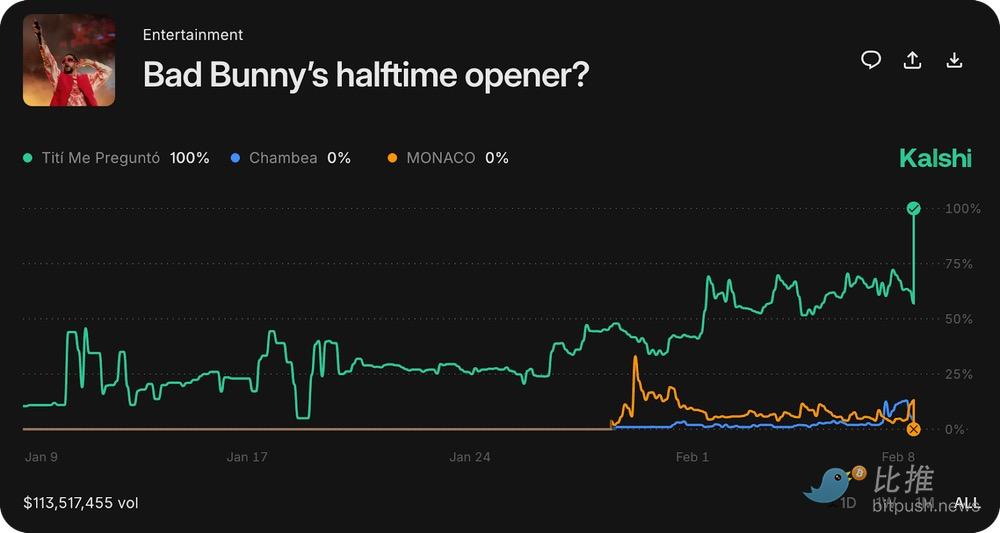
  • Bad Bunny Halftime Show Opening Song: $113.5 million

  • Which Company Will Air the First Commercial: $72.2 million

  • Who Will Perform at the Game: $47.3 million

Just these top few markets saw a combined trading volume of approximately $233 million, far below the $630 million prediction analysts had for the entire prediction market.

Furthermore, Kalshi's flagship NFL market—a "Who Will Win the Super Bowl" contract open for months throughout the season—saw total trading volume exceed $500 million. But this figure reflects the cumulative trading volume over the entire NFL season, not just Super Bowl weekend. Even so, this is less than a third of the amount sportsbooks are predicted to handle for the Super Bowl alone.

For months, sports betting has constituted the vast majority (over 90%) of Kalshi's total trading volume, thanks to its promotional channels which are on par with, if not better than, those of sportsbooks.

First, Kalshi's federal regulation through the CFTC means U.S. users can access it directly via its mobile app, just like a sports betting app. Coupled with a strong venture capital-backed advertising budget and a partnership with Robinhood, Kalshi stands out. This foundation is paying off: In January alone, Kalshi saw 1.9 million downloads, while DraftKings and FanDuel's new prediction market apps, launched in December, saw combined downloads of less than 100,000 (these apps were launched in states where their traditional sports betting apps are not permitted, but response has been tepid so far). Additionally, DraftKings partnered with Crypto.com last Friday to expand its event contract offerings, indicating that established giants are taking this threat seriously.
Polymarket

Polymarket's similar season-long NFL market saw trading volume of about $700 million—higher than Kalshi's—but the situation is different for its Super Bowl-specific markets. Polymarket's top three Super Bowl markets saw a combined trading volume of approximately $76 million:

  • Main Game Market: $55.26 million

  • Super Bowl MVP: $12 million

  • Who Will Perform the Halftime Show: $9 million

Polymarket lacks Kalshi's regulatory approval in the U.S., meaning American users cannot access it directly through a mobile app. Technically, Polymarket now has a U.S. app after acquiring a CFTC-registered exchange last year, but it is currently rolling out gradually through a waitlist, and its Super Bowl offerings were limited. As of the week before the game, the app didn't even list any sports markets; the full suite of Super Bowl features was only available on its global website.

Therefore, most U.S. users still need to access it via the website, using VPNs, etc. For casual sports bettors, this is not on the same playing field as downloading Kalshi from the App Store.

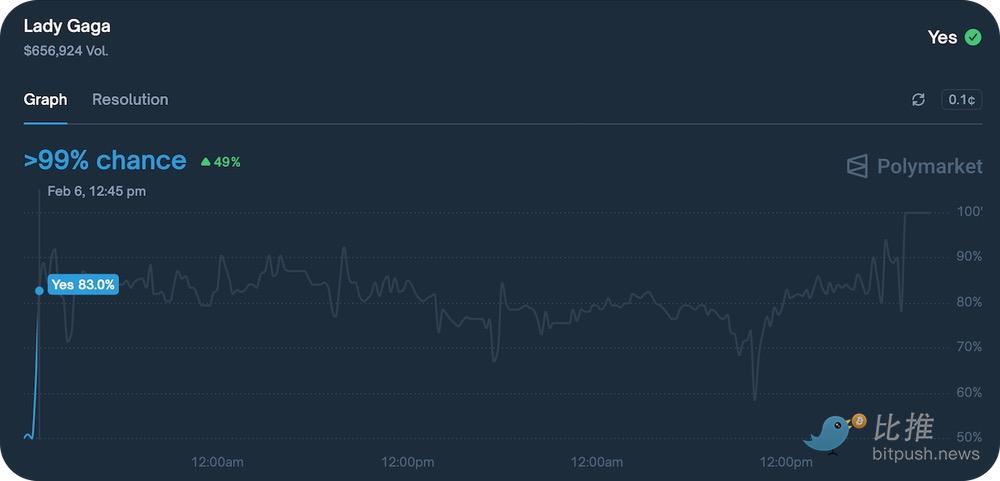
However, where Polymarket truly shines is its primary use case—information discovery. In its halftime show performer market, Lady Gaga's probability remained stable at around 80% in the days leading up to the game—well before her surprise appearance at the halftime show, which Billboard magazine had not reported on and genuinely surprised everyone I watched with.
Regulatory Progress

All of this is happening against the backdrop of unresolved regulatory conflicts.

Kalshi operates as a federally regulated exchange under the CFTC, which allows its sports contracts to proceed—especially after new CFTC Chairman Michael Selig stated he would not block or cede regulatory authority to the states. State gaming regulators, who oversee sportsbooks, continue to pursue legal challenges against Kalshi and its peers, and many analysts expect these cases to eventually reach the Supreme Court.

For now, prediction markets operate in a gray area, allowing them to cover the nation without needing state-by-state approval—a structural advantage that sportsbooks cannot easily replicate.

Summary

So, did prediction markets live up to the hype for Super Bowl LX? Relative to the $630 million prediction, not quite.

The combined trading volume on the visible top Super Bowl-specific markets across the two leading platforms was approximately $310 million—about half the predicted value. The season-long NFL markets on both platforms achieved huge trading volumes, but that was cumulative over months of football games, not a single-week explosion during Super Bowl weekend.

Context is also important. The 1.9 million downloads Kalshi garnered in January dwarf the combined total of DraftKings and FanDuel's prediction market apps. This pressure is already visibly reflected in stock prices—as observed by Fortune, shares of FanDuel parent Flutter Entertainment have fallen for eight consecutive weeks, their longest losing streak in twenty-three years; DraftKings' stock price is hovering near its lows since 2023, down more than 60% from its all-time high. Bloomberg data shows that over the past three months, market expectations for Flutter's Q4 earnings have been sharply cut by nearly 49%, and DraftKings' expectations have also fallen by 29%. Imagine if someone had bet on Polymarket that "DraftKings will underperform," they might have quietly profited by now.

Prediction markets may not have conquered the Super Bowl overnight, but they have certainly arrived—and for traditional sports betting platforms, the trajectory of this trend is alarming enough.


Twitter:https://twitter.com/BitpushNewsCN

Bitpush TG Discussion Group:https://t.me/BitPushCommunity

Bitpush TG Subscription: https://t.me/bitpush

Original link:https://www.bitpush.news/articles/7610501

Preguntas relacionadas

QWhat was the estimated total betting volume for Super Bowl LX by the American Gaming Association?

AThe American Gaming Association estimated that U.S. sportsbooks would handle approximately $1.76 billion in bets for Super Bowl LX.

QWhich two prediction market platforms were highlighted as major players for the Super Bowl markets?

AThe two major prediction market platforms highlighted were Kalshi and Polymarket.

QWhat was the combined trading volume of Kalshi's top three Super Bowl-specific markets?

AThe combined trading volume of Kalshi's top three Super Bowl-specific markets was approximately $233 million.

QWhat key regulatory advantage does Kalshi have over Polymarket in the United States?

AKalshi operates as a federally regulated exchange by the CFTC, which allows U.S. users direct access through its mobile app, unlike Polymarket which lacks this approval and requires most U.S. users to access via its global website, often using a VPN.

QAccording to the article, what was one significant way that Polymarket demonstrated its strength in 'information discovery'?

APolymarket's market on the halftime show performer correctly showed Lady Gaga's probability at around 80% days before the game, well ahead of her surprise appearance which was not reported by Billboard, showcasing its predictive information discovery capability.

Lecturas Relacionadas

Conversation with Arthur Hayes: AI Has Drained Market Liquidity, BTC Will Be Below 100k by Year-End

In this June 2026 podcast interview, BitMEX co-founder Arthur Hayes explains his decision to sell his major crypto holdings (HYPE, NEAR, Worldcoin, Zcash). His rationale is based on a macro view linking oil prices, the Iran conflict, US politics, and an impending AI bubble burst. Hayes argues that high oil prices, driven by the ongoing war, will pressure domestic US inflation. To salvage the Republican Party's chances in the midterm elections, he believes Donald Trump may pivot to a populist, anti-AI stance—advocating for taxes and regulation—which would deflate the AI investment narrative. He sees the AI sector, particularly massive capital expenditure on data centers, as having absorbed nearly all excess market liquidity (around $1.5 trillion in debt issuance since 2025), starving other assets like Bitcoin. He highlights the upcoming SpaceX IPO at a ~$1.8 trillion valuation and 100x price-to-sales ratio as a potential tipping point. If these hyped IPOs underperform, it could shatter market confidence in AI. In such a scenario, all risk assets, including crypto, would fall together as correlations converge to 1 during a broad correction. Hayes has moved his portfolio into Treasuries and energy stocks (like ExxonMobil), predicting Bitcoin will be below $100k by year-end. He sees a potential crypto bull market only after the AI frenzy cools, liquidity stops flowing exclusively into AI, and possibly after a significant market downturn prompts new monetary stimulus.

marsbitHace 4 min(s)

Conversation with Arthur Hayes: AI Has Drained Market Liquidity, BTC Will Be Below 100k by Year-End

marsbitHace 4 min(s)

Fed's Internal Doves Flock to Hawkish Stance, Warsh's Debut "Between a Rock and a Hard Place"

U.S. Federal Reserve officials who previously advocated for rate cuts, including Governor Christopher Waller, have recently shifted their stance, with many now not ruling out the possibility of future rate hikes. This sets a challenging stage for new Fed Chair Kevin Warsh's first policy meeting. Appointed by President Trump based on his dovish views, Warsh now faces a committee where the debate has pivoted from "when to cut" to "whether to hike," driven by persistent inflation above 3%, a strong labor market, and supply-side pressures from AI infrastructure demands and geopolitical tensions. Key figures illustrate the shift. Governor Waller, once concerned about employment, now says data has pushed him toward considering rate increases. Even moderate voices like Governor Lisa Cook, while expecting inflation to ease, have indicated readiness to hike if it fails to do so. Long-time hawks such as regional Fed presidents Beth Hammack, Lorie Logan, and Neel Kashkari have grown more vocal, arguing that the real policy rate is effectively falling and that action may soon be needed. The upcoming Fed meeting is expected to keep rates steady but will likely remove the "easing bias" from its statement, signaling a neutral stance between cuts and hikes. The quarterly "dot plot" is anticipated to show most officials projecting no cuts this year, with some potentially indicating hikes. Chair Warsh, a critic of the Fed's reliance on forward guidance like the dot plot, must navigate communicating this pivot using tools he has questioned, all while steering policy in a direction counter to the preferences of the president who appointed him. The consensus suggests the Fed's next move could well be a rate increase.

marsbitHace 1 hora(s)

Fed's Internal Doves Flock to Hawkish Stance, Warsh's Debut "Between a Rock and a Hard Place"

marsbitHace 1 hora(s)

The Trillion-Yuan Market Cap 'Yi Zhong Tian': Who is the True Value King?

The article analyzes the three leading Chinese optical module companies, collectively nicknamed "Yi Zhong Tian": Xinyisheng, Zhongji Innolight, and TFC Optical Communication. It evaluates their "cost-performance" not by current stock price, but through three lenses: PEG ratio (growth vs. valuation), earnings quality, and premium/discount for certainty. Xinyisheng shows the most attractive PEG ratio and high profitability, but its valuation reflects discounts for risks like high customer concentration and reliance on overseas markets. Zhongji Innolight, the most expensive, commands a premium for its market leadership, dominant share in key products like 800G/1.6T modules, and higher earnings certainty, though it faces geopolitical risks. TFC Optical, as an upstream component supplier ("water seller"), has the highest gross margin and bets on the long-term CPO/NPO architecture trend, but trades at a high valuation with more stable, less explosive growth. The core argument is that while these companies dominate module assembly, the true profit pool and technological moat lie upstream in laser and switch chips, currently controlled by U.S. firms like Lumentum and Coherent. The long-term "cost-performance" for these Chinese leaders hinges on whether the domestic industry, exemplified by companies like Yuanjie Technology, can successfully move up the value chain into high-power laser chips. Otherwise, their high growth may remain confined to the lower-margin assembly segment.

marsbitHace 1 hora(s)

The Trillion-Yuan Market Cap 'Yi Zhong Tian': Who is the True Value King?

marsbitHace 1 hora(s)

Has the Crypto Market Bottomed? Here's What Institutions Think

The crypto market is in a period of significant debate, with leading institutions offering differing views on whether a bottom has been reached. Three prominent firms have published detailed analyses: * **Galaxy Digital** argues Bitcoin has **not yet bottomed**. Their analysis of 13 historical indicators across six dimensions (valuation, profit-taking, miner pressure, etc.) shows only four are fully met. They project a potential bottom range between $30k and $54k. * **NYDIG** states a bottom is **possible but not likely**. While metrics are close to historic bear market extremes, they note the absence of a classic panic-selling event. They also suggest increased institutional adoption may have structurally altered the market cycle, potentially leading to a shallower downturn. * **Standard Chartered Bank** asserts the **bottom has already occurred** at around $59k. They cite two key factors: potential US-Iran diplomatic progress and the anticipated SpaceX IPO, which they believe absorbed capital and caused ETF selling pressure that is now subsiding. They forecast a year-end price target of $100k. Despite the surface-level disagreement, the reports share critical common ground more valuable for long-term investors: 1. All three believe the market bottom will form **within this year**. 2. All agree the current price is **closer to the bottom than to previous highs**. 3. All maintain a **bullish long-term outlook** for Bitcoin and a new cycle. The core takeaway is that while the exact bottom price ($40k, $50k, or $60k) is debated, the consensus is that a bottom is imminent. For long-term holders, the primary focus should not be pinpointing the absolute low, but on the future potential for prices to reach $100k, $200k, or higher. The fundamental thesis for Bitcoin—sovereign debt accumulation, inflation, declining trust in centralized institutions, global digitization, and improved accessibility—remains intact and is arguably strengthening. The overall landscape is viewed as more favorable than in previous crypto winters.

marsbitHace 1 hora(s)

Has the Crypto Market Bottomed? Here's What Institutions Think

marsbitHace 1 hora(s)

Trading

Spot
Futuros
活动图片





