War Won or Lost? Trump: Profited

Odaily星球日报Publicado a 2026-03-24Actualizado a 2026-03-24

Resumen

Former President Trump claimed on Truth Social that productive U.S.-Iran talks had led to a 5-day delay in military strikes, causing immediate market reactions: gold rebounded over $200, oil dropped 14%, and S&P 500 futures rose nearly 4%. However, Iranian media denied any talks occurred, calling it a "psychological operation." Just before Trump’s post, large trades were detected—a $1.5 billion S&P 500 buy order and a $580 million crude oil sell-off—suggesting possible insider trading or sophisticated market anticipation of Trump’s pattern. This isn’t the first time Trump’s statements have moved markets; similar tactics were used during tariff policy shifts in 2025, where rumors and official posts created multiple market swings. Trump’s market influence may serve dual purposes: creating trading opportunities and using stock market gains as a proxy for economic success to bolster political support. Despite accusations, lack of direct evidence shields him from legal consequences. His actions highlight the intersection of financial markets, media, and political strategy.

Original | Odaily Planet Daily (@OdailyChina)

Author | Golem (@web 3_golem)
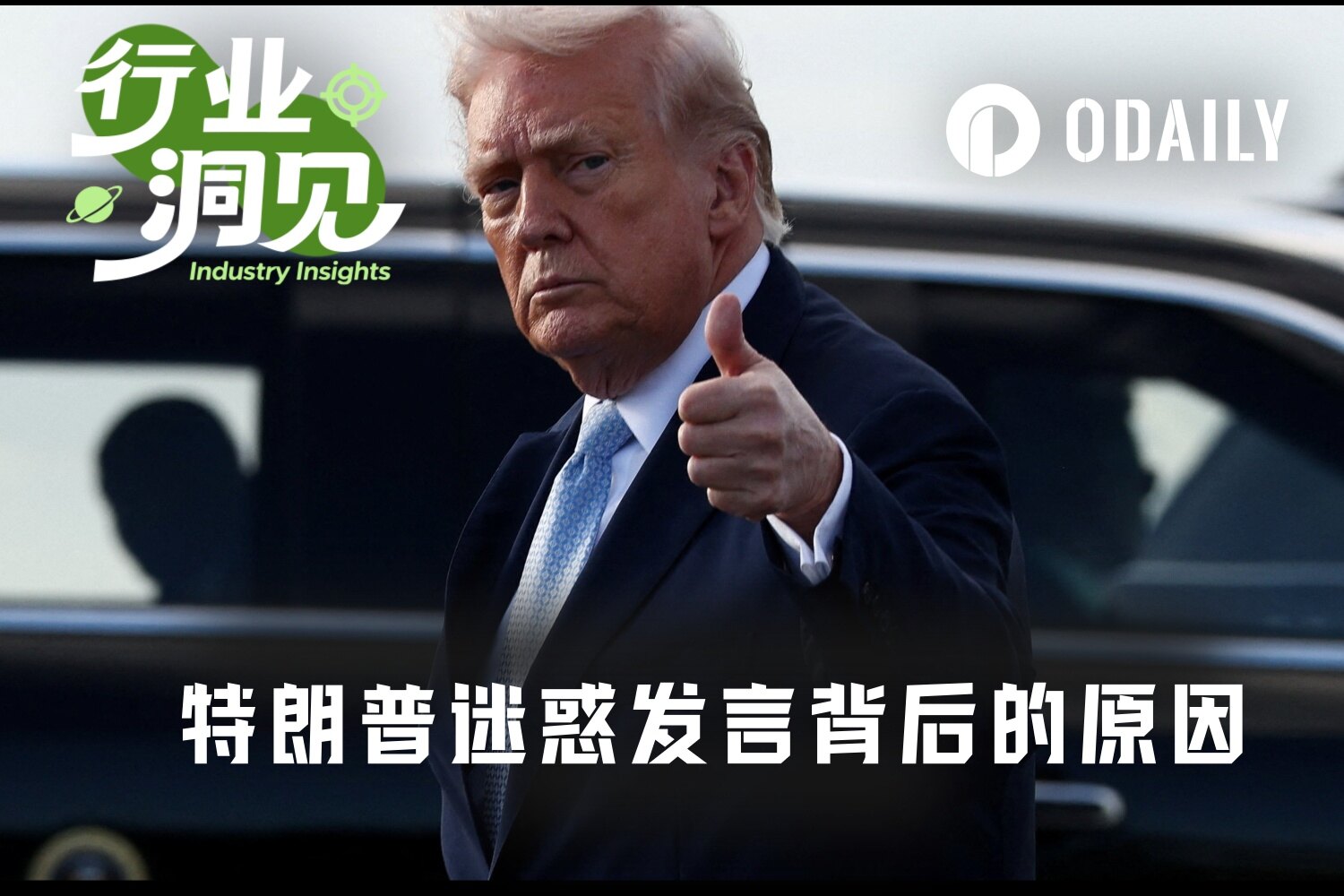
Whether Trump is a competent president is hard to say, but he is definitely an excellent financial market manipulator.

On March 23, Trump started his antics again regarding the US-Iran conflict. At 19:05 Beijing time, he posted on Truth Social, stating that the US and Iran had productive discussions over the past two days and that all military strikes targeting Iranian power plants and energy infrastructure have been delayed for five days.

As soon as these words were out, gold, which had been dropping for days due to inflation concerns and rising global interest rate hike expectations, instantly rebounded. According to Gate data, after Trump's post, gold that had fallen all day rebounded over $200, and S&P 500 index futures also rose nearly 4% in response. Meanwhile, Brent crude oil fell from a high of $113 per barrel to a low of $97, a drop of over 14%.

But less than an hour later, Iranian media came out to "debunk" this, saying there had been no direct or indirect contact between the US and Iran. Iran's Tasnim News Agency even quoted a senior Iranian security official stating that Trump's related remarks were "psychological warfare."

Faced with this rebuttal, Trump tried to brush it off with a simple "I don't know what Iranian media is talking about." To casual observers, this might just seem like another instance of T.A.C.O. (Trump Always Chickens Out), but for traders, it was a mix of joy and sorrow. Because this series of events caused market fluctuations exceeding trillions of dollars within just a few hours.

According to The Kobeissi Letter, 15 minutes before Trump's post, a large buy order for S&P 500 futures with a notional value of $1.5 billion inexplicably appeared in the market. The order was so large that it directly pushed the S&P index up about 0.3% in one minute. And 15 minutes later, this trader/institution who opened the $1.5 billion position pocketed $60 million.
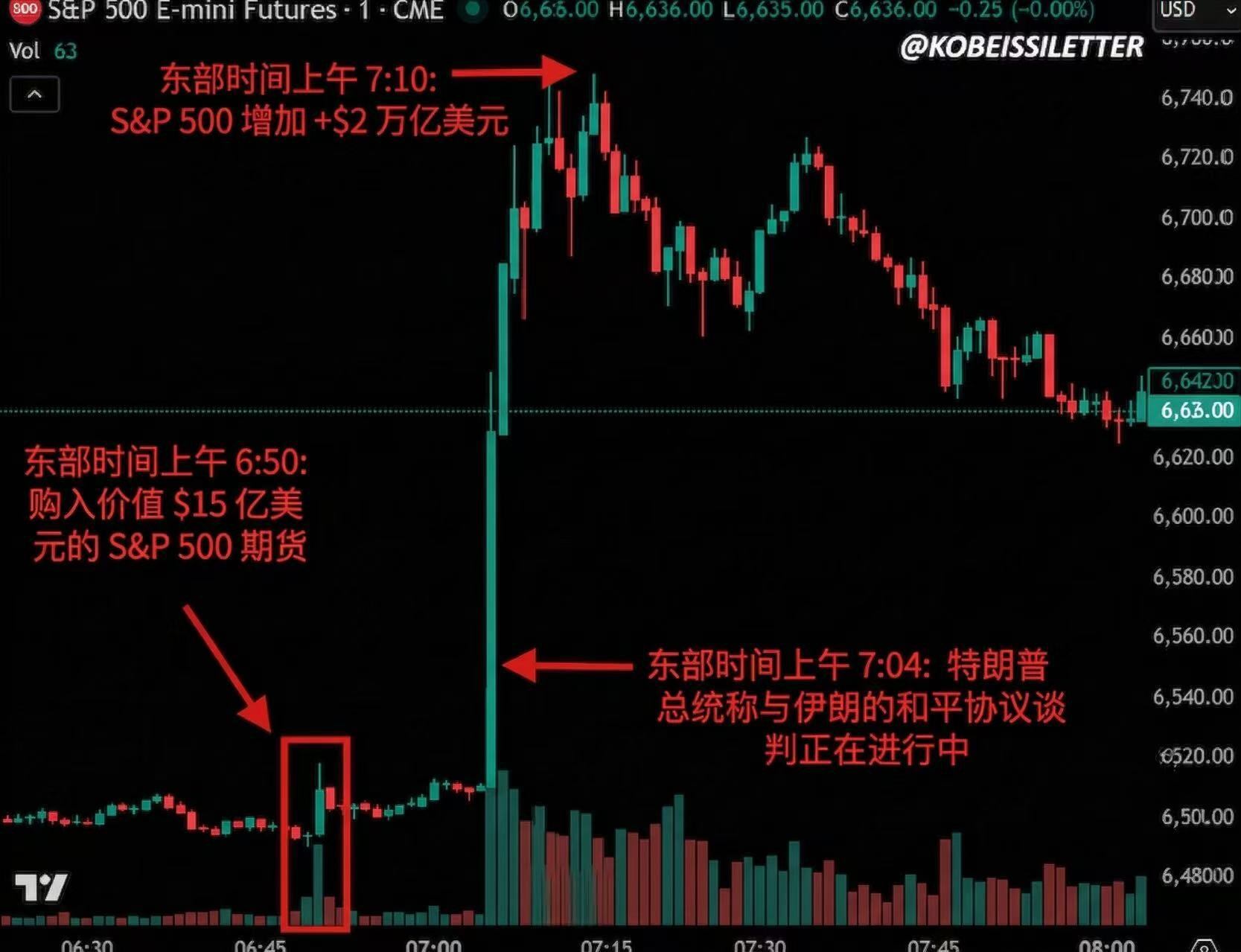
Besides this one who maximized gains, there were also traders who perfectly timed the market top. According to the Financial Times, also 15 minutes before Trump's post, approximately 6,200 Brent crude and West Texas Intermediate (WTI) crude oil futures contracts were sold, with a notional value of $580 million.

Placing large buy or sell orders just before major market news is announced—this looks less like news trading and more like classic insider trading. But whether the source can be traced back to Trump is hard to say. After all, it's not the first time Trump has done something like this. Iranian scholar Seyed Mohammad Marandi posted on platform X, "Trump makes these kinds of statements every week when the market opens to suppress oil prices. Even the five-day deadline he set coincidentally aligns with the energy market's closing time."

This means those trades that seem like insider trading could also be top-tier traders who have figured out Trump's pattern. It wouldn't be strange at all if Wall Street started studying Trump himself as a separate market trading indicator, because this method of his to influence the market isn't the first time he's played it, and it's been remarkably effective every time.

Last year's tariff turmoil was the most typical example. On April 7, 2025, US stocks were being battered by Trump's reciprocal tariff policy when news suddenly emerged that the White House was preparing to suspend tariffs for 90 days for most countries except China. The news caused the Dow Jones to surge about 800 points, but later the White House came out to debunk it as "fake news," and the Dow eventually closed down 629 points that day.

Not many people suspected that this rumor might have been spread by interests related to Trump, but the answer soon appeared.

On April 9, Trump first promoted his own stock on Truth Social, saying verbatim "THIS IS A GREAT TIME TO BUY!!! DJT". A few hours later, he announced a new tariff policy, which was no different from the "fake news" the market heard 2 days earlier—suspending "reciprocal tariffs" for 90 days for countries that did not take retaliatory measures, but raising tariffs on China to 125%. The market took off again instantly, with the three major US stock indices all rising, marking a large single-day rally not seen for many days.

A mediocre manipulator can only use one piece of good news to create one wave of rises, but Trump can use one piece of good news to create two.

Now, against the backdrop of war, every statement from leaders and official media of the conflicting parties naturally carries a price lever. A tough statement can send gold soaring on the spot; a conciliatory statement can also cause risk assets to rebound immediately,上演 "words becoming reality" in the financial markets.

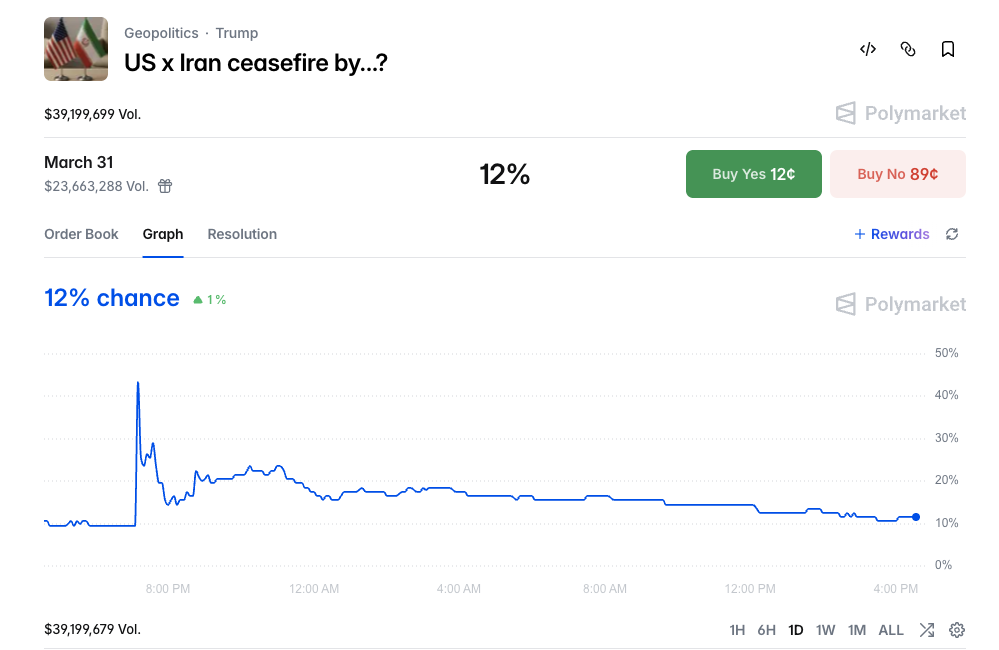
Meeting a master like Trump, even prediction markets that claim to get ahead of the truth of events can be spun in circles. According to monitoring by Odaily Seer先知频道, after Trump posted that US-Iran discussions had made good progress, the probability of the event "US and Iran will cease fire before March 31" on Polymarket quickly rose to 54%. After it was discovered to be a farce, the probability of this event quickly fell back to 16%, and has now dropped to 12%.
Does Trump intentionally manipulate the market? The answer is certainly yes. But is it just for making money? If you think so, you are ignoring another, more cost-effective business—the political dividends behind a rising stock market. Trump, coming from a business background, calculates this economic account clearer than anyone else.

During the 2024 presidential campaign, Trump promised that if he won the election, he would usher in a brand new era of Trump economic prosperity. But economic construction also takes time, and economic prosperity is itself a subjective concept for ordinary people—having money to spend is prosperity, not having money is not. Therefore, Trump urgently needed an immediate indicator to prove to voters that he was delivering results, so stock market prosperity became the best "substitute" for economic prosperity.

During his first term, Trump repeatedly touted new highs in the Dow Jones and S&P, almost treating the stock market as his personal governance scorecard. But every time Trump talks up the market, he aims to please not just stockholders, but also the capital and business owners behind them, because they are often either already or will eventually become Trump's political donors.

This script has already been played out in the crypto field. Trump was previously called the first "Crypto President" of the United States because during the 2024 US election year and early 2025 after Trump was elected president, he frequently extended olive branches to the crypto industry, such as participating in crypto industry conferences, making various crypto promises, and enacting crypto-friendly decrees. Each time, it brought upward momentum to the crypto market. In return, the crypto industry gave Trump support from tens of millions of US voters and hundreds of millions of dollars in political donations from crypto companies.

Manipulating the market without the purpose of making money also allows Trump to find loopholes in the law. Previously, countless US lawmakers and regulatory officials have accused Trump of manipulating the crypto market for profit, but these accusations ultimately came to nothing because there is no direct evidence that Trump obtained economic benefits from the market.

After the March 23 farce, some also accused Trump of涉嫌 insider trading. White House spokesperson Kush Desai stated that the White House does not tolerate any officials using insider information for illegal profit, provided there is evidence. But the "profit" referred to here mostly means economic benefit. And Trump? He has long withdrawn from his family business and moved behind the scenes,施展 intricate political and commercial手段 within the gaps of the law.

This is where Trump's true "brilliance" lies. He knows that in this world, power trumps money; but he also understands how money, in turn, influences the power structure.


Criptos en tendencia

Preguntas relacionadas

QWhat was the immediate market reaction to Trump's post on Truth Social about productive talks with Iran?

AGold rebounded by over $200, and S&P 500 futures rose nearly 4%, while Brent crude oil fell by over 14% to as low as $97 per barrel.

QHow did some traders allegedly profit from Trump's statement before it was publicly known?

AA large buy order of $1.5 billion in S&P 500 futures was placed 15 minutes before Trump's post, netting a profit of $60 million, and approximately $580 million worth of oil futures were sold around the same time.

QWhat does the article suggest is Trump's broader motive for influencing markets, beyond financial gain?

ATrump uses market manipulation to create a perception of economic prosperity, which serves as a political tool to gain voter support and secure donations from industries and capitalists.

QHow did the prediction market on Polymarket react to Trump's claims about U.S.-Iran talks?

AThe probability of a ceasefire between the U.S. and Iran by March 31 initially surged to 54% but quickly dropped to 12% after Iranian media denied the talks.

QWhy has it been difficult to legally prove Trump's involvement in insider trading or market manipulation?

AThere is no direct evidence linking Trump to financial gains from these actions, as he has distanced himself from family businesses and operates within legal loopholes, focusing on political rather than personal profit.

Lecturas Relacionadas

Must-Watch Events Next Week|CLARITY Act Could Face Senate Vote; SpaceX, Circle to Report Earnings (8.3-8.9)

**Summary: Key Events and Developments to Watch (August 3-9)** The upcoming week is marked by significant financial disclosures, key legislative deadlines, and notable product updates. **Major Financial Events:** Several companies are scheduled to release their Q2 2026 earnings. American Bitcoin (ABTC) will report on August 3, followed by SpaceX and Hut 8 Mining Corp. on August 4, and Circle on August 5. Notably, a significant portion of SpaceX shares (up to 12% of total shares) will be unlocked on August 6 following their earnings release. **Key Legislative Deadline:** The U.S. Senate faces an August 7 deadline to secure 60 votes for the CLARITY Act, a bipartisan bill aiming to establish a federal regulatory framework for cryptocurrencies. The Senate may hold a full vote on the bill during the week. **Economic Data:** The U.S. July Non-Farm Payrolls report will be released on August 7, providing crucial labor market data. **Technology & Product Updates:** * **Shutdowns:** DeFi portfolio tracker Zapper and wallet app Ctrl Wallet will cease operations on August 3. * **Upgrades:** LayerZero will deprecate its v1 relayers on August 3. XRP Ledger's new version 3.3.0, featuring five new functions, is expected next week. * **AI:** Elon Musk announced that the advanced Grok 4.6 AI model is set for release around August 7. * **Bitcoin:** The BIP-110 forced signaling for a potential Bitcoin network change is scheduled to begin around August 8. **Other Notable Events:** Chinese robotics firm Unitree Tech has set its preliminary price inquiry for its IPO for August 5. South Korean exchange Upbit will delist AQT and AERGO tokens on August 3.

marsbitHace 1 hora(s)

Must-Watch Events Next Week|CLARITY Act Could Face Senate Vote; SpaceX, Circle to Report Earnings (8.3-8.9)

marsbitHace 1 hora(s)

Stocks Are Plummeting More Sharply Than Cryptocurrencies. Where Has the Money Gone?

Stock Markets Plunge Deeper Than Cryptocurrencies: Where Did the Money Go? In late July, Seoul's Kospi index triggered circuit breakers for two consecutive days, plummeting over 40% from its June high. The collapse was led by heavyweight stocks like SK Hynix, whose record profits still disappointed investors, and devastating leveraged ETFs, with one major product losing over 83% of its value. This signaled a global, forced deleveraging targeting the most crowded trades. Interestingly, while stocks exhibited extreme volatility akin to crypto markets, Bitcoin rose nearly 15% in July after a prior steep drop. Analysis shows the money fleeing equities did not flow into Bitcoin. Instead, Bitcoin had already absorbed its sell-off in May-June, when U.S. spot Bitcoin ETFs saw historic outflows. The true safe-haven beneficiary was gold, whose price rose over 20% year-on-year, highlighting a decoupling between Bitcoin and gold as "digital gold." The sell-off was a targeted unwinding of leveraged positions in tech and semiconductors, accelerated by broker-dealer risk management and shifts in the AI narrative, including new competition from Chinese memory chipmakers. The retreat path was clear: from high-valuation tech stocks to cash and U.S. Treasuries, then to gold. For Bitcoin to attract sustained institutional inflows, conditions like eased global liquidity pressure, a "soft-landing" Fed rate cut, and U.S. regulatory clarity via legislation like the stalled CLARITY Act are needed. Currently, Bitcoin is not a safe haven but an already-cleared asset. Its low correlation with tech stocks, however, makes it a potential diversification play for institutional portfolios once the storm passes. The money isn't here yet, but the positioning is underway.

marsbitHace 1 hora(s)

Stocks Are Plummeting More Sharply Than Cryptocurrencies. Where Has the Money Gone?

marsbitHace 1 hora(s)

In Conversation with Ray Dalio: We Are Currently in an AI Bubble, with 1% of My Portfolio in Bitcoin

Ray Dalio, founder of Bridgewater Associates, warns in an interview that the current AI boom shows classic bubble characteristics, which could lead to significant economic downturns as seen in past cycles like 1929 or 2000. He explains that speculative enthusiasm, fueled by debt and overvaluation, often precedes a crash when rising rates or taxation force asset sales, causing widespread losses and recession. Dalio also outlines his "Big Cycle" theory, describing an approximate 80-year pattern where widening wealth gaps, massive government deficits, and shifting geopolitical power (like China's rise) create internal conflict and global instability. He emphasizes that we are in a late-cycle, transitional phase where traditional powers like the US and UK face decline. For personal wealth protection, Dalio advises diversification beyond cash into assets like stocks, bonds, real estate, and particularly gold, which he prefers over Bitcoin. While he holds about 1% of his portfolio in Bitcoin as a non-printable hard asset, he views gold as more secure from technological or governmental threats. Regarding AI's impact, Dalio believes it will disproportionately benefit capital owners, worsening inequality by replacing both physical and cognitive labor. He suggests that human intuition and emotional intelligence, combined with AI, will be key for future workers. On taxation, Dalio argues that wealth taxes are impractical and risk triggering asset sell-offs, reducing productive investment. He points to the UK as a cautionary example of debt, low productivity, and political strife. Geopolitically, Dalio foresees a more regionalized world, with the US showing weakness in prolonged conflicts like with Iran, akin to past imperial declines. The ideal outcome, he suggests, is coexisting powerful blocs (e.g., Americas, China-Asia Pacific) without major war.

marsbitHace 5 hora(s)

In Conversation with Ray Dalio: We Are Currently in an AI Bubble, with 1% of My Portfolio in Bitcoin

marsbitHace 5 hora(s)

Trading

Spot

Artículos destacados

Cómo comprar WAR

¡Bienvenido a HTX.com! Hemos hecho que comprar WAR (WAR) sea simple y conveniente. Sigue nuestra guía paso a paso para iniciar tu viaje de criptos.Paso 1: crea tu cuenta HTXUtiliza tu correo electrónico o número de teléfono para registrarte y obtener una cuenta gratuita en HTX. Experimenta un proceso de registro sin complicaciones y desbloquea todas las funciones.Obtener mi cuentaPaso 2: ve a Comprar cripto y elige tu método de pagoTarjeta de crédito/débito: usa tu Visa o Mastercard para comprar WAR (WAR) al instante.Saldo: utiliza fondos del saldo de tu cuenta HTX para tradear sin problemas.Terceros: hemos agregado métodos de pago populares como Google Pay y Apple Pay para mejorar la comodidad.P2P: tradear directamente con otros usuarios en HTX.Over-the-Counter (OTC): ofrecemos servicios personalizados y tipos de cambio competitivos para los traders.Paso 3: guarda tu WAR (WAR)Después de comprar tu WAR (WAR), guárdalo en tu cuenta HTX. Alternativamente, puedes enviarlo a otro lugar mediante transferencia blockchain o utilizarlo para tradear otras criptomonedas.Paso 4: tradear WAR (WAR)Tradear fácilmente con WAR (WAR) en HTX's mercado spot. Simplemente accede a tu cuenta, selecciona tu par de trading, ejecuta tus trades y monitorea en tiempo real. Ofrecemos una experiencia fácil de usar tanto para principiantes como para traders experimentados.

233 Vistas totalesPublicado en 2024.12.11Actualizado en 2026.06.02

Cómo comprar WAR

Discusiones

Bienvenido a la comunidad de HTX. Aquí puedes mantenerte informado sobre los últimos desarrollos de la plataforma y acceder a análisis profesionales del mercado. A continuación se presentan las opiniones de los usuarios sobre el precio de WAR (WAR).

活动图片












