Wall Street Plunged into 'AI Phobia': An Indiscriminate Sell-off Is Spreading

marsbitPublicado a 2026-02-11Actualizado a 2026-02-11

Resumen

Wall Street is experiencing a widespread "AI panic," triggering indiscriminate sell-offs across sectors perceived as vulnerable to AI disruption. The fear intensified recently when a tax-strategy tool from startup Altruist Corp. caused sharp declines in shares of major wealth managers like Charles Schwab, Raymond James, and LPL Financial. This reflects a broader market shift from focusing on AI winners to hastily dumping stocks of companies—from small software firms to large financial services—deemed at risk of being replaced by AI-driven products. Similar sell-offs occurred earlier in software, insurance, and asset management after AI companies like Anthropic and Insurify launched new tools. While some investors see this as an overreaction, citing the slow pace of technological adoption historically, others warn that AI’s rapid advancement is fueling legitimate anxiety. High market valuations have made stocks particularly sensitive to any negative signals, amplifying the volatility. The key uncertainty remains how quickly and deeply AI will reshape industries, leaving the market in a state of cautious speculation.

Source: Jinshi Data

On Wall Street, growing fears about artificial intelligence are hammering the stocks of companies that could become its targets of disruption, from small software firms to large wealth management companies, none have been spared.

The latest round of selling erupted on Tuesday when a tax strategy tool launched by a little-known startup, Altruist Corp., caused shares of Charles Schwab Corp., Raymond James Financial Inc., and LPL Financial Holdings Inc. to fall by 7% or more.

This marked the steepest decline for some of these stocks since the market crash triggered by the trade war last April. But it is just the latest example of the "sell first, ask questions later" mentality—a mindset that is rapidly taking hold as the hundreds of billions of dollars poured into AI begin to translate into commercial products, sparking anxiety that AI could disrupt entire industries.

"Companies with any potential disruption risk are being sold off indiscriminately," said John Belton, a fund manager at Gabelli Funds.

Over the past few years, advancements in AI technology have been at the forefront of Wall Street, with tech stocks leading the gains. As this rally pushed stock prices to record highs, questions have persisted about whether this is a bubble about to burst or whether it will trigger a productivity boom that reshapes the American corporate landscape.

But since the beginning of last week, a series of AI product launches has triggered a noticeable market shift. Instead of focusing on picking winners, investors are quickly trying to avoid holding any company facing even the slightest risk of being replaced.

"I don't know what's going to happen next," said Will Rhind, CEO of Graniteshares Advisors.

"Last year's story was that we all believed in AI—but we were looking for applications, and as we keep discovering applications that seem increasingly powerful and persuasive, it is now leading to disruption."

For some time, the software industry has been troubled by concerns about AI. Last week, when a new tool from Anthropic PBC triggered sharp declines in stocks across industries such as software, financial services, asset management, and legal services, these worries began to shift more broadly to other sectors.

The same fears hit U.S. insurance broker stocks hard on Monday after the online insurance marketplace Insurify launched a new app using ChatGPT to compare auto insurance rates. On Tuesday, wealth management stocks became the next victim, as the product Hazel launched by Altruist—which helps financial advisors create personalized strategies for clients—dragged these stocks down.
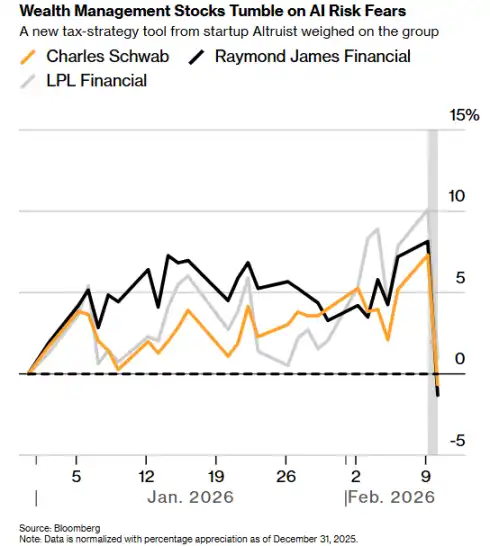
Wealth management stocks plunge on AI risk concerns

Altruist CEO Jason Wenk said he himself was surprised by the scale of the stock market reaction, which wiped tens of billions of dollars from the market value of several investment firms. But he said it sends a strong signal about the competitive threat his company poses.

"People are beginning to realize—the architecture we used to build Hazel, it can replace any job in wealth management," he said in an interview. "Usually these jobs are done by entire teams. And now, AI can effectively do these jobs for just $100 a month."

AI companies like OpenAI and Anthropic have already made solid progress in the field of software engineering with products that help developers simplify and debug code processes, and are now entering other industries.

However, many questions remain about how this technology will be adopted. Take banking, for example, which has periodically faced challenges from electronic services and other technologies, but these have ultimately failed to undermine its dominance.

Gabelli fund manager Belton is one of the skeptics about how Wall Street has shifted from worrying about an AI bubble to fearing its imminent disruption of large parts of the economy.

"There will be winners and losers in every industry," Belton said. But he added: "A rule of thumb is that technological disruption often takes longer to materialize than expected."

This pullback may also reflect widespread anxiety about the sharp rise in stock prices over the past few years, driven by the AI spending boom and an unusually resilient U.S. economy. This has already pushed valuations too high and made investors more sensitive to concerns about a reversal.

"As long as they emit a signal that the market perceives as somewhat negative, the stock will fall 10%, which would never happen in a market that hasn't reached current trading levels," said Graniteshares' Rhind.

For Ross Gerber, CEO of Gerber Kawasaki, the anxiety about AI losers that has been hitting parts of the market over the past week is premature. He said it is still too early to say exactly what the impact will be.

"We can try to extrapolate how AI will change the world in five years, but we just don't know," he said. "The market is trying to judge this while we are still at the beginning of this infancy."


Preguntas relacionadas

QWhat is the main reason behind the recent sell-off in Wall Street stocks, particularly affecting companies like Charles Schwab and Raymond James?

AThe sell-off is primarily driven by growing fears that new AI products, such as Altruist Corp's tax strategy tool Hazel, could disrupt traditional business models in industries like wealth management, leading investors to indiscriminately dump stocks perceived as vulnerable to AI-driven disruption.

QHow did the launch of Altruist Corp's Hazel tool impact the stock prices of major financial firms?

AThe launch of Hazel caused significant stock price declines, with companies like Charles Schwab Corp., Raymond James Financial Inc., and LPL Financial Holdings Inc. falling by 7% or more, marking some of their worst drops since the market crash triggered by the trade war in April of last year.

QWhat shift in investor behavior is observed as AI products become commercially available?

AInvestors have shifted from focusing on picking AI winners to rapidly avoiding any companies that face even the slightest risk of being disrupted by AI, adopting a 'sell first, ask questions later' mentality.

QAccording to Jason Wenk, CEO of Altruist, why is AI seen as a threat to the wealth management industry?

AJason Wenk stated that AI tools like Hazel, built with advanced architectures, can replace various jobs in wealth management that are typically done by entire teams, performing these tasks effectively for as low as $100 per month.

QWhat skepticism do some experts, like John Belton of Gabelli Funds, express about the current AI-driven market disruption fears?

AJohn Belton expresses skepticism, noting that technological disruption often takes longer to materialize than expected, and while there will be winners and losers in every industry, the current panic may be premature given the early stage of AI adoption.

Lecturas Relacionadas

The Waged Worker Driven to Poverty by AI Subscriptions

"AI Membership: The Hidden Cost Pushing Workers Toward 'Poverty'" The widespread corporate push for AI adoption is creating a hidden financial burden for employees. Companies, from giants like Alibaba to small firms, are mandating AI use, often tying token consumption to KPIs, but frequently refuse to cover the costs. Workers are forced to pay for subscriptions out of pocket to stay competitive and avoid being replaced. Front-end developer Long Shen spends up to 2000 RMB monthly on tools like Cursor and ChatGPT Plus, seeing it as a necessary 3% salary investment to handle 90% of his coding tasks. While it boosted his performance and led to promotions, he now faces idle time at work, pretending to be busy. Designer Peng Peng navigates strict company firewalls by using personal devices and accounts for AI image generation tools like Midjourney, spending hundreds monthly without reimbursement, while her boss demands faster, more numerous revisions. The pressure creates workplace anxiety and suspicion. Programmer Li Huahua, after a friend's experience of raised KPIs following AI success, fears being branded a "traitor" for using it yet worries about falling behind if she doesn't. The dynamic allows management to demand results without understanding the tools or covering expenses, treating employees like AI "agents." While some, like entrepreneur Jin Tu, find high value in paid AI, building entire systems and winning competitions, for most, it's a trap. Free tools like Kimi and Doubao are introducing fees, closing off alternatives. The initial efficiency gains individual advantage, but as AI becomes ubiquitous, the personal edge disappears, workloads increase, and a cycle of dependency begins. Workers like Long Shen realize they cannot maintain AI-generated code without AI, making stopping harder than continuing to pay. The tool promising liberation is instead becoming a compulsory, costly chain in the modern workplace.

marsbitHace 36 min(s)

The Waged Worker Driven to Poverty by AI Subscriptions

marsbitHace 36 min(s)

SK Hynix's Trillion-Won Empire: The Successors

"SK Hynix's Trillion-Won Empire and Its Heirs" explores the unconventional succession narrative within SK Group, South Korea's second-largest conglomerate, following SK Hynix's dramatic market rise. Unlike traditional chaebol scripts prioritizing the eldest son, ownership, and political marriages, Chairman Choi Tae-won's three children from his first marriage are charting distinct paths. The eldest daughter, Choi Yun-jeong, is considered the most visible candidate. With a background in biology, consulting, and a PhD, she holds executive roles at SK Bioscience and SK Inc.'s growth strategy unit, focusing on biopharma and new businesses. Her marriage is to an AI infrastructure entrepreneur, not a traditional chaebol heir. The second daughter, Choi Min-jeong, took a unique route by voluntarily serving as a South Korean naval officer, including a tour in the Gulf of Aden. She later worked on policy and strategy for SK Hynix in Washington D.C. before co-founding an AI-driven healthcare startup in San Francisco. She married a former U.S. Marine Corps officer, connecting the family to U.S. defense and policy networks. The son, Choi In-geun, who has Type 1 diabetes, followed a more classic preparatory path with a physics degree and a stint at SK E&S but left to join McKinsey's Seoul office. He remains publicly silent and holds no SK shares, defying the traditional "crown prince" archetype. Their paths unfold against the backdrop of their parents' high-profile, contentious divorce and a record-setting asset division lawsuit. The article argues that as SK Hynix becomes a geopolitical asset in the AI era, the conventional rules of chaebol inheritance are changing. The heirs are being groomed not simply to take over, but to navigate a complex global landscape defined by AI, biotech, geopolitics, and policy, forging legitimacy through their own expertise and networks rather than birth order alone.

marsbitHace 45 min(s)

SK Hynix's Trillion-Won Empire: The Successors

marsbitHace 45 min(s)

BitMart Research Institute Weekly Highlights: A Comprehensive Review of Macro Environment, Crude Oil, AI Tech Stocks, and Crypto Market

**Weekly Market Review: Macro, Oil, AI Tech Stocks & Crypto Market** **Macroeconomic & Traditional Finance** The April U.S. Non-Farm Payrolls report of 115K new jobs exceeded expectations, but the data's quality was questioned. Growth was heavily concentrated in healthcare, while other sectors contracted, and manufacturing employment turned negative. A statistical model accounted for a large portion of the gains, conflicting with household survey data showing a loss of 226K jobs. Meanwhile, AI's impact on jobs is emerging, with information sector roles declining, though overall unemployment remains at ~4.3%. Oil prices hovered near $100 per barrel. Global oil buffer inventories have drawn down significantly, supporting prices, but high costs are suppressing demand. China's recent reduction in crude imports acted as a market stabilizer. Geopolitically, the U.S. and Iran are likely to reach a tentative agreement to keep the Strait of Hormuz open and avoid price spikes. For AI tech stocks, short-term prospects are mixed. A potential SpaceX IPO in June could pressure current index heavyweights like Nvidia, while smaller components might benefit. The mid-term focus shifts to Q2 earnings, emphasizing AI's return on investment. Long-term risks include potential election policy shifts and massive IPOs from companies like OpenAI, which could test the sector's sustainability. **Crypto Market & Ecosystem** Crypto markets rose moderately, with BTC climbing from ~$77K to ~$82K, driven by improved risk sentiment. Spot trading volumes remain low, but buying pressure is evident. ETF inflows continued (~$791M last week). However, institutional purchases of BTC and ETH were more modest than expected. The derivatives market shows lingering bearish bets, particularly on alts and ETH. A key trend is the "dual-track" model where projects pursue public listings for traditional funding while also building their own blockchains/tokens to capture crypto liquidity, as seen with Circle's ARC chain. Stablecoins and institutional chains present significant future opportunities. *Disclaimer: This is market analysis, not investment advice.*

marsbitHace 1 hora(s)

BitMart Research Institute Weekly Highlights: A Comprehensive Review of Macro Environment, Crude Oil, AI Tech Stocks, and Crypto Market

marsbitHace 1 hora(s)

Trading

Spot
Futuros
活动图片