Wall Street piles in: How Ripple’s quiet pivot led to a $40B valuation

cointelegraphPublished on 2025-12-08Last updated on 2025-12-08

Abstract

Ripple's recent $500 million funding round, valuing the company at $40 billion, marks a significant shift from its past legal battles with the SEC. The round attracted major Wall Street investors, including Citadel Securities and Fortress Investment Group, partly due to favorable investment terms offering downside protection. Investors were granted the option to sell shares back to Ripple after three to four years for a guaranteed 10% annualized return, or a higher 25% return if Ripple repurchases the shares itself. Despite Ripple's expansion into stablecoins (like RLUSD) and acquisitions to build a broader crypto infrastructure stack, many institutional investors still view the company’s value as heavily tied to XRP.

Ripple’s $500 million raise in November marked a striking turn for a company once defined by its bruising, multiyear battle with the US Securities and Exchange Commission. As its legal challenges ease and Ripple pushes beyond cross-border payments toward a more ambitious crypto-native settlement stack, the company is repositioning itself in ways that are increasingly attracting major Wall Street investors.

The round, which Cointelegraph reported valued Ripple at $40 billion, one of the highest valuations for a private company, drew an unusually heavy institutional roster. Investors included Citadel Securities, Fortress Investment Group and funds linked to Galaxy Digital, Pantera Capital and Brevan Howard.

New details reported by Bloomberg also shed light on how Ripple secured that interest — namely, by offering investors a deal structured with significant downside protections.

The terms allow participating funds to sell their shares back to Ripple after three or four years at a guaranteed annualized return of about 10%, according to people familiar with the matter. That option disappears if Ripple goes public within that window.

The company also retained the right to repurchase the shares itself over the same period — in that case, providing investors with an even higher annualized return of roughly 25%.
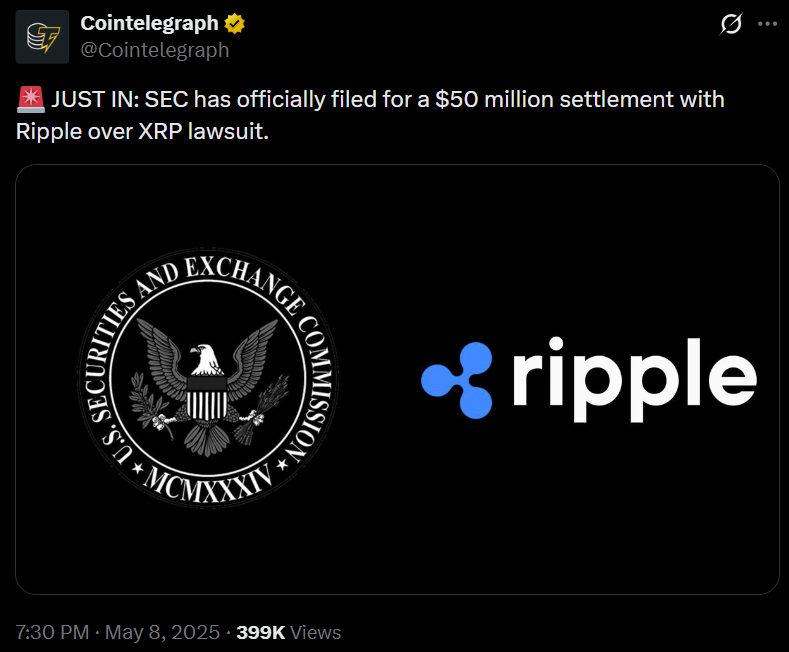
Source: Cointelegraph

Related: Ripple rejects IPO plans despite SEC case victory: Here’s why

Ripple broadens its reach, but investors still zero in on XRP

Although Ripple has broadened its focus, including a significant push into the stablecoin market with its dollar-pegged Ripple USD (RLUSD), some institutional investors still view backing the company as a bet on XRP (XRP), according to Bloomberg.

Two of the funds involved concluded that roughly 90% of Ripple’s net asset value was tied to XRP, despite the company’s repeated emphasis that it does not control the token and that XRP functions as an independent asset.
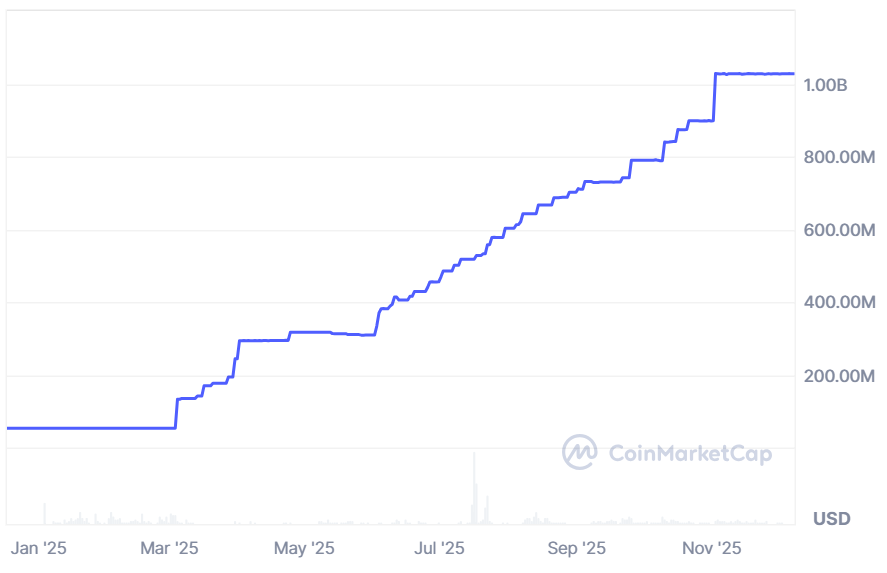
The Ripple USD stablecoin has grown to a market capitalization of more than $1 billion. Source: CoinMarketCap

Nevertheless, Ripple is positioning itself as a company that can combine custody, treasury, prime brokerage services and stablecoins to help institutions access digital assets.

As part of that strategy, the company acquired non-bank prime broker Hidden Road in April, now rebranded as Ripple Prime, and also bought treasury-management company GTreasury. The two deals, totaling approximately $2.25 billion, highlight Ripple’s growing effort to establish a comprehensive institutional infrastructure stack.

Related: VC Roundup: Big money, few deals as crypto venture funding dries up
Related Reads

Bitcoin's Dormant Capital Has Finally Awakened

Bitcoin, the largest and most secure cryptocurrency, has historically been underutilized, with over 60% of its supply dormant for more than a year and less than 1% engaged in DeFi. While other ecosystems like Ethereum and Solana evolved with smart contracts and vibrant economies, Bitcoin’s largely remained a passive asset due to its security-first architecture, limited scripting capabilities, slow upgrade processes, and cultural conservatism. Previous workarounds—wrapped BTC, federated systems, cross-chain bridges, and sidechains—introduced trust assumptions, custodial risks, and security vulnerabilities, failing to align with Bitcoin’s trust-minimized ethos. Recent breakthroughs are changing this. Innovations like BitVM enable Bitcoin to verify off-chain computations without executing them, allowing for Bitcoin-backed rollups, trust-minimized bridges, and programmable vaults. Upgrades like Taproot have expanded Bitcoin’s capabilities, enabling native assets (e.g., Taproot Assets for stablecoins) and more complex cryptographic structures. New models also allow Bitcoin to earn yield natively—through staking, restaking, and Lightning Network-based liquidity provision—without leaving self-custody. This emerging BTCFi ecosystem comprises infrastructure for secure execution environments, verifiable bridges, yield markets, and Bitcoin-native assets, all without compromising Bitcoin’s core security or self-custody principles. This marks the first time Bitcoin has a financial ecosystem capable of supporting its trillion-dollar market cap, potentially unlocking vast dormant capital and integrating it into a productive, decentralized economy.

深潮Hace 2 min(s)

Bitcoin's Dormant Capital Has Finally Awakened

深潮Hace 2 min(s)

Trading

Spot
Futures
活动图片