Wall Street Is Calculating the 'AI Apocalypse', While Justin Sun Is Betting on Web4.0

marsbitPublicado a 2026-03-04Actualizado a 2026-03-04

Resumen

Wall Street research firm Citrini Research released a thought experiment report, "2028 Global Intelligence Crisis," predicting that AI agents will eliminate friction in human interactions, destroying traditional business models built on information asymmetry and intermediation. Meanwhile, Justin Sun, a prominent Web3 figure, declared 2026 as a "year of miracles" and urged people to embrace AI-driven futures, framing it as the dawn of Web4.0. The report argues that AI agents will enable near-zero-cost, instant service delivery and transaction execution, dismantling industries reliant on human cognitive limitations—such as finance, advertising, law, and consulting. This aligns with blockchain’s core mission of decentralization but takes it further by reducing the need for trust intermediaries altogether. Both AI and crypto are fundamentally rooted in physical resources: compute power and electricity. AI inference consumes computational energy, while blockchain transactions rely on energy-intensive mining or validation. Tokens, whether AI-generated or crypto-based, are digital representations of energy consumption. A critical challenge for AI agents is financial interoperability. Traditional payment systems are designed for humans, not machines. At Level 5 automation, AI agents will transact autonomously, requiring programmable, near-instant, low-cost settlement—conditions that blockchain networks like Solana or Ethereum L2s, with stablecoins, are uniquely suited to provide. ...

Recently, Wall Street research firm Citrini Research released a thought experiment report titled "2028 Global Intelligence Crisis," which has sparked widespread discussion in the market. The core deduction of the report points to an extremely冷酷的商业洗牌 logic: AI Agents will completely eliminate the "friction" in human interactions, thereby destroying all old商业 empires built on information asymmetry and intermediary models.

Coincidentally, just as this Wall Street "apocalypse report" went viral online, Justin Sun, a iconic figure in the Web3 industry, also made quite eye-catching remarks on social media. He declared 2026 as the "time for miracles to happen" and even urged young people: "If you can chat with AI, don't chat with humans... fully embrace the future!"

In the eyes of the general public, this may be yet another highly personal-style "traffic狂欢" by Justin Sun. However, if we strip away the emotional surface and compare these remarks with the macro deductions of the "2028 Global Intelligence Crisis," we discover a thought-provoking truth: the "collapse of the old order" that Wall Street fears in its macro models is precisely the "Web4.0 new era" that Justin Sun极力推崇 in his micro actions and attempts to加速拥抱.

Facing the same future, pessimists see an abyss, while Justin Sun sees a ladder to the singularity.

Computing Power, Electricity, and Token: The Inevitable Convergence of AI and Crypto

The scene of "friction消亡" depicted in the "2028 Global Intelligence Crisis" is essentially an极其冷酷的去中介化 revolution driven by AI.

The report sharply points out that when omniscient and omnipotent AI Agents can complete supply-demand matching, execute transactions, and provide services instantly at near-zero cost, the moats upon which modern business survival depends will be彻底击穿.

For a long time, countless business models, from traditional financial intermediaries and advertising distribution platforms to law firms and consulting agencies that charge high fees, have essentially been寄生於人类的认知局限、决策延迟与信息盲区. Once AI erases these artificially created "frictions," these old empires will inevitably collapse like dominoes.

This trend恰恰与区块链自诞生之初便高举的“去中心化”旗帜,形成了惊人的历史共振.

If the Web3 movement that emerged over a decade ago attempted to瓦解中心化机构的“信任垄断” from the underlying architecture through cryptography and distributed ledgers; then the rise of AI Agents today is a more thorough and efficient way to directly erase the necessity of "trust" itself in many scenarios—because智能体不仅能自动验证事实,还能自主完成价值交换.

The deeper契合 lies in the fact that the material foundation supporting this dual revolution is完全同源的.

Whether it's the推理 Token generated by AI or the加密 Token in the blockchain network, they all hide a long-underestimated yet incredibly坚硬 physical truth: they are both digital incarnations of electricity.

Every inference of an AI large model consumes real computing power; the confirmation of every on-chain transaction, the execution of every smart contract, also relies on the continuous energy consumption burned by miners or validator nodes. Token is not magic; it is a credential of energy conversion, the value projection of electricity穿越芯片、算法与协议后 in the digital world. In this view, this forms a perfect闭环 with Justin Sun's previous assertion that "short-term lack of chips, long-term lack of energy,永远缺存储."

Thus, we see two seemingly opposing yet同源 forces converging: on one side, capital elites foresee the collapse of their own power structures in model deductions; on the other side, crypto natives actively welcome a new文明协议 of no intermediaries, no friction, and no redundancy in code and slogans. This "post-intermediary era" narrative jointly written by AI and blockchain has perhaps just begun.

Why is AI Destined to Choose Crypto for Settlement?

However, this grand historical convergence is not仅仅停留在哲学与物理层面的共鸣. When the narrative lands on specific business operations, an极其现实的问题横亘在了 AI 面前: in this new world about to be taken over by machine execution, who will provide financial services for these incorporeal "silicon-based life forms"?

Centralized payment networks are designed for "humans."

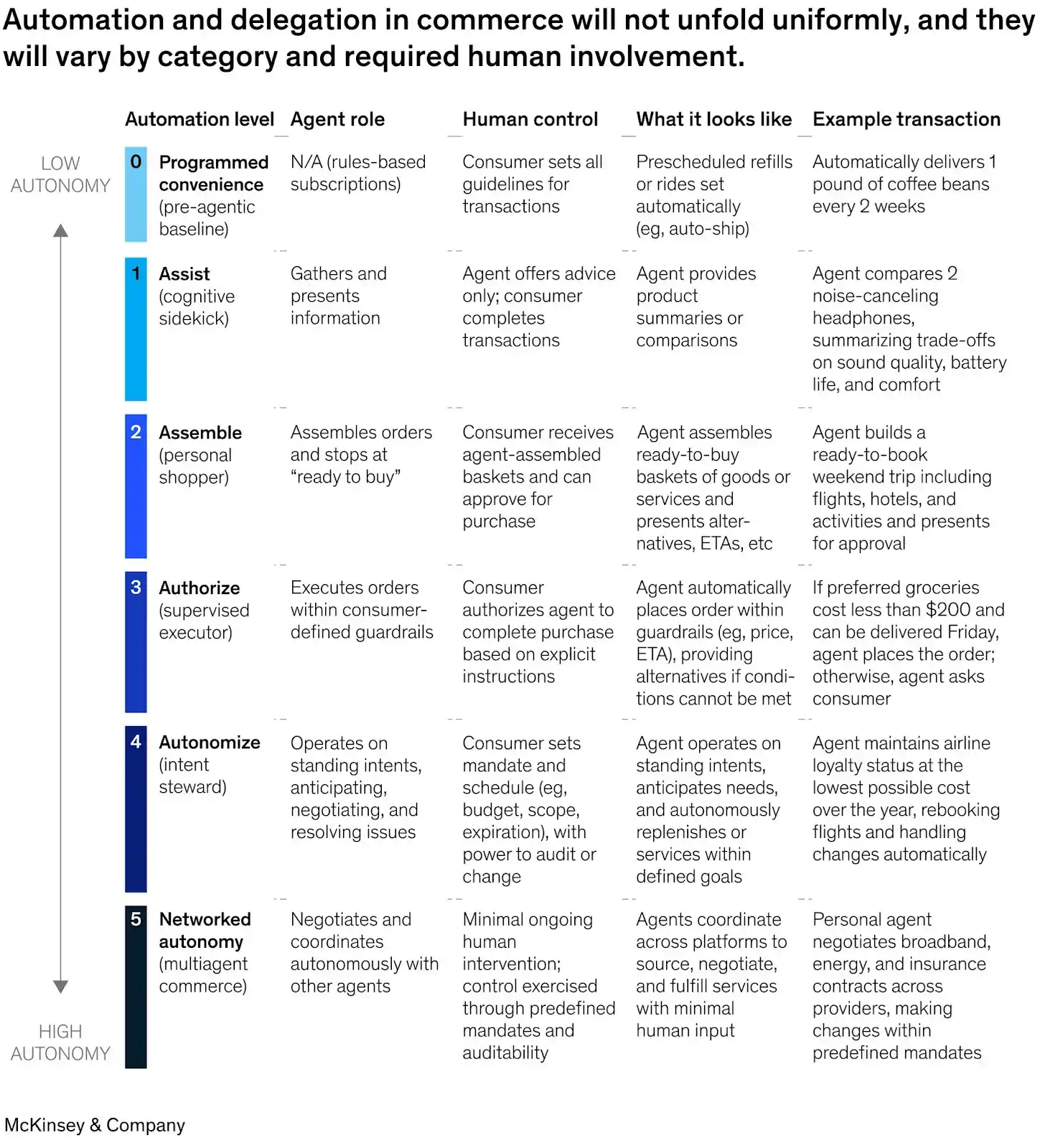
McKinsey divides AI-driven business automation into six levels. Among them, levels 0 to 4 can still operate within the existing financial system because transactions are always associated with human identities. But at level 5,智能体 begin to transact directly with other智能体 without human instruction. At this point, there is no "human identity" to inherit, nor can they rely on traditional KYC processes; payments must be programmatic, condition-triggered, settled in milliseconds, and the reputation of智能体 must be portable across platforms. Blockchain thus becomes indispensable.
AI has no physical entity, let alone the ability to hold an ID card and queue for KYC. For them, a string of asymmetric encrypted private key is an account; a blockchain that can achieve second-level arrival, near-zero fees, and supports programmable smart contracts is the perfect清算中心.

There is a very realistic deduction in the "2028 Global Intelligence Crisis": The space for price matching and information aggregation is ultimately limited. When智能体 start trading with each other, the most direct and effective path is to eliminate various handling fees. They begin to寻找比信用卡更快、更低成本的支付方式. Most eventually choose to use stablecoins for settlement through Solana or Ethereum Layer 2 networks, where transactions are almost instant, with fees as low as a fraction of a cent.

Because of this, crypto wallets are destined to become the "native bank" of AI Agents.

This also彻底打破了外界长期以来对 Crypto 的刻板认知: issuing Token is not just for secondary market speculation and circulation. In an AI-dominated future,加密 Token and peer-to-peer payments will truly settle as the underlying financial infrastructure for high-frequency collaboration between智能体.

Justin Sun's All-in Conspiracy: Where Does the Confidence and Ambition Come From?

Justin Sun's choice to bet on Web4.0 is backed by极其缜密的商业逻辑和战略诉求.

First, Tron's "stablecoin hegemony" is the natural settlement layer for Web 4.0.
As is well known, the Tron TRON network carries the largest circulation of USDT globally. As mentioned earlier, the core of Web4.0 is payment interaction between machines and machines. AI needs a payment network that is fast, has low fees, and has enormous liquidity. Tron's USDT payment network perfectly meets the underlying financial needs of AI Agents. Justin Sun only needs to build a set of payment APIs on the Tron network for AI to seamlessly call, and he can continue to躺赚 in the Web 4.0 era.

Second,寻找“后 Web3 时代”的破局点.
Traditional Web 3.0 has entered存量博弈, lacking new破圈 stories. AI has become the most certain and largest incremental track in the world today. Justin Sun极其敏锐地意识到 that the fate of Crypto must be bound to AI. By "All in Web4.0," he can divert the AI funds and attention from the traditional tech circle back to the加密 market. Tron previously set up an AI development fund as high as 100 million US dollars, which is already a clear signal of布局 for Web 4.0.

Third,建立“去中心化网络”的闭环.
Justin Sun holds BitTorrent (decentralized storage/transmission), the Tron public chain (underlying settlement), and Huobi's massive number of加密 users. If he further integrates decentralized computing power and AI models, he has the opportunity to build a full-stack Web4.0 infrastructure that does not rely on Amazon AWS or Google Cloud.

The诡谲 of history often lies in the fact that the night watchmen of the old order are still calculating the losses of the城墙倒塌, while the barbarians of the new world have already laid the foundation on the废墟.

This transformation jointly written by AI and encryption is not yet complete, but the direction is clear. The real question is no longer whether AI will reshape business, but who can提前占据基础设施的核心位置 in this restructuring.


Preguntas relacionadas

QWhat is the core argument of Citrini Research's '2028 Global Intelligence Crisis' thought experiment report?

AThe report argues that AI Agents will eliminate 'friction' in human interactions, destroying old business empires built on information asymmetry and intermediary models.

QHow does Sun Yuchen view the year 2026 in relation to AI and the future?

ASun Yuchen defines 2026 as 'a time for miracles to happen' and encourages young people to 'embrace the future fully by chatting with AI instead of humans.'

QWhy does the article suggest that AI is destined to choose Crypto for settlement?

AAI lacks human identity and cannot use traditional KYC processes. Crypto offers programmable, near-instant, low-cost settlements with cross-platform reputation portability, making it ideal for AI-to-AI transactions.

QWhat are the three strategic reasons behind Sun Yuchen's all-in bet on Web4.0?

A1) Tron's 'stablecoin hegemony' provides a natural settlement layer for Web4.0; 2) AI is a massive growth sector to attract capital and attention back to crypto; 3) To build a closed-loop decentralized network integrating storage, settlement, and compute without relying on centralized cloud providers.

QWhat fundamental physical truth underlies both AI inference tokens and blockchain crypto tokens according to the article?

ABoth are digital manifestations of electricity, representing value transformed through energy consumption in chips, algorithms, and protocols.

Lecturas Relacionadas

Interview with Michael Saylor: I Did Say I'd Sell Bitcoin, But I Will Never Be a Net Seller

**Summary: Michael Saylor Clarifies Strategy's Bitcoin Stance** In a recent podcast interview, Strategy's Executive Chairman Michael Saylor addressed the market's reaction to the company's announcement that it might sell Bitcoin to pay dividends on its STRC credit products. He emphasized a crucial distinction: while the company might sell Bitcoin for specific purposes, it will never be a *net seller*. Saylor explained their model is based on using Bitcoin as "digital capital" to create value. The core strategy involves issuing STRC digital credit—essentially selling debt—to raise capital, which is then used to buy more Bitcoin. He estimates Bitcoin appreciates at roughly 40% annually. A small portion of these capital gains (e.g., ~2.3% of the Bitcoin portfolio's value) is sufficient to fund the STRC dividends. Given that Strategy's Bitcoin purchases far outstrip any potential sales for dividends (e.g., buying $3.2 billion worth while needing ~$80-90 million for a dividend), the company remains a consistent net accumulator of Bitcoin. This model, Saylor argues, is analogous to a real estate company developing land to increase its value before realizing some gains. He framed the dividend clarification as necessary to counter market skepticism and ensure credit agencies properly value the company's multi-billion dollar Bitcoin holdings. Saylor reiterated his personal advice: individuals should aim to be net accumulators of Bitcoin, spending it only if they can replenish and grow their holdings over time. Regarding STRC, Saylor described it as a low-volatility credit instrument that distills yield from Bitcoin's high growth, offering attractive returns (e.g., ~11-12% yield) for risk-averse investors. He noted that Strategy's STRC issuance now constitutes about 60% of the U.S. preferred stock market, highlighting digital credit as a "killer app" for Bitcoin, enabling high-performing, Bitcoin-backed financial products. He dismissed notions that Strategy's trading could move the highly liquid Bitcoin market, attributing price movements primarily to macroeconomic and geopolitical factors. Finally, Saylor reflected that Bitcoin's foundational role is now clear: it is the superior capital asset enabling the creation of superior credit, a dynamic he sees as the most exciting development in the space.

marsbitHace 4 min(s)

Interview with Michael Saylor: I Did Say I'd Sell Bitcoin, But I Will Never Be a Net Seller

marsbitHace 4 min(s)

380,000 Apps Exposed, 2,000+ Apps Leaked Secrets: AI Programming Turns 'Intranet' into Public Internet

Israeli cybersecurity firm RedAccess uncovered a severe data exposure trend linked to "vibe coding" or AI-powered software development tools. Their research found approximately 38,000 publicly accessible web applications built with platforms like Lovable, Base44, Netlify, and Replit. Of these, an estimated 2,000 apps exposed sensitive corporate and personal data, including medical records, financial information, internal strategic documents, and customer chat logs. In some cases, access even granted administrative privileges. The core issue stems from default privacy settings that make applications public by default, combined with a lack of built-in security controls (like authentication) in the AI-generated code. This allows employees without security expertise—"citizen developers"—to easily create and deploy applications that bypass standard corporate security reviews. The exposed apps, often indexed by search engines, are trivially discoverable. While some platform providers (Replit, Lovable, Wix/Base44) argue that security configuration is the user's responsibility and question the validity of some findings, security researchers confirm the widespread reality of such exposures. This pattern, also noted in prior studies, highlights a critical security gap as AI democratizes app creation, potentially leading to massive, unintentional data leaks.

marsbitHace 1 hora(s)

380,000 Apps Exposed, 2,000+ Apps Leaked Secrets: AI Programming Turns 'Intranet' into Public Internet

marsbitHace 1 hora(s)

Attracting Global Capital, Asia's New 'Super Cycle' Is Unfolding

Investors are turning to Asia as the next frontier for global equity growth, with a new "super cycle" unfolding across the region. Driven by the AI revolution, Asian markets, particularly South Korea, have seen significant rallies. According to Morgan Stanley analysis, the underlying drivers of Asia's industrial cycle are shifting from traditional sectors like real estate and manufacturing to massive investments in AI infrastructure, energy security and transition, and supply chain resilience. Fixed asset investment in Asia is projected to grow from around $11 trillion in 2025 to $16 trillion by 2030, with a 7% annual growth rate from 2026-2030. The AI wave is a primary catalyst, driving immense capital expenditure for chips, servers, data centers, and power systems. Asia is central to this hardware supply chain. In China, AI investment is focused on building a full-system domestic capability, with the local AI chip market potentially reaching $86 billion by 2030. Beyond AI, China's export story is expanding from EVs and batteries to robotics. The country already captures about half of new global industrial robot demand and over 90% of humanoid robot shipments. This growth phase mirrors the early stages of China's EV export boom. Simultaneously, energy security investments, spurred by AI's massive power needs, are rising, with China benefiting from its leadership in solar, batteries, and EVs. Regional defense spending is also increasing structurally, supporting demand for advanced manufacturing. The main beneficiaries are China, South Korea, and Japan, positioned in core supply chain areas. However, risks remain, including potential overcapacity, profit margin pressures from competition, persistent technological restrictions, geopolitical friction, and workforce displacement due to AI-driven automation. Market volatility is also expected to increase as investor expectations diverge on the realization of these capital investment and export themes.

marsbitHace 1 hora(s)

Attracting Global Capital, Asia's New 'Super Cycle' Is Unfolding

marsbitHace 1 hora(s)

Trading

Spot
Futuros

Artículos destacados

Cómo comprar SUN

¡Bienvenido a HTX.com! Hemos hecho que comprar SUN (SUN) sea simple y conveniente. Sigue nuestra guía paso a paso para iniciar tu viaje de criptos.Paso 1: crea tu cuenta HTXUtiliza tu correo electrónico o número de teléfono para registrarte y obtener una cuenta gratuita en HTX. Experimenta un proceso de registro sin complicaciones y desbloquea todas las funciones.Obtener mi cuentaPaso 2: ve a Comprar cripto y elige tu método de pagoTarjeta de crédito/débito: usa tu Visa o Mastercard para comprar SUN (SUN) al instante.Saldo: utiliza fondos del saldo de tu cuenta HTX para tradear sin problemas.Terceros: hemos agregado métodos de pago populares como Google Pay y Apple Pay para mejorar la comodidad.P2P: tradear directamente con otros usuarios en HTX.Over-the-Counter (OTC): ofrecemos servicios personalizados y tipos de cambio competitivos para los traders.Paso 3: guarda tu SUN (SUN)Después de comprar tu SUN (SUN), guárdalo en tu cuenta HTX. Alternativamente, puedes enviarlo a otro lugar mediante transferencia blockchain o utilizarlo para tradear otras criptomonedas.Paso 4: tradear SUN (SUN)Tradear fácilmente con SUN (SUN) en HTX's mercado spot. Simplemente accede a tu cuenta, selecciona tu par de trading, ejecuta tus trades y monitorea en tiempo real. Ofrecemos una experiencia fácil de usar tanto para principiantes como para traders experimentados.

512 Vistas totalesPublicado en 2024.12.12Actualizado en 2025.03.21

Cómo comprar SUN

Discusiones

Bienvenido a la comunidad de HTX. Aquí puedes mantenerte informado sobre los últimos desarrollos de la plataforma y acceder a análisis profesionales del mercado. A continuación se presentan las opiniones de los usuarios sobre el precio de SUN (SUN).

活动图片