Wall Street Finally Couldn't Hold Back: Altcoin ETFs Officially Charge into the Main Arena

比推Published on 2025-12-08Last updated on 2025-12-08

Abstract

Wall Street has entered the altcoin ETF market, with a wave of approvals in Q4 2025. Following Bitcoin and Ethereum ETFs, spot ETFs for XRP, DOGE, LTC, and HBAR have launched in the U.S., while others like AVAX and LINK are in fast-track approval. This rapid adoption—contrasting with Bitcoin’s decade-long regulatory struggle—stems from two key developments: the SEC’s revised "Generic Listing Standards for Commodity Trust Shares" in September 2025, which streamlined the approval process, and the triggering of the 8(a) clause during the November government shutdown, which allowed issuers to fast-track registrations. Analysis of major altcoin ETFs from October to December 2025 shows varied performance: - **SOL ETF** saw significant inflows of $618M despite a 31% price drop, with Bitwise’s BSOL leading due to its staking rewards mechanism. - **XRP ETF** attracted $824M in inflows amid a 9% price decline. - **HBAR ETF** drew $82M despite a 28% drop, indicating confidence in its enterprise use cases. - **LINK ETF** had a strong start with $40.9M inflows on its first day. - **DOGE ETF** saw minimal interest ($2.68M inflows), highlighting institutional skepticism toward meme coins. - **LTC ETF** struggled with low inflows ($7.47M) and lack of narrative appeal. Funding for these ETFs comes from both reallocated Bitcoin/ETH ETF capital and new institutional players like BlackRock and Fidelity, accessing crypto via retirement plans, wealth management, and other traditi...

In the fourth quarter of 2025, the U.S. market witnessed a concentrated explosion of spot altcoin ETFs. Following the opening of the ETF door by Bitcoin and Ethereum, ETFs for altcoins such as XRP, DOGE, LTC, and HBAR were successively launched in the United States, while ETFs for assets like AVAX and LINK also entered a rapid approval phase. In stark contrast to the decade-long regulatory battle for Bitcoin ETFs, this batch of altcoin ETFs completed the entire process from application to listing in just a few months, demonstrating a significant shift in the U.S. regulatory attitude. The emergence of altcoin ETFs is no longer an isolated event but a natural outcome following a structural relaxation of crypto regulation.

The key catalysts for this listing boom primarily stem from two points: the amendment to the "Generic Listing Standards for Commodity Trust Shares" approved by the SEC on September 17, 2025, and the triggering of the "8(a) clause" during the U.S. government shutdown in November. The Generic Listing Standards established a unified access system for crypto asset ETFs, allowing eligible assets to no longer face the SEC's lengthy individual reviews. As long as a crypto asset has a history of more than six months on a CFTC-regulated futures market and has a monitoring sharing mechanism in place, or if there is already at least 40% related exposure in the market, it can qualify under this system, thereby shortening the exchange-side approval cycle from 240 days to 60-75 days.

Secondly, the triggering of the "8(a) clause" in November and the SEC's passive situation accelerated the process of these ETF listings. During the U.S. government shutdown, the generic standards were briefly interrupted, but the SEC issued guidance on November 14, for the first time allowing issuers to proactively remove the delaying amendment clause from their S-1 registration statements. According to Section 8(a) of the Securities Act of 1933, statements that do not contain this clause will automatically become effective after 20 days, unless the SEC actively stops them. This created a de facto tacit approval channel for listing. At this time, due to the shutdown of various government departments, they were unable to block applications individually within the limited time. Issuers like Bitwise and Franklin Templeton quickly seized the window, completing rapid registration by removing the delaying clause, pushing the altcoin ETFs to land intensively in mid-to-late November, forming the current wave of crypto asset ETF listings in the market.

II. Analysis of Major Altcoin ETF Performance (October–December 2025)

Solana (SOL)

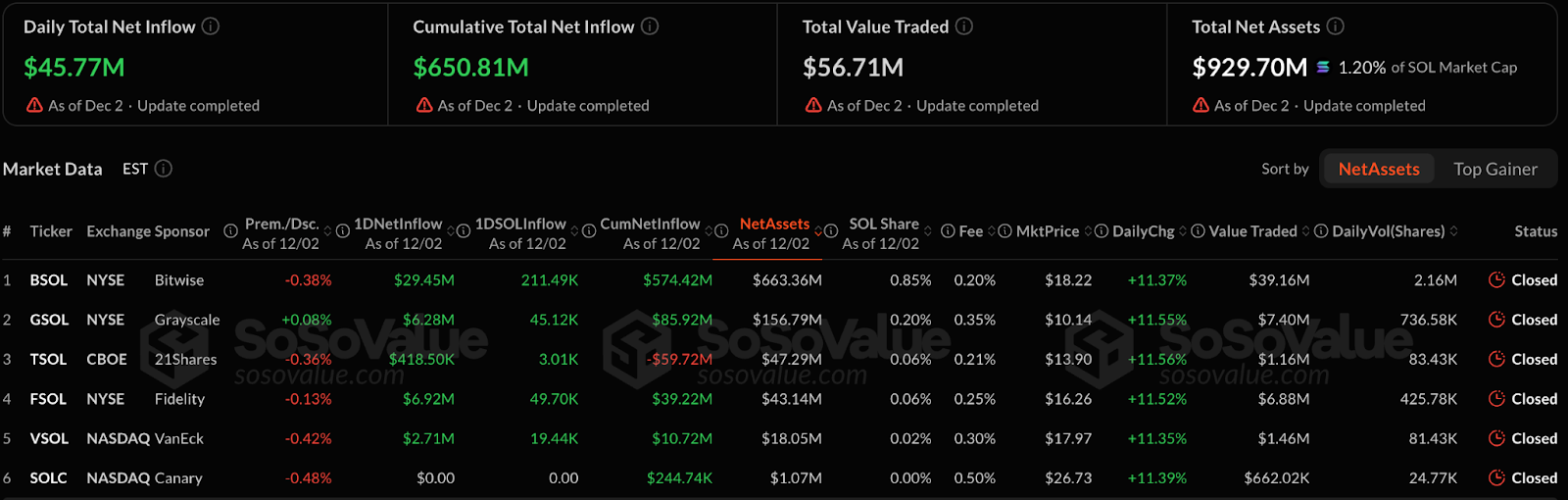
The first batch of SOL products was listed on October 28. Although the price of SOL has continued to fall by about 31% since listing, funds have shown a counter-trend inflow, buying more as the price dropped. As of December 2, the entire SOL ETF sector had accumulated a net inflow of $618 million, with total assets reaching $915 million, accounting for 1.15% of SOL's total market capitalization. Achieving such a scale in less than two months also reflects, to some extent, the market's broad recognition of SOL's positioning as the "third largest public chain".

The BSOL product launched by Bitwise performed most prominently, with this single product attracting approximately $574 million in funds, making it the single largest fund in terms of inflows among SOL ETFs. BSOL's lead is largely due to its designed staking reward mechanism—all held SOL is directly staked, and the staking rewards obtained are not distributed to investors but are automatically reinvested to enhance the fund's net asset value growth. This method of linking staking returns to the fund's NAV provides a compliant, convenient, and yield-advantageous alternative for institutions/investors who wish to participate in the SOL ecosystem but are unwilling to manage private keys and nodes themselves.
Ripple (XRP)

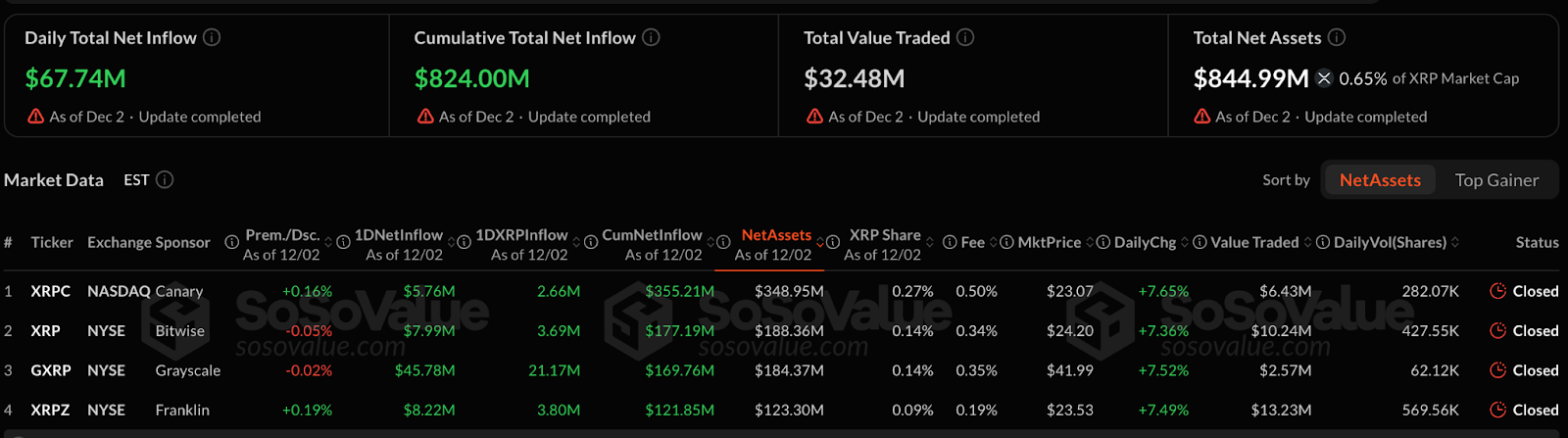
XRP ETFs began陆续上线 starting November 13, 2025. During the same period, the XRP price fell by about 9%. Like SOL, XRP ETFs also showed a trend of increased buying as the price fell. As of December 2, the cumulative net inflow was $824 million, with total assets valued at approximately $844 million, accounting for 0.65% of XRP's total market capitalization. The size differences among major issuers in the XRP ETF product space were not significantly pronounced, with multiple institutions showing a relatively balanced market share.
Doge (DOGE)

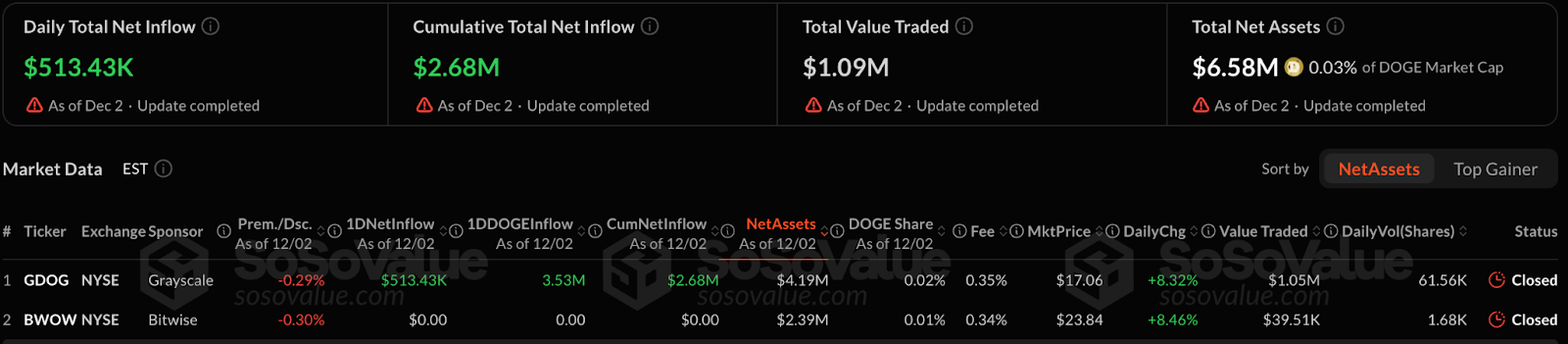
DOGE ETFs encountered a complete cold shoulder from the market, confirming the huge gap between Meme coins and institutional funding channels. Products represented by Grayscale's GDOG (listed November 24) performed extremely poorly, with a cumulative net inflow of only $2.68 million and assets under management of less than $7 million, accounting for only 0.03% of Doge's total market capitalization. More severely, Bitwise's similar product even saw zero inflows, and the low daily trading volume (about $1.09 million) also indicates that traditional investors currently remain skeptical of MEME assets like Doge, which lack fundamental support and rely mainly on community sentiment.
Hedera (HBAR)

HBAR ETF, as a representative of small and mid-cap projects, achieved relatively successful penetration for its size. The ETF was listed on October 29. Although the HBAR price fell about 28% in nearly two months, the ETF累计获得了 a net inflow of $82.04 million. This brought the assets under management of the HBAR ETF to 1.08% of HBAR's total market capitalization. This penetration effect is far higher than that of altcoins like Doge and LTC, which may also mean the market has some confidence in mid-cap assets like HBAR that have clear enterprise-level applications.

Litecoin (LTC)

The LTC ETF became a classic case study: traditional assets lacking new narratives struggle to rejuvenate even with ETF access, at least for now. After its listing on October 29, its price performance was weak, falling about 7.4%. At the fund level, attention was scarce, with a cumulative net inflow of only $7.47 million, and it faced the尴尬局面 of zero inflows on multiple single days. A daily trading volume of only about $530,000 highlights its lack of liquidity. This indicates that the old narratives LTC currently relies on, such as "digital silver," lack appeal in today's market.

ChainLink (LINK)

Grayscale's GLINK ETF was officially listed on December 3. On its first day of trading, it attracted nearly $40.9 million in inflows. The total asset value currently stands at approximately $67.55 million, accounting for 0.67% of Link's total market capitalization. Judging from the first-day trading results, GLINK had a good start in terms of both liquidity and fund attraction.

III. Major Participants and Funding Sources of Altcoin ETFs

Since the陆续上市 of altcoin ETFs, the crypto ETF market has seen a clear divergence: while the prices of Bitcoin and Ethereum continued to fall, and related ETFs experienced constant outflows, altcoin ETFs like SOL, XRP, HBAR, and LINK saw counter-trend inflows of funds. This means that some of the funds withdrawn from BTC and ETH ETFs did not leave the crypto market but turned to assets with higher growth potential. This also indicates that the funding sources for altcoin ETFs have a two-tier structure, involving both存量再配置 (reallocation of existing holdings) and增量入场 (new capital entering the market).

The new incremental funds mainly come from the traditional financial giants participating in this issuance round, including BlackRock, Fidelity, VanEck, FranklinTempleton, Canary, etc. The funding sources behind these institutions cover pension funds, insurance capital, wealth management accounts, 401K retirement plans, asset management clients, and family offices. Previously limited by compliance thresholds from directly purchasing altcoins, they can now achieve legal allocation for the first time through ETFs, forming real new capital inflows. In other words, the batch launch of altcoin ETFs has given traditional capital a new opportunity to enter the market and buy crypto assets.

IV. Future Outlook: The Next Round of Altcoin ETF Expansion

The successful launch of the first batch of products like SOL, XRP, and HBAR has clearly landed the institutionalized path for altcoin ETFs. Next, public chains with larger ecosystems and higher institutional attention will become the focus of the next batch, including AVAX, ADA, DOT, BNB, TRX, SEI, APT, etc. Once approved for listing, these assets are expected to further attract compliant funds, bringing a new round of liquidity expansion to the multi-chain ecosystem. Looking ahead, the altcoin ETF market will show three major trends:

First, intensifying concentration at the top and product differentiation will proceed in parallel.

Assets with clear fundamentals and long-term narratives will receive sustained funding preference, while projects lacking ecosystem drivers will struggle to improve their performance even after listing. Meanwhile, competition among ETF products will increasingly revolve around fees, staking rewards, and brand capability, with leading issuers sucking up most of the funds.

Second, product forms will move from single-asset tracking to strategization and portfolioization.

Index-type, multi-asset basket, and actively managed products will emerge陆续, meeting the professional needs of institutions for risk diversification, yield enhancement, and long-term allocation.

Third, ETFs will become a key force reshaping the funding structure of the crypto market.

Assets included in ETFs will gain a "compliance premium" and stable fund inflows, while tokens not entering the compliant framework will face continued loss of liquidity and attention, further strengthening the market's layered structure.

In other words, the competitive focus of altcoin ETFs is shifting from "whether it can be listed" to "how to continuously attract funds after listing." As AVAX, ADA, DOT, BNB, TRX, etc., enter the final stages of审批, the second round of expansion for altcoin ETFs has quietly begun. 2026 will become a key node for the comprehensive institutionalization of crypto assets, not only continuing to expand in the number of listings but also bringing deep reshaping to the logic of fund pricing and the landscape of ecological competition.


Twitter:https://twitter.com/BitpushNewsCN

Bitpush TG Discussion Group:https://t.me/BitPushCommunity

Bitpush TG Subscription: https://t.me/bitpush

Original link:https://www.bitpush.news/articles/7593868

Related Questions

QWhat were the two key factors that triggered the wave of altcoin ETF approvals in the US market in late 2025?

AThe two key factors were: 1) The approval of the revised 'Generic Listing Standards for Commodity-Based Trust Shares' on September 17, 2025, which created a unified entry system and shortened the exchange-side approval cycle. 2) The triggering of the '8(a) provision' during the US government shutdown in November, which created a de facto tacit approval channel allowing issuers to expedite registration.

QWhich altcoin ETF defied its token's price decline and attracted the largest net inflows, and what unique feature did its most successful product offer?

AThe Solana (SOL) ETF defied its token's 31% price decline and attracted the largest net inflows of $618 million. The most successful product, Bitwise's BSOL, which attracted $574 million, featured a staking rewards mechanism where all held SOL was staked and the rewards were automatically reinvested to increase the fund's net asset value.

QHow did the performance of the Dogecoin (DOGE) ETF compare to other major altcoin ETFs, and what does this indicate about institutional investor sentiment?

AThe Dogecoin (DOGE) ETF performance was extremely weak, with a net inflow of only $2.68 million and assets under management of less than $7 million, representing just 0.03% of DOGE's total market cap. This indicates that traditional institutional investors remain highly skeptical of meme coins that lack fundamental support and rely primarily on community sentiment.

QAccording to the article, what is the two-tiered structure of the capital flowing into altcoin ETFs?

AThe capital flowing into altcoin ETFs has a two-tiered structure: 1) Reallocated funds from existing capital, specifically money flowing out of Bitcoin and Ethereum ETFs. 2) New incremental capital from traditional financial giants (like BlackRock, Fidelity) whose funds come from sources like pensions, insurance funds, and wealth management accounts that were previously restricted from direct altcoin purchases.

QWhat are the three major future trends for the altcoin ETF market as outlined in the article's展望 (Future Outlook) section?

AThe three major future trends are: 1) Intensified concentration towards top assets and product differentiation, where assets with clear fundamentals will be preferred. 2) A shift from single-asset tracking to strategic and portfolio products, including index, multi-asset basket, and actively managed funds. 3) ETFs will become a key force reshaping the capital market structure, creating a 'compliance premium' for included assets and strengthening market stratification.

Related Reads

Pump and Dump? Bitcoin and Ethereum Long-Short Squeeze, Direction to Be Decided Tonight! Best Time to Layout Altcoins: ZEC, FARTCOIN, TON Back to $8?

The cryptocurrency market is currently experiencing high volatility with significant liquidations, as Bitcoin and Ethereum remain in key consolidation zones. Over $204 million was liquidated in 24 hours, affecting over 87,000 traders. Bitcoin has been trading sideways since November 21st around $80,600, with a tightening Bollinger Band suggesting an imminent breakout. A move above $92,600 could signal a rally toward $94,185 and $96,012, while a drop below $87,600 may lead to a decline below $80,600. Post-Fed rate decision volatility is expected, and a "sell the news" scenario is possible. Ethereum continues to trade within a large range between $4,146 and $3,011. Key resistance lies at $3,138 and $3,260, while support levels are $3,050, $2,980, and $2,900. A bounce from $3,050–$3,020 could present a buying opportunity. The article emphasizes that fundamentals drive long-term trends, while technicals reflect market sentiment. Messaging and news only cause short-term fluctuations. Examples like SUI and HYPE show steady growth, whereas TON struggles despite positive news due to underlying issues. Several risky tokens have recently been listed, often a sign of low liquidity and potential market manipulation. Traders should be cautious. Two altcoins are highlighted: ZEC, which saw a 20% pump and is now above $400—consider taking partial gains; and FARTCOIN, which presents a buying opportunity in the $0.36–0.38 range with a stop loss at $0.342, targeting $0.55 upon breaking $0.42.

金色财经Hace 30 min(s)

Pump and Dump? Bitcoin and Ethereum Long-Short Squeeze, Direction to Be Decided Tonight! Best Time to Layout Altcoins: ZEC, FARTCOIN, TON Back to $8?

金色财经Hace 30 min(s)

Farcaster Shifts Course, 'Binance Square' and Others Take Over Crypto Social

Farcaster, a decentralized social protocol once seen as a flagship SocialFi project, has pivoted from its "social-first" strategy after four and a half years. Instead, it will now focus on building a consumer wallet to drive user growth, acknowledging that its previous approach lacked product-market fit. While Farcaster enjoyed support from top VCs and crypto influencers, it failed to retain users long-term. The platform struggled to compete with established Web2 social networks like Twitter and Telegram, where crypto communities are deeply embedded. Its shift aims to leverage wallet-based interactions to naturally spark social demand. However, this strategic turn may have come too late. Centralized exchanges, particularly Binance, have already successfully embedded social features into trading environments. Binance Square, originally Binance Feed, allows content creators to earn up to 50% commission from trades generated through their content. This incentive model, combined with Binance’s massive user base, has attracted influential traders and analysts, making it a dominant crypto social platform. Other exchanges like OKX and Gate are following suit, developing their own social features, indicating a broader trend of trading platforms expanding into social ecosystems. These platforms reduce compliance risks for creators and align naturally with crypto users’ financial motivations. The piece argues that crypto social products don’t necessarily need decentralization or heavy tokenization to succeed. Instead, they must serve real user needs: facilitating valuable information exchange, community building, and trust within crypto-native context. The success of exchange-based social platforms like Binance Square suggests that the future of crypto social may lie in utility-driven, scenario-specific networks rather than idealized decentralized social graphs.

Odaily星球日报Hace 54 min(s)

Farcaster Shifts Course, 'Binance Square' and Others Take Over Crypto Social

Odaily星球日报Hace 54 min(s)

A 'Headhunting Scheme' Disguised as a Beauty Pageant: How Huobi HTX Uses 'Her Power' to Reshape Its Ecosystem's Soft Power?

Summarizing the provided Chinese article about the HTX "First Lady" competition into a concise English abstract. **Abstract:** Beyond the Beauty Pageant: How HTX is Leveraging "Her Power" to Reshape Its Ecosystem In the crypto world, female leaders like Binance's He Yi, Bitget's Gracy Chen, and HTX's own Molly have proven to be pivotal forces. Against this backdrop, HTX's third "First Lady" competition has concluded, revealing itself to be far more than a traditional beauty contest. It functions as a strategic talent pipeline and "headhunting operation" for the exchange. Five winners were directly offered roles within the HTX ecosystem, moving from contestants to core builders. Their recent "debut" showcased their focus on solving real Web3 challenges: improving UX, community culture, and bridging cultural gaps. Their newly defined roles are highly practical: * **PP (Champion):** Ambassador for SunX, acting as a dedicated point of contact to simplify complex concepts for users. * **Olivia (Top 4):** HTX DAO Community Culture Ambassador, fostering engagement and breaking down barriers between the official platform and its users. * **Gun Gun:** Key Account Manager, providing warm, professional service and asset advice. * **Yiyi (Runner-up):** Cultural Ambassador, acting as a bilingual bridge between Chinese and global communities. * **Saki (Creativity Award):** Crypto Culture Ambassador, using creative content to make crypto more accessible. This initiative is validated by the "hardcore" career growth of past winners, who have evolved into essential roles such as official hosts, business development managers, and DAO philanthropy ambassadors, demonstrating a successful long-term strategy of converting visibility into value. Ultimately, HTX is redefining the role of women in Web3—from being seen to being indispensable builders. The program dismantles stereotypes, proving that "her power" is a crucial, resilient soft asset for the ecosystem.

深潮Hace 55 min(s)

A 'Headhunting Scheme' Disguised as a Beauty Pageant: How Huobi HTX Uses 'Her Power' to Reshape Its Ecosystem's Soft Power?

深潮Hace 55 min(s)

Trading

Spot
Futures
活动图片