Volume Shows Big Players Are Reloading On Solana As They Push For 4-Month Highs

bitcoinistPublicado a 2026-05-14Actualizado a 2026-05-14

Resumen

Institutional investors are showing renewed bullish interest in Solana (SOL), driven by significant inflows into Solana ETFs. Since the beginning of the month, these ETFs have seen total net inflows of $90 million, including a single-day high of $26 million on May 11. This activity has pushed SOL to a four-month high near $97 and boosted total ETF net assets to $1.02 billion. While derivative data presents mixed signals—with a long/short ratio below 1 indicating some bearishness—trading volume has surged significantly. However, broader market pressure persists due to geopolitical tensions and inflation concerns. Bullish fundamentals for SOL include the upcoming major "Alpenglow" network upgrade, Western Union's launch of its USDPT stablecoin on Solana, and potential regulatory clarity from the advancing CLARITY Act. Technical analysis suggests a strong buy sentiment with key resistance at $95, a breakout above which could target $100. Despite these positive factors, SOL's price was trading around $90 at the time of writing, reflecting a 5% daily decline.

Solana is seeing renewed interest from institutional investors, who appear to have flipped bullish on SOL again. This follows the record inflows that the SOL ETFs have recorded since the start of this month, which have pushed the altcoin to a four-month high.

Solana Sees Fresh Inflows From Institutional Investors

According to SoSoValue data, Solana ETFs have recorded a total net inflow of $90 million since the start of the month, higher than their net inflows over the past three months. Notably, these funds saw total inflows of $26 million on May 11, which is the highest daily net inflow since February 25.

The Solana ETFs now boast total net assets of $1.02 billion, which represents almost 2% of SOL’s market cap. Meanwhile, renewed inflows into these funds pushed SOL to a four-month high of around $97, with the altcoin now eyeing a push toward the psychological $100 level. However, derivatives data paint a mixed signal about the sentiment towards SOL at the moment.

CoinGlass data show that the long/short ratio is currently below 1, suggesting that more traders remain bearish on Solana. However, SOL’s derivative trading volume has surged by 33%, reaching $12.81 billion. Options volume is up 116%, reaching $37.75 million, while the options open interest has climbed 22% to $125 million.

It is worth noting that Solana and the broader crypto market remain under bearish pressure as U.S.-Iran peace talks appear to have stalled. This has raised concerns that the war could begin again, which is bearish for crypto prices. At the same time, recent inflation data show that inflation is steadily rising due to the war in Iran.

Other Bullish Fundamentals For SOL

In addition to renewed inflows into Solana ETFs, there are other bullish fundamentals for SOL, including the Alpenglow upgrade going live on the community test cluster. This comes ahead of the planned rollout on the mainnet in the third quarter of this year. This upgrade is notably the biggest consensus change in Solana’s history, and it aims to make the network 100x faster.

Meanwhile, Western Union just launched its USDPT stablecoin on the Solana network, boosting the network’s adoption. The CLARITY Act is also set to advance, which would provide regulatory clarity for SOL once the Senate eventually passes the crypto bill. From a technical analysis perspective, crypto researcher Senior noted that technicals signal a strong buy sentiment, with the immediate resistance for SOL at $95. His accompanying chart indicated that SOL could easily rally to $100 if it successfully breaks above this resistance.
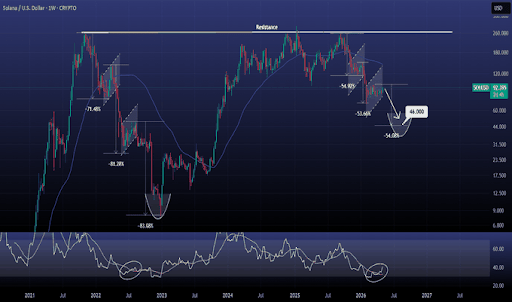
Source: Chart from Senior on X

At the time of writing, the Solana price is trading at around $90, down over 5% in the last 24 hours, according to data from CoinMarketCap.


SOL trading at $90 on the 1D chart | Source: SOLUSDT on Tradingview.com

Preguntas relacionadas

QAccording to the article, what is the key reason behind Solana reaching a four-month high price?

AThe key reason is renewed interest and record inflows into Solana ETFs from institutional investors. Since the start of the month, these ETFs have recorded a total net inflow of $90 million, pushing SOL to a four-month high of around $97.

QWhat does the data from CoinGlass show about trader sentiment towards SOL in the derivatives market?

ACoinGlass data shows a mixed signal. The long/short ratio is currently below 1, suggesting more traders are bearish on Solana. However, derivative trading volume surged by 33%, options volume is up 116%, and options open interest has climbed 22%, indicating heightened market activity.

QWhat is the Alpenglow upgrade, and why is it significant for Solana?

AThe Alpenglow upgrade is a major consensus change that has gone live on Solana's community test cluster, ahead of its planned mainnet rollout in Q3. It is significant because it is described as the biggest consensus change in Solana's history and aims to make the network 100x faster.

QBesides ETF inflows, what are two other bullish fundamentals for SOL mentioned in the article?

ATwo other bullish fundamentals mentioned are: 1) Western Union launching its USDPT stablecoin on the Solana network, boosting adoption. 2) The potential advancement of the CLARITY Act, which would provide regulatory clarity for SOL if the Senate passes the crypto bill.

QWhat is the immediate technical resistance level for SOL according to the crypto researcher Senior, and what could happen if it breaks above that level?

AAccording to crypto researcher Senior, the immediate technical resistance level for SOL is at $95. His analysis indicates that if SOL successfully breaks above this resistance level, it could easily rally to $100.

Lecturas Relacionadas

Why Did Zhipu Surge Nearly 30% in a Single Day?

"Global AI Model Unicorn" Zhipu's stock surged nearly 30% in a single day, reaching a new market cap high. The catalyst was the launch of its GLM-5.1-highspeed API, boasting a generation speed of **400 tokens per second**, setting a new global benchmark. This speed, roughly 3-5 times faster than industry leaders like OpenAI's GPT-4o and Anthropic's Claude, is achieved **without compromising the full-scale model's capabilities**. In the era of AI Agents requiring dozens of self-calls, such latency reduction is critical, transforming speed from a system metric into a determinant of intelligence limits. The breakthrough stems from a three-layer technical overhaul: 1. **TileRT Inference Engine**: Compiles the entire model into a continuous, always-on computation pipeline using "Warp Specialization," minimizing GPU idle time by having different processor groups handle data loading, computation, and communication in parallel. 2. **Heterogeneous Parallelism for MLA**: To efficiently run the GLM-5.1 model using the MLA attention mechanism, TileRT employs a heterogeneous strategy. One GPU handles sparse indexing/routing, while the others perform dense computation, optimizing for MLA's unique workflow. 3. **ZCube Network Architecture**: Replaces the standard Spine-Leaf (ROFT) network topology with a flat, dual-group interconnect. This design creates a single optimal path between any two GPUs, eliminating network congestion at scale and reducing latency. The business impact is significant: a 15% increase in cluster throughput (free extra capacity), a 40.6% reduction in tail latency (improved stability), and a one-third cut in networking hardware costs. Long-term, this innovation challenges the dominance of NVIDIA's integrated hardware-software stack (GPU+NVLink+InfiniBand), potentially benefiting manufacturers of high-density Leaf switches and optical modules while lowering the software barrier for domestic AI chips like Huawei's Ascend. The innovation proves that more can be achieved with the same compute, reshaping the infrastructure beyond just GPUs.

marsbitHace 1 hora(s)

Why Did Zhipu Surge Nearly 30% in a Single Day?

marsbitHace 1 hora(s)

Bidding Farewell to the 'Gray Gambling Game'! Polymarket Charges into the Compliance Track—How Will This Impact the Entire Crypto Industry?

From Gray to Regulated: How Polymarket’s Compliance Journey Reshapes Crypto The evolution of Polymarket, a decentralized prediction market platform, illustrates a critical trend in crypto: innovative, high-value sectors ultimately integrate into regulatory frameworks. Founded in 2020, Polymarket quickly gained traction by leveraging low-cost Layer 2 blockchain technology for event-based trading, notably during the 2024 US presidential election where its markets outperformed traditional polls. However, its "build first, comply later" approach led to a 2022 CFTC enforcement action, resulting in a $1.4 million fine and a ban from the US market. A pivotal shift occurred in 2025 under a new US administration. Polymarket strategically acquired CFTC-licensed derivatives exchange QCX for $112 million, securing a regulated pathway back into the US. This move coincided with a regulatory reversal, as the CFTC withdrew a prior proposal to ban political event contracts. The platform’s successful "regulatory acquisition" strategy, avoiding a lengthy independent licensing process, highlights a viable compliance path for crypto-native projects. Its journey from regulatory target to a CFTC-recognized entity—bolstered by a major data partnership and investment from Intercontinental Exchange (ICE)—signals the maturation of prediction markets from a "crypto novelty" into acknowledged financial infrastructure. The story underscores that genuine utility provides negotiating power with regulators and that embracing compliance does not necessarily mean sacrificing core technological advantages.

marsbitHace 1 hora(s)

Bidding Farewell to the 'Gray Gambling Game'! Polymarket Charges into the Compliance Track—How Will This Impact the Entire Crypto Industry?

marsbitHace 1 hora(s)

Trading

Spot
Futuros

Artículos destacados

Cómo comprar 4

¡Bienvenido a HTX.com! Hemos hecho que comprar 4 (4) sea simple y conveniente. Sigue nuestra guía paso a paso para iniciar tu viaje de criptos.Paso 1: crea tu cuenta HTXUtiliza tu correo electrónico o número de teléfono para registrarte y obtener una cuenta gratuita en HTX. Experimenta un proceso de registro sin complicaciones y desbloquea todas las funciones.Obtener mi cuentaPaso 2: ve a Comprar cripto y elige tu método de pagoTarjeta de crédito/débito: usa tu Visa o Mastercard para comprar 4 (4) al instante.Saldo: utiliza fondos del saldo de tu cuenta HTX para tradear sin problemas.Terceros: hemos agregado métodos de pago populares como Google Pay y Apple Pay para mejorar la comodidad.P2P: tradear directamente con otros usuarios en HTX.Over-the-Counter (OTC): ofrecemos servicios personalizados y tipos de cambio competitivos para los traders.Paso 3: guarda tu 4 (4)Después de comprar tu 4 (4), guárdalo en tu cuenta HTX. Alternativamente, puedes enviarlo a otro lugar mediante transferencia blockchain o utilizarlo para tradear otras criptomonedas.Paso 4: tradear 4 (4)Tradear fácilmente con 4 (4) en HTX's mercado spot. Simplemente accede a tu cuenta, selecciona tu par de trading, ejecuta tus trades y monitorea en tiempo real. Ofrecemos una experiencia fácil de usar tanto para principiantes como para traders experimentados.

727 Vistas totalesPublicado en 2025.10.20Actualizado en 2025.10.20

Cómo comprar 4

Discusiones

Bienvenido a la comunidad de HTX. Aquí puedes mantenerte informado sobre los últimos desarrollos de la plataforma y acceder a análisis profesionales del mercado. A continuación se presentan las opiniones de los usuarios sobre el precio de 4 (4).

活动图片