Vitalik Wrote a Proposal Teaching You How to Stealthily Use AI Large Models

比推Publicado a 2026-03-13Actualizado a 2026-03-13

Resumen

Vitalik Buterin and Ethereum Foundation's AI lead Davide Crapis co-authored a proposal titled "ZK API Usage Credits," which introduces a method for anonymously accessing AI models like ChatGPT using zero-knowledge proofs. Instead of requiring users to register and link personal information, the proposal suggests depositing funds (e.g., 100 USDC) into a smart contract. Users can then generate a zero-knowledge proof to verify they are on an encrypted whitelist and have sufficient balance—without revealing their identity. This approach aims to protect user privacy while preventing abuse. Although still in the research phase and facing skepticism, the proposal reflects Vitalik's broader focus on privacy and Ethereum's potential role in providing a tamper-proof data layer in the AI era, where verification and anonymity may become increasingly critical.

Author: Deep Tide TechFlow

Original Title: Vitalik Wrote a Proposal Teaching You How to Stealthily Use AI Large Models


Everyone is talking about AI, and the crypto space seems much quieter on the timeline.

Meanwhile, ETH has been hovering around 2000 for almost two months. What Vitalik says or does doesn't seem to attract much attention anymore.

However, I recently checked his X (Twitter) and found that AI has influenced more than just us. Over the past month, a significant portion of his posts have been about AI, and they've even reached the level of technical proposals.

Among them, the most noteworthy is a proposal co-authored with Davide Crapis, the AI lead at the Ethereum Foundation, published on ethresear.ch on February 11th, titled "ZK API Usage Credits."
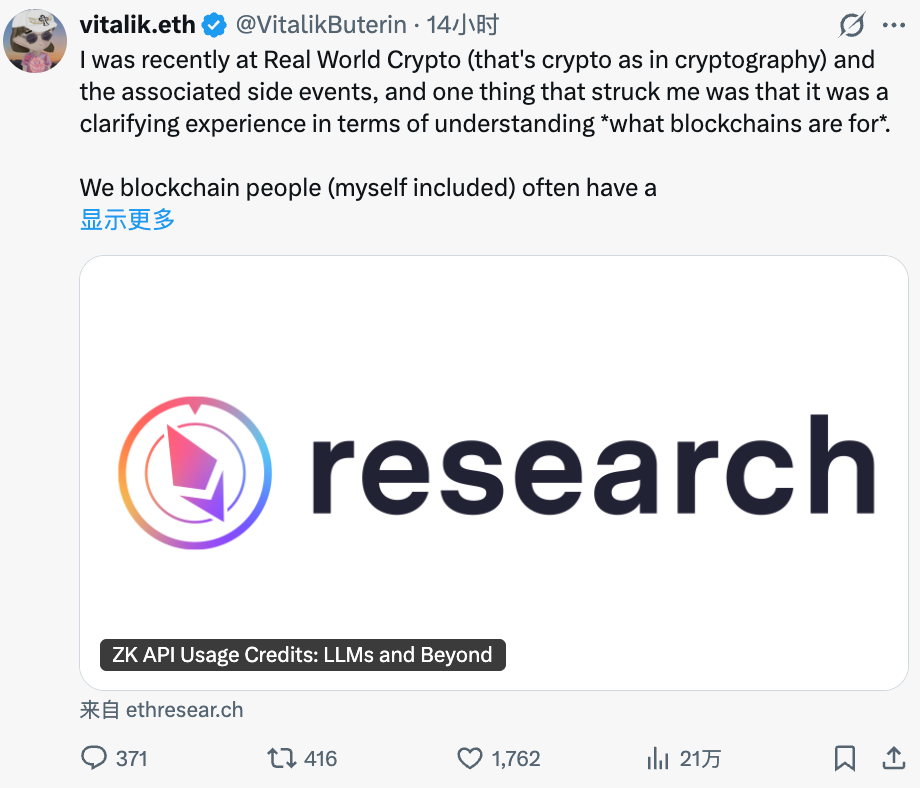
In a nutshell, it's about using zero-knowledge proofs to let you anonymously call AI large models.

Right now, whether you use ChatGPT or call Claude's API, there's only one way to pay:

Register an account, bind an email, bind a credit card.

Every conversation you have, every prompt you send, the platform knows it's from you. What you asked, when you asked it, how many times you asked—all tied to your real identity.

Vitalik and Crapis's proposal offers another path.

  1. The user deposits a sum of money into a smart contract, say 100 USDC.

  2. The contract registers this deposit into an encrypted on-chain list. After that, every time you call the API, you don't need to reveal your identity; you just generate a zero-knowledge proof.

  3. This proof does two things for the service provider: it proves you're on the list, and it proves your balance is sufficient. But the proof itself doesn't reveal which specific entry on the list you are.
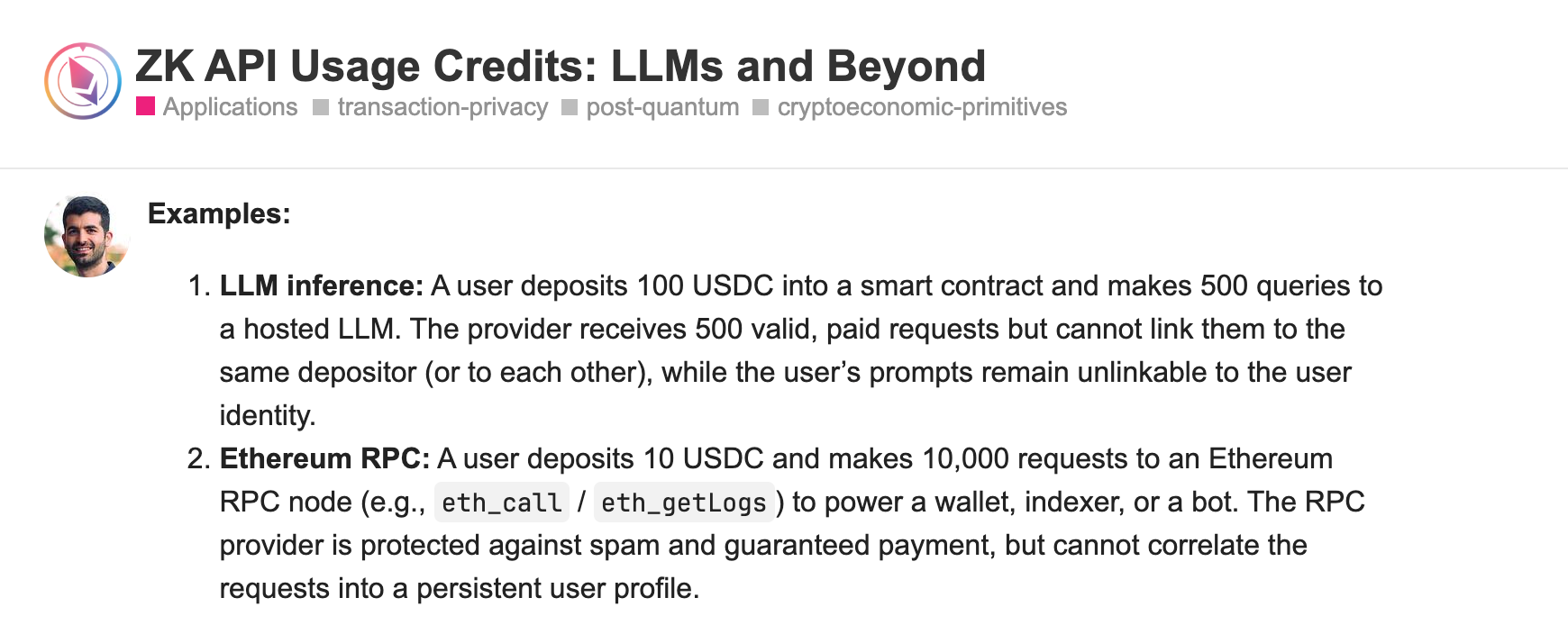
The service provider gets paid and can prevent abuse, but never knows who you are.

You can interpret this proposal as Vitalik believing that in the AI era, users shouldn't have to surrender their identity just to use an AI tool.

This proposal is still in the research phase, far from implementation, and large model manufacturers might not agree to such a method. The comments section of the proposal is also full of rebuttals and skepticism, arguing that AI model companies will always find a way to know your real identity.

But the author believes the significance of this proposal isn't entirely about whether it can be implemented.

Privacy is something Vitalik has worked on for a decade. From early support for Tornado Cash to promoting zero-knowledge proofs as a core technical roadmap for Ethereum, this thread has never been broken. It's just that in the past few years, privacy in the crypto industry's narrative lacked a big enough story to carry it.

AI has filled that story. When you talk to a large model more than anyone else every day, privacy becomes a real demand.

Vitalik Embraces AI

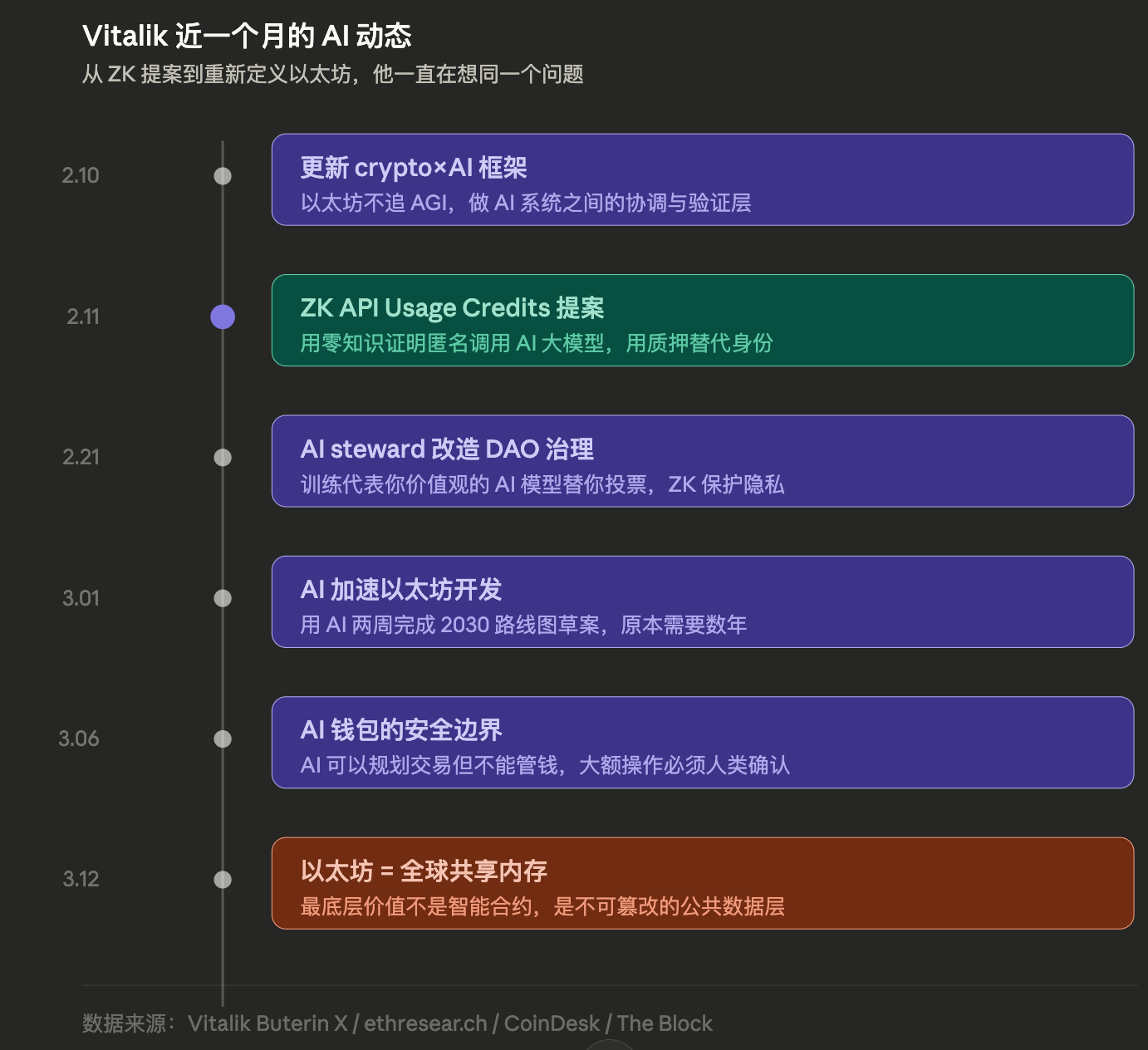
From February until now, a significant portion of what Vitalik has posted on X has been related to AI, with a density that suggests it's more than just casual chat.

Yesterday he posted a long thread saying he recently attended a cryptography conference where people cared about privacy, cared about open source, cared about censorship resistance... but had no affection for blockchain.
Among that crowd, he conducted a thought experiment:

Forget "we are the Ethereum community," start from scratch and think about where Ethereum is actually most useful.

His conclusion is that Ethereum's most fundamental value is as a bulletin board. A place where anyone can write, anyone can read, and no one can change or delete anything.

In the context of AI, this might be the most important thing Vitalik has said in the last couple of years.

We are entering an era of infinitely cheap generation. Text, images, videos, identities—AI can mass-produce them all. When everything can be forged, what becomes scarce?

These questions ultimately point to the same place: a public, persistent, irreversible data layer. And an unchangeable record is exactly what Ethereum can provide.

Over the past two years, the skepticism Ethereum has faced can be summed up in one sentence: What do you still have that others can't replace?

Looking at it now, Vitalik hasn't answered that question directly.

However, the Ethereum Foundation has done a few low-key things over the past year: formed a 50-person privacy team, established a nearly 50-person privacy research cluster, released the Kohaku privacy framework, specifically appointed an AI lead; the 2026 roadmap lists institutional-grade privacy and faster transaction confirmation as top priorities.

Looking back at his intensive output this month, it's mostly been discussions about Ethereum's privacy and efficiency issues in the context of AI.

I think Vitalik is betting on one thing: the more powerful AI becomes, the more rigid the demand for privacy and verification infrastructure will be. Whether Ethereum can meet this demand is another matter, but he has clearly chosen his table.

ETH is still hovering around 2000. Most people still aren't paying much attention to what he's been saying lately.

But perhaps in a few years, looking back, this might be the time we should have been paying attention.


Twitter:https://twitter.com/BitpushNewsCN

BitPush TG Discussion Group:https://t.me/BitPushCommunity

BitPush TG Subscription: https://t.me/bitpush

Original link:https://www.bitpush.news/articles/7619566

Preguntas relacionadas

QWhat is the main idea of Vitalik Buterin's proposal 'ZK API Usage Credits'?

AThe main idea is to use zero-knowledge proofs to allow users to anonymously call AI large language model APIs. Users deposit funds into a smart contract, which registers them on an encrypted on-chain list. They can then generate a zero-knowledge proof to show they are on the list and have sufficient balance without revealing their identity.

QHow does the proposed system protect user privacy when using AI models?

AThe system protects privacy by allowing users to generate a zero-knowledge proof that verifies they are on the approved list and have enough funds, without disclosing which specific user they are. The service provider receives payment and can prevent abuse but never learns the user's identity.

QWhy does Vitalik Buterin believe privacy is crucial in the AI era?

AVitalik believes that as AI becomes more integrated into daily life and people interact more with models than with humans, privacy becomes a genuine and critical need. Users should not have to surrender their identity just to use an AI tool.

QWhat role does Ethereum play in Vitalik's vision for the future?

AVitalik sees Ethereum's core value as providing a public, persistent, and immutable data layer—a bulletin board that anyone can write to and read from, but no one can alter or delete. This becomes essential in an AI era where content and identities can be easily forged, creating demand for verifiable and tamper-proof records.

QWhat actions has the Ethereum Foundation taken recently regarding AI and privacy?

AThe Ethereum Foundation has formed a 50-person privacy team, established a nearly 50-person privacy research cluster, released the Kohaku privacy framework, and appointed an AI lead. Their 2026 roadmap prioritizes institutional-grade privacy and faster transaction confirmations.

Lecturas Relacionadas

Bank of Japan Signals Interest Rate Hike Despite Keeping Them at 1%

The Bank of Japan (BOJ) kept its benchmark interest rate at 1% on July 31, as widely expected, following a June hike to a 31-year high. The decision passed with an 8-1 vote, with board member Hajime Takata again dissenting in favor of a hike to 1.25%. Despite holding rates steady, the BOJ signaled a hawkish tilt, warning that underlying inflation is likely to accelerate and exceed 2% from the latter half of the fiscal year. While it slightly lowered its core inflation forecast for FY2026, officials expressed stronger confidence that an overshoot will occur later, driven by yen weakness, corporate pricing behavior, and lingering energy shock effects. Markets were focused on the BOJ's forward guidance. Analysts noted the central bank appeared to balance short-term caution with a long-term warning of tighter policy. Governor Kazuo Ueda faces the challenge of reconciling a government reluctant to tighten further with bond markets already pricing in additional hikes, with the timing of the next move debated. Adding complexity, the BOJ reportedly intervened in currency markets hours before the rate decision, buying yen to support the currency which had fallen to 40-year lows against the dollar. Yen weakness stems from the wide U.S.-Japan interest rate gap, high fuel prices, and market skepticism about the pace of BOJ policy normalization. The yield on Japan's 10-year government bonds fell to 2.8%, indicating investor expectations for future monetary tightening.

cryptonews.ruHace 5 min(s)

Bank of Japan Signals Interest Rate Hike Despite Keeping Them at 1%

cryptonews.ruHace 5 min(s)

Why Are Leveraged ETFs like 7709 Inherently Negative EV Products?

This article argues that the SK H力士 2x Leveraged ETF (7709) is fundamentally a negative expected value (EV) product, rather than simply a "double SK H力士" investment. Its core issue stems from its daily rebalancing mechanism to maintain a 2x leverage target. After a price move, the fund must buy more after a rise or sell after a fall to readjust its leverage, creating a systematic pattern of buying high and selling low. This introduces a "delay loss": it always reacts to past price changes, missing potential gains from adjusting earlier during an uptrend and suffering greater losses from adjusting later during a downtrend. While more frequent intraday rebalancing would improve returns in strong, smooth trending markets by reinvesting profits or cutting losses sooner, it also dramatically increases volatility drag (frictional losses) during choppy, oscillating markets due to more frequent high-buy/low-sell trades. The author draws a parallel to an option seller who delta hedges (short gamma), which involves similar "buy high, sell low" dynamic hedging. However, unlike an option seller who receives upfront premium (IV and theta) as compensation for this risk, the leveraged ETF investor receives no such compensation. Instead, they bear all the path-dependent volatility decay, plus additional costs like swap/derivatives financing, management fees, and trading slippage. Thus, the product's return profile can be framed as: 2x directional return minus realized variance drag minus financing costs minus derivatives costs minus management fees minus transaction costs. For the investor to profit, SK H力士's price must not only rise significantly but do so in a strong, sustained, and smooth trend to overcome these inherent structural costs. High volatility and frequent price reversals are particularly damaging. The article also notes that while the ETF has no explicit liquidation line like perpetual futures, avoiding a sudden "blow-up," its net asset value can still decay towards zero over time through this combination of volatility drag and fees. For experienced traders, directly managing leverage via perpetual contracts may offer more control and potentially lower costs than this packaged, mechanistic product.

marsbitHace 12 min(s)

Why Are Leveraged ETFs like 7709 Inherently Negative EV Products?

marsbitHace 12 min(s)

'Backstabbing' or 'Win-Win'? How Likely Is TradeXYZ to Break Away from Hyperliquid and Go Solo?

The article discusses the growing debate over whether TradeXYZ, which dominates Hyperliquid's HIP-3 market with over 90% of its volume, might break away to build its own independent trading platform. This possibility is fueled by TradeXYZ's immense market influence and the common industry trend of successful projects seeking more control and profit capture. Key arguments for a potential split include TradeXYZ's overwhelming contribution to Hyperliquid's metrics and the financial incentive to retain all transaction fees, as it currently splits them 50/50 with Hyperliquid. The piece draws parallels to other cases, like Anthropic's "Claude Code" competing with its former partner Cursor, suggesting "betrayal" can occur when business leverage shifts. However, strong counterarguments suggest a split is unlikely or would be detrimental. TradeXYZ relies on Hyperliquid's high-performance infrastructure and its platform as a primary user acquisition channel. Building a comparable system would be challenging. Furthermore, the founders of both projects share a history of trust and mutual admiration. The analysis concludes that a separation would likely be a lose-lose scenario: Hyperliquid would lose a major growth narrative and trading volume, while TradeXYZ would face technical hurdles, user migration issues, and reputational damage, potentially allowing competitors to seize market share. The most rational path is seen as continued collaboration, with TradeXYZ potentially negotiating better terms while leveraging Hyperliquid's established strengths.

marsbitHace 22 min(s)

'Backstabbing' or 'Win-Win'? How Likely Is TradeXYZ to Break Away from Hyperliquid and Go Solo?

marsbitHace 22 min(s)

Trading

Spot
活动图片