Virtuals Launches Hyperboost: Extends 14 Days of Rewards for Each Graduated Token to Combat 'Peak on Day One' Curse

marsbitPublicado a 2026-07-29Actualizado a 2026-07-29

Resumen

Virtuals Protocol launched "Hyperboost" on July 27, 2026, to combat the "first-day peak" trend where over 75% of its AI Agent tokens see trading volume peak within 24 hours of graduation (launch to Uniswap). The mechanism automatically allocates a fraction of each token's previously idle graduation supply into a 14-day reward pool. Rewards are distributed daily, split between users based on trading volume share and creators for content posted about the token on platforms like X. Claims are immediate with no vesting. Early data from the first ~48 hours shows newly graduated tokens like AMARA and MAGE still experiencing significant post-graduation price declines (-78% and -55% in 24h respectively), indicating it's too early to judge effectiveness. Community concerns focus on potential wash trading due to volume-based rewards and a lack of transparency around content reward criteria. Hyperboost is part of Virtuals' broader ecosystem, which has over 18,000 AI Agent tokens and $750M+ in protocol revenue. While the feature could theoretically boost activity for its native VIRTUAL token by increasing trading volume in its paired pools, VIRTUAL's price remains influenced by broader market trends, down 7.4% over the past week. Observers note that several weeks of data will be needed to properly assess the mechanism's impact on sustaining post-graduation trading activity.

Author: Claude, Shenchao TechFlow

Shenchao TL;DR: Virtuals Protocol launched the "Hyperboost" mechanism on July 27th, which converts a portion of the idle token supply at graduation into 14 days of daily released trading and content rewards, automatically covering all newly graduated tokens.

Official data shows that over 75% of tokens on the platform reach their trading volume peak within 24 hours after graduation launch, followed by a rapid decline. Hyperboost aims to extend this price discovery window, but the mechanism has only been live for two days. Early graduated projects still show the typical 'post-graduation plunge' trend, and its effectiveness remains to be seen.
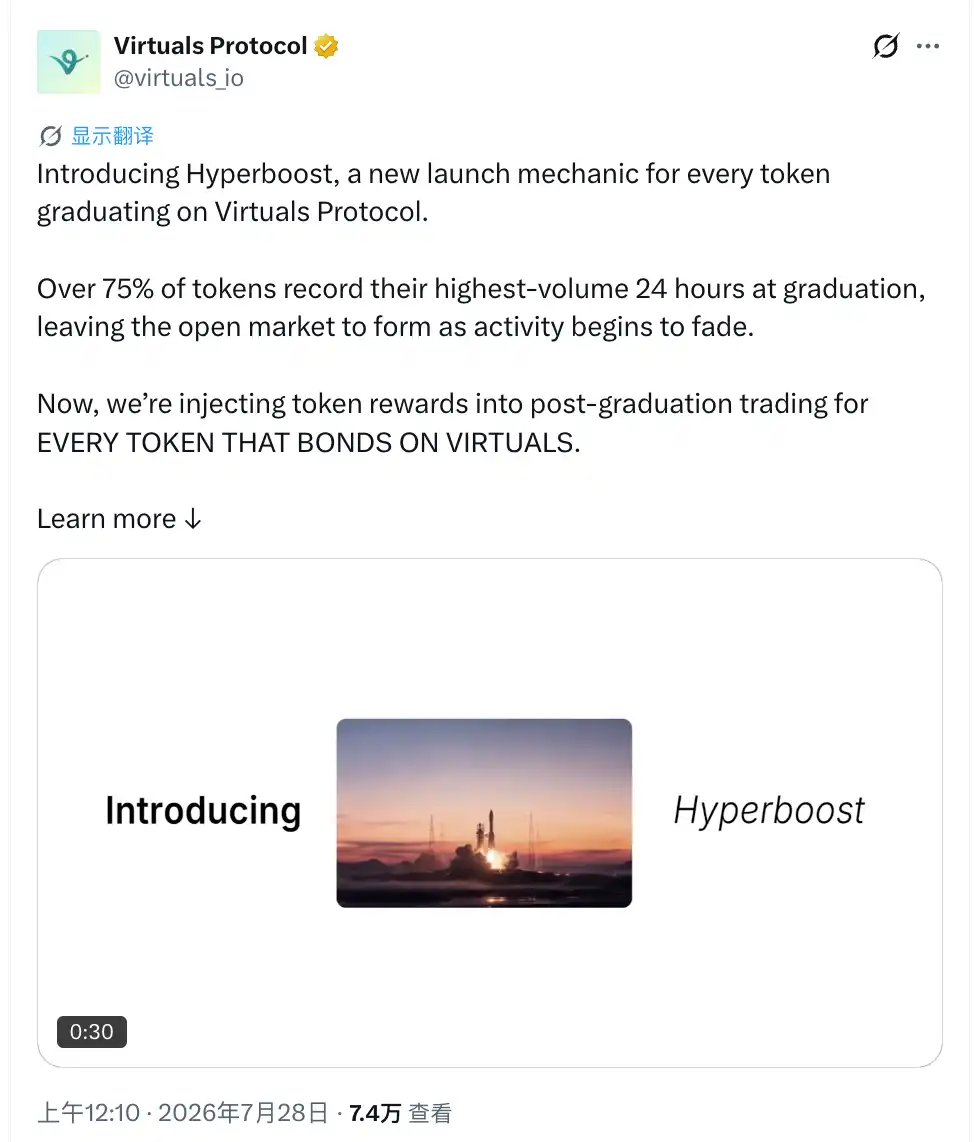
The AI Agent token launch platform Virtuals Protocol has long faced a persistent issue:

The day a token "graduates" from the bonding curve and launches, its trading volume typically peaks and then declines steadily. Platform data indicates that over 75% of tokens record their highest trading volume within 24 hours after graduation, with public market activity quickly fading thereafter.

On July 27th, Virtuals introduced the Hyperboost mechanism, attempting to use economic incentives to prolong post-graduation market interest.

Mechanism Breakdown: Idle Supply Converted to Trading Rewards, Released Daily for 14 Days

The core logic of Hyperboost is to activate a portion of token supply that was previously idle.

In the past, when a token graduated from the bonding curve and entered public trading on Uniswap, a portion of the supply was reserved for smoothing the transition, essentially remaining idle.

Hyperboost reallocates this portion, converting it into a reward pool released daily over the 14 days following graduation.

Rewards are distributed along two tracks: trading rewards are allocated based on a wallet's proportion of the day's trading volume; content rewards are directed at creators publishing content about the token on platforms like X. A total of 1/14th of the total rewards are released each day, with no lock-up or vesting restrictions upon claiming. Rewards are claimable upon arrival.

This mechanism activates automatically, requiring no founder configuration or manual activation. All tokens completing graduation after 16:00 UTC on July 27th will automatically enter the Hyperboost window.

The official whitepaper does not disclose the specific idle supply ratio or reward allocation percentage, only describing it as "a fraction of token supply".

Details regarding the content reward evaluation criteria are also limited. The community has raised questions about the transparency of anti-sybil mechanisms and content scoring rules.

Virtuals Ecosystem Status: 18k+ Agents, Market Cap ~$400M

Hyperboost is not an isolated product; it is embedded within Virtuals' broader AI Agent tokenization ecosystem.

As of H1 2026, the Virtuals Protocol platform has launched over 18,000 AI Agent tokens, with cumulative protocol revenue exceeding $75 million.

Amidst overall crypto market shifts and AI Agent development, Virtuals has undertaken intensive ecosystem and product expansion efforts since the beginning of the year. In March, it launched the ERC-8183 standard (in collaboration with the Ethereum Foundation) for on-chain AI Agent identity.

In early July, it completed the migration of cross-chain infrastructure from LayerZero to Chainlink CCIP, involving over $700 million in VIRTUAL liquidity. Robinhood Chain also announced plans to integrate Virtuals' AI Agent infrastructure on its new chain.

The above developments align more with long-term considerations and updates to the product foundation. Hyperboost appears more like an innovative play in token trading and rules.

Two Days Post-Launch, Some Graduated Projects Still 'Plummeting as Usual'

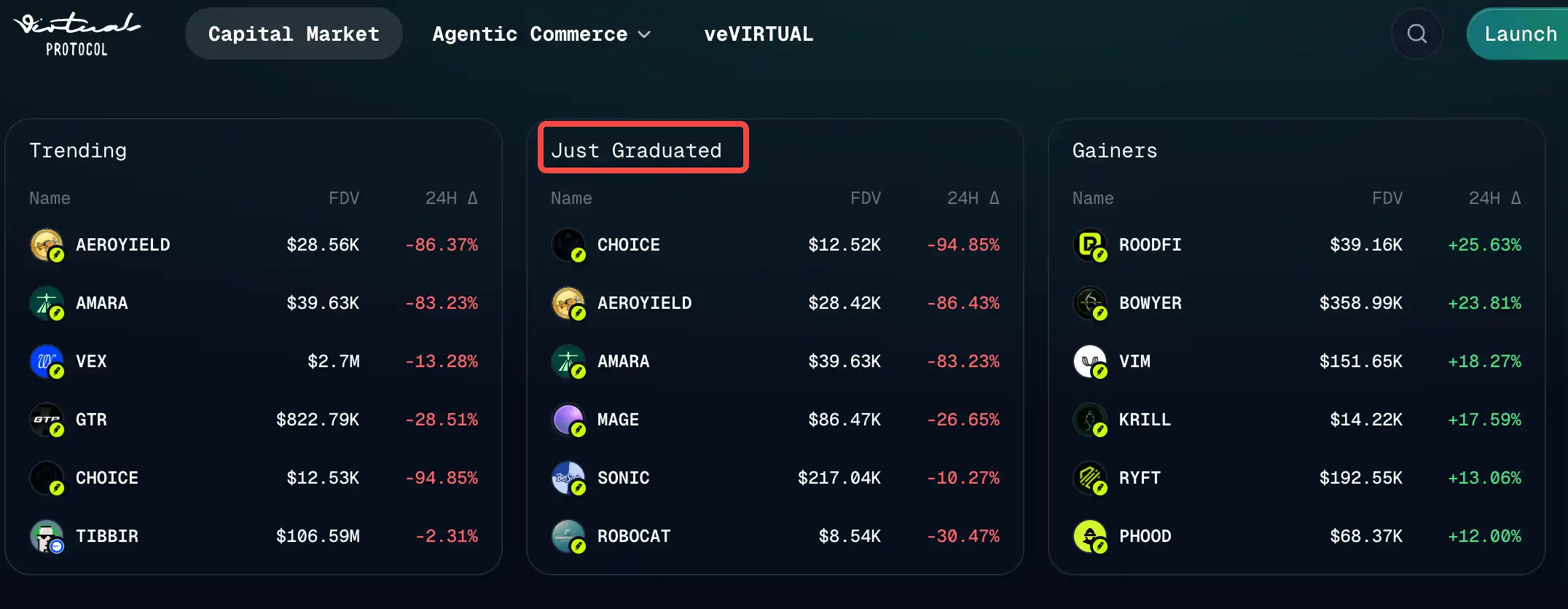
Hyperboost has been live for only about two days. The "Just Graduated" section on app.virtuals.io shows some early examples.

AMARA (Amara Exchange) graduated about 9 hours ago, FDV ~$51k, 24-hour decline ~78%, trading volume ~$358k, holders ~185.

MAGE is associated with the Mage Trading AI Agent, 24-hour decline ~55%. GTR (gtr.trade) launched ~4 days ago, FDV ~$700k, 24-hour decline ~44%, holders ~1700, liquidity ~$110k.

The data from these examples still presents the typical "peak post-graduation followed by decay" pattern, precisely what Hyperboost aims to mitigate. However, given the mechanism has been active for less than 48 hours and the first 14-day reward cycle is not yet complete, the current sample size and time span are insufficient to judge effectiveness.
Core Questions: Could Trading Volume Rewards Become a Farmer's ATM?

Currently, community discussions around this new product focus on several key points.

First, if trading rewards are allocated based on trading volume share, this design inherently attracts wash trading. If a wallet contributes 50% of the day's trading volume, it claims 50% of that day's trading rewards. For tokens with an FDV of only tens of thousands of dollars, the cost of wash trading could be lower than the reward revenue, creating a clear arbitrage opportunity.

The official response is that the daily reward pool is fixed. Even if someone wash trades, they merely take a larger slice of a fixed pie, not infinitely inflating it. However, this argument holds only if the reward pool itself is relatively small (undisclosed by the official). If the reward scale is significant, wash trading incentives remain.

Second, the evaluation criteria for content rewards are also vague. Current rules state "parameters are set by the protocol and may be adjusted to maintain distribution integrity" but do not disclose specifics like the content scoring mechanism, whether account verification is needed, or how to prevent bulk spamming.

For a mechanism publicly stated to incentivize content creation on platform X, the absence of these rules casts doubt on its practical effectiveness.

Limited Impact on VIRTUAL Token

In narrative terms, Hyperboost provides VIRTUAL with a new growth story. If the mechanism genuinely extends the active trading period of graduated tokens, it implies more trading volume flows through VIRTUAL-paired liquidity pools, indirectly increasing demand for VIRTUAL.

According to TronWeekly, the VIRTUAL price showed short-term technical bullish signals following the Hyperboost launch, with some analysts setting a short-term target of $0.70.

However, simultaneously, VIRTUAL has declined about 7.4% over the past 7 days, still generally weighed down by the broader market downturn. BTC recently turned negative, and overall crypto market sentiment is weak.

A breakout star token might be more effective in reversing this trend. Follow-up metrics to watch include the trading volume retention rate of graduated tokens during the 14-day window, whether the number of newly graduated tokens increases due to the incentives, and the actual consumption of VIRTUAL as a pairing asset.

Accumulating sufficient data for these points will likely take at least 2 to 4 weeks. Nevertheless, in a climate where many crypto projects are shutting down or pivoting, it is encouraging to see Virtuals continuously iterate and update its playbook.


Criptos en tendencia

Preguntas relacionadas

QWhat is the Hyperboost mechanism launched by Virtuals Protocol and what problem does it aim to solve?

AVirtuals Protocol launched the Hyperboost mechanism on July 27th. It aims to combat the 'first-day peak curse,' where over 75% of tokens on the platform see their highest trading volume within 24 hours of graduation before rapidly declining. Hyperboost automatically converts a portion of a graduating token's initially idle supply into a 14-day reward pool, released daily to incentivize trading and content creation, thereby attempting to extend the price discovery window.

QHow does the Hyperboost mechanism distribute its rewards?

AThe Hyperboost reward pool is distributed across two tracks over 14 days: 1) Trading Rewards: Distributed to wallets based on their daily trading volume share for that specific token. 2) Content Rewards: Awarded to creators who publish content about the token on platforms like X (formerly Twitter). Each day, 1/14th of the total reward pool is released. Users can claim their rewards with no lock-up or vesting period.

QAccording to the article, what are the main concerns within the community regarding the Hyperboost mechanism?

AThe community's main concerns focus on potential exploitation: 1) Trading rewards based on volume share could incentivize wash trading, especially for low-FDV tokens where the reward might outweigh the cost of fake trading. 2) The criteria and anti-spam mechanisms for content rewards are vague and lack transparency, raising questions about how content quality is judged and how 'farming' with bot accounts will be prevented.

QWhat was the performance of some early token samples after the Hyperboost launch, and what does this indicate?

AEarly samples like AMARA, MAGE, and GTR, which graduated shortly after Hyperboost went live, still showed significant price declines (~44% to ~78% in 24 hours). This indicates the typical 'post-graduation slump' pattern that Hyperboost is designed to mitigate. However, the article notes that with the mechanism being active for less than 48 hours and the full 14-day cycle not yet complete, it's too early to judge its effectiveness based on this limited data.

QWhat is the potential impact of Hyperboost on the VIRTUAL token itself, and what factors will determine its success?

AHyperboost could indirectly benefit the VIRTUAL token by potentially increasing trading activity and volume across its paired liquidity pools, thus boosting demand for VIRTUAL as the pairing asset. However, its direct impact is considered limited, as VIRTUAL's price remains influenced by broader market trends. The mechanism's success should be measured by observing metrics over 2-4 weeks, such as the retention of trading volume for graduated tokens during the 14-day window, an increase in new token graduations, and the actual consumption/utility of VIRTUAL in these pools.

Lecturas Relacionadas

STRC Major De-pegging's First Financial Report, How Will Strategy Repair Its Capital Flywheel?

Bitcoin treasury company Strategy released its Q2 2026 earnings report on July 31. Despite a 6.9% year-over-year revenue increase to $122 million, the company recorded a net loss of $8.22 billion, largely due to $8.32 billion in unrealized losses from Bitcoin price fluctuations. As of quarter-end, Strategy holds 843,775 BTC with an average cost of $75,000 per coin, and Bitcoin per share increased. The report highlights a critical shift in Strategy's capital model following the de-pegging of its key financing tool, STRC (Strategic Coin), which fell below its $100 target. Management's top priority is restoring STRC to its target value, aiming for a recovery by September 8. They rule out discounted STRC issuances and plan to maintain its dividend yield at 12%, instead focusing on bolstering its $3.75 billion cash reserve. Strategy has moved from a one-way "buy-and-hold" Bitcoin strategy to active capital management. This new approach, part of its "Digital Credit Capital Framework," involves flexibly managing its balance sheet across four elements: BTC, USD cash, common stock (MSTR), and digital credit securities like STRC. This allows for BTC monetization (having sold $218.4 million in BTC so far), strategic repurchases of discounted securities, and debt optimization, as seen with a $1.5 billion convertible bond buyback. The company's future hinges on two key tests: successfully re-pegging STRC to restore market confidence in its digital credit system, and a long-term recovery in Bitcoin's price to ultimately support its growth thesis.

marsbitHace 16 min(s)

STRC Major De-pegging's First Financial Report, How Will Strategy Repair Its Capital Flywheel?

marsbitHace 16 min(s)

STRC's First Financial Report Post-Depegging, How is Strategy Restoring the Capital Flywheel?

On July 31, 2026, Bitcoin treasury company Strategy released its Q2 financial report. Despite a 6.9% year-over-year increase in revenue to $122 million, the company recorded a substantial net loss of $8.22 billion, primarily due to $8.32 billion in unrealized losses from Bitcoin holdings. While Strategy's core Bitcoin strategy remains intact—its holdings grew 11% to 843,775 BTC—the company is undergoing a fundamental shift in its capital model. Following the de-pegging of its key financing tool, the STRCoin (STRC), from its $100 target in May, Strategy has pivoted from a one-directional "raise funds, buy Bitcoin" cycle to a more dynamic, multi-asset capital management approach. A key part of this new framework is the "Monetization Program," through which Strategy has sold approximately $218.4 million worth of BTC to bolster liquidity. The company's top priority is repairing STRC's peg, committing not to issue discounted shares until it returns to its target range. It has initiated a $1 billion buyback program for discounted digital credit securities, having repurchased $28.9 million face value of STRC so far. Management aims to restore the peg around September 8, 2026. Strategy now actively manages a matrix of assets: Bitcoin (for accumulation or strategic sales), USD cash reserves (now at $3.75 billion), common stock (MSTR), and digital credit securities like STRC. This allows for tactical moves like repurchasing discounted debt or equity to capture value. The future success of Strategy's "capital flywheel" hinges on two factors: the short-term ability to successfully re-peg STRC to restore market confidence in its digital credit system, and the long-term price trajectory of Bitcoin, upon which its entire investment thesis ultimately depends.

Odaily星球日报Hace 21 min(s)

STRC's First Financial Report Post-Depegging, How is Strategy Restoring the Capital Flywheel?

Odaily星球日报Hace 21 min(s)

With Two Consecutive Quarters of Losses, Coinbase Must Rely on Paths Beyond Trading

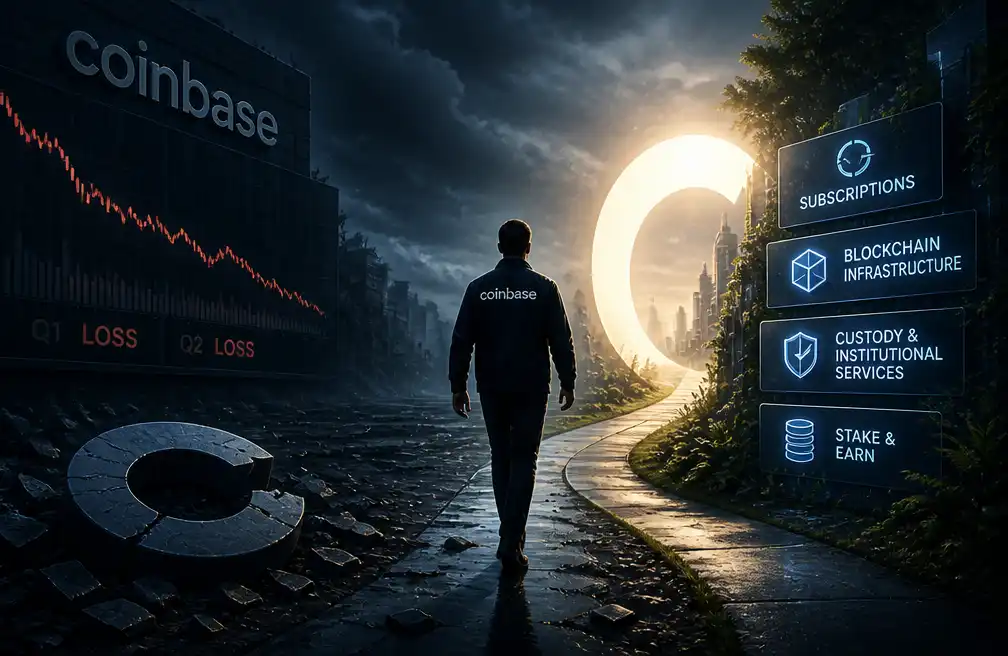
Coinbase posted its second consecutive quarterly net loss of $359 million on $1.22 billion in revenue for Q2, highlighting its vulnerability to crypto market cycles where weaker prices and lower volatility reduce user trading. However, the report also reveals a strategic shift in its business model. Despite a 25% quarter-over-quarter decline in global spot trading volume, Coinbase increased its market share to a company-record 10.3%. This suggests its position as a compliant U.S. on-ramp is strengthening even in a cooler market. A key development is the diversification of revenue streams. Transaction revenue fell to $599 million, nearly equaling subscription and services revenue of $555 million. Stablecoin services, generating $292 million, are becoming a crucial revenue "floor." This income, derived from interest on the $20 billion average USDC balance held on its platform, is less tied to daily trading activity. Furthermore, while spot trading volume dropped significantly, derivatives volume held steady at $1.03 trillion. Coinbase is pushing to integrate spot, stablecoin, and derivatives liquidity to create a more interconnected and sticky ecosystem for users. The GAAP net loss includes non-cash expenses like stock-based compensation and crypto asset valuation changes. Its adjusted EBITDA remained positive at $208 million for the 14th straight quarter, indicating core operations can cover ongoing costs. The company is also reducing expenses to manage the downturn. The central question moving forward is whether Coinbase's growing market share, stablecoin revenues, and expanding product integration can sufficiently offset the inherent cyclicality of its core trading business during future market contractions.

marsbitHace 37 min(s)

With Two Consecutive Quarters of Losses, Coinbase Must Rely on Paths Beyond Trading

marsbitHace 37 min(s)

Trading

Spot

Artículos destacados

Cómo comprar ONE

¡Bienvenido a HTX.com! Hemos hecho que comprar Harmony (ONE) sea simple y conveniente. Sigue nuestra guía paso a paso para iniciar tu viaje de criptos.Paso 1: crea tu cuenta HTXUtiliza tu correo electrónico o número de teléfono para registrarte y obtener una cuenta gratuita en HTX. Experimenta un proceso de registro sin complicaciones y desbloquea todas las funciones.Obtener mi cuentaPaso 2: ve a Comprar cripto y elige tu método de pagoTarjeta de crédito/débito: usa tu Visa o Mastercard para comprar Harmony (ONE) al instante.Saldo: utiliza fondos del saldo de tu cuenta HTX para tradear sin problemas.Terceros: hemos agregado métodos de pago populares como Google Pay y Apple Pay para mejorar la comodidad.P2P: tradear directamente con otros usuarios en HTX.Over-the-Counter (OTC): ofrecemos servicios personalizados y tipos de cambio competitivos para los traders.Paso 3: guarda tu Harmony (ONE)Después de comprar tu Harmony (ONE), guárdalo en tu cuenta HTX. Alternativamente, puedes enviarlo a otro lugar mediante transferencia blockchain o utilizarlo para tradear otras criptomonedas.Paso 4: tradear Harmony (ONE)Tradear fácilmente con Harmony (ONE) en HTX's mercado spot. Simplemente accede a tu cuenta, selecciona tu par de trading, ejecuta tus trades y monitorea en tiempo real. Ofrecemos una experiencia fácil de usar tanto para principiantes como para traders experimentados.

365 Vistas totalesPublicado en 2024.12.12Actualizado en 2026.06.02

Cómo comprar ONE

Discusiones

Bienvenido a la comunidad de HTX. Aquí puedes mantenerte informado sobre los últimos desarrollos de la plataforma y acceder a análisis profesionales del mercado. A continuación se presentan las opiniones de los usuarios sobre el precio de ONE (ONE).

活动图片