VIRTUAL surges 12% as bulls align – But downside risk still lurks

ambcryptoPublicado a 2026-03-17Actualizado a 2026-03-17

Resumen

VIRTUAL surged 12% in 24 hours, driven by strong bullish sentiment across both spot and futures markets. Futures activity showed a positive funding rate of 0.0022%, with $12 million inflows boosting open interest to $102.42 million, indicating dominant long positioning. Spot market demand also accelerated sharply, with net purchases rising nearly tenfold from $72,000 to $697,140 within a day, reflecting growing investor confidence. However, liquidity clusters above and below the current price suggest potential downside risk, making near-term price direction dependent on sustained momentum.

VIRTUAL continues to gain strength as market sentiment shifts decisively in its favor. The asset recorded a 12% increase over the past 24 hours, reflecting growing bullish positioning.

AMBCrypto’s analysis highlights a rare alignment between Spot and Futures markets, with participants across both segments actively accumulating the asset.

Futures market drives capital inflow

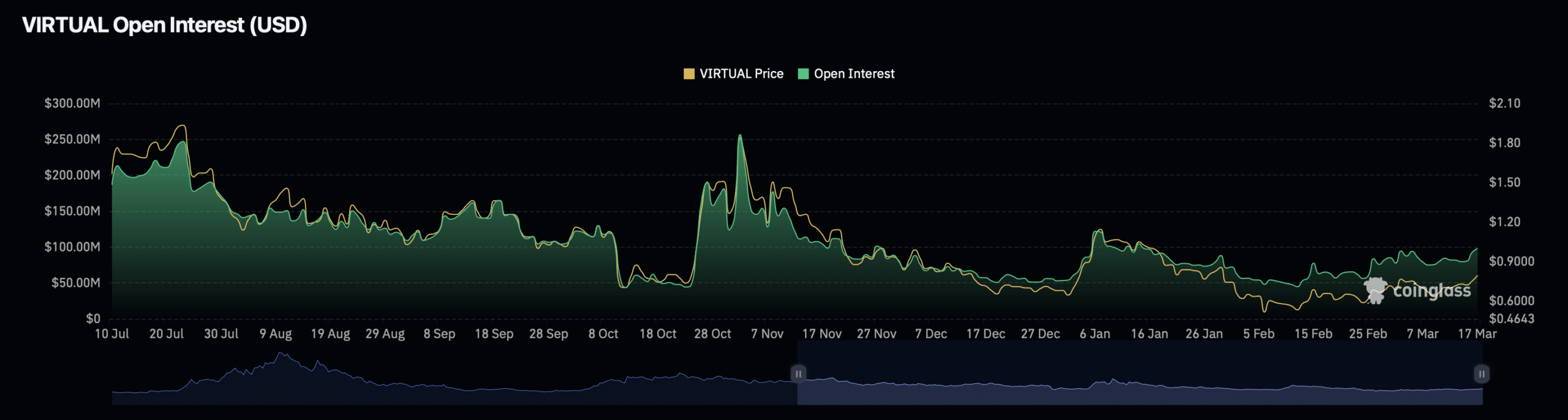
The recent surge in Virtual [VIRTUAL] has been largely fueled by bullish activity in the Futures market. This bias is reinforced by a positive Funding Rate of 0.0022%, indicating that long traders are paying a premium to maintain their positions.

In effect, long positions dominate capital flows into VIRTUAL contracts, signaling strong expectations of continued upside.
Source: CoinGlass

Within the last 24 hours, capital inflows totaled $12 million, pushing Open Interest to $102.42 million. This sharp increase reflects rising participation and conviction among derivatives traders.

With most of this capital concentrated in long positions, bullish momentum remains firmly intact—at least in the short term.

Spot demand strengthens conviction

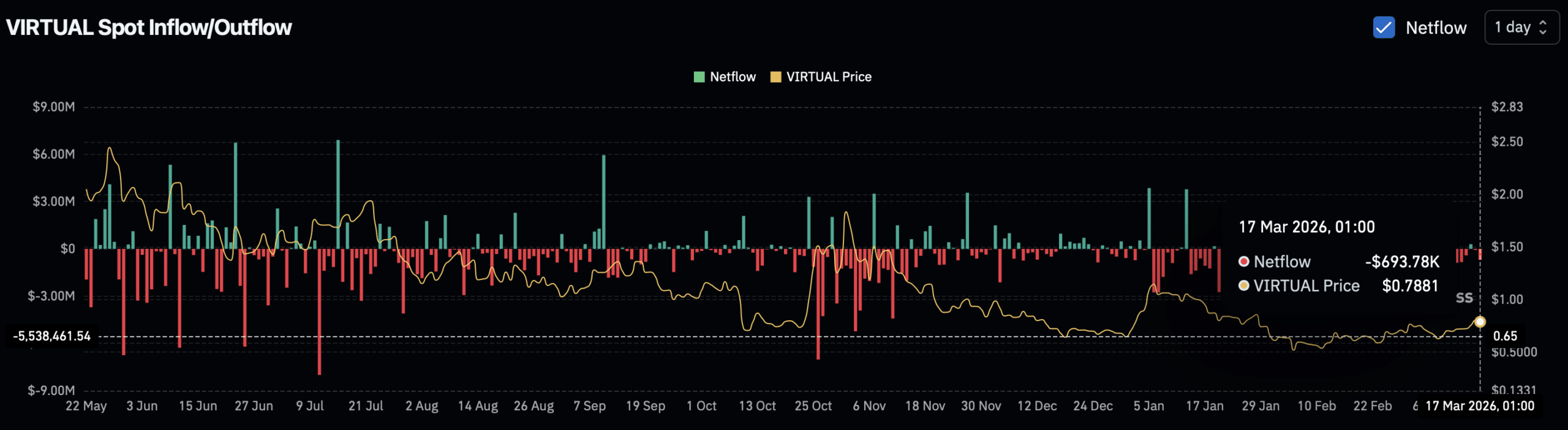
Spot market activity has also accelerated, reinforcing the broader bullish outlook. Accumulation began modestly on the 16th of March, with net inflows of just $72,000, according to CoinGlass data.

However, this quickly scaled. By the 17th of March, total purchases surged to $697,140—nearly ten times the previous day’s volume.
Source: CoinGlass

This sharp increase signals renewed investor confidence. When capital inflows expand at this pace, it typically reflects stronger conviction and a growing expectation of sustained price appreciation.

If this level of demand persists, it could provide the structural support needed to extend the rally. A slowdown, however, would weaken that foundation and expose the asset to downside pressure.

Liquidity clusters leave direction open

Despite the bullish buildup, liquidation data suggests the next move is not yet fully determined.

The heatmap shows liquidity clusters both above and below the current price. These clusters—visible as dense shaded zones—tend to attract price action.
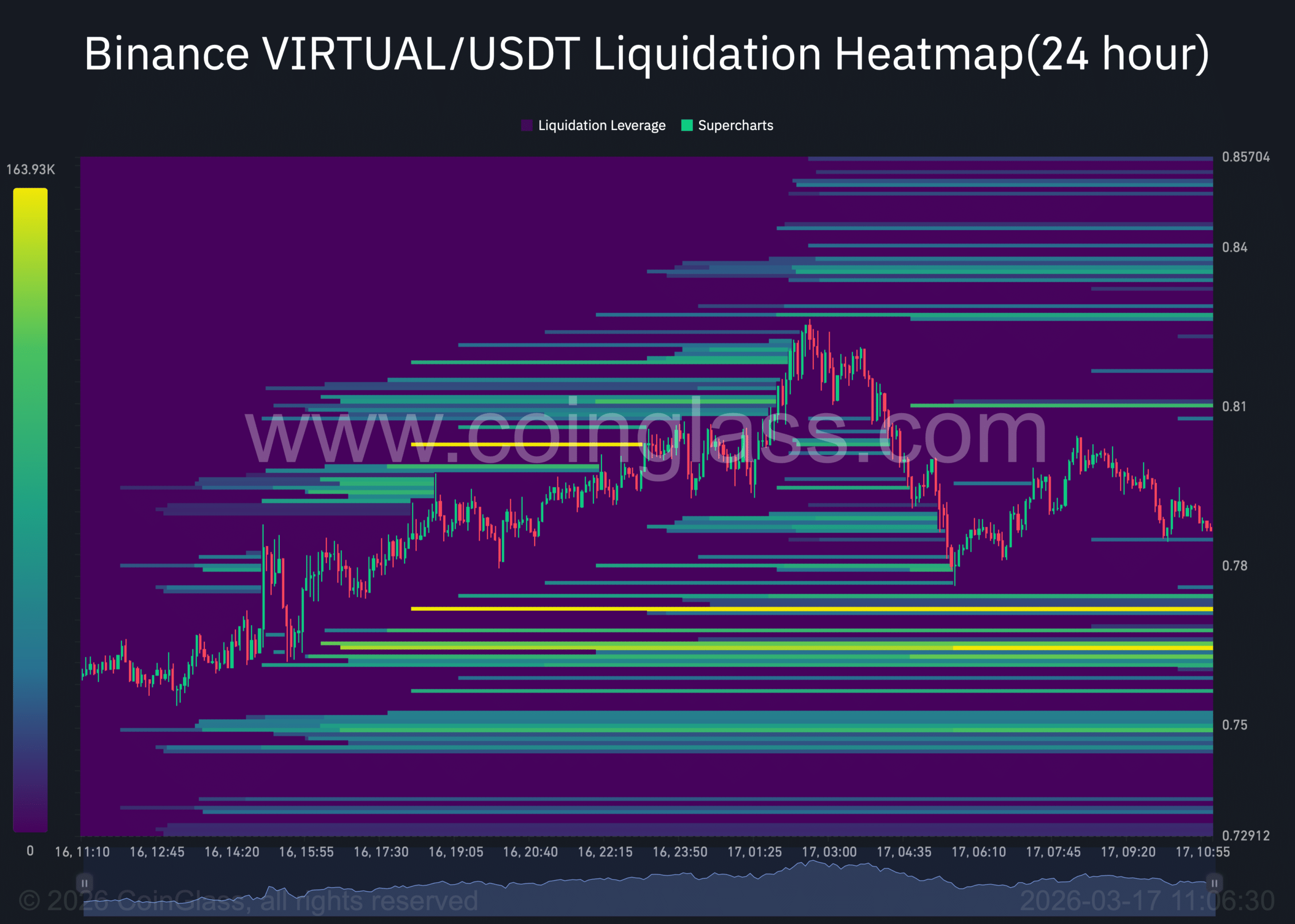
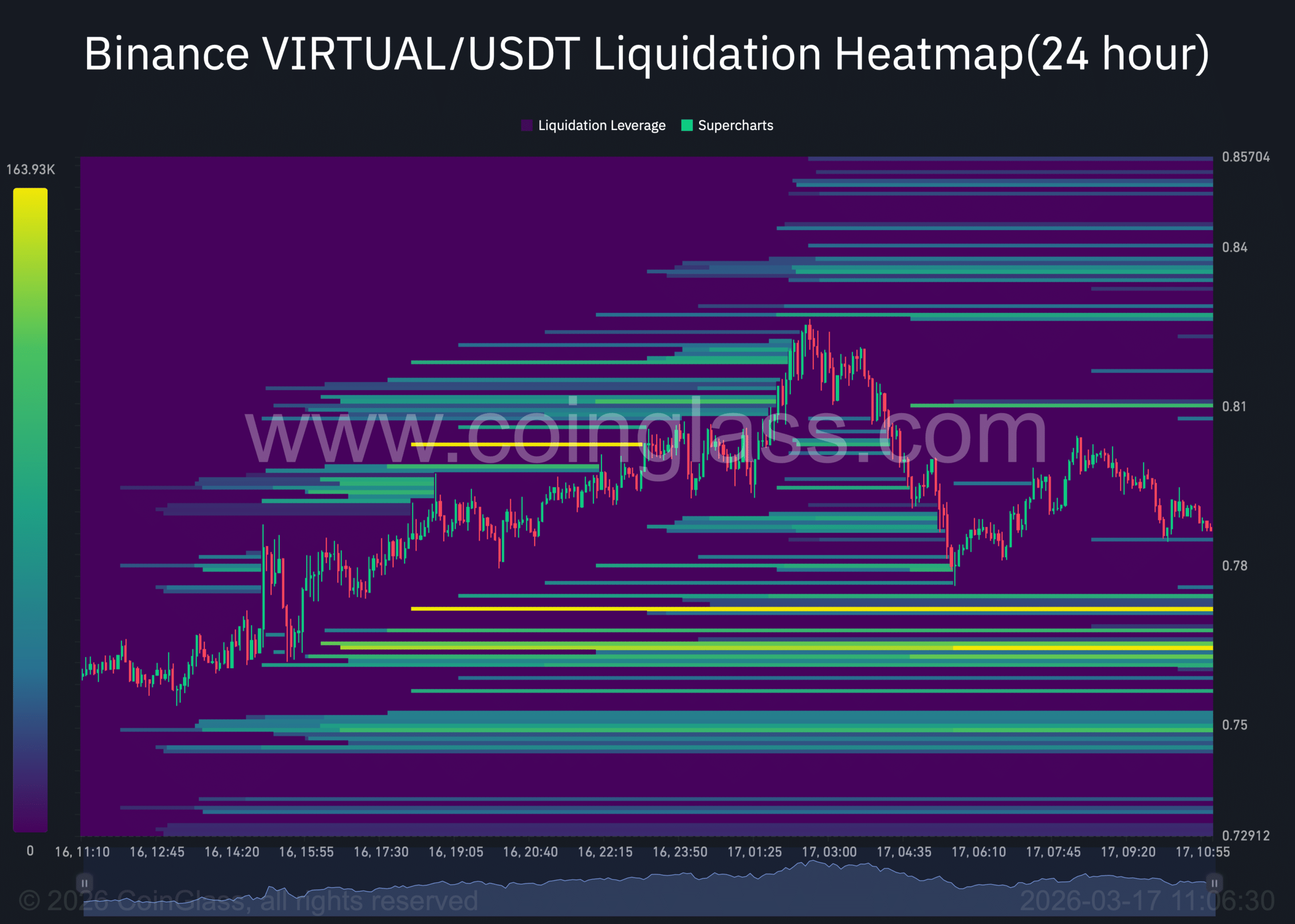
Source: CoinGlass

While liquidity remains split, the clusters below price appear more concentrated, suggesting stronger downside pull.

This creates a balanced but fragile setup. As a result, the next phase of price action will depend heavily on momentum, with VIRTUAL likely to move toward the dominant liquidity zone in the near term.


Final Summary

  • VIRTUAL’s price rally and capital inflows were driven primarily by long traders in the perpetual market.
  • Spot investors intensified accumulation, with purchases rising nearly tenfold day-over-day.

Lecturas Relacionadas

Bitcoin Withdrawals Continue: 8 Years of Storage in a Coldcard Cold Wallet Ended in Zero

Coldcard Hardware Wallet Hacked: Losses Mount Due to Vulnerable Seed Generation A critical vulnerability in Coldcard hardware wallets has led to a continued wave of fund thefts. According to Galaxy Research, the total stolen has reached 1,367.05 BTC (approx. $88.6 million) from 4,585 addresses, a significant increase from the initial 594.5 BTC reported on July 30, 2026. Most of the stolen funds remain on the attackers' addresses. The issue is not with the current firmware, which Coinkite has updated, but with seed phrases generated on vulnerable devices between March 2021 and the release of fixed firmware versions. Due to a programmer error, devices switched from using a hardware random number generator to the software-based Yasmarang generator, which was initialized with publicly accessible data like the chip's serial number. This made the seed phrases predictable through offline brute-force attacks, meaning wallets remain at risk until funds are moved to a new wallet generated with the patched firmware. Affected devices include Mk2/Mk3 with firmware 4.0.1–4.1.9 (and up to 5.0.3), Mk4/Mk5 up to version 5.6.0, and Q models up to 1.5.0Q. The only exceptions are seeds created with a high-entropy method like at least 50 independent dice rolls or a strong unique BIP-39 passphrase. All other owners must generate a new seed on the fixed firmware and transfer their assets. A case highlighting the human impact involves a 39-year-old long-term investor who lost 2 BTC (approx. $130,000) in minutes. He had accumulated the Bitcoin over eight years through physical labor, viewing it as a financial lifeline and a retirement plan in a country suffering from hyperinflation. His story underscores that even conservative "buy and hold in cold storage" strategies can be compromised by such underlying technical flaws. From a technical perspective, this incident echoes historical failures where weak random number generators undermined cryptographic security, challenging the assumption that offline storage is automatically foolproof.

cryptonews.ruHace 1 hora(s)

Bitcoin Withdrawals Continue: 8 Years of Storage in a Coldcard Cold Wallet Ended in Zero

cryptonews.ruHace 1 hora(s)

Trading

Spot
活动图片




