Veteran Chinese Public Chain NEO's Two Founders in a Feud, Financial Opacity as the Core Reason

marsbitPublicado a 2026-01-01Actualizado a 2026-01-01

Resumen

Summary: A public conflict has erupted between Erik Zhang (Zhang Zhengwen) and Da Hongfei, the two co-founders of the Chinese-origin blockchain project NEO. The core issue is a lack of financial transparency within the NEO Foundation. Zhang, who had left NEO years ago and officially returned in September, accused Da of maintaining a "black box" of assets. He claims Da has sole control over the Foundation's non-token assets and lacks a proper audit mechanism. Zhang also alleged that Da was using NEO's resources to develop a separate project, EON, which prompted his return. The dispute escalated in December when Zhang publicly demanded financial disclosures and unilaterally announced that Da would be removed from NEO mainnet affairs to focus on sidechain and new project development starting January 1, 2026. In response, Da countered that Zhang actually controls the majority of the ecosystem's funds (NEO/GAS tokens) and consensus node voting power. He accused Zhang of delaying the transfer of these funds to a multi-signature wallet for years. Da committed to releasing a financial report for 2025 by Q1 2026.

It's unexpected that a veteran domestic public chain could come to such a day. What's even more lamentable is that top domestic AI projects like Manus, Kimi, and Minimax have had major news for two consecutive days—either being acquired for billions of dollars or raising hundreds of millions in funding—while this old-school public chain has started a feud.

As it stands, the two co-founders of the NEO public chain, founded in 2014, Zhang Zhengwen (Erik Zhang) and Da Hongfei, have essentially completely fallen out, continuing to trade barbs on X. Based on their statements and publicly available information online, let's try to figure out what exactly happened between the two founders of this veteran public chain.

Financial Black Box

Actually, Zhang Zhengwen had left NEO a few years ago, which he confirmed on his own Twitter, and then officially returned in September this year. The trigger for this feud was in November. According to community news and public information, Zhang Zhengwen, as the technical core, encountered obstacles when seeking to obtain the detailed financial report and fund flow of the Neo Foundation.
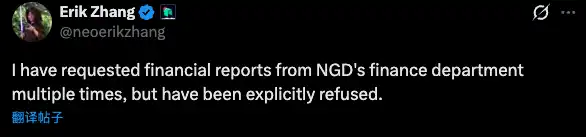
Subsequently, Zhang Zhengwen accused the Neo Foundation of long-term opaque operations, with its financial status resembling a "black box." He pointed out that Da Hongfei has long solely controlled the foundation's assets other than NEO/GAS tokens, and there is a lack of a complete, auditable disclosure mechanism.

In today's exchange of accusations, we also discovered the reason for Zhang Zhengwen's previous departure. He said that Da Hongfei approached him alone, stating that it was inefficient for the two of them to be responsible for NEO, so he chose to temporarily withdraw from management to "improve efficiency." However, he found that Da Hongfei was using NEO's resources to develop an independent public chain project, EON. This prompted him to return and intervene in the foundation's governance.

In community discussions in November, Zhang Zhengwen stated that NEO had previously relied on hackathons to create "false prosperity," with no real users, and many hackathon projects disappeared after receiving awards.

Escalation of Conflict

In December, Zhang Zhengwen publicly issued a statement demanding that Da Hongfei fulfill the financial disclosure obligations promised since December 9th. More explosively, Zhang Zhengwen unilaterally announced that, according to a previous phone agreement between them, starting January 1, 2026, Da Hongfei will no longer participate in NEO mainnet affairs and will instead focus on the development and operation of the sidechain NeoX and the new project SpoonOS.

Da Hongfei (Da Shu) responded immediately, stating that Zhang Zhengwen actually controls the vast majority of the funds in the NEO ecosystem (including the core assets NEO and GAS tokens) and dominates the voting rights of consensus nodes. He also accused Zhang Zhengwen of delaying the transfer of funds to the foundation's multi-signature address (Multisig) for years under various pretexts (such as waiting for the completion of the N3 migration).

Da Hongfei承诺将在 2026 年第一季度发布 2025 年末的财务报告,并会提前分享初步数据。

Criptos en tendencia

Preguntas relacionadas

QWhat is the core reason for the public conflict between the two co-founders of NEO, as mentioned in the article?

AThe core reason is financial opacity, with Erik Zhang accusing Da Hongfei of controlling the foundation's assets (excluding NEO/GAS tokens) in a 'black box' manner without a complete, auditable disclosure mechanism.

QAccording to the article, why did Erik Zhang initially leave NEO's management?

AHe left because Da Hongfei told him that having two people in charge was inefficient. Zhang agreed to step back temporarily to 'improve efficiency'.

QWhat specific event prompted Erik Zhang to return and get involved in the NEO Foundation's governance?

AHe returned after discovering that Da Hongfei was using NEO's resources to develop an independent public chain project called EON.

QWhat did Erik Zhang unilaterally announce regarding Da Hongfei's role starting January 1, 2026?

AHe announced that, based on a prior phone agreement, Da Hongfei would no longer be involved in NEO mainnet affairs and would instead focus on developing and operating the sidechain NeoX and a new project called SpoonOS.

QHow did Da Hongfei counter Erik Zhang's accusations about financial control?

ADa Hongfei stated that Zhang actually controls the vast majority of the funds in the NEO ecosystem (including the core NEO and GAS tokens) and the consensus node voting power. He also accused Zhang of delaying the transfer of funds to the foundation's multi-signature address for years.

Lecturas Relacionadas

Bitcoin Withdrawals Continue: 8 Years of Storage in a Coldcard Cold Wallet Ended in Zero

Coldcard Hardware Wallet Hacked: Losses Mount Due to Vulnerable Seed Generation A critical vulnerability in Coldcard hardware wallets has led to a continued wave of fund thefts. According to Galaxy Research, the total stolen has reached 1,367.05 BTC (approx. $88.6 million) from 4,585 addresses, a significant increase from the initial 594.5 BTC reported on July 30, 2026. Most of the stolen funds remain on the attackers' addresses. The issue is not with the current firmware, which Coinkite has updated, but with seed phrases generated on vulnerable devices between March 2021 and the release of fixed firmware versions. Due to a programmer error, devices switched from using a hardware random number generator to the software-based Yasmarang generator, which was initialized with publicly accessible data like the chip's serial number. This made the seed phrases predictable through offline brute-force attacks, meaning wallets remain at risk until funds are moved to a new wallet generated with the patched firmware. Affected devices include Mk2/Mk3 with firmware 4.0.1–4.1.9 (and up to 5.0.3), Mk4/Mk5 up to version 5.6.0, and Q models up to 1.5.0Q. The only exceptions are seeds created with a high-entropy method like at least 50 independent dice rolls or a strong unique BIP-39 passphrase. All other owners must generate a new seed on the fixed firmware and transfer their assets. A case highlighting the human impact involves a 39-year-old long-term investor who lost 2 BTC (approx. $130,000) in minutes. He had accumulated the Bitcoin over eight years through physical labor, viewing it as a financial lifeline and a retirement plan in a country suffering from hyperinflation. His story underscores that even conservative "buy and hold in cold storage" strategies can be compromised by such underlying technical flaws. From a technical perspective, this incident echoes historical failures where weak random number generators undermined cryptographic security, challenging the assumption that offline storage is automatically foolproof.

cryptonews.ruHace 1 hora(s)

Bitcoin Withdrawals Continue: 8 Years of Storage in a Coldcard Cold Wallet Ended in Zero

cryptonews.ruHace 1 hora(s)

Trading

Spot

Artículos destacados

Cómo comprar CORE

¡Bienvenido a HTX.com! Hemos hecho que comprar CORE (CORE) sea simple y conveniente. Sigue nuestra guía paso a paso para iniciar tu viaje de criptos.Paso 1: crea tu cuenta HTXUtiliza tu correo electrónico o número de teléfono para registrarte y obtener una cuenta gratuita en HTX. Experimenta un proceso de registro sin complicaciones y desbloquea todas las funciones.Obtener mi cuentaPaso 2: ve a Comprar cripto y elige tu método de pagoTarjeta de crédito/débito: usa tu Visa o Mastercard para comprar CORE (CORE) al instante.Saldo: utiliza fondos del saldo de tu cuenta HTX para tradear sin problemas.Terceros: hemos agregado métodos de pago populares como Google Pay y Apple Pay para mejorar la comodidad.P2P: tradear directamente con otros usuarios en HTX.Over-the-Counter (OTC): ofrecemos servicios personalizados y tipos de cambio competitivos para los traders.Paso 3: guarda tu CORE (CORE)Después de comprar tu CORE (CORE), guárdalo en tu cuenta HTX. Alternativamente, puedes enviarlo a otro lugar mediante transferencia blockchain o utilizarlo para tradear otras criptomonedas.Paso 4: tradear CORE (CORE)Tradear fácilmente con CORE (CORE) en HTX's mercado spot. Simplemente accede a tu cuenta, selecciona tu par de trading, ejecuta tus trades y monitorea en tiempo real. Ofrecemos una experiencia fácil de usar tanto para principiantes como para traders experimentados.

297 Vistas totalesPublicado en 2024.12.13Actualizado en 2026.06.02

Cómo comprar CORE

Discusiones

Bienvenido a la comunidad de HTX. Aquí puedes mantenerte informado sobre los últimos desarrollos de la plataforma y acceder a análisis profesionales del mercado. A continuación se presentan las opiniones de los usuarios sobre el precio de CORE (CORE).

活动图片













