VC Retrospective 2025: Compute is King, Narrative is Dead

比推Publicado a 2025-12-23Actualizado a 2025-12-23

Resumen

Venture Capital Review 2025: Compute is King, Narrative is Dead The article reflects on the challenging yet transformative year of 2025 for crypto and AI investments. While on-chain financial tools and the machine economy saw significant growth, long-term crypto investors faced a difficult market structure plagued by a "negative prisoner's dilemma," premature token unlocks, and a major market failure in October that triggered industry-wide deleveraging. Despite these setbacks, the value creation in crypto and AI over the past decade has been immense, far outpacing other regions and sectors. The "Magnificent 7" tech giants and crypto assets collectively added trillions in market cap. The key lesson from 2025 is that value accrued to the narratives but to the owners of physical and financial bottlenecks: power, semiconductors, and scarce compute. Public market winners were companies like NVIDIA, TSMC, IREN, and Bloom Energy. In software, value flowed to embedded, "must-have" platforms (e.g., Alphabet, Meta) rather than optional tools. In private markets, foundational AI companies grew rapidly but faced fragility, while value-controlling companies (e.g., Applied Intuition, Anduril) were better positioned. Tokenized networks were the weakest performers, as usage failed to translate into token value capture. The core takeaway is that the market rewarded ownership of choke points and punished projects lacking control over cash flow or compute. For 2026, the investment focus shi...

Source: Fintech Blueprint

Original Title: Analysis: Learning from 2025 to win big in the 2026 machine economy

Compiled and Edited by: BitpushNews


Structural Issues in the Crypto Market

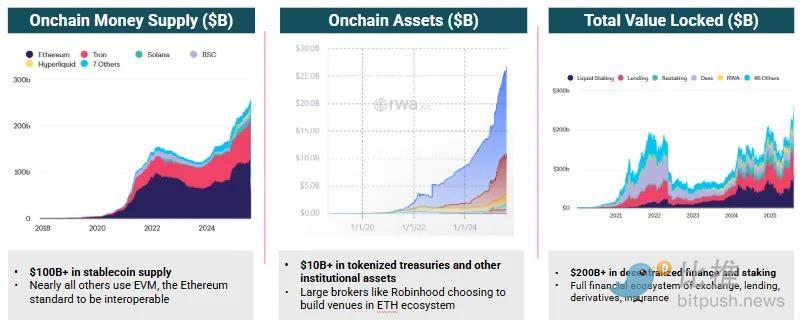
Adoption of on-chain financial instruments and the machine economy trend are booming.

Over the past year, we have seen massive expansion in blockchain-native finance across these five dimensions: (1) stablecoins, (2) decentralized lending and trading, (3) perpetual contracts, (4) prediction markets, and (5) Digital Asset Treasuries (DATs). The regulatory environment in the U.S. has become extremely favorable, driving up both project numbers and risk appetite.

Putting aside uncertainties from tariffs and market structure, a forgiving macro environment has also provided fertile ground for crypto innovation to take root. These trends are well-known and don't require further data elaboration.
However, 2025 has been an extremely difficult year for long-term investors in tokens and crypto assets other than Bitcoin.

If you were a trader or banker, you might have done alright—we saw record commissions for bringing DATs to market, and massive fee income for exchanges like Binance from their listing processes.

But for those of us with a 3-5 year investment horizon, the market structure has been terrible.

We are completely stuck in a kind of 'negative prisoner's dilemma': token holders, anticipating future selling pressure, sell any and all assets; while market makers and exchanges that support the entire crypto economy take speculative positions focused solely on short-term gains. Token unlock mechanisms and issuance prices often drag projects down before they have achieved profitability or found product-market fit.

Furthermore, the market structural failure on October 10th clearly hit several major players hard, although the losses have not been made public, and the清算 aftermath continues. The correlation between all crypto assets has risen to near 1, indicating industry-wide participant deleveraging, despite their vastly different fundamental logics.

It is easy to retreat and become cynical at this moment.
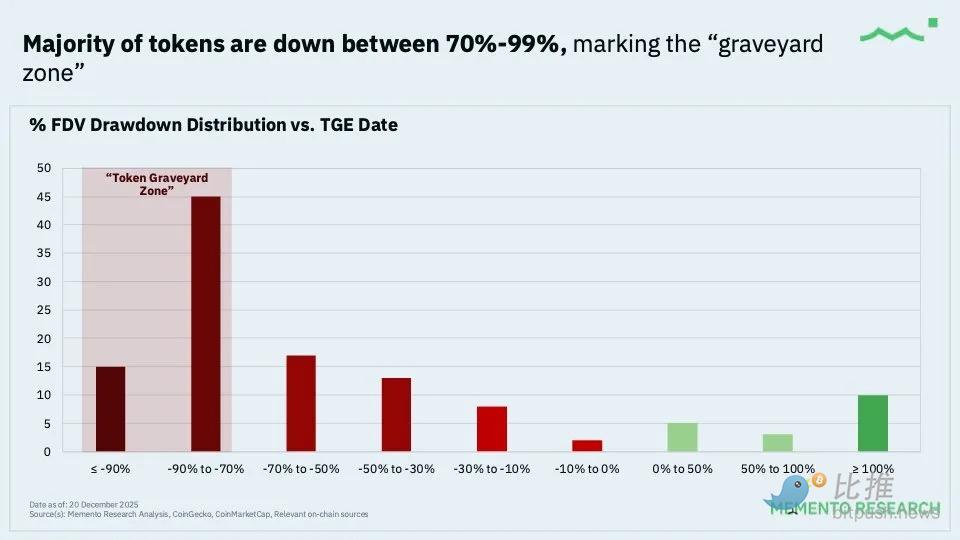
But we prefer to 'mark-to-market' as clearly as possible in order to plan for future positioning.

The decline in the crypto investment space in 2025 is information, but not the final word. It is likely that 2026 will see large-scale liquidations in the secondary market for private companies, at which point we will analyze how so many Special Purpose Vehicles (SPVs) were issued at high valuations during the crypto boom.

Meanwhile, the vision of programmable finance and 'Robot Money' continues to materialize, and we must continue to work hard to find the best positioning in its inevitable rise.

For context, see the chart below. This chart, zoomed out over the past decade, shows市值 creation across several regions and industries.
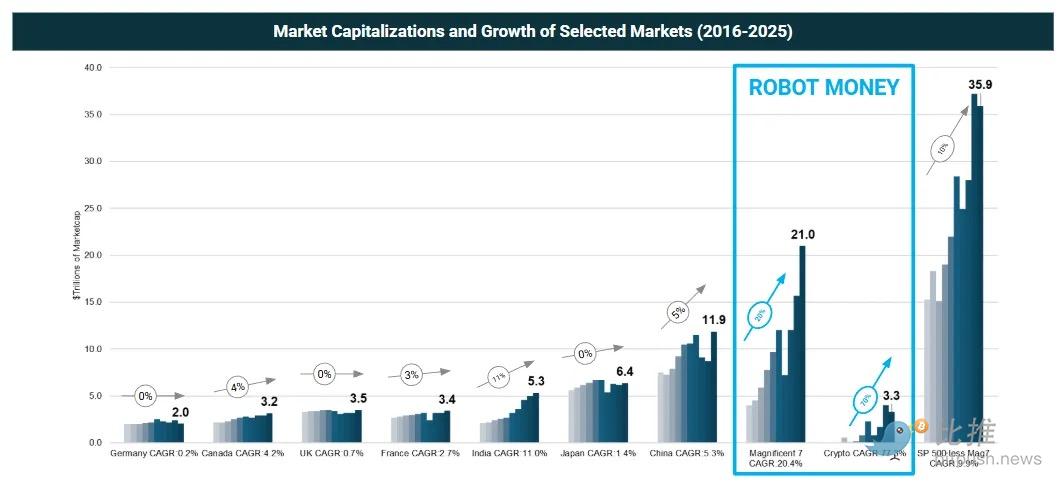
When we look at this history, the value creation in the cryptocurrency and AI fields is staggering compared to the rest of the world.

European capital markets (~$2-3 trillion per country) have achieved almost nothing, merely maintaining the status quo. You might as well invest in government bonds and earn 3% interest per year, which might create more value. On the right side of the chart, India and China show a 5-10% compound annual growth rate (CAGR), with net market cap growth of approximately $3 trillion and $5 trillion respectively over the same period.

Understanding this scale, look again at what we define as 'Robot Money':

(1) The US 'Magnificent 7' representing tech and AI added about $17 trillion in market cap at a rate of 20% per year;

(2) The crypto asset market, representing modern financial rails, added $3 trillion over the same period, with a staggering 70% CAGR.

This is the future financial center.

But being logically correct is not enough. We must深入细致地 lock onto the parts of the value chain that have not yet been noticed by the world. Think back to talking about robo-advisors in 2009, neobanks in 2011, or DeFi in 2017—the vocabulary and associations were not yet formed at the time, and it wasn't until 2-5 years later that these outcomes hardened into clear business opportunities.

Value Capture in the Machine Economy

As a form of 'masochistic' exercise, we compiled a 158-page summary report covering the most relevant players in the 2025 machine economy.
In public markets, 2025 was a year of 'the strong getting stronger, the weak falling behind'.
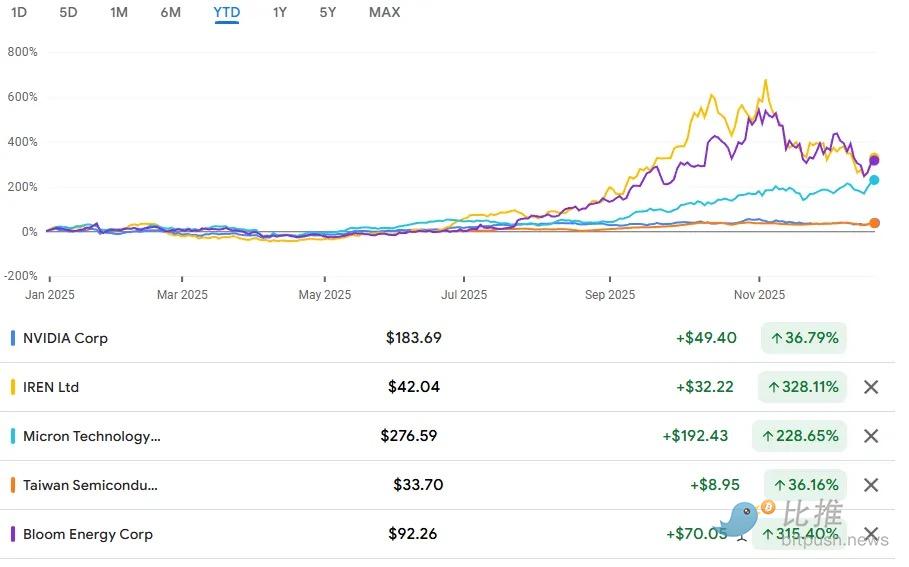
The clear winners were the owners of physical and financial bottlenecks: electricity, semiconductors, and scarce compute power.

Bloom Energy, IREN, Micron, TSMC, and NVIDIA all significantly outperformed the broader market, as capital chases assets that 'machines must pass through'.

Bloom and IREN are typical examples: they stand directly in the path of AI capital expenditure, converting urgency into revenue.

In contrast, traditional infrastructure like Equinix performed sluggishly, reflecting the market's view that the value of general-purpose capacity is far lower than that of power-guaranteed, high-density customized compute.
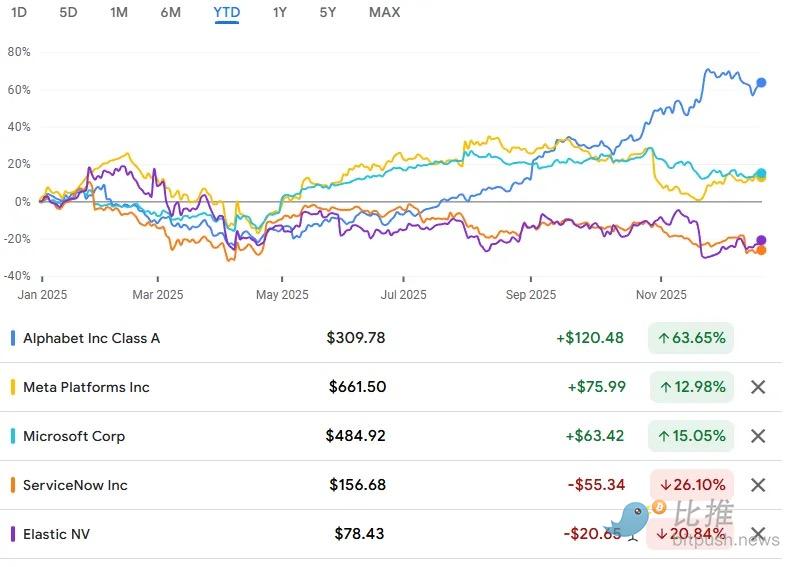
In the software and data领域, performance diverged along another dimension: (1) Mandatory vs. (2) Optional. Platform-like enterprise systems embedded in workflows with mandatory renewals (like Alphabet, Meta) continued compound growth, both rising year-to-date, as AI spending reinforced their existing distribution moats. ServiceNow and Datadog, despite strong products, saw returns dragged down by valuation pressure, bundling pressure from hyperscale cloud providers, and slower AI monetization. Elastic illustrates the不利 case: strong technical capabilities, but squeezed by cloud-native alternatives, with unit economics deteriorating.
极

The private market also shows a similar screening mechanism.

Foundation model companies are the protagonists of the story, but fragility is increasing. OpenAI and Anthropic have rapid revenue growth, but their neutrality, capital intensity, and margin compression are now clear risks. Scale AI is this year's cautionary tale: a partial acquisition by Meta destroyed its 'neutral' status and triggered customer churn, proving how quickly a heavy-service business model can unravel once trust is broken. In contrast, companies that control value (Applied Intuition, Anduril, Samsara, and emerging fleet operating systems) appear better positioned, even if value realization mostly remains private.

Tokenized networks were the worst-performing sector.

With very few exceptions, decentralized data, storage, agent, and automation protocols performed poorly, as usage failed to translate into token value capture.

Chainlink remains strategically important, but struggles to align protocol revenue with token economics; Bittensor is the biggest bet in crypto AI, but does not yet pose a substantive threat to Web2 lab companies; Giza and similar agent protocols show real activity, but remain trapped by dilution and meager fees. The market no longer rewards 'collaborative narratives' without mandatory fee mechanisms.
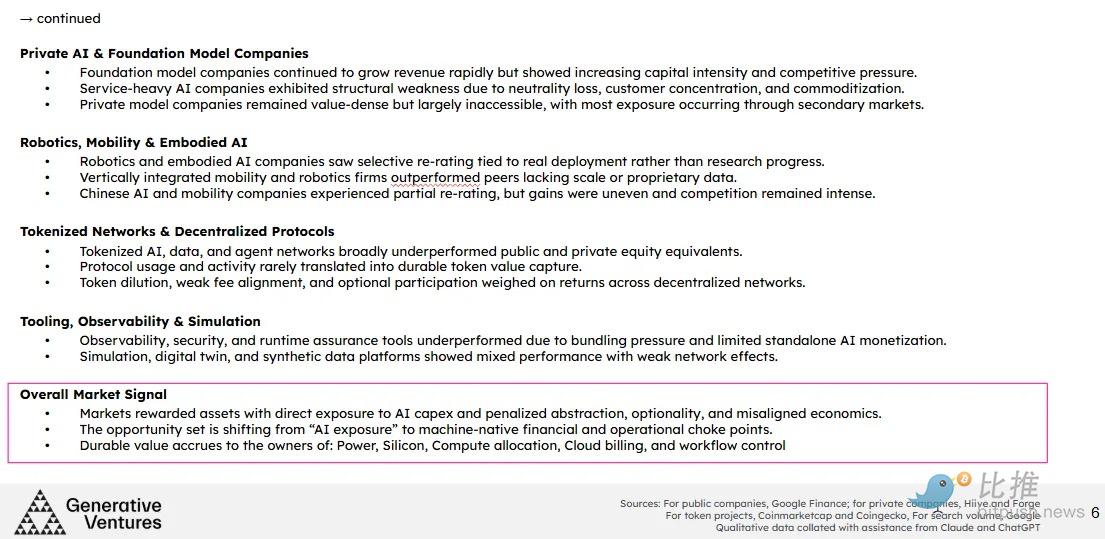
Value is accumulating where machines are already paying—for electricity, silicon, compute contracts, cloud bills, and regulated balance sheets—not where they might choose to pay someday in the future.

In 2025, the market rewarded ownership of 'chokepoints' and punished projects with ideals but lacking control over cash flow or compute power. The future core lies in: identifying where economic power already exists, and betting on assets that machines cannot bypass.

Key Revelations:

  • AI value realization is 'one layer deeper' than most people anticipated.

  • Neutrality is now a first-class economic asset (refer to Scale AI).

  • 'Platforms' only work when combined with control points, not just as a feature.

  • AI software is deflationary (pricing pressure); AI infrastructure is inflationary.

  • Vertical integration only matters if it can lock in data or economic effects.

  • Token networks are repeatedly experiencing the same market structure tests.

  • Simply having AI exposure is not enough, positioning quality determines everything.

Robotics hardware and software will be the next hype cycle, and we will likely see a similar investment wave and selective winners.

2026 Positioning

Over the past two years, we have built a core portfolio covering the key themes discussed here. Looking ahead to 2026, our positioning and investment execution will be further strengthened.
Next, I will talk about our holding strategy.
Although the long-term vision of autonomous agents, robotics, and machine-native finance is directionally correct, the market is currently in a phase of extremely离谱 valuations in the private AI and robotics space. Aggressive secondary liquidity and implied valuations above $100 billion mark a transition from the 'discovery phase' to the 'exit phase'.

As an early-stage fund with a fintech angle, we must lock onto targets downstream of this spending:

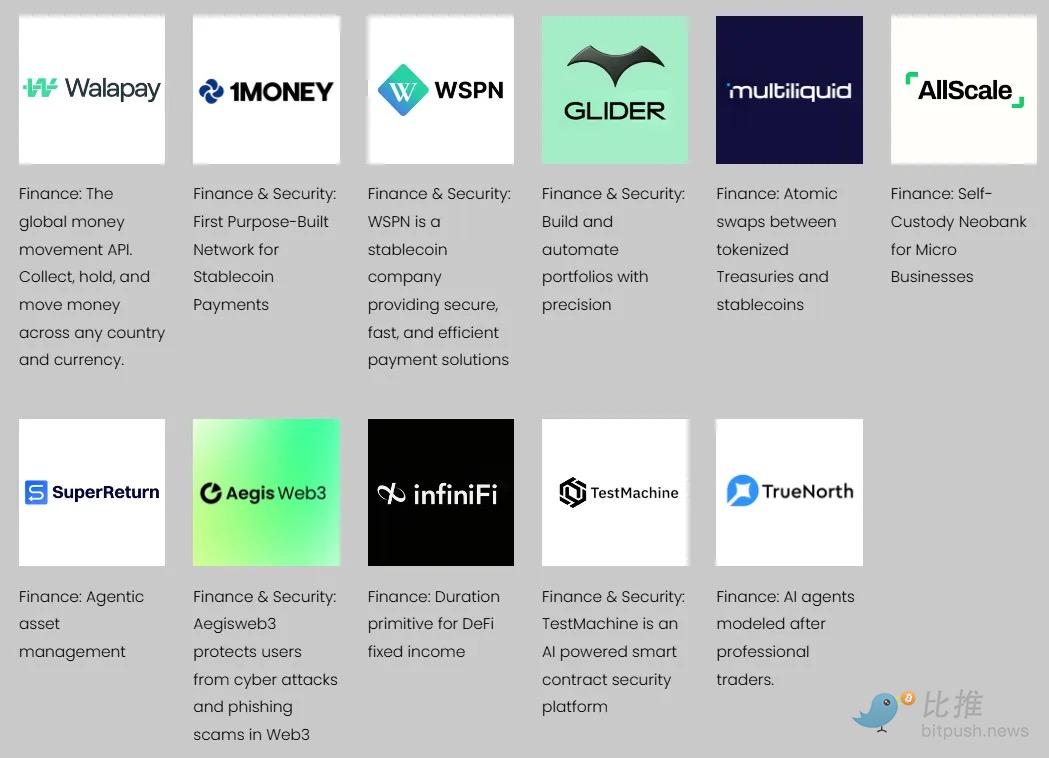
  1. Machine Transaction Surfaces: Layers where machines or their operators already carry economic activity, such as payments, billing, metering, routing, and the orchestration of capital or compute, compliance, custody, and settlement primitives. Returns are earned through transaction volume, acquisition, or regulatory status, not speculative narratives. Walapay and Nevermined in our portfolio are examples.

  2. Applied Infrastructure With Budgets: Infrastructure that enterprises or platforms are already procuring, such as compute aggregation and optimization, data services embedded in workflows, tools with recurring spend and switching costs. The focus is on ownership of budgets and depth of integration. Examples include Yotta Labs and Exabits.

  3. High-Novelty Opportunities: A few asymmetric upside opportunities with uncertain timing: basic research, frontier science, AI-related culture or IP platforms. Our recent investment in Netholabs (a lab dedicated to simulating the complete digital brain of a mouse) fits this characteristic.

Additionally, until the token market structure issues are resolved, we will invest more actively in equity. Previously, our exposure was 40% tokens and 40% equity, with 20% flexible allocation. We believe the token space needs 12-24 months to digest the current difficulties.

Key Takeaways

You don't need to be a venture capitalist to learn from and benefit from this market dynamic.

Massive capital expenditure is flowing from tech giants to energy and component suppliers. A handful of companies are expected to be the multi-trillion-dollar public market winners, but they choose to remain private while spinning off Special Purpose Vehicles (SPVs). Public companies are doing their best to defend. Political power is centralizing and nationalizing these initiatives—whether it's Musk and Trump, or China and DeepSeek—rather than supporting their decentralized alternatives in Web3. Robotics is intertwined with national manufacturing and the military-industrial complex.

In the creative industries (from games to film, music), there is resistance to AI, with people engaged in 'human crafts'排斥 those robots that pretend to do the same thing.

Whereas in the software, science, and mathematics industries, people see AI as a great achievement that can help discover and build efficient business architectures.

We need to stop believing this collective illusion and return to reality. On one hand, dozens of companies have achieved over $100 million in annual revenue by serving users; on the other hand, the market is also filled with大量 falsehoods and scams. Both are true, existing in parallel.

The new year will bring a comprehensive reshuffle, but also contains huge opportunities. Success can only be achieved by walking cautiously on the tightrope of opportunity. Let's meet again on the other side!


Twitter:https://twitter.com/BitpushNewsCN

Bitpush TG Discussion Group:https://t.me/BitPushCommunity

Bitpush TG Subscription: https://t.me/bitpush

Original article link:https://www.bitpush.news/articles/7597956

Criptos en tendencia

Preguntas relacionadas

QWhat were the main structural problems in the crypto market in 2025 according to the article?

AThe main structural problems included a 'negative prisoner's dilemma' where token holders sold assets anticipating future selling pressure, while market makers and exchanges took short-term speculative positions. Token unlock mechanisms and issuance prices often crushed projects before they achieved profitability or market fit. A major market structural failure on October 10th also caused significant damage and industry-wide deleveraging, with correlation between all crypto assets rising to nearly 1.

QWhich sectors were the clear winners in the public markets for the 'machine economy' in 2025?

AThe clear winners were the owners of physical and financial bottlenecks: power, semiconductors, and scarce compute. Companies like Bloom Energy, IREN, Micron, TSMC, and NVIDIA significantly outperformed the market as capital chased assets that 'machines must pass through'.

QHow did the performance of 'tokenized networks' compare to other sectors in the machine economy?

ATokenized networks were the worst-performing sector. With few exceptions, decentralized data, storage, agent, and automation protocols performed poorly because usage failed to translate into token value capture. The market no longer rewarded 'collaborative narratives' without mandatory fee mechanisms.

QWhat is the core investment thesis for 2026 as outlined by the venture capital firm in the article?

AThe core investment thesis for 2026 is to focus on areas where economic activity already exists and where machines cannot avoid paying. This includes: 1) Machine Transaction Surfaces (payment, billing, compliance layers), 2) Applied Infrastructure With Budgets (compute aggregation, data services already purchased by enterprises), and 3) High-Novelty Opportunities (asymmetric bets on frontier science and research).

QWhat key lesson does the article suggest about the relationship between AI software and AI infrastructure?

AThe key lesson is that AI software is deflationary (faces pricing pressure), while AI infrastructure is inflationary. Value is accumulating in the physical and financial bottlenecks that machines must pay for, such as power, silicon, and compute contracts, rather than in the optional software layers.

Lecturas Relacionadas

After Three Consecutive Quarters of Decline, Can the Crypto Market Find a Window for Stabilization in Q3?

The cryptocurrency market has just concluded its worst-performing quarter since 2022, with total capitalization dropping 12.6% to $2.1 trillion. All core metrics indicate capital is leaving the sector, not just rotating within it. Bitcoin fell 14.2% and Ethereum dropped 25.4% in Q2, breaking their previous correlation with US tech stocks. A key driver is the reversal in US spot Bitcoin ETF flows, which saw a net outflow of approximately $4.67 billion in Q2, including a record monthly outflow near $4.5 billion in June. While recent data suggests long-term holders are accumulating again, sustained ETF outflows mean continued selling pressure. Market focus is now singularly on the Federal Reserve. The upcoming July FOMC meeting is seen as the most critical event for Q3. A dovish signal could support Bitcoin reclaiming a $68,000-$84,000 range, while a hawkish stance might establish a new trading band around $50,000-$56,000. Additionally, regulatory uncertainty persists, with the progress of the crucial *CLARITY Act* stalling in the Senate, reducing its perceived 2026 passage probability to 40-45%. Despite the broad downturn, a few sectors showed growth. Prediction markets saw nominal volume surge 48.7% year-over-year to $113.8 billion, and tokenized collectibles transaction volume rose 143% quarterly to $1.4 billion. The Real-World Asset (RWA) tokenization sector also continued steady growth, now representing ~$28.1 billion in on-chain value. The market's foundation for an extreme crash appears limited, with Bitcoin price hovering near its 200-week moving average. However, the trading paradigm has shifted from narrative-driven speculation to decisions based on price action, policy developments, and interest rate expectations, making a broad sentiment-driven rally unlikely in the near term.

marsbitHace 28 min(s)

After Three Consecutive Quarters of Decline, Can the Crypto Market Find a Window for Stabilization in Q3?

marsbitHace 28 min(s)

BIT Trading Moment: BTC Still Suppressed by Weekly 200 EMA, Rejection May Restart Decline; Storage and Semiconductors that Surged Last Night Begin Falling in Evening Trading

**Crypto & Stock Market Wrap: Bitcoin Tests Resistance, Stocks Retreat After AI Surge** Bitcoin consolidates around $66,000, facing key resistance near $68,000—an area seen as a major psychological and technical hurdle where previous rallies have failed. Analysts note the cryptocurrency is caught between its 200-week moving average (~$63,333) and 200-week EMA (~$68,328). A clear break above $68k is needed to signal a stronger bullish trend, while a rejection could lead to a retest of $63k support. Market sentiment remains cautious, with low futures open interest pointing to a low-liquidity rebound rather than a full bull market. Bitcoin spot ETFs saw another $203 million inflow. US stock futures pointed lower after a strong Tuesday session led by a massive rebound in semiconductors and memory stocks. The rally was fueled by renewed optimism about AI-driven hardware demand, with Micron, SanDisk, and SK Hynix surging. However, those gains reversed in pre-market trading. Super Micro Computer (SMCI) soared over 20% after hours on strong guidance and a record backlog. Other standouts included Rocket Lab and nuclear energy plays Oklo and X-Energy. Rising oil prices (Brent above $91) and climbing Treasury yields (10-year near 4.64%), however, are reigniting inflation concerns and acting as a headwind for equities. In Asia, markets were mixed. South Korea's KOSPI pared early gains to close slightly higher as semiconductor stocks like SK Hynix gave back initial surges. Japan's Nikkei edged lower as the yen hit a fresh 38-year low against the dollar, raising fears of potential market intervention. Key events to watch include the Samsung Galaxy launch, AMD's AI event, and a slew of major tech earnings from Alphabet, Tesla, and IBM after the close on Wednesday, followed by the ECB meeting and Intel's earnings on Thursday.

marsbitHace 36 min(s)

BIT Trading Moment: BTC Still Suppressed by Weekly 200 EMA, Rejection May Restart Decline; Storage and Semiconductors that Surged Last Night Begin Falling in Evening Trading

marsbitHace 36 min(s)

Former CFTC Chairman, Circle President Tarbert: Preaching Long-Termism While Cashing Out $30 Million Himself

Former CFTC Chairman and Circle President Heath Tarbert has consistently advocated for a long-term vision in public, urging patience from investors as Circle’s stock price has fallen significantly from its peak. However, it has been revealed that since Circle’s IPO, Tarbert has continuously sold his CRCL shares through pre-arranged trading plans, cashing out approximately $30 million, without making any public market purchases. This contrast between his public messaging and personal actions has drawn criticism. Tarbert joined Circle in July 2023 as Chief Legal Officer, leveraging his regulatory experience to help guide the company through its IPO and expansion. Despite promoting stablecoins as long-term infrastructure, he established a 10b5-1 trading plan just before Circle went public, leading to substantial stock sales over the following year. In March 2026, he initiated another plan to sell more shares. His career trajectory highlights a pattern of moving between high-level regulatory roles and influential positions in the financial sector. After resigning as CFTC Chairman in early 2021, he joined Citadel Securities as Chief Legal Officer just 27 days later, during a period of intense regulatory scrutiny for the firm. He later joined Circle, aiding its efforts to navigate regulatory challenges for its public listing. While Tarbert's expertise in policy and compliance is valuable to companies like Circle, his actions—advocating long-term confidence while personally divesting—raise questions about the alignment between his public statements and his private financial decisions, leaving investors who followed his advice to bear the market risks.

marsbitHace 59 min(s)

Former CFTC Chairman, Circle President Tarbert: Preaching Long-Termism While Cashing Out $30 Million Himself

marsbitHace 59 min(s)

Gate Research Institute: The 'Wall Street-ization' Wave of Crypto Financial Products – Competition or Integration?

The article titled "Gate Research Institute: Are Crypto Financial Products Sparking a 'Wall Street' Wave—Competition or Convergence?" explores the evolving relationship between the crypto ecosystem and traditional finance (TradFi). The piece begins by reflecting on Bitcoin's original 2009 vision of decentralization, disintermediation, and moving away from banks. It then contrasts this with the 2024 landscape, where key crypto assets like Bitcoin are increasingly held through Wall Street products like ETFs issued by giants like BlackRock. The article questions whether this signifies that TradFi is systematically taking over the rights to issue, price, custody, and distribute crypto financial assets. The core argument is that this is not a zero-sum takeover but rather a bidirectional convergence where each side addresses the other's weaknesses. Crypto offers 24/7 global markets, programmable settlement, and open access but lacks compliant channels, institutional-grade custody, deep fiat liquidity, and mainstream distribution. TradFi possesses these but is constrained by legacy systems, limited operating hours, and slow settlement. Two primary convergence paths are highlighted: * **Path A (CEX to TradFi):** Exemplified by Gate, which has progressed from offering tokenized stocks and CFDs to providing direct, real stock trading (US, Hong Kong, South Korea) within its platform, using USDT. * **Path B (TradFi to Crypto):** Exemplified by Robinhood, which has integrated crypto trading, acquired exchanges like Bitstamp, and is moving traditional assets like stocks onto the blockchain via tokenization and its own Layer 2. Both paths are ultimately competing to become the next-generation, unified financial account—a "super account" where users can seamlessly trade cryptocurrencies, stocks, ETFs, RWA (Real World Assets), and tokenized treasury products in one interface. The growth of RWA and tokenized treasuries (e.g., BlackRock's BUIDL) is presented as the asset-layer fusion, providing stable, yield-bearing assets on-chain and acting as a bridge between the two worlds. In conclusion, the "Wall Street-ization" of crypto is framed as a mutual transformation. Decentralized ideals persist in the protocol layer, while at the application layer, a more efficient, global, and accessible unified capital market is emerging from this convergence. The future competition lies not between crypto exchanges and stockbrokers, but between platforms vying to offer the most comprehensive asset coverage, liquidity, and user experience within a single account.

marsbitHace 1 hora(s)

Gate Research Institute: The 'Wall Street-ization' Wave of Crypto Financial Products – Competition or Integration?

marsbitHace 1 hora(s)

Trading

Spot

Artículos destacados

Cómo comprar WIN

¡Bienvenido a HTX.com! Hemos hecho que comprar WINkLink (WIN) sea simple y conveniente. Sigue nuestra guía paso a paso para iniciar tu viaje de criptos.Paso 1: crea tu cuenta HTXUtiliza tu correo electrónico o número de teléfono para registrarte y obtener una cuenta gratuita en HTX. Experimenta un proceso de registro sin complicaciones y desbloquea todas las funciones.Obtener mi cuentaPaso 2: ve a Comprar cripto y elige tu método de pagoTarjeta de crédito/débito: usa tu Visa o Mastercard para comprar WINkLink (WIN) al instante.Saldo: utiliza fondos del saldo de tu cuenta HTX para tradear sin problemas.Terceros: hemos agregado métodos de pago populares como Google Pay y Apple Pay para mejorar la comodidad.P2P: tradear directamente con otros usuarios en HTX.Over-the-Counter (OTC): ofrecemos servicios personalizados y tipos de cambio competitivos para los traders.Paso 3: guarda tu WINkLink (WIN)Después de comprar tu WINkLink (WIN), guárdalo en tu cuenta HTX. Alternativamente, puedes enviarlo a otro lugar mediante transferencia blockchain o utilizarlo para tradear otras criptomonedas.Paso 4: tradear WINkLink (WIN)Tradear fácilmente con WINkLink (WIN) en HTX's mercado spot. Simplemente accede a tu cuenta, selecciona tu par de trading, ejecuta tus trades y monitorea en tiempo real. Ofrecemos una experiencia fácil de usar tanto para principiantes como para traders experimentados.

408 Vistas totalesPublicado en 2024.12.11Actualizado en 2025.03.21

Cómo comprar WIN

Discusiones

Bienvenido a la comunidad de HTX. Aquí puedes mantenerte informado sobre los últimos desarrollos de la plataforma y acceder a análisis profesionales del mercado. A continuación se presentan las opiniones de los usuarios sobre el precio de WIN (WIN).

活动图片













