Valuation Surpasses 200 Billion, Kimi Reportedly Raises 13.6 Billion More, Speeds Up Hong Kong IPO

marsbitPublicado a 2026-06-08Actualizado a 2026-06-08

Resumen

Beijing-based AI unicoth MoonDark (Kimi) is reportedly in talks for a new funding round aiming to raise up to $20 billion (approximately RMB 136 billion), targeting a post-money valuation of $300 billion (approximately RMB 2.035 trillion). If successful, this would mark its third round in six months and a six-fold increase from its $43 billion valuation in December last year. Last month, the company completed a $20 billion funding round led by Meituan Longzhu, reaching a valuation exceeding $200 billion. According to reports, MoonDark has raised over RMB 376 billion across six rounds, making it the most funded large language model startup in China. Founded in 2023 by CEO Yang Zhilin, the company's core product is the Kimi AI Assistant. In April, it launched and open-sourced its flagship model, Kimi K2.6, which has demonstrated performance comparable to top models like GPT-5.4 in certain benchmarks. Recently, it began beta testing for Kimi Work, a local AI agent for knowledge workers. Commercially, the company's Annual Recurring Revenue (ARR) reportedly surpassed $2 billion in April. Regarding its IPO plans, Bloomberg reported in March that MoonDark is preparing for a listing in Hong Kong, though the process remains in early stages. The funding and IPO pace for leading Chinese AI firms has accelerated notably in 2026, mirroring global trends where companies like OpenAI and Anthropic are also setting new fundraising and valuation records. Securing substantial capital is bec...

Zhixi News, June 8 — According to reports, the Beijing-based AI large model unicorn Moon's Dark Side (Kimi) is currently negotiating a new round of financing, aiming for a maximum scale of 20 billion USD (approximately 136 billion RMB) and a target valuation of 300 billion USD (approximately 2,035 billion RMB).

If this round is completed as targeted, Moon's Dark Side's valuation would increase by about 6 times compared to its 4.3 billion USD (approximately 298 billion RMB) valuation in December last year. This would also be the third round of financing initiated by Moon's Dark Side in nearly six months.

Just last month, Moon's Dark Side completed a financing round of approximately 20 billion USD (approximately 136 billion RMB), with a post-money valuation exceeding 200 billion USD (approximately 1,356 billion RMB). This round was led by Meituan Dragon Ball, with participation from Tsinghua Capital, China Mobile, CPE (CITIC Private Equity), among others.

According to previous reports by Huafeng Capital, Moon's Dark Side has completed 6 rounds of financing, with a total funding amount exceeding 37.6 billion RMB, making it the domestic large model startup with the highest cumulative financing.
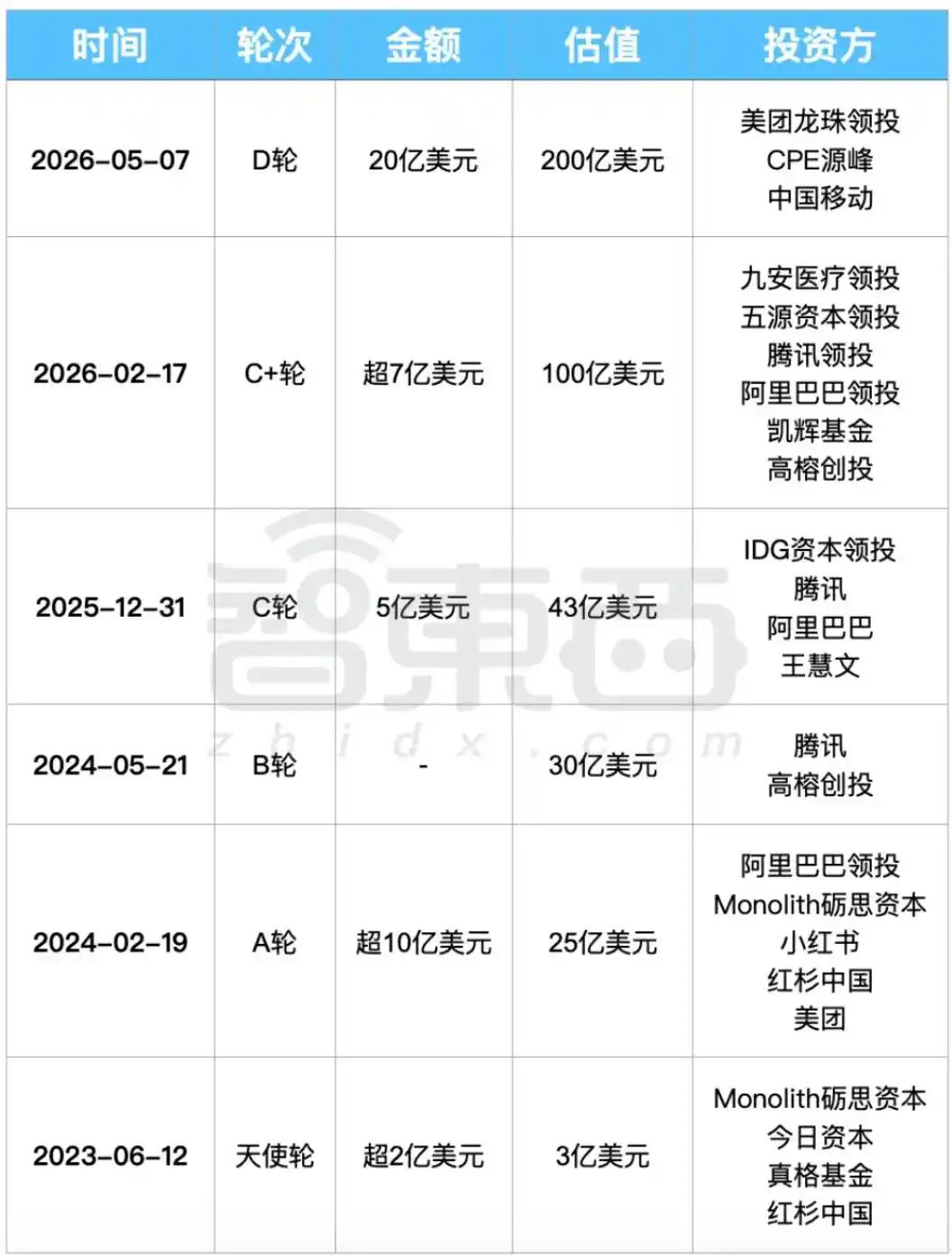
▲ Moon's Dark Side's past financing situation (Chart by Zhixi News, data source: Qichacha)

Moon's Dark Side was founded in 2023 in Beijing. Its founder and CEO, Yang Zhilin, earned his bachelor's degree from the Department of Computer Science at Tsinghua University and his Ph.D. from Carnegie Mellon University (CMU). He previously worked at Google Brain and Meta AI.

The core product of Moon's Dark Side is the Kimi Intelligent Assistant. On April 20, Moon's Dark Side released and open-sourced its flagship model Kimi K2.6. In multiple global authoritative benchmark tests, K2.6's performance in certain dimensions matched or even surpassed top closed-source models such as GPT-5.4, Claude Opus 4.6, and Gemini 3.1 Pro.

As of today, on the OpenRouter Benchmarks list, Kimi K2.6 ranks 9th on the Artificial Analysis Intelligence Index list with a score of 53.9, placing it after MiniMax-M3 and before Xiaomi MiMo-V2.5-Pro.
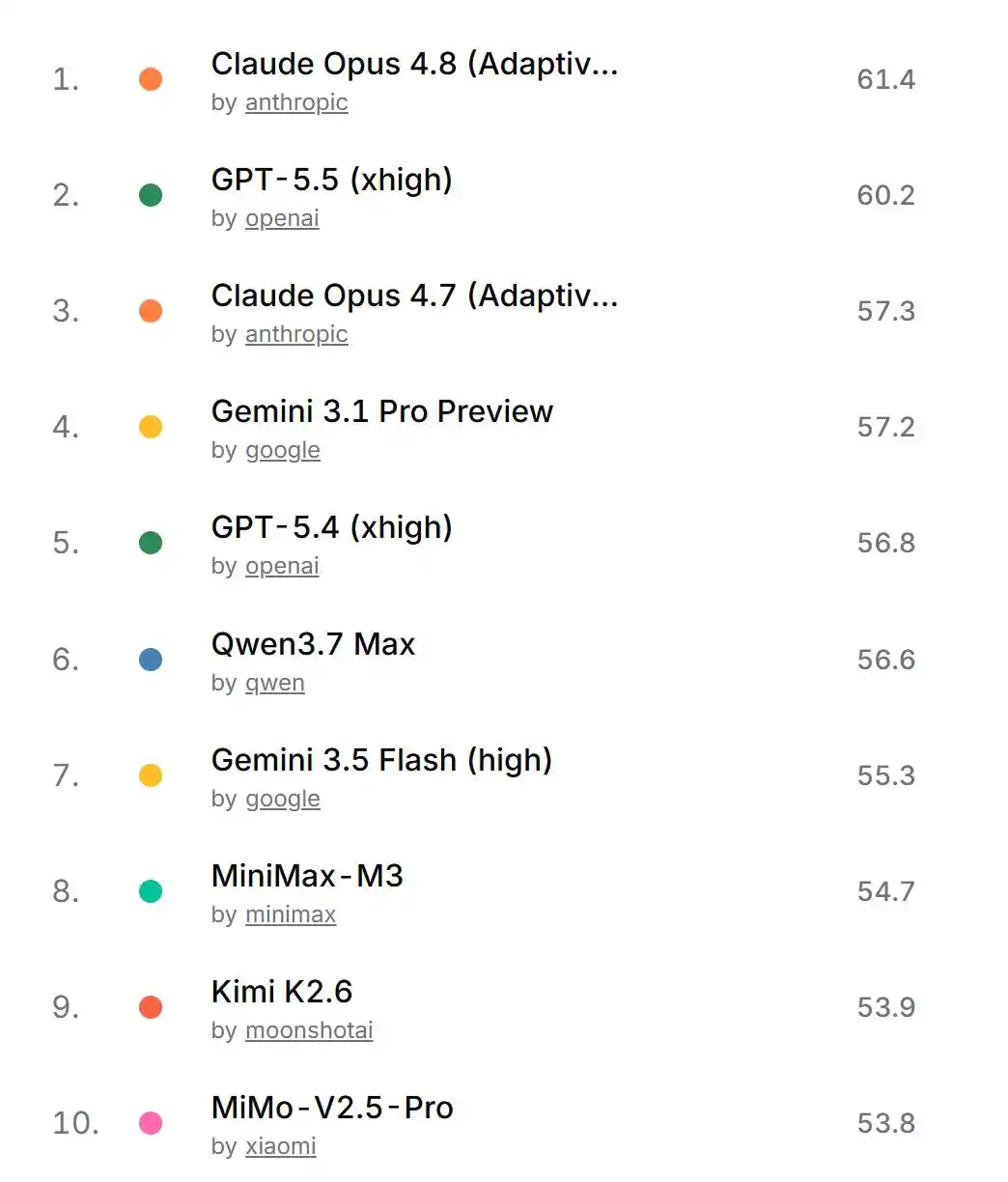
▲ Kimi K2.6 ranks 9th on the Artificial Analysis Intelligence Index list (Source: OpenRouter)

On the product side, on June 3, Moon's Dark Side began the beta testing of Kimi Work Beta, positioned as a local universal Agent for knowledge workers. Users can describe task goals in natural language, and Kimi Work can decompose tasks, call tools, use browsers, create and organize files locally on the computer, and deliver work products such as documents, spreadsheets, and PPTs.

Regarding commercialization, Moon's Dark Side has begun to generate a certain scale of revenue. According to previous disclosures by Huafeng Capital, Moon's Dark Side's Annual Recurring Revenue (ARR) in April had already exceeded 200 million USD (approximately 1.36 billion RMB), with accelerated growth in paid subscriptions and API revenue.

In terms of IPO progress, on March 26, Bloomberg reported that Moon's Dark Side is recently preparing for a Hong Kong IPO. Sources familiar with the matter stated that Moon's Dark Side is in the early stages, with the aim of stimulating investor interest in AI. Another source revealed that related preparations are still ongoing, and an IPO launch may not ultimately proceed.

Overall, since entering 2026, the capitalization process of leading domestic large model companies has significantly accelerated. On one hand, companies like Moon's Dark Side and Stepwise Stars have densely completed large-scale financing rounds, and DeepSeek was also reported last week to be about to complete its first external financing since its founding. On the other hand, companies like Zhipu and MiniMax have already taken the lead in opening the door to the Hong Kong stock market and are continuing to advance related work for A-share listings.

Looking globally, leading overseas AI companies like OpenAI and Anthropic are also preparing for IPOs, continuously setting new records for financing and valuation. In March this year, OpenAI completed a financing round of 122 billion USD (approximately 8,272 billion RMB), achieving a post-money valuation of 852 billion USD (approximately 57.8 trillion RMB). On June 1, Anthropic announced the completion of a 65 billion USD (approximately 4,407 billion RMB) Series H financing round, with a post-money valuation reaching 965 billion USD (approximately 65.3 trillion RMB), and secretly filed its IPO prospectus the following day.

Against this backdrop, the financing and IPO pace of domestic large model companies has noticeably quickened. Capital, computing power, and commercialization capabilities are becoming key variables alongside model competition. For large model companies still in a high-investment cycle, large-scale financing and IPOs are not only ways to replenish ammunition but will also become important chips in the next phase of competing for top positions.

This article is from the WeChat public account "Zhixi News" (ID: zhidxcom), author: Yang Jingli

Criptos en tendencia

Preguntas relacionadas

QWhat is the rumored size of Moonshot AI's (Kimi) new funding round and its target valuation?

AMoonshot AI is reportedly in talks for a new funding round aiming to raise up to $20 billion, with a target valuation of $300 billion.

QHow many funding rounds has Moonshot AI completed, and what is its total cumulative funding amount?

AAccording to the article, Moonshot AI has completed 6 funding rounds, with a total cumulative funding exceeding 37.6 billion RMB.

QWhat is the name of Moonshot AI's core product and its recently launched flagship model?

AMoonshot AI's core product is the Kimi Intelligent Assistant. It recently released and open-sourced its flagship model, Kimi K2.6.

QWhat significant beta testing did Moonshot AI begin in early June 2026?

AOn June 3rd, Moonshot AI began the beta test of 'Kimi Work,' a local universal Agent designed for knowledge workers to perform complex tasks on their computers.

QWhat is the reported Annual Recurring Revenue (ARR) for Moonshot AI as of April, and what is its potential IPO plan?

AAs of April, Moonshot AI's Annual Recurring Revenue (ARR) reportedly exceeded $200 million. The company is reportedly preparing for a potential IPO in Hong Kong.

Lecturas Relacionadas

Qualcomm Chip Price Hike Deals a Blow to Android Phones

Qualcomm has officially announced a new round of price increases for its entire chip portfolio, effective September 1. The hikes, reaching up to 18% for the flagship Snapdragon 8 Elite Gen 6 Pro, follow similar moves by MediaTek, intensifying cost pressures on the already strained smartphone industry. CEO Cristiano Amon confirmed the plan, citing the need to offset rising industry-wide costs and restore declining profit margins. Qualcomm's Q3 FY2026 results showed a 25% drop in net profit, with mobile revenue plunging 20% year-over-year, hitting its lowest level since 2021. The surge in AI computing demand has led memory manufacturers to prioritize HBM production, creating a shortage in general-purpose DRAM and NAND Flash chips. Their prices soared by 93%-98% and 55%-60% respectively in Q1 2026, causing the memory cost share in smartphones to jump from 10%-15% to over 30%. Coupled with the soaring cost of advanced nodes like TSMC's 2nm and packaging, overall chip costs have reached historic highs. These upstream pressures are forcing downstream smartphone brands like Xiaomi, OPPO, and vivo to cut orders for mid-to-low-end models by up to 20% and use cost-saving measures like older chipsets. Reportedly, the Snapdragon 8E5 will be repurposed as a "long-lasting" chip for sub-brand phones in H2 2026. Amid this cost crisis, the Android market remains sluggish. Q2 2026 smartphone shipments in China fell 4.3% year-over-year, marking five consecutive quarters of decline. Major Android brands saw market share drop, while Huawei and Apple, with their in-house chip advantages, gained share. Qualcomm is diversifying into automotive and IoT sectors to reduce reliance on smartphones, but these new segments cannot yet fill the mobile revenue gap. Industry observers warn that the full impact of component cost hikes will hit in the second half of 2026, likely leading to higher-than-expected price increases for Android flagships and a further contraction in the Chinese smartphone market.

marsbitHace 15 min(s)

Qualcomm Chip Price Hike Deals a Blow to Android Phones

marsbitHace 15 min(s)

Breaking: GPT-5.6 Prices Slashed Effective Today

OpenAI has announced significant price cuts for its GPT-5.6 model API, effective immediately. The entry-level **GPT-5.6 Luna** sees the most drastic reduction, with input prices dropping 80% to $0.20 per million tokens and output prices falling to $1.20 per million tokens. The mid-tier **GPT-5.6 Terra** is reduced by 20%, now costing $2.00 (input) and $12.00 (output) per million tokens. The flagship **GPT-5.6 Sol** maintains its original price but introduces a new **Fast mode**, offering speeds up to 2.5 times faster for double the cost. The company attributes these price reductions to efficiency gains achieved through **GPT-5.6 Sol's own involvement in optimizing its production systems**. The model assisted in rewriting GPU kernels and improving speculative decoding, leading to a 20% reduction in end-to-end service costs and over 15% improvement in token generation efficiency. OpenAI emphasizes this process remained human-led. A key focus of the降价 is to lower the barrier for running **AI agent workflows**. By making the capable, tool-calling Luna model significantly cheaper, OpenAI aims to enable more frequent use in cost-sensitive, high-volume tasks like code review and monitoring. This creates a potential feedback loop: model-assisted efficiency gains lead to lower costs, which enables broader agent deployment, which in turn drives further optimization. The new pricing and features will also apply to Codex and ChatGPT Work subscriptions. The changes intensify competition in the large language model market, with OpenAI directly challenging rivals like Anthropic to respond.

marsbitHace 45 min(s)

Breaking: GPT-5.6 Prices Slashed Effective Today

marsbitHace 45 min(s)

South Koreans' 'Gambling Nature' is Actually Forced by Life

This article explores how systemic pressures in South Korea, rather than inherent "gambling" tendencies, drive widespread speculative financial behavior. It begins by noting the high frequency of flights from South Korea to Macau, symbolizing the search for outlets beyond domestic restrictions. The core argument is that ordinary life goals—stable employment, home ownership, and financial security—have become increasingly tied to asset markets due to structural economic factors. South Korea's development model, historically reliant on corporate leverage (chaebols), has evolved into a society where household debt and personal leverage are normalized as pathways to social mobility. Key mechanisms discussed include: * **Housing Policy:** Government measures to improve affordability, like extending mortgage terms to 50 years and the unique *jeonse* (key money) rental system, embed high leverage into the housing market. * **Financial Products:** The recent approval and explosive popularity of single-stock 2x leveraged ETFs (e.g., on Samsung and SK Hynix), easily accessed via mobile apps, lowered barriers to high-risk trading. * **Social Pressure:** Media narratives around soaring corporate profits (e.g., SK Hynix) and employee bonuses create a fear of missing out, pushing individuals to use leverage to "catch up." The article concludes that this "leveraged life" is a product of institutional history and policy choices. When traditional paths to success feel constrained, and policy facilitates debt-based solutions for housing and investment, speculative behavior becomes a rational, if risky, strategy for many. The rapid cycle of regulatory approval for leveraged ETFs followed by a market crash and official apology in mid-2026 exemplifies the system's inherent contradictions. Ultimately, the "bet" is not just on assets, but on using future earnings to secure a place in the present society.

marsbitHace 45 min(s)

South Koreans' 'Gambling Nature' is Actually Forced by Life

marsbitHace 45 min(s)

Trading

Spot

Artículos destacados

Cómo comprar UP

¡Bienvenido a HTX.com! Hemos hecho que comprar Superform (UP) sea simple y conveniente. Sigue nuestra guía paso a paso para iniciar tu viaje de criptos.Paso 1: crea tu cuenta HTXUtiliza tu correo electrónico o número de teléfono para registrarte y obtener una cuenta gratuita en HTX. Experimenta un proceso de registro sin complicaciones y desbloquea todas las funciones.Obtener mi cuentaPaso 2: ve a Comprar cripto y elige tu método de pagoTarjeta de crédito/débito: usa tu Visa o Mastercard para comprar Superform (UP) al instante.Saldo: utiliza fondos del saldo de tu cuenta HTX para tradear sin problemas.Terceros: hemos agregado métodos de pago populares como Google Pay y Apple Pay para mejorar la comodidad.P2P: tradear directamente con otros usuarios en HTX.Over-the-Counter (OTC): ofrecemos servicios personalizados y tipos de cambio competitivos para los traders.Paso 3: guarda tu Superform (UP)Después de comprar tu Superform (UP), guárdalo en tu cuenta HTX. Alternativamente, puedes enviarlo a otro lugar mediante transferencia blockchain o utilizarlo para tradear otras criptomonedas.Paso 4: tradear Superform (UP)Tradear fácilmente con Superform (UP) en HTX's mercado spot. Simplemente accede a tu cuenta, selecciona tu par de trading, ejecuta tus trades y monitorea en tiempo real. Ofrecemos una experiencia fácil de usar tanto para principiantes como para traders experimentados.

402 Vistas totalesPublicado en 2026.02.10Actualizado en 2026.06.02

Cómo comprar UP

Discusiones

Bienvenido a la comunidad de HTX. Aquí puedes mantenerte informado sobre los últimos desarrollos de la plataforma y acceder a análisis profesionales del mercado. A continuación se presentan las opiniones de los usuarios sobre el precio de UP (UP).

活动图片