Valuation of $1 Billion, After Five Years of Exploration, Why Did It "Admit Defeat"?

marsbitPublicado a 2025-12-09Actualizado a 2025-12-09

Resumen

Farcaster, a once-promising decentralized social protocol that raised $180 million and reached a near-$1 billion valuation, has officially pivoted away from its Web3 social networking strategy after 4.5 years of effort. Co-founder Dan Romero announced the shift toward a wallet-first approach, acknowledging that the original vision of a decentralized Twitter alternative did not achieve product-market fit. Despite initial excitement and growth—with monthly active users (MAU) briefly surging to around 80,000 in mid-2024—Farcaster failed to break out beyond the crypto-native user base. Its MAU later declined to under 20,000 by late 2025, revealing structural challenges: high onboarding barriers, highly insular content, and an inability to compete with established platforms like X or Instagram. The protocol’s wallet feature, initially introduced as a supplementary tool, demonstrated stronger retention and usage patterns, leading the team to refocus on wallet-based growth. The recent acquisition of token launch tool Clanker further signals this strategic turn toward financial utility rather than social interaction. The shift has sparked community debate, with long-time users expressing concern over the platform’s cultural change from social networking to transaction-oriented interactions. Nonetheless, Farcaster’s move underscores a broader realization in Web3: that social needs may not be the primary entry point for users, whereas practical tools like wallets offer clearer paths...

After five years of operation, raising approximately $180 million in total funding, and once reaching a valuation nearing $1 billion, Farcaster has officially admitted: the path of Web3 social has not succeeded.
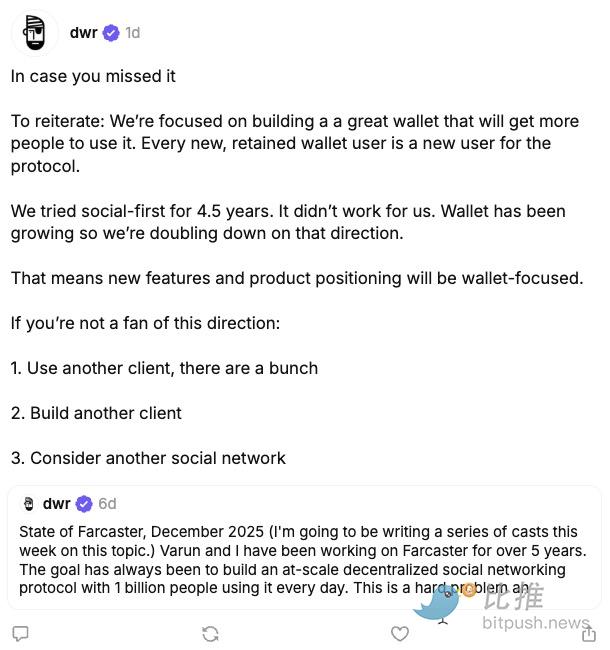
Recently, Farcaster co-founder Dan Romero posted a series of messages on the platform, announcing that the team will abandon the "social-first" product strategy and instead fully focus on the wallet direction. In his words, this is not an active upgrade but a choice forced by reality after a long period of attempts.

"We tried a social-first approach for 4.5 years, but it didn't work."

This judgment not only signifies Farcaster's transformation but also once again highlights the structural challenges of Web3 social.

The Gap Between Ideal and Reality: Why Farcaster Failed to Become a "Decentralized Twitter"

Farcaster was born in 2020, during the rise of the Web3 narrative. It attempted to address three core issues of Web2 social platforms:

  • Platform monopoly and censorship
  • User data not belonging to the users themselves
  • Creators unable to monetize directly

Its design approach was highly idealistic:

  • Decentralized protocol layer
  • Freely buildable clients
  • On-chain social relationships, migratable

Among the various "decentralized social" projects, Farcaster was once considered the product closest to PMF. Especially after Warpcast gained traction in 2023, many KOLs from Crypto Twitter joined, making it seem like the prototype of the next-generation social network.

But problems soon emerged.

According to Farcaster's monthly active user (MAU) statistics on Dune Analytics, Farcaster's user growth trajectory shows a very clear but not optimistic pattern:
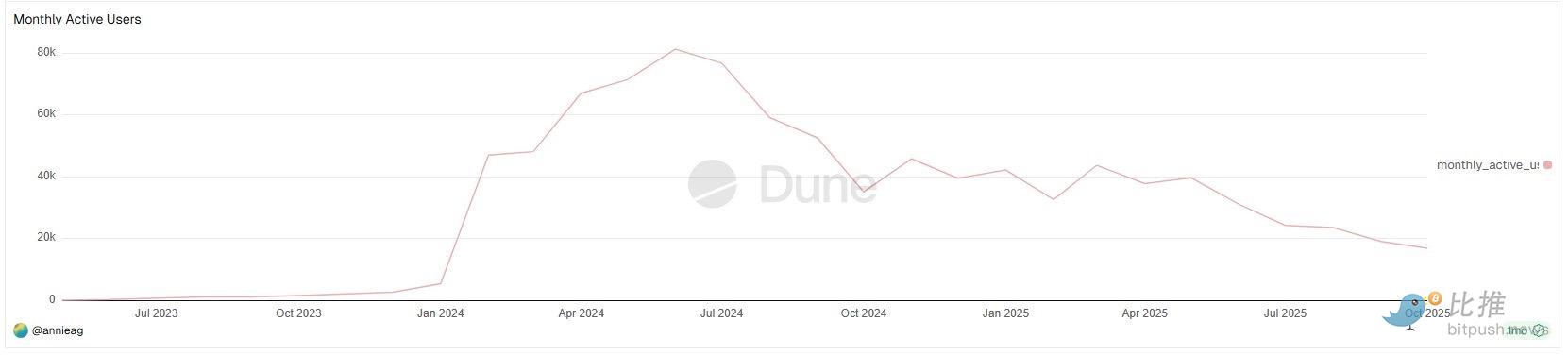
For most of 2023, Farcaster's monthly active users were almost negligible;

The real growth inflection point occurred in early 2024, with MAU rapidly increasing from a few thousand to about 40,000–50,000 in a short period, and even approaching 80,000 by mid-2024.

This was the only truly scalable growth window since Farcaster's inception. It is particularly noteworthy that this growth did not happen during a bear market but during a period of high activity in the Base ecosystem and the emergence of dense SocialFi narratives.

However, this window did not last long.

Starting in the second half of 2024, the MAU data showed a clear decline, and over the following year, it exhibited a volatile downward trend:

  • MAU rebounded multiple times, but the peaks continued to lower
  • By the second half of 2025, monthly active users had fallen to less than 20,000

In fact, Farcaster's growth has always been unable to "break through," with its user structure highly homogeneous:

  • Crypto industry professionals
  • VCs
  • Builders
  • Crypto-native users

For ordinary users:

  • High registration barriers
  • Social content is heavily "insider-focused"
  • The user experience is not better than X / Instagram

This prevented Farcaster from ever forming true network effects.

DeFi KOL Ignas (@DeFiIgnas) on X bluntly stated that Farcaster "just admitted what everyone has felt for a long time":

The strength of X's (formerly Twitter) network effects is almost impossible to break head-on.

This is not a problem with the crypto narrative but a structural barrier of social products. From a product perspective, the issues with Farcaster's social side are very typical:

  • User growth remained locked within the crypto-native population
  • Content was highly insular, difficult to spill over
  • Creator monetization and user retention did not form a positive feedback loop

This is why Ignas succinctly summarized Farcaster's new strategy in one sentence:

"It's easier to add social to a wallet than to add a wallet to a social product."

This judgment essentially acknowledges that "social is not the first-order need of Web3."

"The Bubble Is Comfortable, but the Numbers Are Cold"

If the MAU data answers "How did Farcaster perform?", then another question is: How big is this market itself?

Crypto creator Wiimee provided a set of striking comparative data on X.
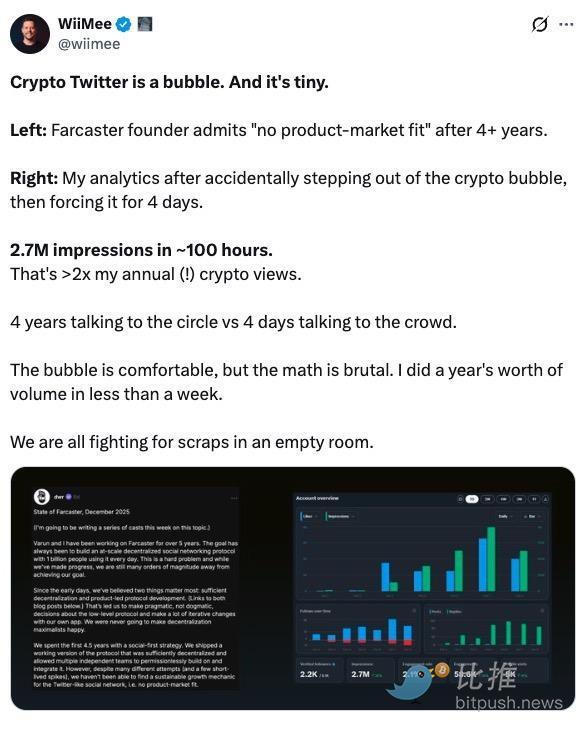
After "accidentally stepping out of the crypto content circle," Wiimee created content for a general audience for four consecutive days. His analysis data showed that in about 100 hours, he received 2.7 million impressions, more than double the total views of all his crypto content over a year.

He stated:

"Crypto Twitter is a bubble, and it's small. Four years of speaking to insiders is less effective than four days of speaking to the general public."

This is not a direct criticism of Farcaster but reveals a more fundamental problem:

Crypto social itself is a highly self-referential ecosystem with weak spillover capabilities. When content, relationships, and attention are confined to the same batch of native users, even the most refined protocol design struggles to break through the upper limit of market size.

This means that Farcaster's challenge was not that "the product wasn't good enough" but that "there aren't enough people in the field."

Wallet, However, Achieved PMF

What truly changed Farcaster's internal judgment was not a reflection on social but the unexpected validation of the wallet.

Earlier in 2024, Farcaster introduced a built-in wallet in its application, initially intended as a supplement to the social experience. But from the usage data, the wallet's growth slope, frequency of use, and retention performance were significantly different from the social module.

Dan Romero emphasized in a public response:

"Every new and retained wallet user is a new user for the protocol."

This statement itself reveals the core logic of the strategic shift. The wallet addresses not "the desire to express" but real, rigid on-chain behavioral needs: transfers, transactions, signatures, and interactions with new applications.

In October, Farcaster acquired Clanker, an AI Agent-driven token issuance tool, and gradually integrated it into the wallet system. This move was also seen as the team's clear bet on the "wallet-first" path.

From a business perspective, this direction has clear advantages:

  • Higher frequency of use
  • Clearer monetization paths
  • Tighter integration with the on-chain ecosystem

In contrast, social seems more like a nice-to-have rather than an engine for growth.

Although the wallet strategy is justified by the data, community controversy followed.

Several long-term users explicitly stated that they are not opposed to the wallet itself but are uncomfortable with the resulting cultural shift: from "users" being redefined as "traders," from "co-builders" being labeled as "old guard."

This exposes a practical problem: when a product direction changes, community sentiment is often harder to migrate than the roadmap. Farcaster's protocol layer remains decentralized, but the choice of product direction is still concentrated in the hands of the team. This tension is amplified during a transformation.

Romero later admitted that communication was problematic but made it clear that the team had made its choice.
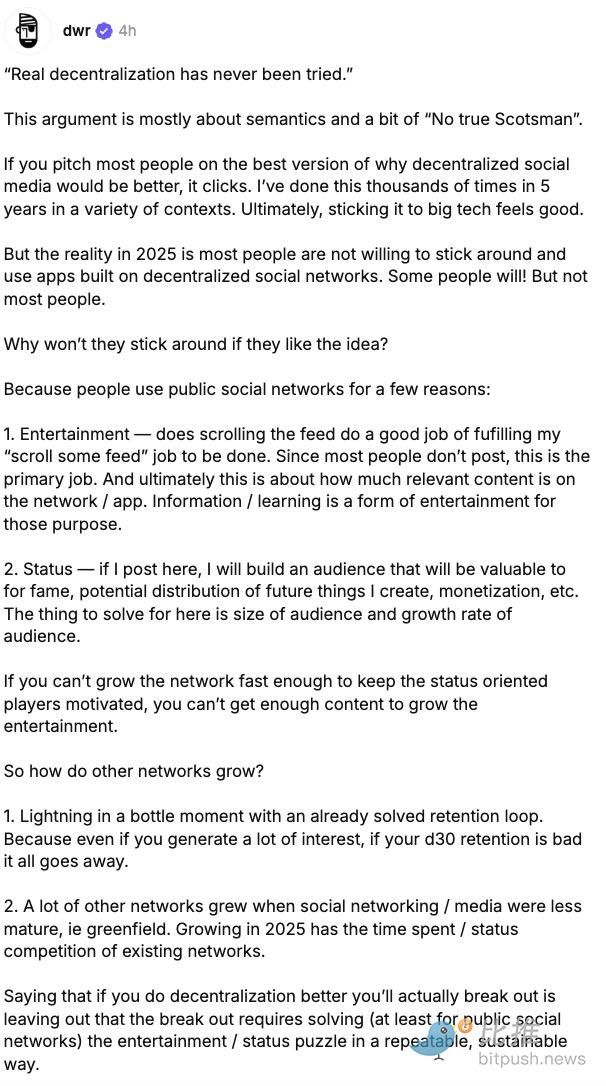
This is not arrogance but a common realistic decision made by startup projects in the later stages of their lifecycle. In this sense, Farcaster did not abandon the social ideal but gave up the illusion of its scalability.

As one observer perhaps rightly said:

"First, let users stay for the tools; then there is space for social."

Farcaster's choice may not be the most romantic, but it might be the one closest to reality. Deeply integrating native financial tools (wallets, transactions, issuance) is the practical path to converting into sustainable commercial value.

Preguntas relacionadas

QWhy did Farcaster decide to pivot from a social-first strategy to focusing on wallets?

AFarcaster pivoted because after 4.5 years, the social-first approach did not work. The platform struggled to achieve product-market fit (PMF) for social, with user growth remaining confined to a small, crypto-native audience and failing to break out into the mainstream. In contrast, the wallet feature showed stronger growth, higher usage frequency, and better retention, indicating a clearer path to sustainable value.

QWhat were the main user growth challenges Farcaster faced with its social product?

AFarcaster's user growth was highly homogenous, consisting mainly of crypto professionals, VCs, builders, and crypto-native users. It failed to attract ordinary users due to high registration barriers, heavily insular 'crypto-only' content, and an user experience not superior to established platforms like X (Twitter) or Instagram. This prevented it from achieving network effects and scaling beyond its niche.

QHow did the performance of Farcaster's wallet feature influence its strategic shift?

AThe wallet feature demonstrated significantly better performance metrics than the social module, including a steeper growth curve, higher frequency of use, and improved user retention. This data convinced the team that wallet-driven growth, tied to essential on-chain activities like transactions and interacting with dApps, was a more viable path to achieving PMF and sustainable protocol adoption.

QWhat structural barriers did Farcaster encounter in competing with established social platforms like X (Twitter)?

AFarcaster faced immense structural barriers, primarily the powerful network effects of incumbent platforms like X (Twitter), which are nearly impossible to disrupt head-on. The crypto social ecosystem itself is a small, self-reinforcing bubble with limited ability to attract a broad user base, making it difficult for any protocol, no matter how well-designed, to achieve significant market scale.

QWhat does Farcaster's pivot reveal about the perceived role of social in the Web3 ecosystem?

AFarcaster's pivot suggests that social interaction is not a primary, first-order need in Web3. Instead, utility-driven tools like wallets, which facilitate core on-chain activities such as trading, transfers, and interacting with applications, are more fundamental and have a clearer path to product-market fit and commercial sustainability than social features alone.

Lecturas Relacionadas

The "Impossible Triad" Is Fundamentally a Pseudo-Problem

The article argues that blockchain's fundamental limitation is not the scalability trilemma (decentralization, scalability, security), which has been largely solved, but the lack of **privacy** and, until recently, clear **legitimacy**. Blockchain is described as a slow, expensive, globally shared computer whose core value is censorship resistance and verifiability. While ideal for native digital assets like money (e.g., stablecoins), its default transparency acts as a **tax**, exposing all transactions and enabling MEV extraction, which deters serious institutional capital. Simultaneously, its permissionless nature created regulatory ambiguity. The piece contends that **privacy** is the missing critical feature. It rejects the false choice between total transparency and complete anonymity. Modern cryptography (like zero-knowledge proofs) enables **compliant privacy**: users can prove facts (solvency, KYC status, compliance) without revealing the underlying sensitive data (specific holdings, identities). This preserves auditability for regulators and eliminates the leak of financial information. With recent regulatory progress (e.g., the GENIUS Act) addressing legitimacy, adding default, provably compliant privacy becomes a pure upgrade. It transforms blockchain from a costly, public ledger into a confidential settlement layer, finally bridging the gap to mainstream institutional and individual adoption of on-chain finance.

链捕手Hace 3 hora(s)

The "Impossible Triad" Is Fundamentally a Pseudo-Problem

链捕手Hace 3 hora(s)

Optical Chips: Collective Capacity Expansion

The global optical chip industry is experiencing a massive wave of expansion driven by surging AI data center demand. Major players across the US, Japan, Europe, and China are aggressively investing to ramp up production capacity. In the US, Coherent is expanding its 6-inch Indium Phosphide (InP) semiconductor fab in Texas, supported by CHIPS Act funding and a $2 billion strategic investment from NVIDIA. Lumentum is building a new factory for InP optical devices, and Nokia is scaling its advanced photonic chip packaging and testing capabilities. NVIDIA's investments aim to secure future supply of critical lasers and optical interconnect products for AI infrastructure. Japan's JX Advanced Metals, a leading InP substrate supplier, plans a multi-billion yen investment to increase its capacity 7-10 times, strengthening its grip on the crucial upstream materials market. In Europe, IQE and Tower Semiconductor settled a patent dispute and signed a multi-year InP epitaxial wafer supply agreement, highlighting that next-generation silicon photonics platforms will integrate high-performance InP components. STMicroelectronics and Sivers Semiconductors are also expanding silicon photonics production and partnerships. China is rapidly building out its domestic supply chain. Dongshan Precision's subsidiary, Source Photonics, announced a $12 billion project to expand optical chip and module production. Companies like Sanan Optoelectronics and Yunnan Germanium are scaling up InP chip manufacturing and substrate production, moving towards vertical integration from materials to modules. While debate continues around the exact future architecture—whether CPO (Co-Packaged Optics), NPO, or pluggables will dominate—analysts like Morgan Stanley argue the underlying driver is unchangeable: the explosive growth in bandwidth demand. This will inevitably increase the volume of optical engines, lasers, and related content per GPU, regardless of the final technical path. The competition for "more light" in the AI era has intensified into a global, full-chain capacity race.

marsbitHace 5 hora(s)

Optical Chips: Collective Capacity Expansion

marsbitHace 5 hora(s)

Stablecoins Finally Find Real Yield: An In-Depth Look at On-Chain Reinsurance Re | A Conversation with Re Founder Karan Saroya

Stablecoin Real Yield Found: A Deep Dive into On-Chain Reinsurance with Re's Karan Saroya As stablecoin supply exceeds $170 billion, the search for sustainable, non-speculative yield intensifies. Re, an on-chain reinsurance platform, provides an answer: connecting stablecoin capital to the trillion-dollar traditional reinsurance market. Re operates as a regulated reinsurer, accepting stablecoin deposits as collateral to back US insurance companies. These insurers pay premiums, generating yield that flows back to on-chain depositors. Currently supporting 35 insurers and underwriting $500 million, Re projects scaling to over $1 billion soon. Key insights from a Bankless podcast with founder Karan Saroya and investor Avichal of Electric Capital: 1. **Uncorrelated, Real-World Yield:** Re offers stablecoin holders access to reinsurance returns (targeting 12-14%+), an asset class entirely separate from crypto or equity markets. 2. **Operational Efficiency via Smart Contracts:** Re replaces traditional, labor-intensive capital fundraising with smart contracts, allowing a ~12-person team to compete with industry giants. 3. **Regulatory Leverage:** For every $1 of collateral, regulations allow backing $5-7 in written premiums. This leverage amplifies returns from the underlying risk-free rate. 4. **DeFi Integration:** Depositors receive receipt tokens, which can be used in protocols like Morpho for "looping," potentially pushing yields to 18-20%+. 5. **The "DeFi Mullet" Model:** A compliant front-end (regulated reinsurer) paired with a decentralized back-end (smart contracts, DeFi capital markets). 6. **RE Governance Token:** Modeled on Lloyd's of London, the token governs the central capital pool's allocation, counterparty acceptance, and parameters. 7. **Real Economic Impact:** Capital funds real-world productivity (factories, clinics, businesses) via insurance, moving beyond crypto's internal loops. The discussion highlights a pivotal moment: DeFi's supply-side infrastructure is now met by real demand for productive yield, potentially kickstarting a flywheel where vast on-chain stablecoin capital seeks these real-world returns.

链捕手Hace 6 hora(s)

Stablecoins Finally Find Real Yield: An In-Depth Look at On-Chain Reinsurance Re | A Conversation with Re Founder Karan Saroya

链捕手Hace 6 hora(s)

1996 or 1999? Walsh's First Test is 'How to View AI'

"1996 or 1999? Wall's First Big Test Is 'How to View AI'" Federal Reserve Chairman Wall's initial challenge is not whether to raise or cut rates, but a more fundamental judgment: what kind of boom is the current AI boom? This will determine the Fed's policy path and define his legacy. Economics is split between two opposing views, according to reporter Nick Timiraos. One sees imminent productivity gains that will increase supply and cool inflation, allowing the Fed to hold steady. The other argues that while productivity benefits are distant, demand shocks are here now, and waiting for data confirmation risks missing the intervention window, forcing sharper rate hikes later. Wall has signaled a leaning toward the first view, echoing 1996-era Alan Greenspan, who embraced strong, productivity-driven growth without fear of inflation. However, Wall faces a different macro environment than Greenspan did, with tariff pressures, expanding fiscal deficits, and diminishing globalization benefits, which could force more significant inflation pressures even if AI benefits materialize. Wall's logic, expressed before taking office, is that AI-driven productivity gains won't show in official data for years. If the Fed waits for confirmation, it might mistakenly tighten policy and choke off the very growth that could suppress inflation. This argues for using forward-looking narratives over lagging data. Chicago Fed President Austan Goolsbee presents a key counter-argument. He distinguishes between expected and unexpected productivity booms. A widely anticipated boom, like the current AI wave, can cause people to spend future wealth gains in advance, overheating the economy before productivity actually rises, thus requiring preemptive rate hikes. He cites rising costs for AI data centers as evidence of such overheating. Fed Governor Christopher Waller offers a rebuttal to Goolsbee, noting the "expected spending" mechanism only works if people can borrow against future income, which many households cannot do due to borrowing constraints. Wall also faces a paradox related to his desire to reduce the Fed's use of "forward guidance" (pre-announcing policy moves). This practice was established in 1999 when Greenspan began signaling hikes to avoid market shocks. If the economy follows a less optimistic path, Wall may be forced to choose between using the guidance he wants to abolish or risking market volatility by staying silent. The ultimate question defining Wall's first major test remains: Is this 1996 or 1999?

marsbitHace 7 hora(s)

1996 or 1999? Walsh's First Test is 'How to View AI'

marsbitHace 7 hora(s)

Trading

Spot
Futuros
活动图片