Valuation at $1.25 Billion Post-SPAC Listing, Securitize to Issue "True Equity" On-Chain Stocks

Odaily星球日报Publicado a 2025-12-19Actualizado a 2025-12-19

Resumen

Securitize, a major RWA (Real World Assets) platform, plans to launch native on-chain stock products by Q1 2026. Unlike synthetic or beneficial-rights models that track prices or represent indirect claims, Securitize will issue legally recognized shares directly on-chain, with tokens representing full shareholder rights including dividends and voting. These shares will be recorded on the issuer’s official cap table. Valuing compliance and integration with traditional finance, Securitize is an SEC-registered transfer agent. It has already tokenized over $3 billion in assets, including BlackRock’s $1.7+ billion BUIDL money market fund, and works with major institutions like Apollo, KKR, and VanEck. In October, Securitize announced plans to go public via a SPAC merger with Cantor Equity Partners II at a $1.25 billion valuation (ticker: SECZ). Backed by investors such as Morgan Stanley, BlackRock, and ARK Invest, the company is positioning itself as a bridge between traditional finance and decentralized systems, emphasizing regulatory alignment and institutional adoption.

Original | Odaily Planet Daily (@OdailyChina)

Author | DingDang (@XiaMiPP)
On December 17, the RWA platform Securitize announced plans to launch native on-chain stock products in the coming months, targeting the first quarter of 2026. Unlike most "stock tokenization" solutions on the market, Securitize will directly issue real, regulated shares on the blockchain, simultaneously recording them in the issuer's official share register; its tokens represent full shareholder rights, including dividends, proxy voting, and more.

On October 28 this year, Securitize disclosed that it would go public via a SPAC merger, with a post-merger valuation estimated at $1.25 billion and a stock ticker of SECZ. As a key player in the tokenized money market fund space, Securitize has partnered with traditional asset management institutions such as BlackRock, Apollo, KKR, Hamilton Lane, and VanEck, with cumulative tokenized asset scale exceeding $3 billion.

Amid the ongoing heat of the RWA narrative, Securitize, with its frequent moves, has become a market focus. Odaily Planet Daily will analyze it from a business perspective to help readers gain an in-depth understanding of the company's layout and prospects.

Native On-Chain Stocks: Not "Price Mapping," But Legally Recognized Shares

To understand the importance of Securitize's product path, it must first be placed within the overall structure of the current stock tokenization track. Most existing stock tokenization platforms can be broadly divided into two mainstream models.

The first is the synthetic model. Early examples like Mirror Protocol and Synthetix fall into this category, where tokens track stock prices through derivative structures or oracle mechanisms, providing only price exposure without involving any real shares. Such products lack shareholder rights, carry counterparty risk and pricing deviations, and are essentially derivatives rather than equity.

The second is the beneficial interest model. For example, MSX typically involves the platform or a third-party custodian holding the real shares (usually 1:1 backed), issuing tokens that represent beneficial interests or claims to these shares. Holders gain economic exposure (e.g., price movements, possibly dividend pass-through) but are not direct legal owners; the official share register records the custodian, not the token holder.

Different from these two paths, Securitize is attempting a third model—the native on-chain stock model. What Securitize plans to issue will be shares recognized in law as real stock, issued natively directly on the blockchain, and simultaneously recorded in the issuing company's official share register. Token holders possess full shareholder rights, including dividends, proxy voting, etc. More crucially, Securitize itself, as an SEC-registered transfer agent, ensures that token holders are the direct legal owners, not holding indirectly via an intermediary or SPV. In other words, this type of asset is neither a price tracker nor an IOU" from a custodian.

However, it is undeniable that the complexity of the native on-chain stock model is significantly higher than that of synthetic or beneficial interest schemes. It must not only solve the problems of on-chain issuance and instant settlement but also simultaneously comply with a series of traditional financial rules such as securities regulation, corporate law, and transfer agent systems, achieving seamless integration with existing financial infrastructure. In practical terms, this means higher compliance costs, longer advancement cycles, and each step being exposed to regulatory and institutional friction.

In contrast, the advantages of synthetic or beneficial interest schemes are obvious: faster implementation, lighter structure, lower cost, and easier achievement of 24/7 trading and DeFi compatibility. The path chosen by Securitize aims not to "circumvent regulation" but to attempt, within the system, to truly eliminate the long-standing structural gap between the traditional financial system and the on-chain system.

It is under this choice that Securitize's position in the RWA track becomes clearer.

Securitize is Becoming One of the "Standard Answers" for RWA Infrastructure

Securitize was founded in November 2017 by Carlos Domingo and Jamie Finn, headquartered in San Francisco, California, USA. The company focuses on using blockchain technology to transform traditional financial assets (such as stocks, funds, bonds, private equity, etc.) into compliant digital securities.

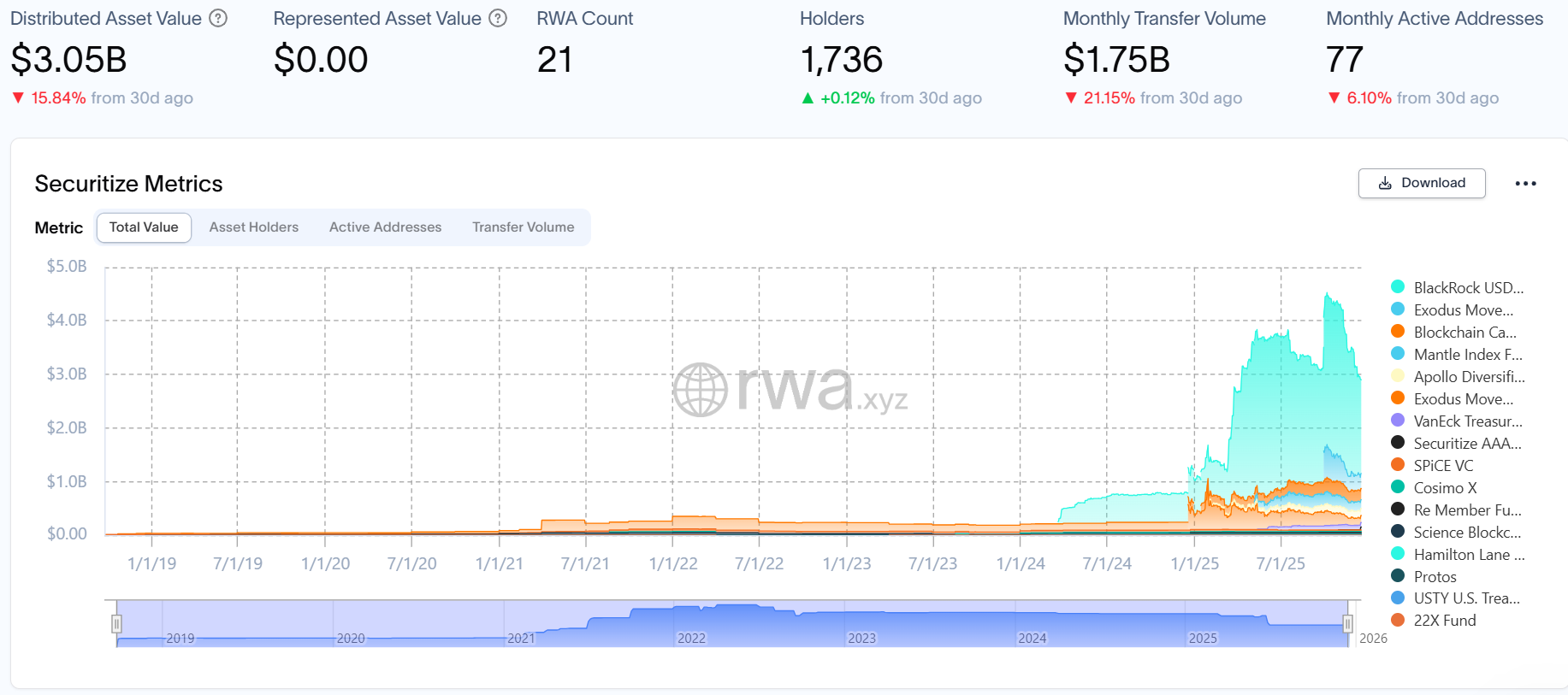
This positioning directly determines Securitize's partners and business form. Securitize's most well-known case is providing tokenization services for BlackRock's BUIDL money market fund. To date, the fund's size has exceeded $1.7 billion, making it the largest tokenized money fund product in the current RWA market.

In addition, Securitize has partnered with several traditional asset management institutions including Apollo, KKR, Hamilton Lane, and VanEck. Official data shows that its cumulative tokenized asset scale has surpassed $3 billion. If the early stages of RWA were more about "conceptual feasibility," then Securitize's business has begun to enter the verification stage of "institutional feasibility."
This "bridge-type" positioning is also clearly reflected in Securitize's financing and shareholder structure.

Public information shows that Securitize has raised approximately $122 million to $147 million through multiple rounds of private equity financing. Early investors mostly came from the crypto industry itself, including Coinbase, Ripple, etc. As the RWA narrative gradually clarified, its shareholder structure also changed significantly, with traditional financial giants such as Morgan Stanley and BlackRock entering one after another. The number of investors exceeds 50, and it has also received significant holdings from Cathie Wood's ARK Invest.

This process from "crypto circle recognition" to "Wall Street endorsement" is not accidental but a natural result of its business path and institutional choices.

Under This Logic, Moving Towards the Capital Market is Not Surprising

On October 28, Securitize announced that it would go public through a merger with special purpose acquisition company (SPAC) Cantor Equity Partners II, Inc. After the transaction is completed, the company's valuation is expected to reach $1.25 billion, and it plans to trade under the ticker symbol SECZ.

Cantor Equity Partners II, Inc. (NSDQ:CEPT) is sponsored by a company under financial services giant Cantor Fitzgerald, with its head being Brandon Lutnick, son of the U.S. Secretary of Commerce. Notably, Twenty One, the third-largest bitcoin reserve company, also went public by merging with another SPAC under Cantor Fitzgerald, showing the group's continued layout in the crypto asset field.

To support the listing and public market operations, Securitize has also simultaneously strengthened its compliance and governance capabilities, announcing the appointment of former PayPal digital asset legal head Jerome Roche as General Counsel, preparing for future continuous reporting and regulatory communication on Nasdaq.

Conclusion

Returning to Securitize itself, as a leading project in the RWA track, the market's earliest expectation for it might have been just when it would issue a token. But judging from today's progress, this expectation itself might just be the inertial thinking of the crypto market.

What Securitize is ultimately moving towards is not a narrative stage centered around a token, but the larger structure formed by the capital market and regulatory system. But this choice itself is not surprising. Because from the beginning, the role it has played has been closer to a bridge connecting TradFi and DeFi.

In this sense, Securitize's development path may reflect the profound transformation the RWA narrative is undergoing, moving from imagination to reality, from concept to institution. How far this path can go depends not only on the expansion speed of a certain company but also on whether the traditional financial system is truly willing to reserve a realistic space for "native on-chain assets."

Preguntas relacionadas

QWhat is the key difference between Securitize's planned on-chain stock product and existing stock tokenization models?

ASecuritize's native on-chain stock represents a direct, legally recognized share of equity issued natively on the blockchain and recorded on the issuer's official cap table, granting holders full shareholder rights like dividends and voting. This differs from synthetic models (which are just price-tracking derivatives) and beneficial interest models (where a custodian holds the real stock and issues an IOU token).

QWhat major traditional asset management firms has Securitize partnered with for its tokenization services?

ASecuritize has partnered with major traditional asset managers including BlackRock, Apollo, KKR, Hamilton Lane, and VanEck.

QHow is Securitize planning to become a publicly traded company and what is its expected valuation?

ASecuritize is planning to go public through a merger with a Special Purpose Acquisition Company (SPAC) called Cantor Equity Partners II, Inc. The combined company is expected to have a valuation of $1.25 billion and trade under the ticker symbol SECZ.

QWhat is the total value of assets that Securitize has tokenized so far, and what is its most prominent product?

ASecuritize has cumulatively tokenized over $3 billion in assets. Its most prominent product is the tokenized BlackRock USD Institutional Digital Liquidity Fund (BUIDL), which is the largest tokenized money market fund in the RWA market with over $1.7 billion in assets.

QWhat regulatory and infrastructure challenges does the native on-chain stock model face compared to other tokenization approaches?

AThe native on-chain stock model faces higher complexity and compliance costs because it must satisfy securities regulations, corporate law, and transfer agent requirements, and integrate with existing financial infrastructure. This is more challenging than synthetic or beneficial interest models, which are faster to launch, cheaper, and more easily compatible with DeFi but do not provide direct legal ownership.

Lecturas Relacionadas

Stuck Polymarket: The Real Test After Riding the Traffic Boom Has Arrived

Polymarket, a leading prediction market platform, is facing significant technical challenges as its growth outpaces its current infrastructure on Polygon. Users are experiencing laggy transactions, unresponsive orders, and delayed confirmations, severely impacting the trading experience. In response, DeFi Engineering VP Josh Stevens outlined a comprehensive engineering overhaul. The plan includes reducing on-chain data delays, fixing order cancellation issues, rebuilding the central limit order book (CLOB), improving website performance, and developing a unified SDK and API. A major revelation was the ongoing "chain migration," indicating a potential move away from Polygon. The core issue is that Polymarket has evolved from a simple prediction market into a high-frequency trading platform, making Polygon's limitations—such as block space, gas fees, and block time—a ceiling for further growth. The migration is not just a simple chain switch but a fundamental rebuild of its trading system to support more complex products like perpetual contracts (Perps). This announcement has sparked competition among chains like Solana, Sui, and Algorand, all vying to host Polymarket. For Polygon, losing this key application, which contributes significantly to its gas fee revenue, would be a major setback. The real test for Polymarket is no longer attracting users but proving it can provide a stable, reliable trading environment that retains them.

Odaily星球日报Hace 16 min(s)

Stuck Polymarket: The Real Test After Riding the Traffic Boom Has Arrived

Odaily星球日报Hace 16 min(s)

Lowering Expectations for BTC's Next Bull Market

The author, Alex Xu, explains his decision to significantly reduce his Bitcoin holdings (from full to ~30% of his portfolio) during the current bull cycle, citing a lowered long-term outlook for BTC's price appreciation in the next cycle. He outlines six key reasons for this reduced expectation: 1. **Diminished Growth Drivers:** The narrative of exponential user adoption has largely played out with institutional ETF adoption. The next major growth phase—adoption by sovereign national reserves or central banks—seems unlikely in the near future. 2. **Personal Opportunity Cost:** More attractive investment opportunities have emerged in other assets, such as undervalued companies. 3. **Industry-Wide Contraction:** The broader crypto industry is struggling, with most Web3 business models (SocialFi, GameFi, DePIN) failing. This overall萧条 (depression) reduces the fundamental demand and consensus for Bitcoin. 4. **Strain on Major Buyer:** MicroStrategy, a major corporate buyer of BTC, faces rising financing expenses for its debt, which could slow its purchasing rate and create significant marginal pressure on the market. 5. **Increased Competition from Gold:** The emergence of "tokenized gold" has closed the functional gap (portability, divisibility) between physical gold and Bitcoin, offering a strong competitor in the non-sovereign store-of-value space. 6. **Security Budget Concerns:** The block reward halving continues to exacerbate the long-standing issue of funding Bitcoin's network security, with new fee source explorations like Ordinals and L2s largely failing. The author's decision to hold a significant (though reduced) position reflects a cautious, not bearish, outlook. He remains open to increasing his exposure if the fundamental reasons for his skepticism change or if new positive catalysts emerge.

marsbitHace 54 min(s)

Lowering Expectations for BTC's Next Bull Market

marsbitHace 54 min(s)

Can Iran 'Control' the Strait of Hormuz?

Iran has announced a comprehensive plan to assert control over the strategic Strait of Hormuz, a critical global oil shipping chokepoint. The proposed measures include requiring all vessels to obtain Iranian permission for passage, imposing fees for security, environmental protection, and navigation management—preferably paid in Iranian rials—and absolutely banning Israeli ships. Vessels from countries deemed hostile by Iran’s top security bodies may also be barred. Analysts suggest Iran’s motives are multifaceted: increasing pressure on the U.S. and Israel by leveraging control over oil transit to influence global prices and inflation; creating a new revenue stream, potentially exceeding $7.7 billion annually, to counter Western sanctions and support postwar reconstruction; and using transit permissions as bargaining chips in future negotiations, notably with the U.S. However, the plan faces significant practical and diplomatic challenges. Enforcing comprehensive interception and fee collection in the busy waterway, patrolled by international military forces, would be difficult. The U.S. has already countering with a blockade of Iranian ports and threats to intercept any ship paying fees, potentially strangling Iran’s oil exports and fee revenue. Broad international opposition, led by European and Gulf states, and legal controversies further complicate implementation. The proposal may ultimately serve more as a negotiating tactic than a feasible policy, with its execution remaining highly uncertain.

marsbitHace 2 hora(s)

Can Iran 'Control' the Strait of Hormuz?

marsbitHace 2 hora(s)

Trading

Spot
Futuros
活动图片

