USDC gets major banking push from Standard Chartered – Details!

ambcryptoPublicado a 2026-07-03Actualizado a 2026-07-03

Resumen

Standard Chartered and Circle have partnered to bring USD Coin (USDC) closer to traditional banking. The collaboration enables institutional clients to mint and redeem USDC directly through Standard Chartered's banking platform, starting in the Dubai International Financial Centre (DIFC) with plans for expansion. This integrated service combines banking, custody, and digital asset offerings, eliminating the need for separate accounts with Circle. Standard Chartered claims it is the first Global Systemically Important Bank to provide such a service. The partnership is significant as the stablecoin market has grown substantially, with USD-pegged stablecoin supply nearly doubling from about $160 billion to around $300 billion over the past 24 months. While Tether (USDT) remains the market leader, USDC is the second-largest stablecoin, maintaining a supply of $70-$80 billion. This scale and Circle's established corporate presence make USDC a likely choice for institutional adoption through this new banking-led access.

Standard Chartered and Circle are bringing USD Coin [USDC] closer to traditional banking. This new partnership will help institutions mint and redeem USDC through bank-led rails, starting in Dubai’s DIFC.

USDC minting moves to Standard Chartered’s banking platform

Standard Chartered and Circle have created a way for institutional clients to mint and redeem USDC through a bank-led process. This would be instead of setting up separate accounts directly with Circle.

The financial giant has stated that it is the first Global Systemically Important Bank to offer this kind of USDC service. According to its statement, the company announced,

AD

By embedding USDC access directly within Standard Chartered’s institutional offering, Standard Chartered will bring together banking, custody, and digital asset services within one integrated offering…

The first rollout will happen through the Dubai International Financial Centre, with expansion to other markets planned. The service is said to also support payment-related use cases later.

The scale makes it that much important

This development comes at a good time though, especially since stablecoins are no longer a niche product. In fact, Artemis showed that USD-pegged stablecoin supply has nearly doubled over the past 24 months. We went from about $160 billion to around $300 billion by July 2026.
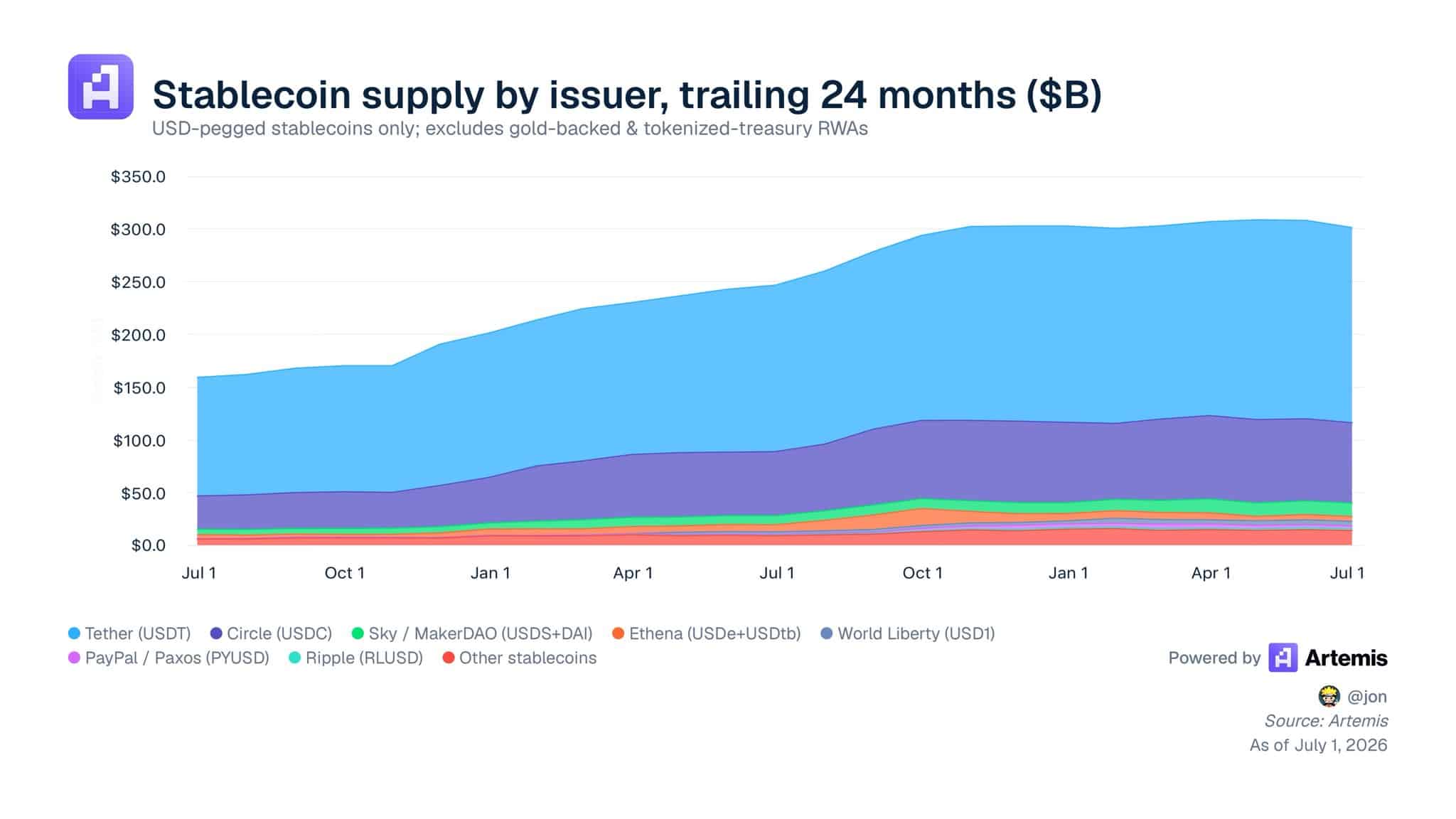
Source: Artemis

While USDT [Tether] still leads the market, Circle’s USDC is still the second-largest stablecoin. It is also one of the greater corporate plays in the space. That becomes important when you think of Standard Chartered’s move, with the bank building access around a stablecoin that already has scale.

USDC supply has stayed around the $70 billion-$80 billion range in recent months, so that demand has held up even with new issuers entering the market. So, while stablecoins may have multiple long-term winners, Circle is still one of the names institutions are most likely to work with.


Final Summary

  • Standard Chartered and Circle will let institutions mint and redeem USDC.
  • USDC is the second-largest stablecoin, with 70B-$80B in supply.

Criptos en tendencia

Preguntas relacionadas

QWhat is the main partnership announced between Standard Chartered and Circle regarding USDC?

AStandard Chartered and Circle have partnered to allow institutional clients to mint and redeem the USD Coin (USDC) stablecoin through a bank-led process within Standard Chartered's platform, starting in Dubai's DIFC.

QHow is Standard Chartered positioning itself with this new USDC service?

AStandard Chartered is positioning itself as the first Global Systemically Important Bank (G-SIB) to offer this kind of integrated USDC minting and redemption service for institutions.

QWhat is one key benefit for institutional clients mentioned in the article regarding this partnership?

AA key benefit for institutional clients is that they can access USDC services (minting and redeeming) directly through Standard Chartered's integrated banking, custody, and digital asset offering, eliminating the need to set up separate accounts directly with Circle.

QWhat data does the article cite to show the growth of USD-pegged stablecoins?

AThe article cites data from Artemis showing that the supply of USD-pegged stablecoins has nearly doubled over the past 24 months, growing from about $160 billion to around $300 billion by July 2026.

QWhat is the current approximate supply range of USDC, and how does it rank among stablecoins?

AUSDC's supply has stayed around the $70 billion to $80 billion range in recent months, making it the second-largest stablecoin in the market after USDT (Tether).

Lecturas Relacionadas

Unitree's IPO Frenzy: The Real Mystery is How It Will Spend the 42 Billion Raised

Unitree, a Chinese robotics company, is set for a public listing after its IPO registration was approved by regulators. The company, which started with quadruped robots and has expanded into humanoids, plans to raise approximately 4.2 billion yuan through its offering. The article traces Unitree's rapid growth from its founding in 2016 to its current status. It highlights key milestones like the 2021 CCTV Spring Festival Gala performance, the 2023 launch of its affordable Go2 robot dog and the H1 humanoid robot, and a series of subsequent product launches. By 2025, the company reported revenue of 1.71 billion yuan, profitability, and sales exceeding 5,500 humanoid robots. As the first publicly-listed humanoid robot company on China's STAR Market, Unitree's main challenges are sustaining growth and deploying its newly raised capital effectively. The humanoid robot sector in China is crowded, with over 140 companies. Competitors include UBTech (focusing on industrial and consumer markets), Fourier, and international players like Tesla Optimus and 1X NEO. The article outlines three critical challenges for Unitree: establishing a strong second product line beyond its quadruped robots, maintaining its price advantage while ensuring quality, and successfully advancing its embodied AI capabilities through partnerships like the one with NVIDIA for the H2 Plus platform. Unitree's likely strategy involves a "developer tools + industry benchmarks" approach: using low-cost models like the R1 and G1 to build developer adoption and volume, leveraging high-end platforms for AI training, and securing pilot projects in sectors like logistics and manufacturing to build case studies. The company's future success hinges on converting its current momentum in shipments and pilot programs into sustainable, large-scale commercial contracts as the broader market evolves.

marsbitHace 1 hora(s)

Unitree's IPO Frenzy: The Real Mystery is How It Will Spend the 42 Billion Raised

marsbitHace 1 hora(s)

Examining the Open USD Partner Lineup: Follow Who's Joining to See Where the Money Flows

**Title: Deciphering the Open USD Partner Roster: Following the Money** The launch of Open USD is notable less for the stablecoin itself and more for its expansive list of over 140 founding partners, which reads like a "who's who" of global finance and tech. This coalition, including asset managers like BlackRock, card networks Visa and Mastercard, banks (BNY Mellon, Standard Chartered, etc.), tech giants (Google, IBM), merchants (Shopify), and crypto firms (Coinbase, Ripple, Aave, MetaMask), signals a strategic shift. The diverse membership reveals that stablecoins are increasingly viewed not as products to compete over, but as shared infrastructure too critical to be left to any single entity. Each partner category has distinct motives. Asset managers like BlackRock seek to manage the large, sticky cash reserves, a lucrative fee-generating opportunity. Merchants like Shopify aim for lower-cost settlement and potential yield on balances. Banks join defensively to retain custody and settlement roles, fearing deposit outflows to stablecoins. Tech companies bet on programmable money for future machine-to-machine commerce. Crypto firms gain mainstream legitimacy and distribution channels. Remarkably, the consortium includes direct competitors (Visa vs. Mastercard, Coinbase vs. Ripple), indicating that the fear of exclusion from this emerging financial layer outweighs competitive rivalries. However, this shared governance could also lead to slow decision-making. The roster's composition is the real message: it represents a collective bet that a widely accepted, consortium-owned stablecoin is preferable to proprietary versions or having none at all. For incumbents like Circle and Tether, this alliance poses a significant threat, as potential clients have collectively chosen to build their own alternative. The absence of major U.S. retail banks (busy with their own tokenized deposit networks) is equally telling. In essence, the partner list maps where the industry believes value and risk will flow in a tokenized dollar future, marking stablecoin's evolution from a product to a utility.

Foresight NewsHace 1 hora(s)

Examining the Open USD Partner Lineup: Follow Who's Joining to See Where the Money Flows

Foresight NewsHace 1 hora(s)

Trading

Spot

Artículos destacados

Cómo comprar PUSH

¡Bienvenido a HTX.com! Hemos hecho que comprar Push Protocol (PUSH) sea simple y conveniente. Sigue nuestra guía paso a paso para iniciar tu viaje de criptos.Paso 1: crea tu cuenta HTXUtiliza tu correo electrónico o número de teléfono para registrarte y obtener una cuenta gratuita en HTX. Experimenta un proceso de registro sin complicaciones y desbloquea todas las funciones.Obtener mi cuentaPaso 2: ve a Comprar cripto y elige tu método de pagoTarjeta de crédito/débito: usa tu Visa o Mastercard para comprar Push Protocol (PUSH) al instante.Saldo: utiliza fondos del saldo de tu cuenta HTX para tradear sin problemas.Terceros: hemos agregado métodos de pago populares como Google Pay y Apple Pay para mejorar la comodidad.P2P: tradear directamente con otros usuarios en HTX.Over-the-Counter (OTC): ofrecemos servicios personalizados y tipos de cambio competitivos para los traders.Paso 3: guarda tu Push Protocol (PUSH)Después de comprar tu Push Protocol (PUSH), guárdalo en tu cuenta HTX. Alternativamente, puedes enviarlo a otro lugar mediante transferencia blockchain o utilizarlo para tradear otras criptomonedas.Paso 4: tradear Push Protocol (PUSH)Tradear fácilmente con Push Protocol (PUSH) en HTX's mercado spot. Simplemente accede a tu cuenta, selecciona tu par de trading, ejecuta tus trades y monitorea en tiempo real. Ofrecemos una experiencia fácil de usar tanto para principiantes como para traders experimentados.

230 Vistas totalesPublicado en 2024.12.13Actualizado en 2026.06.02

Cómo comprar PUSH

Discusiones

Bienvenido a la comunidad de HTX. Aquí puedes mantenerte informado sobre los últimos desarrollos de la plataforma y acceder a análisis profesionales del mercado. A continuación se presentan las opiniones de los usuarios sobre el precio de PUSH (PUSH).

活动图片