US Watchdogs Submit Crypto, Prediction Markets Rule Plans For White House Review

bitcoinistPublicado a 2026-03-06Actualizado a 2026-03-06

Resumen

US financial regulators, the SEC and CFTC, have submitted rule proposals to the White House for review, aiming to regulate crypto assets and prediction markets. The SEC’s proposal focuses on applying federal securities laws to crypto assets, potentially establishing a taxonomy for clearer classification and oversight. The CFTC also advanced a rulemaking notice for prediction markets, seeking to set clear standards. Both agencies are collaborating under "Project Crypto" to ensure coherent regulation, prevent market fragmentation, and encourage innovation within U.S. jurisdiction. Officials emphasized the need for clear rules to avoid driving markets offshore.

The Securities and Exchange Commission (SEC) and the Commodities Futures Trading Commission (CFTC) have submitted rule proposals to the White House to oversee the crypto industry and prediction markets, advancing their efforts to provide clarity and regulate emerging markets.

SEC Advances Crypto Taxonomy Plans

This week, Wall Street’s main financial regulators, the SEC and the CFTC, stepped up their efforts to provide formal rules and fully establish a welcoming approach by presenting their rule plans for crypto assets and prediction markets to the White House for review, Bloomberg reported on Wednesday.

Independent agencies such as the SEC and the CFTC weren’t previously mandated to submit new rules to the White House for review, the news media outlet noted. However, in 2025, the Trump administration announced that all executive branch agencies, including US financial regulators, were expected to comply with this requirement.

The White House’s Office of Information and Regulatory Affairs (OIRA) website shows that the agency received a crypto regulatory measure from the SEC on Tuesday regarding the “Application of the Federal Securities Laws to Certain Types of Crypto Assets and Certain Transactions Involving Crypto Assets.”

Bloomberg reported that the commission-level guidance could be related to the taxonomy of crypto assets. An agency spokesperson pointed to previous comments from the SEC’s Chairman Paul Atkins.

Last month, Atkins proposed developing formal guidelines for token classification, in line with the crypto market structure bill, emphasizing that regulatory clarity for digital assets is long overdue.

The agency was set to examine a token taxonomy to define digital assets more accurately and clarify the rules that apply. This could establish categories for crypto assets, determining SEC or CFTC oversight and influencing how firms register, disclose information, and operate.

The SEC’s Chair has advocated for Congress to enact legislation for “future-proof” measures, but has also acknowledged that the agency has substantial authority to proceed with regulations if the market structure bill fails to advance.

CFTC-SEC Push To Foster Regulated Innovation

Notably, the CFTC has also been collaborating with the SEC to bring “coordination, coherence, and a unified approach to the federal oversight of crypto asset markets” through their joint “Project Crypto” initiative.

The sister agencies recently outlined their plan to clarify jurisdictional boundaries, eliminate redundant compliance requirements, and reduce regulatory fragmentation through their collaboration.

CFTC Chairman Michael Selig explained that the agencies aim to ensure that “innovation takes root on American soil, under American law, and in service of American investors, customers, and businesses.”

As part of these efforts, the CFTC submitted an advance notice of proposed rulemaking (ANPR) on prediction markets on Monday, according to the OIRA website. The measure, currently under White House review, could set clear standards for the emerging market, which has exploded in popularity over the past year, but has also faced strong scrutiny in several US states.

On Tuesday, the CFTC chief pledged to establish “very clear standards as to what can be self-certified in our markets and what cannot and how to evaluate the different products that are offered in the space.”

Speaking at the Milken Institute’s Future of Finance conference, Selig noted that, as seen with the crypto industry, the more regulators try to block these markets, the more they move offshore.

“So my view on this stuff is that we’ve got to set the right rules and regulations for it here in the United States, or otherwise, we’re just going to have black markets offshore,” the regulator affirmed.
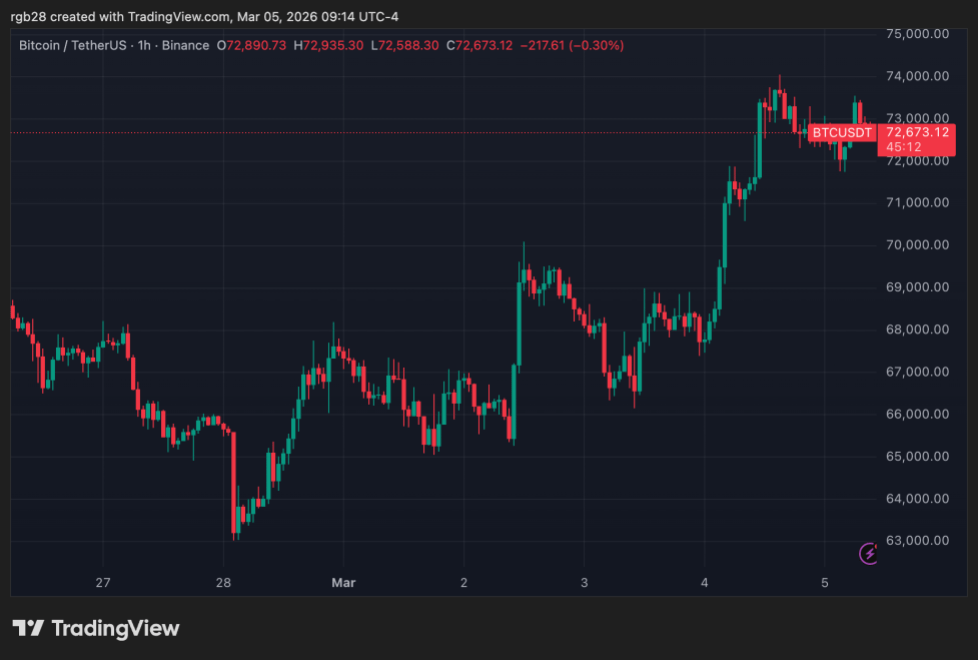
Bitcoin (BTC) trades at $72,673 in the one-week chart. Source: BTCUSDT on TradingView


Preguntas relacionadas

QWhat two US agencies have submitted rule proposals to the White House for the crypto industry and prediction markets?

AThe Securities and Exchange Commission (SEC) and the Commodities Futures Trading Commission (CFTC).

QWhat is the name of the White House office that is reviewing the crypto regulatory measures?

AThe White House’s Office of Information and Regulatory Affairs (OIRA).

QAccording to the article, what did the SEC submit a measure regarding?

AThe 'Application of the Federal Securities Laws to Certain Types of Crypto Assets and Certain Transactions Involving Crypto Assets.'

QWhat is the name of the joint initiative through which the CFTC and SEC are collaborating on crypto oversight?

AProject Crypto.

QWhat did CFTC Chairman Michael Selig argue happens when regulators try to block markets like crypto and prediction markets?

AHe argued that the more regulators try to block these markets, the more they move offshore, creating black markets offshore.

Lecturas Relacionadas

What's the Connection Between Pinduoduo's Huang Zheng and Blockchain?

This text explores the unexpected connection between Pinduoduo founder Colin Huang and blockchain, as suggested in his article *Turning Capitalism Upside Down*. Huang argues Pinduoduo's core business is about managing "uncertainty." He posits that wealth flows to the rich because they absorb life's uncertainties (e.g., illness, job loss) that devastate the poor, who pay a premium for certainty through insurance or stable prices. Pinduoduo's model attempts a "reverse insurance": by aggregating consumer demand via group-buying and flash sales, it creates a large, predictable order for manufacturers. This certainty allows factories to remove risk premiums, passing savings back as lower prices, thus partially reversing the wealth flow. The key obstacle, Huang notes, is that an individual's buying intent is an unreliable promise. He then asks if blockchain is the natural solution for this "reverse insurance." The text elaborates that blockchain, through smart contracts with binding deposits, could transform casual intent into a costly-to-break, enforceable commitment. This replaces interpersonal trust with coded rules, making promises credible, pricable, and resistant to fraud. Finally, the author draws a parallel to Bitcoin, framing two paths to creating certainty: the "Pinduoduo path" of aggregating decentralized will into scale, and the "Bitcoin path" of locking rules into immutable code. Both sacrifice something—personal freedom or system flexibility—to manufacture trust and predictability.

链捕手Hace 36 min(s)

What's the Connection Between Pinduoduo's Huang Zheng and Blockchain?

链捕手Hace 36 min(s)

The Storage Magnate Who Conquered a Trillion-Dollar Kingdom, Yet Ultimately Could Not Become the Richest

**Summary:** "The Memory Magnate Who Built a Trillion-Dollar Empire, Yet Never Became the Richest" explores the journey of Zhu Yiming, founder of GigaDevice (603986) and co-founder of the soon-to-IPO ChangXin Memory Technologies (CXMT). The article positions GigaDevice, a fabless chip designer now valued at ~¥340 billion, as a prequel to the massive IDM (Integrated Device Manufacturer) venture, CXMT. Starting in 2005 with minimal capital, Zhu strategically "picked up the pieces" by focusing on niche markets like NOR Flash and microcontrollers (MCUs), areas major players were exiting. This allowed GigaDevice to grow into a diversified semiconductor company, maintaining robust profitability even during industry downturns by controlling costs. However, the piece argues that in the highly cyclical and capital-intensive memory chip industry, the fabless model has limits. True resilience and scale require the ability for "counter-cyclical expansion" – investing heavily during downturns – a tactic only possible for IDMs like Samsung or SK Hynix. This insight led Zhu to partner with the Hefei city government in 2016 to establish CXMT, an IDM focused on DRAM. Zhu's symbolic moves, like forfeiting salary and diluting his equity, were crucial in securing the massive state and bank funding needed. CXMT's equipment base is now valued even higher than that of BYD's vast auto manufacturing empire. Despite the potential for CXMT to reach a market cap of ¥1-2 trillion upon its IPO, Zhu's indirect stake in both companies is estimated below 3%, placing his personal wealth far below that of China's top billionaires. The article concludes that his strategic vision built a trillion-yuan memory landscape, but the capital structure necessary to achieve it precluded a personal fortune of similar scale.

marsbitHace 43 min(s)

The Storage Magnate Who Conquered a Trillion-Dollar Kingdom, Yet Ultimately Could Not Become the Richest

marsbitHace 43 min(s)

XRP Ledger Daily Fees Drop Below $400 As Network Activity Question Returns

The XRP Ledger is drawing attention as daily network fees have fallen below $400. While low fees align with XRPL's design for affordable transactions and are often seen as a strength, the metric can also serve as an indicator of network demand and paid transaction volume. This data point of around $3,100 in weekly fee burn highlights the stark contrast with higher-fee chains like Ethereum and Bitcoin. The development fuels an ongoing debate. Proponents view low fees as a sign of efficiency and accessibility, while critics may question if the network is generating sufficient high-value activity relative to its market cap and payments-focused narrative. The article cautions against overstating the finding, noting a single low-fee day does not signify network failure. It instead adds context to discussions about XRPL's usage, especially alongside Ripple's broader initiatives in stablecoins (RLUSD), AI payments, and enterprise infrastructure. The report recommends monitoring for a fee rebound, checking transaction counts for a fuller picture, and confirming the trend via native explorers like Bithomp. It frames the story within a larger market shift where on-chain data, protocol updates, and infrastructure developments are becoming crucial alongside price action. The editorial stance is to present the verified data, explain its significance for assessing network activity, and avoid hype, positioning it as part of the daily crypto conversation.

bitcoinistHace 5 hora(s)

XRP Ledger Daily Fees Drop Below $400 As Network Activity Question Returns

bitcoinistHace 5 hora(s)

Trading

Spot
Futuros

Artículos destacados

Cómo comprar HOUSE

¡Bienvenido a HTX.com! Hemos hecho que comprar Housecoin (HOUSE) sea simple y conveniente. Sigue nuestra guía paso a paso para iniciar tu viaje de criptos.Paso 1: crea tu cuenta HTXUtiliza tu correo electrónico o número de teléfono para registrarte y obtener una cuenta gratuita en HTX. Experimenta un proceso de registro sin complicaciones y desbloquea todas las funciones.Obtener mi cuentaPaso 2: ve a Comprar cripto y elige tu método de pagoTarjeta de crédito/débito: usa tu Visa o Mastercard para comprar Housecoin (HOUSE) al instante.Saldo: utiliza fondos del saldo de tu cuenta HTX para tradear sin problemas.Terceros: hemos agregado métodos de pago populares como Google Pay y Apple Pay para mejorar la comodidad.P2P: tradear directamente con otros usuarios en HTX.Over-the-Counter (OTC): ofrecemos servicios personalizados y tipos de cambio competitivos para los traders.Paso 3: guarda tu Housecoin (HOUSE)Después de comprar tu Housecoin (HOUSE), guárdalo en tu cuenta HTX. Alternativamente, puedes enviarlo a otro lugar mediante transferencia blockchain o utilizarlo para tradear otras criptomonedas.Paso 4: tradear Housecoin (HOUSE)Tradear fácilmente con Housecoin (HOUSE) en HTX's mercado spot. Simplemente accede a tu cuenta, selecciona tu par de trading, ejecuta tus trades y monitorea en tiempo real. Ofrecemos una experiencia fácil de usar tanto para principiantes como para traders experimentados.

247 Vistas totalesPublicado en 2025.04.27Actualizado en 2026.06.02

Cómo comprar HOUSE

Discusiones

Bienvenido a la comunidad de HTX. Aquí puedes mantenerte informado sobre los últimos desarrollos de la plataforma y acceder a análisis profesionales del mercado. A continuación se presentan las opiniones de los usuarios sobre el precio de HOUSE (HOUSE).

活动图片












