US Treasury Secretary Urges Congress To Pass Crypto Market Structure Bill This Spring

bitcoinistPublicado a 2026-02-14Actualizado a 2026-02-14

Resumen

US Treasury Secretary Scott Bessent has urged Congress to pass the stalled crypto market structure bill, the CLARITY Act, this spring to provide market reassurance amid recent volatility. He noted that some industry opposition has contributed to instability and emphasized the importance of bipartisan cooperation to advance the legislation. Bessent warned that the opportunity could diminish if Democrats gain control of the House in November. Patrick Witt of the Crypto Council also discussed the bill's progress, highlighting that the Senate Agriculture Committee portion has passed, but the Banking Committee's section remains pending. He called for compromise to address issues like stablecoin regulations without derailing the broader bill, which includes key measures on regulatory clarity and developer protections.

The US Secretary of the Treasury has called for the passage of the long-awaited crypto market structure bill this spring to provide reassurance to the industry amid recent market volatility.

Bessent Calls For Crypto Market Structure Bill

On Friday, Treasury Secretary Scott Bessent urged the US lawmakers to pass the stalled crypto market structure bill soon, highlighting the importance of getting the legislation on President Donald Trump’s desk before the end of the spring legislative window.

In a CNBC interview, Bessent affirmed that part of the recent market volatility was “self-induced” due to the reaction of some industry participants to the bill. He affirmed that some digital assets firms have been blocking it, which hasn’t been “good for the overall crypto community.”

Notably, the long-awaited CLARITY Act has been stalled for nearly a month after the Senate Banking Committee published its bill draft. The legislation was heavily criticized by crypto industry leaders, who slammed multiple of its policies, including key restrictions for stablecoin issuers.

The Treasury Secretary considers that passing the bill would “give great comfort” to the market at a time of significant volatility. Moreover, he pointed out that there’s a bipartisan working group trying to advance the legislation, with democrats “that want to work with republicans on getting a market structure bill.”

However, Bessent noted that the chances of getting a deal done could fall apart if Democrats take control of the House of Representatives in November, highlighting the Biden administration’s crackdown on the industry.

“There’s a lot of innovation that goes on adjacent to crypto, the blockchain, and DeFi. So, I think it’s important to get this clarity bill done as soon as possible and on the president’s desk this spring,” he concluded.

‘More Work To Be Done’

Similarly, Patrick Witt, executive director of the US President’s Council of Advisors for Digital Assets, discussed the progress on the crypto market structure bill on Friday.

Speaking with Yahoo Finance, Witt stated, “We are working hard to address the issues that were raised that led to the postponement of that markup and hopefully get that back on the book soon.”

He highlighted that lawmakers were able to pass the Senate Agriculture Committee’s half of the CLARITY Act, which handles the Commodity Futures Trading Commission (CFTC)’s portion of the bill.

The Crypto Council’s executive director outlined that once the Senate Banking Committee’s portion of the bill is passed, the two pieces of legislation will need to be reconciled before a final vote on the Senate floor. “So, more work to be done, but we are a step closer with the passage of the Ag portion of this a couple of weeks ago,” he said.

Discussing who must bend to advance the bill, Witt affirmed that both sides would have to compromise. “It’s unfortunate that this has become such a big issue, because ultimately, this is not the stablecoin bill that was the GENIUS Act,” he said.

“What we’ve encouraged both sides to do is find a middle ground. Let’s use a scalpel heel here to address this narrow issue of idle yield (...). But let’s not take a chainsaw out of this; let’s not let this derail the bill. There is so much goodness in this bill, no matter what your perspective is,” Witt continued.

He listed some of the “excellent measures” proposed in the bill, including the clear line between the SEC and the CFTC, regulatory jurisdiction, and developer protections, which he considers to be “critical to future-proof this industry from a future Gary Gensler or, God forbid, a Secretary of the Treasury Elizabeth Warren.”

Lastly, he shared that the White House might host another meeting between the banking and crypto industry to discuss the payment of stablecoin rewards.
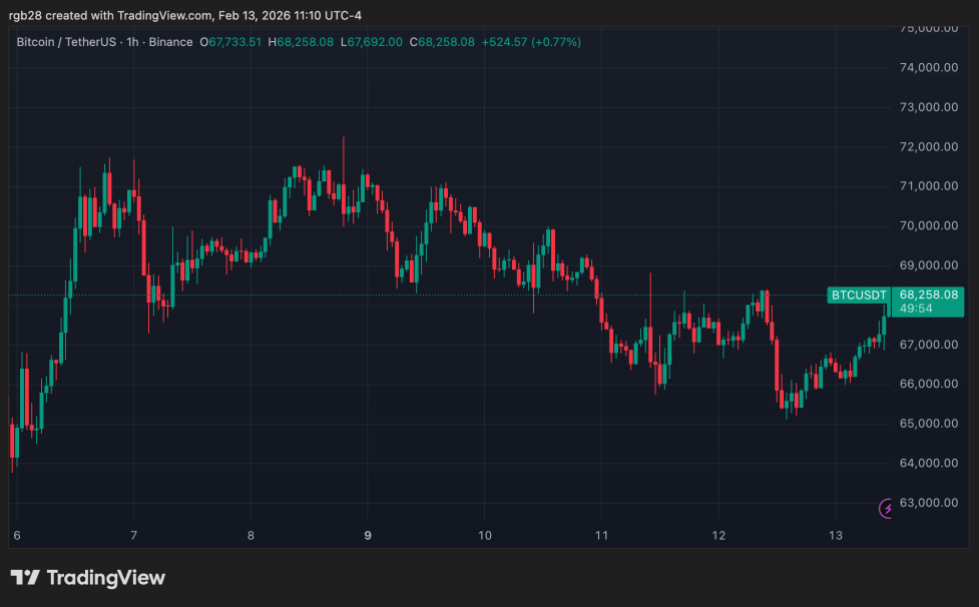
Bitcoin (BTC) trades at $68,258 in the one-week chart. Source: BTCUSDT on TradingView

Preguntas relacionadas

QWho is urging Congress to pass the crypto market structure bill and when?

AUS Treasury Secretary Scott Bessent is urging Congress to pass the crypto market structure bill this spring.

QWhat is the name of the specific bill that has been stalled in the Senate?

AThe specific bill is called the CLARITY Act.

QAccording to the Treasury Secretary, why is it important to pass the bill quickly?

AHe believes passing the bill would 'give great comfort' to the market during a time of significant volatility and provide regulatory clarity for the industry.

QWhat potential political event could cause the chances of a deal to 'fall apart'?

AThe chances of a deal could fall apart if Democrats take control of the House of Representatives in November.

QWhich two committees' bills need to be reconciled before a final Senate vote?

AThe bills from the Senate Banking Committee and the Senate Agriculture Committee need to be reconciled.

Lecturas Relacionadas

Can Generative Models Finally Be Trained End-to-End? The Core Is a For Loop

This article introduces a novel training paradigm for generative models called Explorative Modeling (XM), which enables true end-to-end training. Traditionally, powerful generative models like autoregressive and diffusion models are not trained end-to-end. They are trained to predict a single small step but require iterative multi-step sampling for inference. This "exposure bias" leads to error accumulation and limits performance. The core challenge XM addresses is "mode blurring." In generative tasks, a single input (e.g., "generate a dog") corresponds to many valid outputs (multiple modes). Standard training objectives like reconstruction loss force the model to average these modes, producing unrealistic, blurry outputs. To avoid this, existing models break generation into many small, almost deterministic steps, sacrificing end-to-end training. XM tackles this by restructuring the training loop itself. Its key insight is to amplify "generative expressivity." For each training input, instead of generating one sample, the model generates K candidate outputs. Only the candidate closest to the real data is used for computing the loss and updating the model via backpropagation. This simple "best-of-K" mechanism is implemented as a short for-loop. By exploring multiple possibilities, the model learns to distribute its guesses across different modes rather than collapsing to their uninformative average. The paper demonstrates that "exploration" acts as a new, powerful scaling axis. Gains from XM increase with model size, data scale, and compute. Experiments show improvements in FID scores for image generation and significant efficiency gains, sometimes outperforming larger models without exploration. When pushed to the limit, XM enables fully single-step, end-to-end generative models. In robotics tasks, an "Explorative Policy" matched the performance of a 100-step Diffusion Policy with a single forward pass, drastically improving inference speed. While the best-of-K concept is not entirely new, the authors' contribution lies in formally understanding it as a direct method to boost generative expressivity without fragmenting the generation process. This work suggests that as models scale, enhancing exploration during training may become crucial for overcoming fundamental performance bottlenecks.

marsbitHace 50 min(s)

Can Generative Models Finally Be Trained End-to-End? The Core Is a For Loop

marsbitHace 50 min(s)

Annual Salary of Millions Competing for Electricians, Meta Rushes to Open Its Own Technical School

The AI boom is facing an unexpected bottleneck: a severe shortage of skilled construction workers and electricians. As tech giants like Meta, OpenAI, and Alphabet race to build massive data centers—such as OpenAI's $16 billion "Stargate" project—they are hitting a critical labor wall. The U.S. needs an estimated 130,000 more electricians, 240,000 construction workers, and 150,000 supervisors by 2030 for AI infrastructure alone, but tens of thousands of electrician jobs go unfilled each year. While AI companies offer high premiums, with electricians earning up to $280,000 annually, worker scarcity still causes massive losses—delays on a single project can cost $14.2 million per month. The complexity of building AI data centers, which require immense power (equivalent to powering hundreds of thousands of homes), sophisticated electrical systems, and advanced liquid cooling solutions, demands highly skilled technicians who are in short supply. To combat this, companies are investing heavily in training. Meta has committed $115 million to a free training school offering tuition, housing, and stipends, targeting 5,000 new workers. OpenAI is partnering with unions to secure skilled labor. These efforts are paying off, with a significant rise in Gen Z interest in trade schools over college. However, the power demands are staggering. AI data centers are driving a rapid surge in electricity consumption, projected to account for up to 12% of U.S. power use by 2028 and raising costs for consumers. Furthermore, the construction boom is project-based, leading to a potential future glut of trained workers once building peaks, which could depress wages industry-wide. The race for AI supremacy now depends as much on skilled hands as on advanced chips.

marsbitHace 2 hora(s)

Annual Salary of Millions Competing for Electricians, Meta Rushes to Open Its Own Technical School

marsbitHace 2 hora(s)

Trading

Spot
活动图片