US spot Bitcoin ETFs attract $1 billion — highest since April

cryptonews.ruPublicado a 2026-08-08Actualizado a 2026-08-08

Resumen

Spot Bitcoin ETFs in the U.S. have registered their strongest weekly net inflow in months, attracting approximately $1 billion—the highest since April. This rebound comes after a period of fluctuating investor interest and uncertainty regarding crypto regulation and self-custody security. Analyst Eric Balchunas characterized this period as Bitcoin's "quiet IPO," a term describing a generational shift where early investors sell into demand from ETFs and institutions, suppressing price volatility despite significant new capital. The recovery is particularly notable following a major security breach involving the Coldcard hardware wallet, which led to the theft of roughly $116 million in Bitcoin. Balchunas suggested this incident may, over time, enhance the appeal of spot Bitcoin ETFs for investors wary of managing technical security themselves, though a direct causal link to the recent inflows is not proven.

Demand for US spot bitcoin ETFs recovered this week: investors returned after several months of volatile flows, despite uncertainty around digital asset regulation and the security of self-custody.

On Saturday, Bloomberg ETF analyst Eric Balchunas reported that spot funds attracted approximately $1 billion in net inflows for the week — the best result since April and the third-largest week since last October. He described this period as Bitcoin's "quiet IPO."
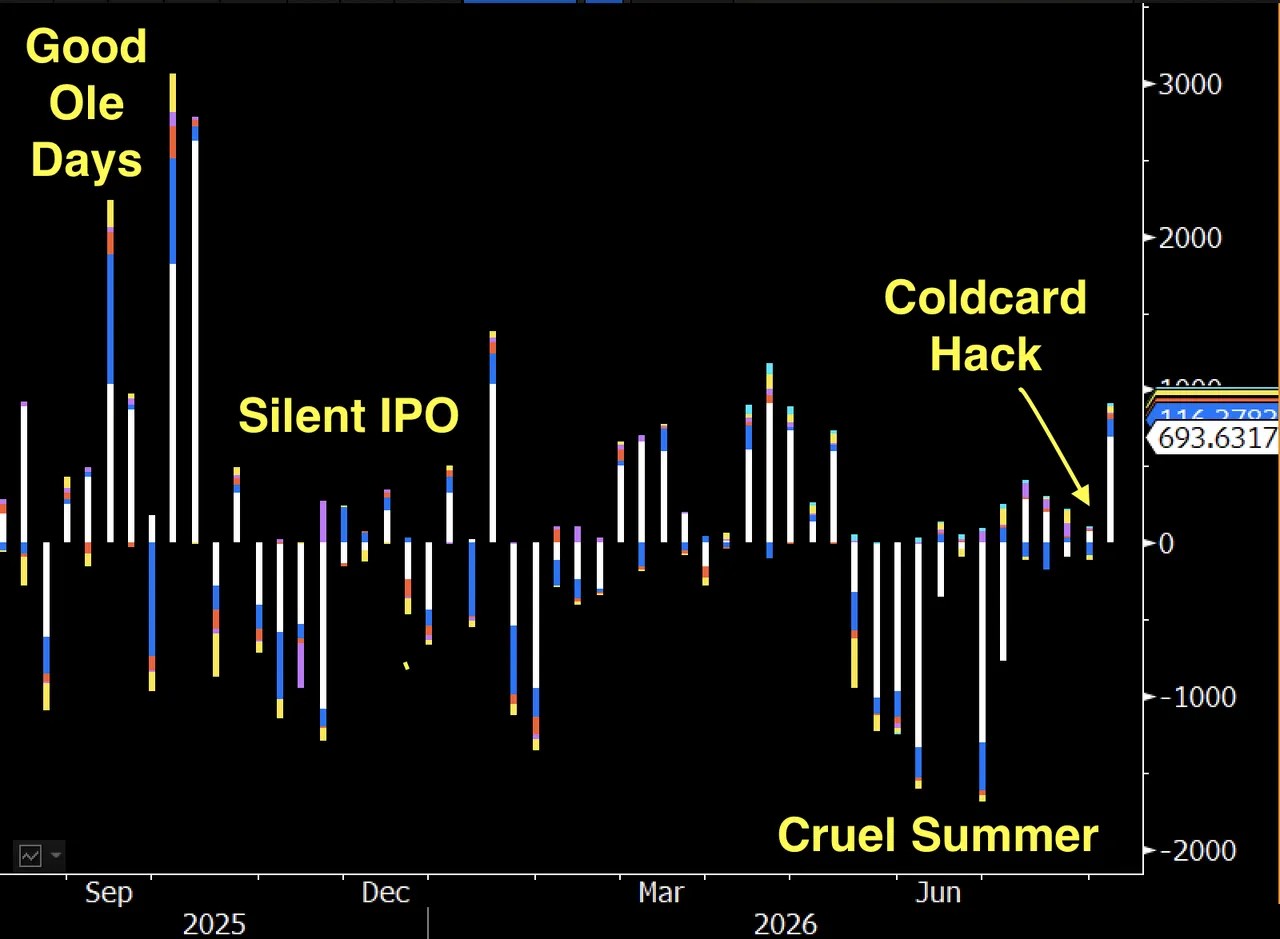
Source: Eric Balchunas

This term was introduced by investor Jordi Visser in November, describing what he sees as a generational shift among Bitcoin holders. According to this theory, early investors sold the asset amid growing demand from ETFs and other institutional buyers. This provided sufficient supply and restrained Bitcoin's rise despite the significant new capital inflow.

The selling by early investors coincided with a weakening of ETF inflows compared to periods of higher demand. Therefore, this week's recovery stands out particularly noticeably.

Related: Bitcoin Miners' Shift to AI Loses Wow Factor for Wall Street

Coldcard Hack Highlights Self-Custody Risks

The recovery followed a major security incident involving Coldcard — Coinkite's popular hardware Bitcoin wallet. As a result, approximately $116 million worth of Bitcoin was stolen. The exploit used a vulnerability in the key generation mechanism on affected devices, allowing attackers to compromise funds in wallets with vulnerable firmware.

On Friday, Balchunas suggested that this incident could over time increase the appeal of spot Bitcoin ETFs for investors unwilling to be solely responsible for technical issues and asset security. He linked the surge in ETF inflows after the hack to a possible, though not yet proven, effect.

Balchunas acknowledged that correlation does not prove causation: "In the long run, it's hard to imagine that no one will switch." This refers to investors who may switch from cold storage to ETFs.

Magazine: Do Coldcard Attacks Mean All Hardware Wallets Are Now Insecure?

end-content

Preguntas relacionadas

QWhat significant milestone did US spot Bitcoin ETFs achieve this week, according to Eric Balchunas of Bloomberg?

AAccording to Eric Balchunas of Bloomberg, US spot Bitcoin ETFs attracted approximately $1 billion in net inflows this week, marking their best performance since April and the third largest week since October of last year.

QWhat term did investor Jordi Visser introduce to describe the shift in Bitcoin holders, and what does it refer to?

AInvestor Jordi Visser introduced the term 'quiet IPO' of Bitcoin to describe a generational shift among holders. It refers to early investors selling their assets amid growing demand from ETFs and other institutional buyers, which provided sufficient supply and curbed Bitcoin's price growth despite significant new capital inflows.

QWhat major security incident preceded the recovery in ETF inflows, and what was its impact?

AThe recovery in ETF inflows was preceded by a major security incident involving the Coldcard hardware wallet from Coinkite. The exploit, which used a vulnerability in the key generation mechanism, led to the theft of approximately $116 million worth of Bitcoin from affected devices.

QHow might the Coldcard security incident influence investor behavior towards spot Bitcoin ETFs in the long term, according to Eric Balchunas?

AEric Balchunas suggested that the Coldcard security incident might, over time, increase the appeal of spot Bitcoin ETFs to investors who are not willing or equipped to handle the technical and security responsibilities of self-custody. He noted a correlation between the hack and the subsequent inflow surge, though he acknowledged correlation does not prove causation.

QWhat is the significance of this week's recovery in ETF inflows given recent market trends?

AThis week's recovery in ETF inflows is particularly significant because it follows several months of volatile or weakened flows, occurring even amidst ongoing regulatory uncertainty and concerns about cryptocurrency self-custody security. It represents a notable reversal and a strong return of investor demand.

Lecturas Relacionadas

Trading

Spot
活动图片