US senator sounds alarm on DeFi, cites PancakeSwap amid market structure delay

cointelegraphPublicado a 2025-12-16Actualizado a 2025-12-16

Resumen

US Senator Elizabeth Warren has called on the Treasury Department and the Department of Justice to investigate potential national security risks posed by decentralized cryptocurrency exchanges, specifically citing PancakeSwap and Uniswap. In a letter to officials, she expressed concerns over money laundering linked to North Korea and possible improper political influence from the Trump administration, including allegations that PancakeSwap promoted coins tied to the Trump family’s crypto venture. Warren emphasized the need for clarity on whether authorities are seriously examining these risks as Congress considers DeFi-related market structure legislation. The markup hearing for the Responsible Financial Innovation Act has been delayed to 2026. Separately, crypto advocate and XRP lawyer John Deaton, who previously ran against Warren, announced he will campaign again for the Senate in 2026.

US Senator Elizabeth Warren, one of the more outspoken voices against digital assets in Congress, is calling for answers from Justice Department and Treasury Department officials about a potential investigation into decentralized crypto exchanges, citing concerns over PancakeSwap and Uniswap.

In a Monday letter to Treasury Secretary Scott Bessent and US Attorney General Pam Bondi, Warren asked whether their respective departments were “investigating significant national security risks posed by decentralized cryptocurrency exchanges like PancakeSwap.”

The Massachusetts senator raised concerns about “improper political influence” from the Trump administration over the selective enforcement of crypto companies and reports of money laundering tied to North Korea, asking for a response by Jan. 12.

“As Congress considers crypto market structure legislation—including rules to prevent terrorists, criminals, and rogue states from exploiting decentralized finance (DeFi) to fund their activities—it is critical to understand whether you are seriously investigating these risks,” Warren wrote to Bessent and Bondi, adding:

“The public deserves to know whether you are investigating the serious risks identified by national security experts and the crypto industry itself.”
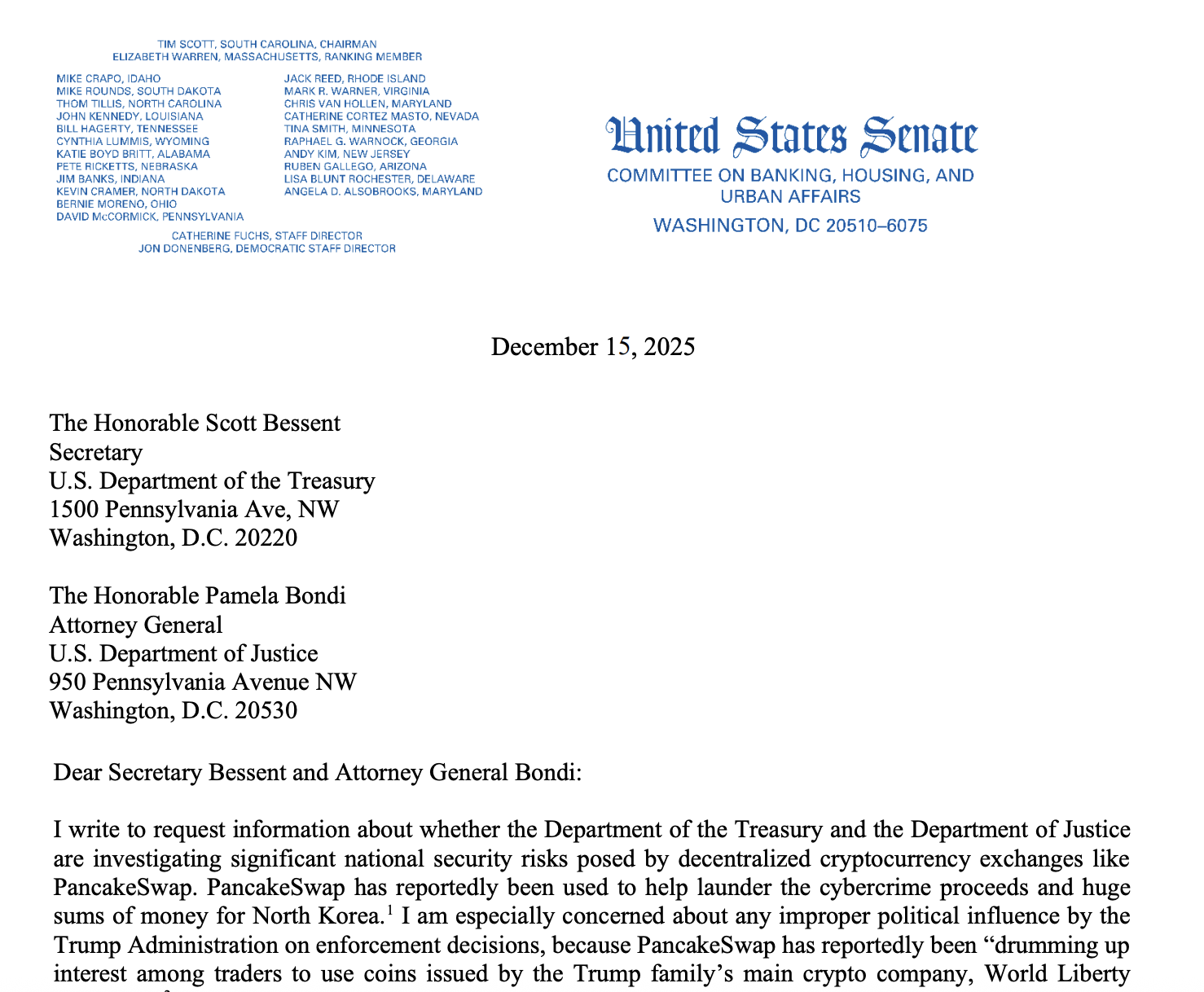
Monday letter from Senator Elizabeth Warren. Source: Senate Banking Committee

Warren’s letter came as the US Senate prepared to wind down activities before the chamber broke for the holidays. Some Republicans on the Banking Committee had expected to address the digital market structure bill, known as the Responsible Financial Innovation Act, before the end of the year. However, Chair Tim Scott confirmed on Monday that a markup hearing on the legislation had been pushed to 2026.

Related: Top US Democrat signals fight over crypto market structure

The Massachusetts senator also raised concerns over reports that PancakeSwap had been “drumming up interest among traders to use coins issued by the Trump family’s main crypto company, World Liberty Financial.”

Some Senate Democrats have raised concerns about the US president’s potential influence and conflicts of interest regarding the legislation, given his and his family’s ties to the crypto industry.

XRP lawyer who challenged Warren in 2024 will run again

John Deaton, the lawyer who ran against Warren in the 2024 US election, is making another bid for Congress. Deaton has been an advocate for XRP (XRP) holders in court, emerging as a prominent figure in the cryptocurrency industry over the past few years.

In November, he announced that he would run as a Republican for the US Senate again in 2026. Warren is not up for reelection next year, so Deaton will be attempting to unseat Democratic Senator Ed Markey.

Magazine: When privacy and AML laws conflict: Crypto projects’ impossible choice

Criptos en tendencia

Lecturas Relacionadas

Bitcoin Withdrawals Continue: 8 Years of Storage in a Coldcard Cold Wallet Ended in Zero

Coldcard Hardware Wallet Hacked: Losses Mount Due to Vulnerable Seed Generation A critical vulnerability in Coldcard hardware wallets has led to a continued wave of fund thefts. According to Galaxy Research, the total stolen has reached 1,367.05 BTC (approx. $88.6 million) from 4,585 addresses, a significant increase from the initial 594.5 BTC reported on July 30, 2026. Most of the stolen funds remain on the attackers' addresses. The issue is not with the current firmware, which Coinkite has updated, but with seed phrases generated on vulnerable devices between March 2021 and the release of fixed firmware versions. Due to a programmer error, devices switched from using a hardware random number generator to the software-based Yasmarang generator, which was initialized with publicly accessible data like the chip's serial number. This made the seed phrases predictable through offline brute-force attacks, meaning wallets remain at risk until funds are moved to a new wallet generated with the patched firmware. Affected devices include Mk2/Mk3 with firmware 4.0.1–4.1.9 (and up to 5.0.3), Mk4/Mk5 up to version 5.6.0, and Q models up to 1.5.0Q. The only exceptions are seeds created with a high-entropy method like at least 50 independent dice rolls or a strong unique BIP-39 passphrase. All other owners must generate a new seed on the fixed firmware and transfer their assets. A case highlighting the human impact involves a 39-year-old long-term investor who lost 2 BTC (approx. $130,000) in minutes. He had accumulated the Bitcoin over eight years through physical labor, viewing it as a financial lifeline and a retirement plan in a country suffering from hyperinflation. His story underscores that even conservative "buy and hold in cold storage" strategies can be compromised by such underlying technical flaws. From a technical perspective, this incident echoes historical failures where weak random number generators undermined cryptographic security, challenging the assumption that offline storage is automatically foolproof.

cryptonews.ruHace 2 hora(s)

Bitcoin Withdrawals Continue: 8 Years of Storage in a Coldcard Cold Wallet Ended in Zero

cryptonews.ruHace 2 hora(s)

Trading

Spot

Artículos destacados

Cómo comprar US

¡Bienvenido a HTX.com! Hemos hecho que comprar Talus Network (US) sea simple y conveniente. Sigue nuestra guía paso a paso para iniciar tu viaje de criptos.Paso 1: crea tu cuenta HTXUtiliza tu correo electrónico o número de teléfono para registrarte y obtener una cuenta gratuita en HTX. Experimenta un proceso de registro sin complicaciones y desbloquea todas las funciones.Obtener mi cuentaPaso 2: ve a Comprar cripto y elige tu método de pagoTarjeta de crédito/débito: usa tu Visa o Mastercard para comprar Talus Network (US) al instante.Saldo: utiliza fondos del saldo de tu cuenta HTX para tradear sin problemas.Terceros: hemos agregado métodos de pago populares como Google Pay y Apple Pay para mejorar la comodidad.P2P: tradear directamente con otros usuarios en HTX.Over-the-Counter (OTC): ofrecemos servicios personalizados y tipos de cambio competitivos para los traders.Paso 3: guarda tu Talus Network (US)Después de comprar tu Talus Network (US), guárdalo en tu cuenta HTX. Alternativamente, puedes enviarlo a otro lugar mediante transferencia blockchain o utilizarlo para tradear otras criptomonedas.Paso 4: tradear Talus Network (US)Tradear fácilmente con Talus Network (US) en HTX's mercado spot. Simplemente accede a tu cuenta, selecciona tu par de trading, ejecuta tus trades y monitorea en tiempo real. Ofrecemos una experiencia fácil de usar tanto para principiantes como para traders experimentados.

609 Vistas totalesPublicado en 2025.12.11Actualizado en 2026.06.02

Cómo comprar US

Discusiones

Bienvenido a la comunidad de HTX. Aquí puedes mantenerte informado sobre los últimos desarrollos de la plataforma y acceder a análisis profesionales del mercado. A continuación se presentan las opiniones de los usuarios sobre el precio de US (US).

活动图片













