US Senate Targets Fall 2026 Release for Crypto Tax Bill Amid CLARITY Act Push

TheNewsCryptoPublicado a 2026-06-24Actualizado a 2026-06-24

Resumen

U.S. Senators are targeting Fall 2026 for the potential release of a dedicated cryptocurrency tax bill. Senator Steve Daines revealed that Republicans have already developed a framework for the legislation, which aligns closely with recent crypto tax proposals from the House of Representatives. The Senate Finance Committee's move is driven by growing congressional interest in establishing clearer tax rules for virtual assets, addressing areas like staking rewards and mining. Concurrently, lawmakers continue to prioritize the broader Digital Asset Market CLARITY Act, which passed the Senate Banking Committee with bipartisan support. This act aims to create comprehensive regulations and define federal regulatory authority over cryptocurrencies. Over 200 industry groups are advocating for its passage, arguing that regulatory clarity will boost innovation and investment. Market observers view the tax bill and the CLARITY Act as complementary efforts to build a more complete regulatory framework for digital assets. While neither proposal has been finalized, the legislative activity signals accelerating progress in U.S. crypto regulation.

U.S. Lawmakers continue to advance digital asset regulations as the Senate moves closer to introducing dedicated cryptocurrency tax legislation. Senator Steve Daines revealed that Republican senators had already developed the framework. During an interview with Bloomberg Tax, Sen. Steve Daines said, “sooner rather than later”. He also said, “We’ve put together a framework,” Which means Congress has developed a framework for deliberation and discussion. Although Daines did not reveal any further information, he added that the plan is very similar to recent cryptocurrency tax bills proposed by the House of Representatives.
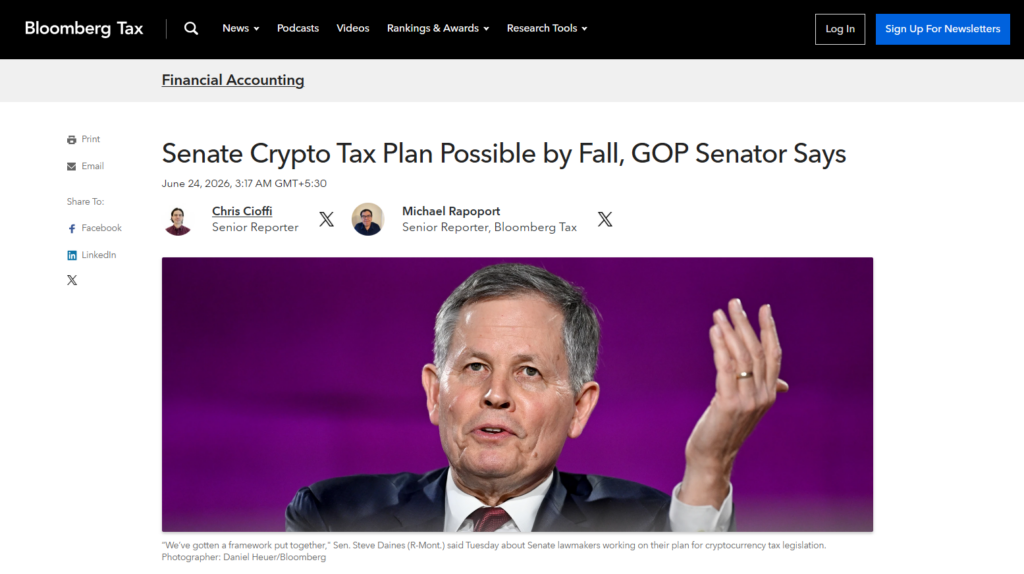
Source: Bloomberg Tax

Growing congressional interest in clearer tax rules for virtual assets prompted the Senate to develop the proposal. The Senate Finance Committee has previously discussed cryptocurrency tax legislation. Especially during hearings on staking rewards, mining, and other issues associated with the reporting of digital assets.

Additionally, several drafts of cryptocurrency tax legislation have been proposed in the House of Representatives, including by the House Ways and Means Committee. The legislation deals with such issues as staking, mining, decentralized finance operations, stablecoin transactions, and others.

CLARITY Act Still the Top Priority

While the Senate is moving forward with its tax proposal, the lawmakers are still discussing the Digital Asset Market CLARITY Act. This act aims at building an all-encompassing regulation for cryptocurrencies and defining regulatory authority for both federal authorities. The Senate Banking Committee passed this bill via a 15-9 bipartisan vote. Although the Senate is awaiting other provisions, the act is already under discussion.

Meanwhile, industry groups remain advocates for the bill, with over 200 cryptocurrency companies calling on the Senate leadership to put the bill up for a vote. They say that clear regulations will spur innovation and investments in the US digital assets market.

Regulatory Clarity Is Still at the Top of the Agenda

Both projects will be followed by market players because taxation and regulation are always crucial for the crypto business and investors. It is believed that the tax provision of the Senate and the CLARITY Act are complementary moves that aim at creating a more complete framework for digital assets. Despite the fact that neither of the projects has been finally approved yet, the activity of Congress demonstrates that the development of legislation for cryptocurrencies is gaining pace. It may be quite interesting for the next few months.

Highlighted Crypto News:

Ripple Secures Preliminary MiCA Approval in Luxembourg for Europe-Wide Expansion

TagsBlockchainBloombergClarity ACTCrypto Taxcrypto taxationSenatorU.SU.S Congress

Criptos en tendencia

Preguntas relacionadas

QWhat is the target release timeline for the US Senate's crypto tax bill, according to the article?

AThe US Senate is targeting a Fall 2026 release for its cryptocurrency tax bill.

QAccording to Senator Steve Daines, what stage has Congress reached regarding the crypto tax framework?

AAccording to Senator Steve Daines, Congress has developed a framework for the cryptocurrency tax legislation for deliberation and discussion.

QWhat is the main goal of the Digital Asset Market CLARITY Act mentioned in the article?

AThe main goal of the CLARITY Act is to build an all-encompassing regulation for cryptocurrencies and define regulatory authority for federal authorities.

QWhy are market players closely following both the Senate's tax proposal and the CLARITY Act?

AMarket players are closely following both projects because taxation and regulation are crucial for the crypto business and investors, and these moves aim to create a more complete framework for digital assets.

QHow did the industry show its support for the CLARITY Act, as per the article?

AOver 200 cryptocurrency companies called on the Senate leadership to put the CLARITY Act up for a vote, advocating that clear regulations will spur innovation and investments in the US digital assets market.

Lecturas Relacionadas

When Billions Begin to Operate Everything by Voice, How Far is ‘All Assets on Chain’?

In June 2026, WeChat began a limited rollout of "Xiaowei," its native AI assistant. This move is more than an upgrade to a smarter chatbot; it signals a crucial step from "universal internet access" toward the broader vision of "full asset tokenization." Xiaowei, powered primarily by WeChat's in-house WeLM model, demonstrates four key capabilities: 1) direct voice/web chat control of app functions, 2) automated access to mini-programs for services, 3) instant comprehension and summarization of complex documents like PDFs, and 4) generating functional mini-program prototypes from simple natural language requests. This represents a fundamental shift from GUI (Graphical User Interface) to LUI (Language User Interface), eliminating friction in human-digital interaction. The rollout is pivotal because it brings AI Agents to China's massive user base with zero friction—no new app downloads or accounts needed. This "seamless access" mirrors past platform revolutions like the App Store or WeChat Mini-Programs, potentially unlocking a global AI Agent market projected to grow from $7.92 billion in 2025 to nearly $295 billion by 2035. The article argues that China's internet evolution has moved from "connecting everyone" to "putting all services online." The next phase is "tokenizing all assets"—a concept broader than just Real World Assets (RWA) like real estate. It encompasses tokenizing personal assets like social influence, attention, and credit history. RWA tokenization itself is forecast to explode from $35 billion in 2025 to over $500 billion in 2026. The convergence of ubiquitous AI Agents and rapidly tokenizing assets points to a future paradigm for wealth management. Your AI Agent could autonomously manage a globally diversified, tokenized portfolio based on your preferences. Initiatives like EXIO Group's full-stack RWA services aim to lower investment barriers, paralleling WeChat's democratization of AI access. In conclusion, the launch of Xiaowei is not merely a technical upgrade but a historic inflection point. It marks AI Agents' transition from niche tools to essential utilities and accelerates the movement toward a future where voice commands seamlessly interact with tokenized value, redefining humanity's relationship with the digital and financial worlds.

marsbitHace 14 min(s)

When Billions Begin to Operate Everything by Voice, How Far is ‘All Assets on Chain’?

marsbitHace 14 min(s)

SoftBank CEO Masayoshi Son's New Trillion-Dollar "Gamble"

SoftBank founder Masayoshi Son is embroiled in a new trillion-dollar "bet" on Physical AI and humanoid robotics, even as his massive wager on OpenAI faces uncertainty ahead of its potential IPO. Recent reports reveal OpenAI's steep losses—$85 billion net loss by Q1 2026 and a $38.5 billion loss in 2025—casting doubt on its path to a trillion-dollar valuation. SoftBank, OpenAI's second-largest external shareholder with a planned 13% stake, stands to gain hugely if OpenAI succeeds. Undeterred, Son is already pushing forward with his next ambitious venture: consolidating SoftBank's AI and robotics assets into a new U.S.-based company named "Roze," targeting a $100 billion IPO as early as late 2026. This move aligns with his belief that Physical AI, merging AI cognition with robotic physical execution, is the next trillion-dollar frontier. Son's confidence stems from recent AI wins; SoftBank's stock surged and he briefly regained the title of Asia's richest person, largely due to OpenAI's soaring valuation. However, his aggressive strategy has raised internal concerns about over-reliance on OpenAI and strained finances. With competitors like Anthropic advancing rapidly and OpenAI's IPO timing uncertain, Son is racing to capitalize on the AI boom. His long-term vision for Physical AI includes a decade of investments in robotics, from Boston Dynamics to recent acquisitions like ABB's robotics unit, and a planned $1 trillion investment in U.S.-based AI robotics industrial parks. Yet, challenges remain: humanoid robotics firms like Figure AI lack the clear revenue paths of AI software companies, and Roze's lofty valuation faces skepticism. For Son, these bets are also driven by an unfulfilled promise of massive returns to key investors like Saudi Arabia's PIF. Despite risks, he continues to double down, betting that the fusion of AI and physical machines will define the next technological era.

marsbitHace 21 min(s)

SoftBank CEO Masayoshi Son's New Trillion-Dollar "Gamble"

marsbitHace 21 min(s)

Trading

Spot
Futuros

Artículos destacados

Cómo comprar PUSH

¡Bienvenido a HTX.com! Hemos hecho que comprar Push Protocol (PUSH) sea simple y conveniente. Sigue nuestra guía paso a paso para iniciar tu viaje de criptos.Paso 1: crea tu cuenta HTXUtiliza tu correo electrónico o número de teléfono para registrarte y obtener una cuenta gratuita en HTX. Experimenta un proceso de registro sin complicaciones y desbloquea todas las funciones.Obtener mi cuentaPaso 2: ve a Comprar cripto y elige tu método de pagoTarjeta de crédito/débito: usa tu Visa o Mastercard para comprar Push Protocol (PUSH) al instante.Saldo: utiliza fondos del saldo de tu cuenta HTX para tradear sin problemas.Terceros: hemos agregado métodos de pago populares como Google Pay y Apple Pay para mejorar la comodidad.P2P: tradear directamente con otros usuarios en HTX.Over-the-Counter (OTC): ofrecemos servicios personalizados y tipos de cambio competitivos para los traders.Paso 3: guarda tu Push Protocol (PUSH)Después de comprar tu Push Protocol (PUSH), guárdalo en tu cuenta HTX. Alternativamente, puedes enviarlo a otro lugar mediante transferencia blockchain o utilizarlo para tradear otras criptomonedas.Paso 4: tradear Push Protocol (PUSH)Tradear fácilmente con Push Protocol (PUSH) en HTX's mercado spot. Simplemente accede a tu cuenta, selecciona tu par de trading, ejecuta tus trades y monitorea en tiempo real. Ofrecemos una experiencia fácil de usar tanto para principiantes como para traders experimentados.

220 Vistas totalesPublicado en 2024.12.13Actualizado en 2026.06.02

Cómo comprar PUSH

Discusiones

Bienvenido a la comunidad de HTX. Aquí puedes mantenerte informado sobre los últimos desarrollos de la plataforma y acceder a análisis profesionales del mercado. A continuación se presentan las opiniones de los usuarios sobre el precio de PUSH (PUSH).

活动图片