US SEC Issues Key Crypto Custody Guidelines For Broker-Dealers

bitcoinistPublicado a 2025-12-19Actualizado a 2025-12-19

In its latest effort to provide clearer regulatory clarity, the US Securities and Exchange Commission (SEC) has published detailed guidelines for broker-dealers on the custody of crypto assets.

SEC Clarifies Crypto Custody Standards For Broker-Dealers

On Wednesday, the SEC’s staff of the Division of Trading and Markets issued a statement addressed its views on the application of paragraph (b)(1) of Rule 15c3-3 to crypto assets that are considered securities, including tokenized versions of an equity or debt security.

Under Securities Exchange Act of 1934, Rule 15c3-3 requires any broker-dealer to “promptly obtain and thereafter maintain physical possession or control of all fully paid and excess margin securities it carries for the account of customers.”

The new guidelines clarify how “any broker-dealer that carries crypto asset securities for customers, including broker-dealers that conduct a traditional securities business” can maintain compliance with this rule despite tokens being on the blockchain.

According to the SEC’s statement, a broker-dealer can consider itself to have “physical possession” of the crypto assets if it has direct access to the asset and the capability to transfer it on the associated distributed ledger technology (DLT).

Broker-dealers must also conduct and document an throughout assessment “of the distributed ledger technology and the associated network where transfers of ownership of a crypto asset security are recorded prior to undertaking to maintain possession of the crypto asset security, and at reasonable intervals thereafter.”

In additions, they must establish, maintain, and enforce “reasonably designed written policies and procedures” to ensure the assets’ security, the protection of private keys, they have adequate plans to address unexpected disruptions to its possession of the crypto assets, including theft, unauthorized used, network attacks, and hard forks.

This circumstance emphasizes that a broker-dealer has policies, procedures, and controls reasonably designed to help ensure that no other person, including the broker-dealer’s customer or a third-party (including the broker-dealer’s affiliate), has access to the relevant private keys and the ability to transfer the asset without the authorization of the broker-dealer.

Meanwhile, the agency explained that “a broker-dealer does not deem itself to possess a crypto asset security if the broker-dealer is aware of any material security or operational problems or weaknesses with the distributed ledger technology and associated network used to access and transfer the crypto asset security or is aware of other material risks posed to the broker-dealer’s business by custodying the crypto asset security.”

SEC’s Path To Clearer Rules

The SEC affirmed that the statement is part of its efforts to provide greater clarity on the application of federal securities laws to crypto assets. Notably, the regulatory agency recently published guidelines to help educate retail investors about the ways they can hold crypto assets and is pushing to modernize its rules to facilitate an positive market environment.

Earlier this month, the US regulator revealed it is evaluating tokenization to modernize the issuance, trading, and settlement of public equities. SEC chairman Paul Atkins asserted that “Distributed ledger technology and the tokenization of financial assets, including securities, have the potential to transform our capital markets.”

Moreover, Atkins recently stated that the Commission could issue innovation exemption rules for crypto firms in early 2026. The agency has been considering the rule exemption since July to “permit novel ways of trading and more narrowly tailored forms of relief to facilitate the building of other components of a tokenized securities ecosystem.”

The change would allow crypto firms to quickly launch products without having to comply with “burdensome prescriptive regulatory requirements that hinder productive economic activity.” Instead, they would “be able to comply with certain principles-based conditions designed to achieve the core policy aims of the federal securities laws.”
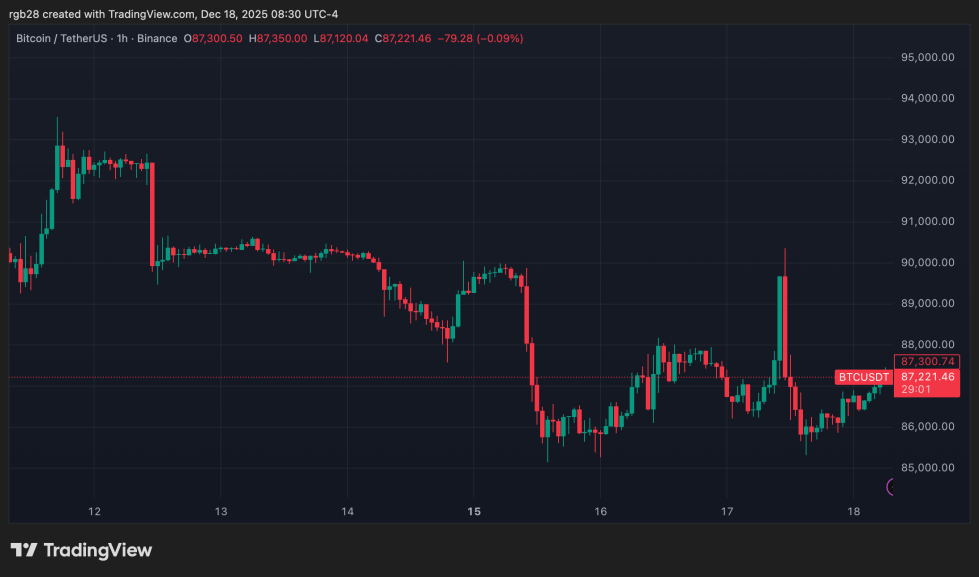
Bitcoin (BTC) trades at $87,221 in the one-week chart. Source: BTCUSDT on TradingView


Criptos en tendencia

Preguntas relacionadas

QWhat is the main focus of the new SEC guidelines for broker-dealers regarding crypto assets?

AThe guidelines clarify how broker-dealers can maintain compliance with Rule 15c3-3 when custodying crypto assets that are considered securities, including requirements for physical possession, security assessments, and written policies.

QAccording to the SEC, when can a broker-dealer consider itself to have 'physical possession' of a crypto asset security?

AA broker-dealer can consider itself to have physical possession if it has direct access to the asset and the capability to transfer it on the associated distributed ledger technology (DLT).

QWhat must broker-dealers assess and document prior to maintaining possession of crypto asset securities?

AThey must conduct and document a thorough assessment of the distributed ledger technology and the associated network where ownership transfers are recorded, both before custody and at reasonable intervals thereafter.

QWhat potential future regulatory change for crypto firms did SEC chairman Paul Atkins mention?

AHe stated that the Commission could issue innovation exemption rules in early 2026, allowing crypto firms to launch products without burdensome prescriptive requirements while complying with principles-based conditions.

QWhat broader initiative is the SEC undertaking regarding tokenization and distributed ledger technology?

AThe SEC is evaluating tokenization to modernize the issuance, trading, and settlement of public equities, recognizing its potential to transform capital markets.

Lecturas Relacionadas

Within Strategy's Framework, STRC's Dividend Yield Remains at 12% as Share Price Stays Below Par Value

Michael Saylor, Executive Chairman of Strategy (MSTR), confirmed that the dividend rate for its STRC perpetual preferred shares will remain at 12.00% through August 2026. The rate has increased from 9% at its July 2025 launch to the current high via a "ratchet" mechanism, which permanently raises the rate by 0.5% whenever the share price falls below $95. This mechanism is intended to push the price back toward its $100 par value and support Strategy's "at-the-market" (ATM) program for issuing new shares to fund Bitcoin purchases. However, the mechanism has not worked as intended. STRC shares closed at $89.46 on July 31, remaining about 10-11% below par value despite the record-high dividend. Competition from rival Strive's higher-yielding SATA securities has pressured demand. The persistent discount has forced Strategy to suspend new STRC issuances via its ATM program, limiting this funding channel for Bitcoin acquisitions. STRC's struggles reflect Bitcoin's own volatility, as the preferred shares historically move in tandem. Analysts have warned the ratchet structure carries long-term, one-way risk. A law firm is investigating Strategy's ability to maintain dividend payments if Bitcoin's price stays low. Retail investors own roughly 83% of outstanding STRC shares, a group seen as prone to panic selling during downturns. In response, Strategy has established financial reserves, including a liquidity cushion covering about 26 months of dividend/interest obligations, and a $2 billion share buyback program alongside a Bitcoin monetization framework, though the company emphasized it is not obligated to sell any Bitcoin.

cryptonews.ruHace 23 min(s)

Within Strategy's Framework, STRC's Dividend Yield Remains at 12% as Share Price Stays Below Par Value

cryptonews.ruHace 23 min(s)

Analyst: Bitcoin's Price Will Drop to $60k in August, Then Rebound to $70k

Financial analyst Andrey Poroshin has provided a new forecast for Bitcoin's price dynamics in August. Poroshin, an analyst at the Bitbanker exchange, expects the cryptocurrency market to experience a downturn this month, with prices retesting the $60,000 level due to a lack of supportive macroeconomic catalysts. He noted that the recent US Federal Reserve decision to hold interest rates did not significantly impact the market, while inflation remains above the 2% target. Poroshin stated that Bitcoin is ending July under pressure from moderate volatility and a lack of new macroeconomic stimuli, leading to continued market caution. According to his base scenario, Bitcoin will drop to a range of $60,000 to $62,000 before recovering to $70,000. He pointed out that even $70,000 remains below the cost of mining in the US, which has prompted some miners to shift towards AI data center operations. Poroshin cited the winding down of BitMEX's operations as a potential catalyst for a price rebound, suggesting the exit of weaker players often coincides with market reversals and reduced short-term selling pressure. He believes Bitcoin is currently less susceptible to geopolitical shocks, such as the Iran-US conflict, and does not expect significant market changes in August related to the pending CLARITY Act. Looking ahead, Poroshin forecasts that September will bring more active price fluctuations driven by potential Fed rate decisions and possible discussions or approval of the CLARITY Act.

cryptonews.ruHace 24 min(s)

Analyst: Bitcoin's Price Will Drop to $60k in August, Then Rebound to $70k

cryptonews.ruHace 24 min(s)

Trading

Spot

Artículos destacados

Cómo comprar US

¡Bienvenido a HTX.com! Hemos hecho que comprar Talus Network (US) sea simple y conveniente. Sigue nuestra guía paso a paso para iniciar tu viaje de criptos.Paso 1: crea tu cuenta HTXUtiliza tu correo electrónico o número de teléfono para registrarte y obtener una cuenta gratuita en HTX. Experimenta un proceso de registro sin complicaciones y desbloquea todas las funciones.Obtener mi cuentaPaso 2: ve a Comprar cripto y elige tu método de pagoTarjeta de crédito/débito: usa tu Visa o Mastercard para comprar Talus Network (US) al instante.Saldo: utiliza fondos del saldo de tu cuenta HTX para tradear sin problemas.Terceros: hemos agregado métodos de pago populares como Google Pay y Apple Pay para mejorar la comodidad.P2P: tradear directamente con otros usuarios en HTX.Over-the-Counter (OTC): ofrecemos servicios personalizados y tipos de cambio competitivos para los traders.Paso 3: guarda tu Talus Network (US)Después de comprar tu Talus Network (US), guárdalo en tu cuenta HTX. Alternativamente, puedes enviarlo a otro lugar mediante transferencia blockchain o utilizarlo para tradear otras criptomonedas.Paso 4: tradear Talus Network (US)Tradear fácilmente con Talus Network (US) en HTX's mercado spot. Simplemente accede a tu cuenta, selecciona tu par de trading, ejecuta tus trades y monitorea en tiempo real. Ofrecemos una experiencia fácil de usar tanto para principiantes como para traders experimentados.

608 Vistas totalesPublicado en 2025.12.11Actualizado en 2026.06.02

Cómo comprar US

Discusiones

Bienvenido a la comunidad de HTX. Aquí puedes mantenerte informado sobre los últimos desarrollos de la plataforma y acceder a análisis profesionales del mercado. A continuación se presentan las opiniones de los usuarios sobre el precio de US (US).

活动图片












