US SEC Issues Key Crypto Custody Guidelines For Broker-Dealers

bitcoinistPublicado a 2025-12-19Actualizado a 2025-12-19

In its latest effort to provide clearer regulatory clarity, the US Securities and Exchange Commission (SEC) has published detailed guidelines for broker-dealers on the custody of crypto assets.

SEC Clarifies Crypto Custody Standards For Broker-Dealers

On Wednesday, the SEC’s staff of the Division of Trading and Markets issued a statement addressed its views on the application of paragraph (b)(1) of Rule 15c3-3 to crypto assets that are considered securities, including tokenized versions of an equity or debt security.

Under Securities Exchange Act of 1934, Rule 15c3-3 requires any broker-dealer to “promptly obtain and thereafter maintain physical possession or control of all fully paid and excess margin securities it carries for the account of customers.”

The new guidelines clarify how “any broker-dealer that carries crypto asset securities for customers, including broker-dealers that conduct a traditional securities business” can maintain compliance with this rule despite tokens being on the blockchain.

According to the SEC’s statement, a broker-dealer can consider itself to have “physical possession” of the crypto assets if it has direct access to the asset and the capability to transfer it on the associated distributed ledger technology (DLT).

Broker-dealers must also conduct and document an throughout assessment “of the distributed ledger technology and the associated network where transfers of ownership of a crypto asset security are recorded prior to undertaking to maintain possession of the crypto asset security, and at reasonable intervals thereafter.”

In additions, they must establish, maintain, and enforce “reasonably designed written policies and procedures” to ensure the assets’ security, the protection of private keys, they have adequate plans to address unexpected disruptions to its possession of the crypto assets, including theft, unauthorized used, network attacks, and hard forks.

This circumstance emphasizes that a broker-dealer has policies, procedures, and controls reasonably designed to help ensure that no other person, including the broker-dealer’s customer or a third-party (including the broker-dealer’s affiliate), has access to the relevant private keys and the ability to transfer the asset without the authorization of the broker-dealer.

Meanwhile, the agency explained that “a broker-dealer does not deem itself to possess a crypto asset security if the broker-dealer is aware of any material security or operational problems or weaknesses with the distributed ledger technology and associated network used to access and transfer the crypto asset security or is aware of other material risks posed to the broker-dealer’s business by custodying the crypto asset security.”

SEC’s Path To Clearer Rules

The SEC affirmed that the statement is part of its efforts to provide greater clarity on the application of federal securities laws to crypto assets. Notably, the regulatory agency recently published guidelines to help educate retail investors about the ways they can hold crypto assets and is pushing to modernize its rules to facilitate an positive market environment.

Earlier this month, the US regulator revealed it is evaluating tokenization to modernize the issuance, trading, and settlement of public equities. SEC chairman Paul Atkins asserted that “Distributed ledger technology and the tokenization of financial assets, including securities, have the potential to transform our capital markets.”

Moreover, Atkins recently stated that the Commission could issue innovation exemption rules for crypto firms in early 2026. The agency has been considering the rule exemption since July to “permit novel ways of trading and more narrowly tailored forms of relief to facilitate the building of other components of a tokenized securities ecosystem.”

The change would allow crypto firms to quickly launch products without having to comply with “burdensome prescriptive regulatory requirements that hinder productive economic activity.” Instead, they would “be able to comply with certain principles-based conditions designed to achieve the core policy aims of the federal securities laws.”
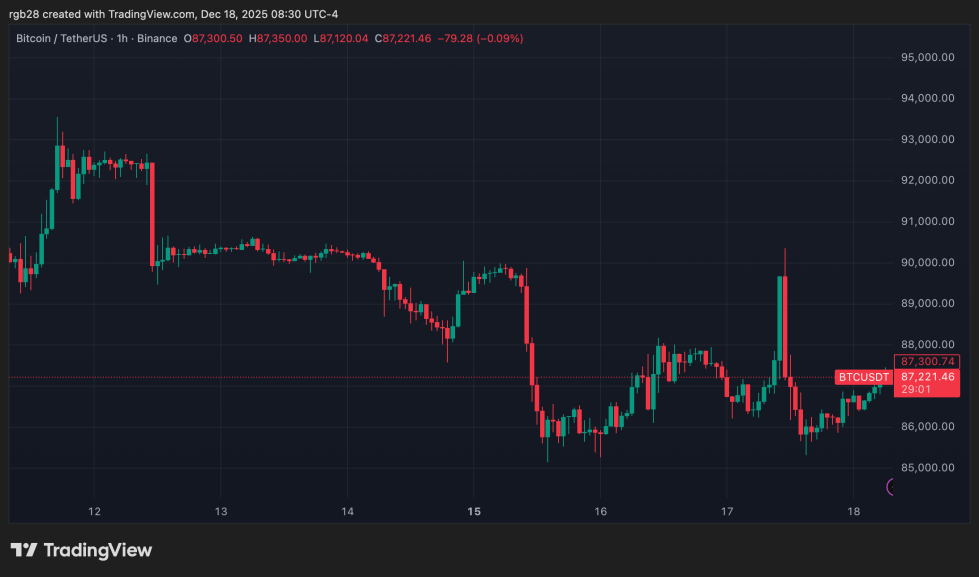
Bitcoin (BTC) trades at $87,221 in the one-week chart. Source: BTCUSDT on TradingView


Preguntas relacionadas

QWhat is the main focus of the new SEC guidelines for broker-dealers regarding crypto assets?

AThe guidelines clarify how broker-dealers can maintain compliance with Rule 15c3-3 when custodying crypto assets that are considered securities, including requirements for physical possession, security assessments, and written policies.

QAccording to the SEC, when can a broker-dealer consider itself to have 'physical possession' of a crypto asset security?

AA broker-dealer can consider itself to have physical possession if it has direct access to the asset and the capability to transfer it on the associated distributed ledger technology (DLT).

QWhat must broker-dealers assess and document prior to maintaining possession of crypto asset securities?

AThey must conduct and document a thorough assessment of the distributed ledger technology and the associated network where ownership transfers are recorded, both before custody and at reasonable intervals thereafter.

QWhat potential future regulatory change for crypto firms did SEC chairman Paul Atkins mention?

AHe stated that the Commission could issue innovation exemption rules in early 2026, allowing crypto firms to launch products without burdensome prescriptive requirements while complying with principles-based conditions.

QWhat broader initiative is the SEC undertaking regarding tokenization and distributed ledger technology?

AThe SEC is evaluating tokenization to modernize the issuance, trading, and settlement of public equities, recognizing its potential to transform capital markets.

Lecturas Relacionadas

Why Do You Always Lose Money on Polymarket? Because You're Betting on News, While the Pros Read the Rules

Why do you always lose money on Polymarket? Because you bet on news, while the pros study the rules. This article explains how top traders ("che tou") profit by meticulously analyzing market rules, not just predicting events. Polymarket, a prediction market platform, often sees disputes over event outcomes due to ambiguous rule wording. For instance, a market asking "Who will be the leader of Venezuela by the end of 2026?" was misinterpreted by many who bet on Delcy Rodríguez, assuming she held power. However, the rules specified "officially holds" as the formally appointed, sworn-in individual. Since Nicolás Maduro was still recognized as president officially, he won the market—even being in prison. To resolve such disputes, Polymarket uses a decentralized arbitration system via UMA protocol. The process involves: 1. Proposal: Anyone can propose a market outcome by staking 750 USDC, earning 5 USDC if unchallenged. 2. Dispute: A 2-hour window allows challenges with a 750 USDC stake; successful challengers earn 250 USDC. 3. Discussion: A 48-hour period on UMA Discord for evidence and debate. 4. Voting: UMA token holders vote in two 24-hour phases (blind then public). Outcomes require >65% consensus and 5M tokens voted; otherwise, four re-votes occur before Polymarket intervention. 5. Settlement: Results are final and automatic. Unlike traditional courts, Polymarket’s system lacks separation between arbitrators and stakeholders—voters often hold market positions, creating conflicts of interest. This leads to herd mentality in discussions and non-transparent outcomes without explanatory rulings, preventing precedent formation. Thus, success on Polymarket hinges on deep rule interpretation, not just event prediction, exploiting gaps between reality and contractual wording.

marsbitHace 1 hora(s)

Why Do You Always Lose Money on Polymarket? Because You're Betting on News, While the Pros Read the Rules

marsbitHace 1 hora(s)

DeepSeek Funding: Liang Wenfeng's 'Realist' Pivot

DeepSeek, a leading Chinese AI company, has initiated its first external funding round, aiming to raise at least $300 million at a valuation of no less than $10 billion. This move marks a significant shift from its founder Liang Wenfeng’s previous idealistic stance of rejecting external capital to maintain independence. Despite strong financial backing from its parent company, quantitative trading firm幻方量化 (Huanfang Quant), which provided an estimated $700 million in revenue in 2025 alone, DeepSeek faces mounting challenges. Key issues include a 15-month gap in major model updates, delays in its flagship V4 release, and the loss of several core researchers to competitors offering significantly higher compensation. The company is also undergoing a strategic pivot by migrating its infrastructure from NVIDIA’s CUDA to Huawei’s Ascend platform, a move aligned with China’s push for technological self-reliance amid U.S. export controls. However, DeepSeek lags behind rivals like智谱AI and MiniMax—both now publicly listed—in areas such as product ecosystem, multimodal capabilities, and commercialization. The funding round, though relatively small in scale, is seen as a way to establish a market-validated valuation anchor, making employee stock options more competitive and facilitating talent retention. It also signals DeepSeek’s transition from a pure research-oriented organization to a commercially-driven player in the global AI ecosystem.

marsbitHace 2 hora(s)

DeepSeek Funding: Liang Wenfeng's 'Realist' Pivot

marsbitHace 2 hora(s)

Trading

Spot
Futuros

Artículos destacados

Cómo comprar US

¡Bienvenido a HTX.com! Hemos hecho que comprar Talus Network (US) sea simple y conveniente. Sigue nuestra guía paso a paso para iniciar tu viaje de criptos.Paso 1: crea tu cuenta HTXUtiliza tu correo electrónico o número de teléfono para registrarte y obtener una cuenta gratuita en HTX. Experimenta un proceso de registro sin complicaciones y desbloquea todas las funciones.Obtener mi cuentaPaso 2: ve a Comprar cripto y elige tu método de pagoTarjeta de crédito/débito: usa tu Visa o Mastercard para comprar Talus Network (US) al instante.Saldo: utiliza fondos del saldo de tu cuenta HTX para tradear sin problemas.Terceros: hemos agregado métodos de pago populares como Google Pay y Apple Pay para mejorar la comodidad.P2P: tradear directamente con otros usuarios en HTX.Over-the-Counter (OTC): ofrecemos servicios personalizados y tipos de cambio competitivos para los traders.Paso 3: guarda tu Talus Network (US)Después de comprar tu Talus Network (US), guárdalo en tu cuenta HTX. Alternativamente, puedes enviarlo a otro lugar mediante transferencia blockchain o utilizarlo para tradear otras criptomonedas.Paso 4: tradear Talus Network (US)Tradear fácilmente con Talus Network (US) en HTX's mercado spot. Simplemente accede a tu cuenta, selecciona tu par de trading, ejecuta tus trades y monitorea en tiempo real. Ofrecemos una experiencia fácil de usar tanto para principiantes como para traders experimentados.

522 Vistas totalesPublicado en 2025.12.11Actualizado en 2025.12.11

Cómo comprar US

Discusiones

Bienvenido a la comunidad de HTX. Aquí puedes mantenerte informado sobre los últimos desarrollos de la plataforma y acceder a análisis profesionales del mercado. A continuación se presentan las opiniones de los usuarios sobre el precio de US (US).

活动图片












