US lawmakers push to fix staking ‘double taxation’ before 2026

cointelegraphPublicado a 2025-12-22Actualizado a 2025-12-22

Resumen

A bipartisan group of 18 U.S. lawmakers is urging the Internal Revenue Service (IRS) to revise crypto staking tax laws before 2026. In a letter led by Republican Mike Carey, they argue the current rules result in "double taxation" by taxing staking rewards both when received and again when sold. They propose taxing rewards only at the time of sale to reflect the staker's actual economic gain. The lawmakers claim the existing policy discourages participation in staking, which is essential for blockchain security and U.S. leadership in digital assets. Separately, representatives Miller and Horsford introduced a draft proposal to exempt small stablecoin transactions from capital gains taxes and allow a deferral option for staking and mining income recognition for up to five years.

A group of 18 bipartisan US House lawmakers is pushing the country’s tax agency to review its rules on crypto staking taxes before the start of 2026.

In a letter sent to Internal Revenue Service acting commissioner Scott Bessent on Friday, the lawmakers, led by Republican Mike Carey, asked for a review and update guidance on "burdensome" crypto staking tax laws.

“This letter is simply requesting fair tax treatment for digital assets and ending the double taxation of staking rewards is a big step in the right direction,” Carey said.

The letter calls for taxes from staking rewards to be applied at the time of sale, so that “stakers are taxed based on a correct statement of their actual economic gain.”
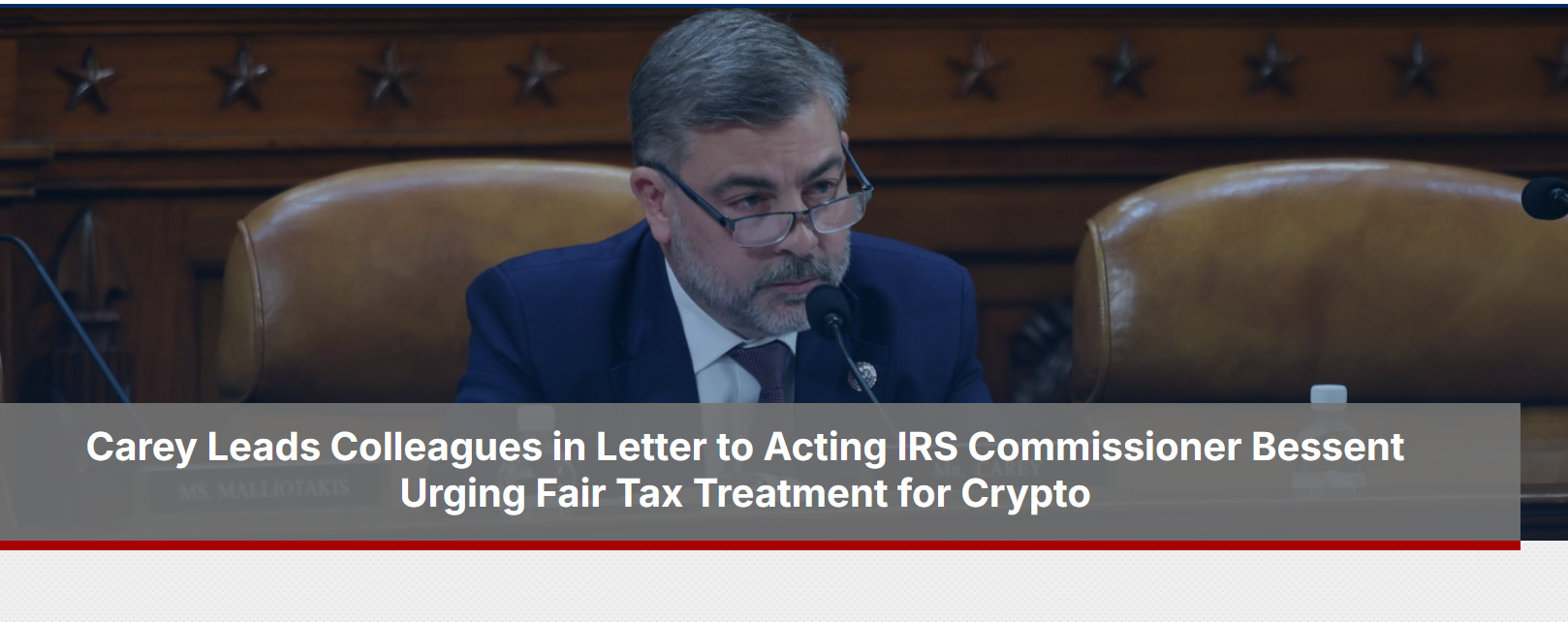
Mike Carey is leading lawmakers to change crypto staking tax rules. Source: Mike Carey

The lawmakers argued that the current laws, which see stakers taxed upon receiving rewards and again when selling them, are hindering participation in the staking market, when the laws should be designed to support a fundamental part of certain blockchains.

Related: Crypto community ‘very sorry’ over Senator Lummis' reelection decision

“Millions of Americans own tokens on these networks. Network security — and American leadership — requires those taxpayers to stake those tokens, but today the administrative burden and prospect of over taxation discourages that participation,” the lawmakers wrote.

The letter concludes by asking if there are any administrative barriers to updating the guidance before the end of the year, and asserts that they should be changed to support the current administration’s goal of “strengthening U.S. leadership in digital asset innovation.”

Not the only push for changes to crypto tax rules

On Saturday, House representatives Max Miller and Steven Horsford also introduced a discussion draft aiming to ease the tax obligations on crypto users by exempting small stablecoin transactions from capital gains taxes and offering a deferral option for staking and mining rewards.

In terms of staking, the reps went a slightly different route by opting for a referral option as opposed to a complete change in the current laws.

The proposal outlines that taxpayers would be allowed to elect to defer income recognition on staking or mining rewards for up to five years, rather than being taxed immediately after receiving them.

Magazine: 11 critical moments in Ethereum’s history that made it the No.2 blockchain

Criptos en tendencia

Preguntas relacionadas

QWhat is the main issue that US lawmakers are addressing regarding crypto staking taxes?

AUS lawmakers are pushing to fix the 'double taxation' issue where stakers are taxed both when they receive staking rewards and again when they sell them.

QWho is leading the bipartisan group of lawmakers in sending the letter to the IRS?

ARepublican Mike Carey is leading the group of 18 bipartisan US House lawmakers.

QWhat specific request did the lawmakers make in their letter to the IRS regarding the timing of taxation?

AThe lawmakers requested that taxes from staking rewards be applied at the time of sale, rather than upon receipt, to reflect the staker's actual economic gain.

QWhat is one of the arguments made by the lawmakers about the current staking tax rules?

AThe lawmakers argued that the current tax rules are hindering participation in the staking market and discouraging network security, which is a fundamental part of certain blockchains.

QWhat alternative proposal was introduced by House representatives Max Miller and Steven Horsford for staking and mining rewards?

AThey introduced a discussion draft proposing that taxpayers be allowed to elect to defer income recognition on staking or mining rewards for up to five years, instead of being taxed immediately.

Lecturas Relacionadas

Analyst Forecasts Bitcoin's Movement in August

Analyst Forecasts Bitcoin Movement in August Bitcoin ends July under market caution due to a lack of new macroeconomic catalysts and regulatory uncertainty, according to Bitbanker analyst Andrey Poroshin. He forecasts that in August, BTC may first test the $60,000–$62,000 range before recovering to around $70,000. The analyst notes that the U.S. Federal Reserve's neutral stance provided no strong market signals, with inflation remaining above target. Currently, Bitcoin trades below the U.S. mining cost range of $73,000–$75,000, a key global profitability benchmark, though costs are lower in some countries like Russia. Significant July events include the bankruptcy of derivatives exchange BitMEX, which Poroshin views as a capitulation of weaker market participants, often preceding potential reversal zones. Retail investor activity has declined, with many placing stop orders in the $60,000–$62,000 range, where significant liquidity is concentrated and could be tested. While geopolitical factors like U.S.-Iran tensions are losing market impact, regulatory uncertainty persists as the U.S. CLARITY Act vote was postponed to September. Typically, August sees lower trading activity due to holidays, leading to more technical, less volatile price movements. Poroshin's base scenario for August is a test of $60,000–$62,000 followed by a recovery to $70,000, with more significant moves likely in September post-Fed signals and potential CLARITY Act developments. Separately, a Russian deputy finance minister stated that non-qualified investors in Russia will soon be allowed to legally purchase Bitcoin, Ethereum, and major stablecoins, with an annual limit of 300,000 rubles per intermediary.

cryptonews.ruHace 13 min(s)

Analyst Forecasts Bitcoin's Movement in August

cryptonews.ruHace 13 min(s)

The Blockchain Industry Enters a Phase of Mass Adoption and Efficiency

In Q2 2026, the blockchain industry demonstrated a divergence between market sentiment and fundamental network growth. While on-chain activity surged, network fee revenues declined due to protocol designs making block space cheaper and more abundant. Ethereum saw institutional staking reach an all-time high of 40.2 million ETH. Despite processing nearly double the transactions per second, its network revenue fell 51% YoY to $64 million, with staker yields driven primarily by consensus rewards. Solana processed nearly 10 billion transactions, but its economic value also dropped to $51 million due to reduced congestion. Notably, its real-world asset (RWA) sector boomed, with tokenized stock trading volume growing 2,479x YoY to $3.32 billion in June 2026. Hyperliquid emerged as an outlier, generating $175 million in revenue with 32% of its $652 billion trading volume from non-crypto markets like commodities. Avalanche saw transaction growth but a sharp drop in fee revenue, while focusing on sovereign L1s for enterprise use. The NEAR Protocol ecosystem shifted from gas-intensive apps to Intents-based trading and introduced a novel feature allowing users to pay for AI services via staked tokens. The Tempo network, backed by Stripe and Paradigm, processed $386 million in stablecoin transfers, including $30 million for contractor payouts by Deel. The report concludes that the industry is transitioning from high-fee speculation to a phase of mass adoption and infrastructure efficiency, where cheap block space fuels transaction growth and institutional entry.

cryptonews.ruHace 13 min(s)

The Blockchain Industry Enters a Phase of Mass Adoption and Efficiency

cryptonews.ruHace 13 min(s)

Trading

Spot

Artículos destacados

Cómo comprar PUSH

¡Bienvenido a HTX.com! Hemos hecho que comprar Push Protocol (PUSH) sea simple y conveniente. Sigue nuestra guía paso a paso para iniciar tu viaje de criptos.Paso 1: crea tu cuenta HTXUtiliza tu correo electrónico o número de teléfono para registrarte y obtener una cuenta gratuita en HTX. Experimenta un proceso de registro sin complicaciones y desbloquea todas las funciones.Obtener mi cuentaPaso 2: ve a Comprar cripto y elige tu método de pagoTarjeta de crédito/débito: usa tu Visa o Mastercard para comprar Push Protocol (PUSH) al instante.Saldo: utiliza fondos del saldo de tu cuenta HTX para tradear sin problemas.Terceros: hemos agregado métodos de pago populares como Google Pay y Apple Pay para mejorar la comodidad.P2P: tradear directamente con otros usuarios en HTX.Over-the-Counter (OTC): ofrecemos servicios personalizados y tipos de cambio competitivos para los traders.Paso 3: guarda tu Push Protocol (PUSH)Después de comprar tu Push Protocol (PUSH), guárdalo en tu cuenta HTX. Alternativamente, puedes enviarlo a otro lugar mediante transferencia blockchain o utilizarlo para tradear otras criptomonedas.Paso 4: tradear Push Protocol (PUSH)Tradear fácilmente con Push Protocol (PUSH) en HTX's mercado spot. Simplemente accede a tu cuenta, selecciona tu par de trading, ejecuta tus trades y monitorea en tiempo real. Ofrecemos una experiencia fácil de usar tanto para principiantes como para traders experimentados.

247 Vistas totalesPublicado en 2024.12.13Actualizado en 2026.06.02

Cómo comprar PUSH

Discusiones

Bienvenido a la comunidad de HTX. Aquí puedes mantenerte informado sobre los últimos desarrollos de la plataforma y acceder a análisis profesionales del mercado. A continuación se presentan las opiniones de los usuarios sobre el precio de PUSH (PUSH).

活动图片