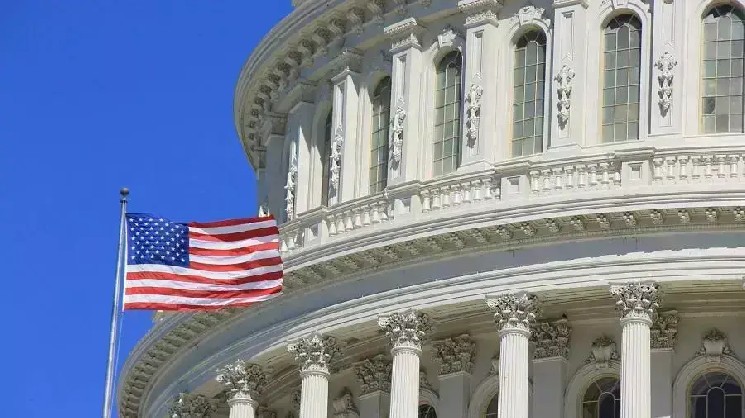
U.S. Government Shutdown Odds for Feb. 14 Spike, Crypto Markets React

TheNewsCryptoPublicado a 2026-02-13Actualizado a 2026-02-13

Resumen

The probability of a U.S. federal government shutdown by February 14, 2026, has been highly volatile, with prediction markets like Polymarket and Kalshi showing odds fluctuating between 29% and 97%. A shutdown could occur if funding for the Department of Homeland Security is not approved. This follows the longest U.S. shutdown in history from October to November 2025, which lasted 43 days. Crypto markets are reacting to the heightened fiscal uncertainty. Bitcoin, which traded near $125K during the previous shutdown, is now around $66K, down over 23% year-to-date. Ethereum and other altcoins have also weakened, with total crypto market cap dropping below $2.28 trillion. If a shutdown occurs, key economic data may be delayed, regulatory agencies could operate with reduced staff, and crypto markets might face increased volatility and further downward pressure, potentially testing Bitcoin's support near $60,000.

While the global crypto market faces selling pressure, the likelihood of a U.S. federal government shutdown by February 14, 2026, has been moving sharply in recent days as lawmakers work toward a funding agreement.

Early today, the prediction market Polymarket showed that the probability of a shutdown by midnight on February 14 briefly reached 97%. Later, that probability fell to around 29%, with the market seeing over $7 million in trading volume.

Similarly, Kalshi, another regulated prediction market, currently places the shutdown odds near 88% with $9,350,895 volume. Both sources indicate elevated but volatile expectations that the government might fail to secure funding in time.

A shutdown occurs when lawmakers fail to pass on appropriations bills by a set deadline, forcing a partial halt of non-essential federal services. If unresolved, this could occur later in 2026, echoing a similar impasse in late 2025 that lasted over 40 days.

Now, a bill to fund the Department of Homeland Security (DHS) is set to expire on February 14. The vote was 52–47, short of the 60 votes needed to move forward with the legislation. As a result, because no replacement funding has been approved, a partial shutdown of DHS operations could occur once funding lapses at midnight on February 14.

The most recent U.S. government shutdown started on October 1, 2025, and lasted 43 days, ending on November 12, 2025, making it the longest in U.S. history. The shutdown occurred because lawmakers couldn’t agree on the federal budget, which caused thousands of government workers to be furloughed or work without pay.

Previous Shutdowns and Crypto Market Response

During the October–November 2025 shutdown, Bitcoin (BTC) traded near $125K but later slipped below the key psychological level of $100K. Since then, BTC has failed to regain momentum and is currently trading in the $66K range. It is down more than 23% year to date, erasing recent gains amid heightened fiscal uncertainty.

Other major cryptocurrencies, including Ethereum (ETH) and XRP, have similarly weakened. With Ethereum recently trading lower at $1.9K and altcoin markets showing greater drawdowns relative to Bitcoin.

Over the past 24 hours, the total cryptocurrency market capitalization has dropped from $2.32 trillion to below $2.28 trillion, reflecting lower buying interest amid broader risk aversion in global financial markets.

Market Outlook If Shutdown Occurs on February 14

If a government shutdown is formally announced by February 14, analysts expect several near‐term effects:

  • Economic data such as employment reports and inflation statistics may be delayed, removing key reference points for traders and potentially increasing short‐term price volatility in crypto markets.
  • Regulatory agencies including the Securities and Exchange Commission would operate with reduced staff, delaying reviews of pending filings that could influence institutional participation in crypto markets.
  • Bitcoin and major altcoins may experience additional downward pressure as risk appetite weakens.

Based on current price levels, a shutdown occurring on the deadline could test support zones for Bitcoin near $60,000, while Ethereum may face additional selling pressure below $1.5K if risk‐off dynamics intensify. Wider crypto market conditions could become range-bound until funding clarity is established.

Top Updated Crypto News

Coinbase Reports Q4 Loss of $667 Million as it Expands Beyond Crypto Trading

TagsAltcoinBitcoinCrypto MarketETHEREUMU.S. government

Preguntas relacionadas

QWhat is the current probability of a U.S. government shutdown by February 14, 2026, according to prediction markets?

AAs per the article, Polymarket showed the probability briefly reaching 97% before falling to around 29%, while Kalshi currently places the odds near 88%.

QWhat was the duration and significance of the most recent U.S. government shutdown mentioned in the article?

AThe most recent shutdown started on October 1, 2025, and lasted 43 days, ending on November 12, 2025, making it the longest in U.S. history.

QHow did Bitcoin (BTC) perform during the previous government shutdown in late 2025?

ADuring the October-November 2025 shutdown, Bitcoin traded near $125K but later fell below the key psychological level of $100K and is currently trading around $66K, down more than 23% year to date.

QWhat are three potential effects on crypto markets if a government shutdown occurs on February 14th?

AAnalysts expect: 1) Delayed economic data increasing short-term volatility, 2) Reduced staff at regulatory agencies like the SEC delaying filings, and 3) Additional downward pressure on Bitcoin and altcoins as risk appetite weakens.

QWhich specific government department faces a funding deadline on February 14th, and what was the vote count on its funding bill?

AFunding for the Department of Homeland Security (DHS) is set to expire. The vote was 52-47, short of the 60 votes needed to move the legislation forward.

Lecturas Relacionadas

Interview with Robinhood Executive: Meme + Tokenized US Stocks as "Barbell" Customer Acquisition Strategy, All Business Lines Achieve Hundreds of Millions in Revenue

Interview with Robinhood executive Johann Kerbrat reveals the company's "barbell" customer acquisition strategy for its new Robinhood Chain, combining meme tokens with tokenized stocks. Three weeks after mainnet launch, the chain has seen over $3B in weekly DEX volume and 105M transactions. Kerbrat explains the logic behind the permissionless chain: meme tokens attract DeFi users, while tokenized real-world assets (RWA), currently over 90 US stocks and ETFs accessible in 120+ countries, serve global users. The goal is to bring Robinhood's 27 million funded accounts on-chain by simplifying DeFi with a user-friendly interface, exemplified by features like Robinhood Earn which offers yield without requiring wallet management. Built on Arbitrum's technology stack for its speed, low cost, and Ethereum's security, the chain focuses on financial products like Earn, spot trading, and perpetuals. Kerbrat downplays direct competition with platforms like Base, emphasizing the goal of expanding the overall market for on-chain assets. He details selective partnerships (e.g., Morpho, Lighter) based on compliance, unique UX, and differentiation. While regulatory clarity is pending for US perpetuals, the expansion continues via Bitstamp in Europe. Finally, Kerbrat positions Robinhood as a "super app" integrating stocks, options, crypto, banking, and AI trading, with all major business lines generating hundreds of millions in revenue. For the chain, current priority is driving adoption over maximizing gas fee revenue.

marsbitHace 2 hora(s)

Interview with Robinhood Executive: Meme + Tokenized US Stocks as "Barbell" Customer Acquisition Strategy, All Business Lines Achieve Hundreds of Millions in Revenue

marsbitHace 2 hora(s)

Fidelity Q3 Report: BTC, ETH, and SOL Continue to Build Bottoms; How Much Further Will This Crypto Bear Market Go?

Fidelity's Q3 Crypto Signal Report analyzes the current bear market, noting Bitcoin (BTC), Ethereum (ETH), and Solana (SOL) are in a prolonged bottoming phase. Key indicators like the weighted Net Unrealized Profit/Loss (NUPL) have turned negative (-0.01), signaling the market is slightly below its aggregate cost basis, with BTC acting as the primary stabilizing asset. BTC's dominance has risen to 68%, indicating a lack of capital rotation to other digital assets. Performance has been weak across the board, with BTC, ETH, and SOL down significantly year-to-date. Market sentiment is depressed, exacerbated by substantial outflows from spot ETPs and a challenging macro environment. The report compares the current ~203-day downtrend to historical ~300-day bottoming cycles, suggesting the process may be two-thirds complete, with late 2026 as a potential timeframe to monitor. For Bitcoin, NUPL at 0.09 indicates cautious sentiment, while momentum signals remain negative. The Yardstick metric points to potential undervaluation relative to network security (hashrate). Ethereum's NUPL is deep in the "capitulation" zone at -0.43, a historically positive signal for future returns, though its momentum and network fee revenue are negative. Solana shows the deepest NUPL at -0.72 but demonstrates relative resilience in on-chain activity and stablecoin transfer volume. The report concludes that while several metrics are near historical capitulation levels, a definitive market bottom has not yet been established. The path forward likely involves continued consolidation, with BTC's relative strength and fundamental on-chain usage for ETH and SOL providing key areas for investor observation.

marsbitHace 2 hora(s)

Fidelity Q3 Report: BTC, ETH, and SOL Continue to Build Bottoms; How Much Further Will This Crypto Bear Market Go?

marsbitHace 2 hora(s)

Trading

Spot
活动图片