U.S. Government Shutdown Difficult, as Both Parties Have Already Calculated the Costs

Odaily星球日报Publicado a 2026-01-29Actualizado a 2026-01-29

Resumen

The U.S. government faces a shutdown risk by January 30 if a funding bill isn't passed, but prediction markets show the probability dropping to 42%, down from 80%. The deadlock stems from partisan disputes over funding for the Department of Homeland Security (DHS), particularly ICE enforcement actions. Democrats seek restrictions after a fatal incident in Minnesota, while Republicans defend ICE's role. Both parties are maneuvering ahead of midterm elections, where control of Congress is at stake. A shutdown could harm the ruling party’s image, making compromise likely. A temporary funding extension is expected to avoid a full shutdown, with negotiations focusing on separating DHS funding from other bills. Reports indicate ongoing talks between Trump and Democratic leaders to prevent a disruption.

Original | Odaily Planet Daily (@OdailyChina)

Author | Golem (@web 3_golem)
A major macroeconomic event this month is whether the U.S. government will shut down by the end of January. Last October, the U.S. government shut down for 43 days, and it only resumed operations after the passage of a temporary funding bill. January 30 is the expiration date of the temporary funding bill. If Congress fails to pass a formal funding bill or if there is no new temporary bill to extend it, the U.S. government will shut down again.

This time, the dispute between the two U.S. parties mainly revolves around the funding for the Department of Homeland Security (DHS). Democrats believe that ICE (Immigration and Customs Enforcement) has issues with its enforcement actions in Minnesota, resulting in two deaths, and they want to strictly restrict funding and related operations. However, Republicans disagree, arguing that ICE is a key force in combating illegal immigration and welfare fraud. As a result, the two sides are at a stalemate. (For details on the dispute between the U.S. parties, please read: Will the U.S. Government Shutdown Storm Strike Again, and Will the Crypto Circle Repeat the Crash Script?)

It is this confrontational state and the approaching expiration date of the temporary funding bill that have sharply increased the probability of a U.S. government shutdown at the end of January in prediction markets. However, this morning, Polymarket data showed that the probability of the U.S. government shutting down at the end of January has continued to decline and currently stands at 42%, down from a previous high of 80%.
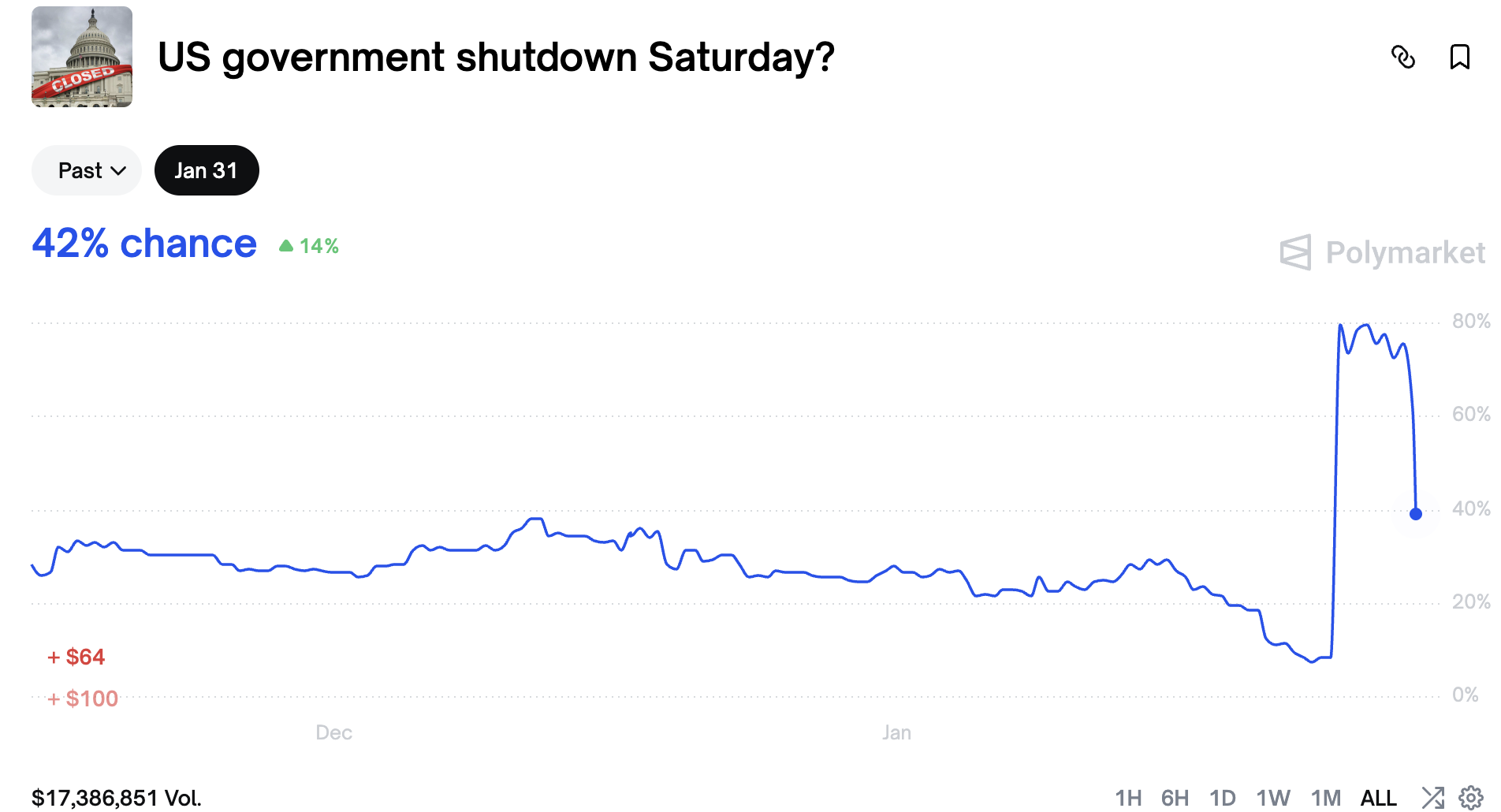
Price changes in prediction markets reflect the results of collective wisdom and博弈. The rising probability that the U.S. government will not shut down at the end of January indicates that people believe the high certainty of a government shutdown, as suggested by the prediction market probabilities, no longer exists under the current U.S. political situation.

Midterm Elections Are the Key Focus of Both U.S. Parties

On January 28, regarding the risk of another possible U.S. government shutdown, U.S. Treasury Secretary Besant stated that the situation is still unclear but emphasized that President Trump has urged the Democratic side to avoid this outcome.

This government shutdown crisis is essentially because the Democrats have caught the Republicans in a political counterattack. The shooting death of a U.S. citizen by ICE officers in Minnesota on January 24 was essentially a result of the Trump administration's increased immigration enforcement efforts, which also led to large-scale public protests expressing dissatisfaction with the Trump administration. The Democrats seized this opportunity and used it as an excuse to block the passage of the funding bill in the Senate. Since it reflects the demands of voters, the Democrats have taken the political initiative in this counterattack.

The Republicans have thus been put in a passive position. If the U.S. government does shut down as a result, the Democrats could blame the Republican government for any subsequent economic and民生 issues (such as delayed economic data releases and large-scale flight delays at airports).

This series of potential chain reactions will also affect the issue that both U.S. parties truly care about this year: the midterm elections.

The U.S. "midterm elections" are held in the second year of a presidential term. All 435 seats in the House of Representatives will be up for election, and approximately one-third of the seats in the Senate are typically up for election. Currently, the Republicans hold a majority in both the House (218 seats) and the Senate (53 seats). For the Republicans to maintain their seat advantage after the midterm elections at the end of the year and reduce governance difficulties, they cannot accumulate too many "stains" politically this year.

Additionally, although the midterm elections do not involve the presidential election, they are also seen as a "midterm referendum" on the incumbent president, affecting the president's policy orientation in the latter two years and reshaping the党内权力结构 and the candidate landscape for the next presidential election. Therefore, it is extremely important for Trump as well.

From the above analysis, it can be seen that this government shutdown is no longer simply a funding issue but a political battlefield set up in advance by both U.S. parties for the midterm elections at the end of the year. The Republicans, in a passive position, are highly likely to compromise to resolve the crisis and矛盾.

For the Democrats, if the Republicans compromise, it would also be a political victory.

Compromise Is Already Underway

This U.S. government shutdown crisis will not be a "full shutdown" like last October (when all 12 funding bills expired). The scale of the shutdown may be much smaller. Funding for the Commerce Department (responsible for releasing GDP data) and the Agriculture Department (responsible for food benefits) has already been secured, but about 78% of federal government functions—involving the remaining six funding bills—may face funding cuts.

The Democrats have already given the Republicans a way out. Senate Minority Leader Chuck Schumer (D-N.Y.) said on January 28 that Senate Democrats are "prepared to quickly advance five funding bills by the January 30 deadline, separate from the Department of Homeland Security funding bill," which could be a way to avoid a large-scale government shutdown. However, Senate Republicans have not yet agreed to separate the DHS bill from the overall funding package.

On the other hand, it is unrealistic to demand changes to the DHS funding before January 30, as any changes to the remaining six funding bills must be approved by the House of Representatives, which will not reconvene until February 2.

For the Democrats, forcing the U.S. government into a shutdown state by being too rigid about amending the funding bill would not be of much benefit, and the "offensive and defensive positions" with the Republicans could even reverse. Therefore, the current consensus between the two U.S. parties may be to pass a temporary funding bill to first address the potential government shutdown and postpone the矛盾 between the two parties.

Just as Odaily was writing this article speculating that the two parties might compromise to avoid a government shutdown, The New York Times also reported that Trump is reaching a possible agreement with Chuck Schumer to avoid a U.S. government shutdown.

According to two informed officials, under the plan being developed, the Senate would separate one of the six spending bills, which aims to fund the Department of Homeland Security, to maintain funding for the military, medical programs, and other federal agencies for the remainder of the fiscal year. The Senate will pass these bills by the Friday midnight deadline, and Congress will also consider a short-term extension of homeland security operations to prevent service disruptions at the TSA, Coast Guard, and FEMA.

It is still unclear how this potential agreement will affect this week's funding bill vote, but it at least shows that the White House and the Senate are working toward resolving the crisis.


Preguntas relacionadas

QWhat is the main reason for the potential U.S. government shutdown at the end of January?

AThe main reason is the dispute between Democrats and Republicans over funding for the Department of Homeland Security (DHS), particularly related to the enforcement actions of ICE (Immigration and Customs Enforcement) in Minnesota.

QAccording to the article, why did the probability of a government shutdown drop from 80% to 42% on Polymarket?

AThe probability dropped because the prediction market reflected a shift in collective opinion, indicating that people believe the high certainty of a shutdown has diminished due to ongoing political negotiations and potential compromises between the two parties.

QHow does the potential government shutdown relate to the U.S. midterm elections?

AThe shutdown is seen as a political battleground for the midterm elections, where both parties are positioning themselves to avoid blame for economic and民生 issues that could affect their electoral prospects and the balance of power in Congress.

QWhat compromise did Democrats propose to avoid a large-scale government shutdown?

ADemocrats proposed separating the Homeland Security funding bill from the other five remaining appropriations bills, allowing the non-DHS bills to pass quickly while delaying the contentious DHS funding debate.

QWhat temporary solution is being considered to prevent a shutdown before the January 30 deadline?

AA short-term extension for Homeland Security operations is being considered to prevent disruptions to agencies like TSA, Coast Guard, and FEMA, while passing the other appropriations bills to keep most government functions funded.

Lecturas Relacionadas

Within Strategy's Framework, STRC's Dividend Yield Remains at 12% as Share Price Stays Below Par Value

Michael Saylor, Executive Chairman of Strategy (MSTR), confirmed that the dividend rate for its STRC perpetual preferred shares will remain at 12.00% through August 2026. The rate has increased from 9% at its July 2025 launch to the current high via a "ratchet" mechanism, which permanently raises the rate by 0.5% whenever the share price falls below $95. This mechanism is intended to push the price back toward its $100 par value and support Strategy's "at-the-market" (ATM) program for issuing new shares to fund Bitcoin purchases. However, the mechanism has not worked as intended. STRC shares closed at $89.46 on July 31, remaining about 10-11% below par value despite the record-high dividend. Competition from rival Strive's higher-yielding SATA securities has pressured demand. The persistent discount has forced Strategy to suspend new STRC issuances via its ATM program, limiting this funding channel for Bitcoin acquisitions. STRC's struggles reflect Bitcoin's own volatility, as the preferred shares historically move in tandem. Analysts have warned the ratchet structure carries long-term, one-way risk. A law firm is investigating Strategy's ability to maintain dividend payments if Bitcoin's price stays low. Retail investors own roughly 83% of outstanding STRC shares, a group seen as prone to panic selling during downturns. In response, Strategy has established financial reserves, including a liquidity cushion covering about 26 months of dividend/interest obligations, and a $2 billion share buyback program alongside a Bitcoin monetization framework, though the company emphasized it is not obligated to sell any Bitcoin.

cryptonews.ruHace 5 min(s)

Within Strategy's Framework, STRC's Dividend Yield Remains at 12% as Share Price Stays Below Par Value

cryptonews.ruHace 5 min(s)

Analyst: Bitcoin's Price Will Drop to $60k in August, Then Rebound to $70k

Financial analyst Andrey Poroshin has provided a new forecast for Bitcoin's price dynamics in August. Poroshin, an analyst at the Bitbanker exchange, expects the cryptocurrency market to experience a downturn this month, with prices retesting the $60,000 level due to a lack of supportive macroeconomic catalysts. He noted that the recent US Federal Reserve decision to hold interest rates did not significantly impact the market, while inflation remains above the 2% target. Poroshin stated that Bitcoin is ending July under pressure from moderate volatility and a lack of new macroeconomic stimuli, leading to continued market caution. According to his base scenario, Bitcoin will drop to a range of $60,000 to $62,000 before recovering to $70,000. He pointed out that even $70,000 remains below the cost of mining in the US, which has prompted some miners to shift towards AI data center operations. Poroshin cited the winding down of BitMEX's operations as a potential catalyst for a price rebound, suggesting the exit of weaker players often coincides with market reversals and reduced short-term selling pressure. He believes Bitcoin is currently less susceptible to geopolitical shocks, such as the Iran-US conflict, and does not expect significant market changes in August related to the pending CLARITY Act. Looking ahead, Poroshin forecasts that September will bring more active price fluctuations driven by potential Fed rate decisions and possible discussions or approval of the CLARITY Act.

cryptonews.ruHace 5 min(s)

Analyst: Bitcoin's Price Will Drop to $60k in August, Then Rebound to $70k

cryptonews.ruHace 5 min(s)

In Jinjiang, Fujian, a Storage Super Unicorn Lies Quiet

In Fujian's Jinjiang, a city known for sportswear, lies a quiet semiconductor giant: Fujian Jinhua Integrated Circuit Co. (JHICC). Once a promising domestic DRAM manufacturer alongside Yangtze Memory and ChangXin Memory Technologies (CXMT), its journey was derailed in 2018 when the U.S. placed it on an Entity List and filed criminal charges for alleged trade secret theft. This halted production for years. A turning point came in February 2024 when a U.S. federal court found JHICC not guilty. However, it had lost crucial time. While CXMT soared to become a top-valued A-share company in 2024, JHICC, with an estimated valuation of 80 billion RMB, was just restarting. Its current output is primarily customized DDR4 chips, not the advanced DDR5/HBM demanded for AI, but it still benefits from the broader memory chip upcycle. JHICC's story is tied to Chen Zhengkun, a veteran engineer who left Micron to lead the venture. Founded in 2016 with state-backed funding, JHICC partnered with Taiwan's UMC to develop DRAM technology. Rapid progress was cut short by the U.S. actions, which Micron initiated, partly due to its heavy reliance on the Chinese market. Post-sanctions, Chen's team worked to rebuild the production line with reduced reliance on U.S. technology. According to its records, JHICC achieved small-scale production and revenue growth under immense pressure. It now focuses on the stable "niche" DRAM market (e.g., TVs, routers) with a monthly capacity of ~40,000 wafers, aiming for 60,000 by 2026. It holds over 1,000 patents but remains on the Entity List. For Jinjiang, investing in JHICC was a bold industrial leap. The local government provided unwavering financial and logistical support during the crisis, helping the company survive. JHICC has become the anchor for a growing local semiconductor cluster. Though its scale lags behind domestic peers, JHICC's persistence symbolizes a hard-won foothold in a global market long dominated by Samsung, SK Hynix, and Micron. Having missed one boom, it seeks a place in the new AI-driven memory supercycle.

marsbitHace 2 hora(s)

In Jinjiang, Fujian, a Storage Super Unicorn Lies Quiet

marsbitHace 2 hora(s)

Trading

Spot
活动图片




