U.S. Government Shutdown Difficult, as Both Parties Have Already Calculated the Costs

Odaily星球日报Publicado a 2026-01-29Actualizado a 2026-01-29

Resumen

The U.S. government faces a shutdown risk by January 30 if a funding bill isn't passed, but prediction markets show the probability dropping to 42%, down from 80%. The deadlock stems from partisan disputes over funding for the Department of Homeland Security (DHS), particularly ICE enforcement actions. Democrats seek restrictions after a fatal incident in Minnesota, while Republicans defend ICE's role. Both parties are maneuvering ahead of midterm elections, where control of Congress is at stake. A shutdown could harm the ruling party’s image, making compromise likely. A temporary funding extension is expected to avoid a full shutdown, with negotiations focusing on separating DHS funding from other bills. Reports indicate ongoing talks between Trump and Democratic leaders to prevent a disruption.

Original | Odaily Planet Daily (@OdailyChina)

Author | Golem (@web 3_golem)
A major macroeconomic event this month is whether the U.S. government will shut down by the end of January. Last October, the U.S. government shut down for 43 days, and it only resumed operations after the passage of a temporary funding bill. January 30 is the expiration date of the temporary funding bill. If Congress fails to pass a formal funding bill or if there is no new temporary bill to extend it, the U.S. government will shut down again.

This time, the dispute between the two U.S. parties mainly revolves around the funding for the Department of Homeland Security (DHS). Democrats believe that ICE (Immigration and Customs Enforcement) has issues with its enforcement actions in Minnesota, resulting in two deaths, and they want to strictly restrict funding and related operations. However, Republicans disagree, arguing that ICE is a key force in combating illegal immigration and welfare fraud. As a result, the two sides are at a stalemate. (For details on the dispute between the U.S. parties, please read: Will the U.S. Government Shutdown Storm Strike Again, and Will the Crypto Circle Repeat the Crash Script?)

It is this confrontational state and the approaching expiration date of the temporary funding bill that have sharply increased the probability of a U.S. government shutdown at the end of January in prediction markets. However, this morning, Polymarket data showed that the probability of the U.S. government shutting down at the end of January has continued to decline and currently stands at 42%, down from a previous high of 80%.
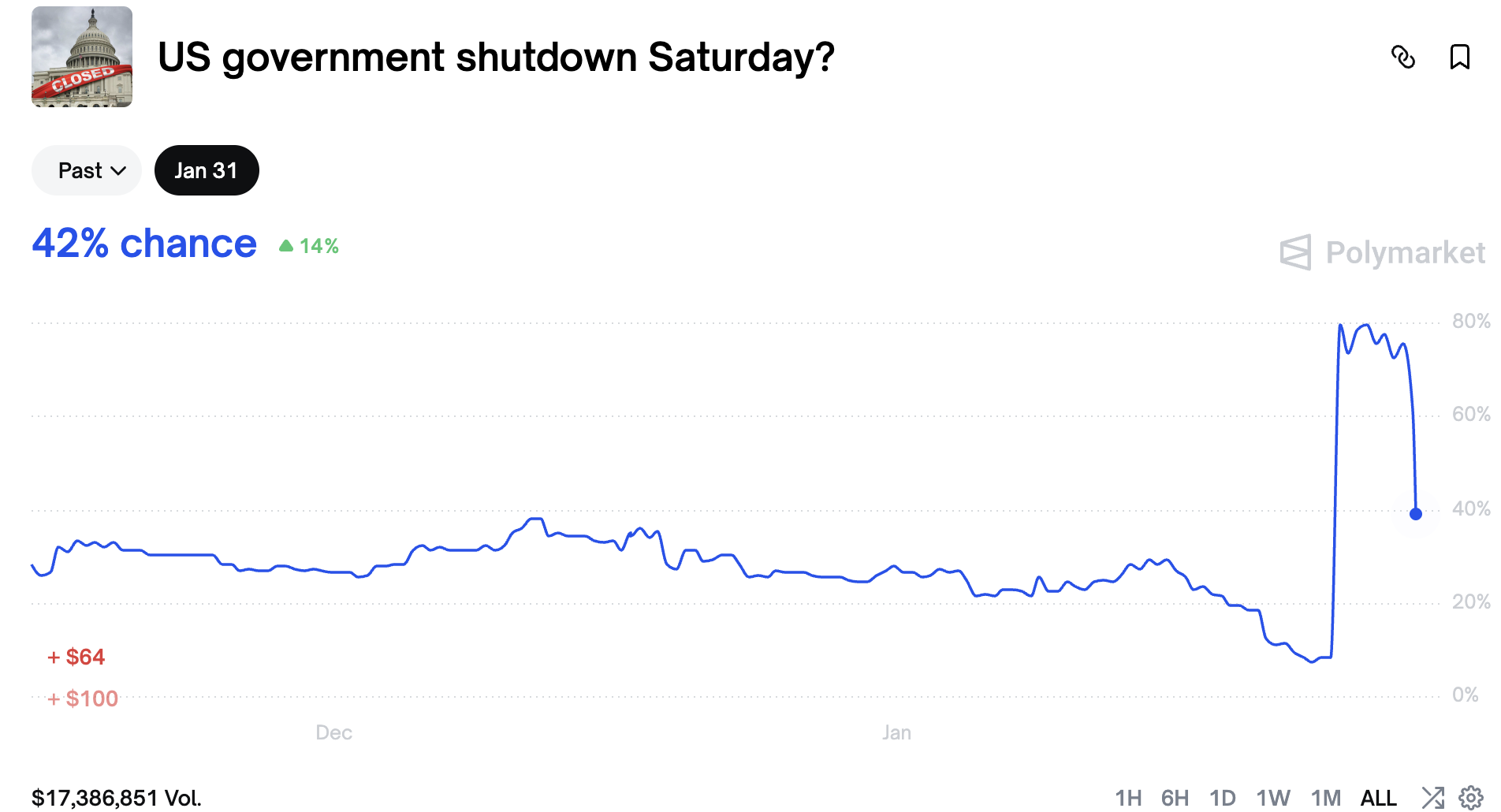
Price changes in prediction markets reflect the results of collective wisdom and博弈. The rising probability that the U.S. government will not shut down at the end of January indicates that people believe the high certainty of a government shutdown, as suggested by the prediction market probabilities, no longer exists under the current U.S. political situation.

Midterm Elections Are the Key Focus of Both U.S. Parties

On January 28, regarding the risk of another possible U.S. government shutdown, U.S. Treasury Secretary Besant stated that the situation is still unclear but emphasized that President Trump has urged the Democratic side to avoid this outcome.

This government shutdown crisis is essentially because the Democrats have caught the Republicans in a political counterattack. The shooting death of a U.S. citizen by ICE officers in Minnesota on January 24 was essentially a result of the Trump administration's increased immigration enforcement efforts, which also led to large-scale public protests expressing dissatisfaction with the Trump administration. The Democrats seized this opportunity and used it as an excuse to block the passage of the funding bill in the Senate. Since it reflects the demands of voters, the Democrats have taken the political initiative in this counterattack.

The Republicans have thus been put in a passive position. If the U.S. government does shut down as a result, the Democrats could blame the Republican government for any subsequent economic and民生 issues (such as delayed economic data releases and large-scale flight delays at airports).

This series of potential chain reactions will also affect the issue that both U.S. parties truly care about this year: the midterm elections.

The U.S. "midterm elections" are held in the second year of a presidential term. All 435 seats in the House of Representatives will be up for election, and approximately one-third of the seats in the Senate are typically up for election. Currently, the Republicans hold a majority in both the House (218 seats) and the Senate (53 seats). For the Republicans to maintain their seat advantage after the midterm elections at the end of the year and reduce governance difficulties, they cannot accumulate too many "stains" politically this year.

Additionally, although the midterm elections do not involve the presidential election, they are also seen as a "midterm referendum" on the incumbent president, affecting the president's policy orientation in the latter two years and reshaping the党内权力结构 and the candidate landscape for the next presidential election. Therefore, it is extremely important for Trump as well.

From the above analysis, it can be seen that this government shutdown is no longer simply a funding issue but a political battlefield set up in advance by both U.S. parties for the midterm elections at the end of the year. The Republicans, in a passive position, are highly likely to compromise to resolve the crisis and矛盾.

For the Democrats, if the Republicans compromise, it would also be a political victory.

Compromise Is Already Underway

This U.S. government shutdown crisis will not be a "full shutdown" like last October (when all 12 funding bills expired). The scale of the shutdown may be much smaller. Funding for the Commerce Department (responsible for releasing GDP data) and the Agriculture Department (responsible for food benefits) has already been secured, but about 78% of federal government functions—involving the remaining six funding bills—may face funding cuts.

The Democrats have already given the Republicans a way out. Senate Minority Leader Chuck Schumer (D-N.Y.) said on January 28 that Senate Democrats are "prepared to quickly advance five funding bills by the January 30 deadline, separate from the Department of Homeland Security funding bill," which could be a way to avoid a large-scale government shutdown. However, Senate Republicans have not yet agreed to separate the DHS bill from the overall funding package.

On the other hand, it is unrealistic to demand changes to the DHS funding before January 30, as any changes to the remaining six funding bills must be approved by the House of Representatives, which will not reconvene until February 2.

For the Democrats, forcing the U.S. government into a shutdown state by being too rigid about amending the funding bill would not be of much benefit, and the "offensive and defensive positions" with the Republicans could even reverse. Therefore, the current consensus between the two U.S. parties may be to pass a temporary funding bill to first address the potential government shutdown and postpone the矛盾 between the two parties.

Just as Odaily was writing this article speculating that the two parties might compromise to avoid a government shutdown, The New York Times also reported that Trump is reaching a possible agreement with Chuck Schumer to avoid a U.S. government shutdown.

According to two informed officials, under the plan being developed, the Senate would separate one of the six spending bills, which aims to fund the Department of Homeland Security, to maintain funding for the military, medical programs, and other federal agencies for the remainder of the fiscal year. The Senate will pass these bills by the Friday midnight deadline, and Congress will also consider a short-term extension of homeland security operations to prevent service disruptions at the TSA, Coast Guard, and FEMA.

It is still unclear how this potential agreement will affect this week's funding bill vote, but it at least shows that the White House and the Senate are working toward resolving the crisis.

Preguntas relacionadas

QWhat is the main reason for the potential U.S. government shutdown at the end of January?

AThe main reason is the dispute between Democrats and Republicans over funding for the Department of Homeland Security (DHS), particularly related to the enforcement actions of ICE (Immigration and Customs Enforcement) in Minnesota.

QAccording to the article, why did the probability of a government shutdown drop from 80% to 42% on Polymarket?

AThe probability dropped because the prediction market reflected a shift in collective opinion, indicating that people believe the high certainty of a shutdown has diminished due to ongoing political negotiations and potential compromises between the two parties.

QHow does the potential government shutdown relate to the U.S. midterm elections?

AThe shutdown is seen as a political battleground for the midterm elections, where both parties are positioning themselves to avoid blame for economic and民生 issues that could affect their electoral prospects and the balance of power in Congress.

QWhat compromise did Democrats propose to avoid a large-scale government shutdown?

ADemocrats proposed separating the Homeland Security funding bill from the other five remaining appropriations bills, allowing the non-DHS bills to pass quickly while delaying the contentious DHS funding debate.

QWhat temporary solution is being considered to prevent a shutdown before the January 30 deadline?

AA short-term extension for Homeland Security operations is being considered to prevent disruptions to agencies like TSA, Coast Guard, and FEMA, while passing the other appropriations bills to keep most government functions funded.

Lecturas Relacionadas

MoonPay Launches PayBox

MoonPay, a developer of payment solutions for crypto and traditional currencies, has launched PayBox, a new type of payment wallet that enables AI assistants in Claude and ChatGPT to conduct transactions. Users can manage digital assets and pay for online services directly within chat interfaces. Upon user request, the AI can perform actions such as purchasing PYUSD, swapping tokens, cross-chain transfers, depositing funds into DeFi protocols, and booking flights. All transactions require user confirmation via an access key before execution. PayBox supports Solana and EVM-based blockchains like Ethereum, Base, Arbitrum, Polygon, Hyperliquid, Tempo, and Robinhood Chain, with plans to add more networks. It can store both crypto wallets and payment cards. Security is provided via MPC (Multi-Party Computation) technology and secure execution environments, ensuring no single entity—including MoonPay or the AI assistant—has full access to user funds. The wallet offers two permission modes: "Always Ask," requiring manual approval for each transaction, and "Standalone," where the AI can operate autonomously within user-set limits. Permissions can be modified or revoked at any time. PayBox is built on technology from Sodot, a secure crypto wallet solutions provider acquired by MoonPay earlier this year. This infrastructure reportedly secures over $50 billion in digital assets across more than 10 million wallets.

cryptonews.ruHace 6 min(s)

MoonPay Launches PayBox

cryptonews.ruHace 6 min(s)

Now the Greatest Regret Is to My Family: Crypto Experts Took a Stumble in the Stock Market

Summary: This article examines the significant losses recently suffered by cryptocurrency traders and influencers who ventured into the stock market, specifically by heavily investing in AI-related and semiconductor storage stocks. The narrative centers on the dramatic reversal in the Korean and US equity markets in late July, with stocks like SK Hynix and related leveraged ETFs experiencing historic plunges, erasing massive gains. The analysis highlights several key factors behind the "flip." Traders, accustomed to crypto's high volatility and frustrated by a stagnant market, chased the apparent momentum in AI-themed equities. Many made fatal mistakes: applying high-leverage strategies common in crypto (e.g., 2x ETFs, on-chain perpetual contracts) to stocks, and failing to understand the distinct rules of different stock markets (like Korean pre-market trading). This led to widespread liquidations, especially when a thin Korean pre-market trade triggered a cascading flash crash on a decentralized exchange. Post-crash reflections from prominent figures reveal deep regret and self-criticism. They acknowledge misjudging their expertise, overestimating their edge against sophisticated institutional players, and the dangers of leverage. The article concludes that while such setbacks are part of trading, surviving long-term requires recognizing one's limitations and the inherent risks of cross-market strategies.

marsbitHace 51 min(s)

Now the Greatest Regret Is to My Family: Crypto Experts Took a Stumble in the Stock Market

marsbitHace 51 min(s)

US Senate Makes Important Amendments to "Conflict of Interest" Section of Cryptocurrency Bill

The U.S. Senate has taken a key step regarding the CLARITY Act, which could shape the future of the U.S. crypto market. On July 29, Senators Tom Tillis and Ruben Gallego finalized amendments to the bill's "conflict of interest" rules, one of its most contentious aspects. The bipartisan bill aims to tighten restrictions on high-level federal officials' ties to digital assets. The new text, crafted as an alternative to a White House-endorsed ethics code, is expected to impose stricter rules limiting officials' ability to issue or directly participate in digital asset projects. However, with Congress entering an August recess and the revised text not yet reviewed by much of the Senate, the bill's timeline is uncertain. Senate Majority Leader John Thune indicated a procedural vote could occur between July 29 and August 1 but expressed doubt the full bill could pass before the break. The House-approved CLARITY Act, passed in July 2025, has been under Senate negotiation for over a year. Key goals of the CLARITY Act include clarifying jurisdictional boundaries between the SEC and CFTC, setting rules for digital commodity spot markets, and addressing topics like stablecoin yields, DeFi, and illicit financing. The stablecoin yield provisions could significantly impact U.S.-based DeFi protocols, exchanges, and issuers, affecting their global competitiveness. The outcome is being closely watched by both the U.S. and global digital asset markets.

cryptonews.ruHace 1 hora(s)

US Senate Makes Important Amendments to "Conflict of Interest" Section of Cryptocurrency Bill

cryptonews.ruHace 1 hora(s)

Pavel Durov Designated as a Terrorist in Russia. What Does This Mean for Telegram Users?

Pavel Durov, the founder of Telegram, has been added to Russia's list of terrorists and extremists by Rosfinmonitoring, as published on July 30. The entry includes his name and date of birth. The designation follows an announcement by the Russian Federal Security Service (FSB) on July 29, which charged Durov with aiding terrorist activity. The FSB alleges that a Telegram dating bot named "DaiVinchik" was used to recruit 46 individuals for attacks on police and arson, orchestrated by Ukrainian special services. The FSB also accuses Telegram's administration of failing to remove channels and bots used by Ukrainian intelligence and extremist groups. Durov is reportedly subject to an international arrest warrant. Inclusion on the Rosfinmonitoring list leads to significant restrictions: the freezing of Durov's bank accounts and assets, severe limitations on financial transactions, and a ban on election participation, media interaction, and event organization. Transfers to his accounts may be considered terrorism financing. For ordinary Russian Telegram users, purchasing Telegram Premium is not classified as financing terrorism, according to an IT expert. General use of the messenger—messaging, managing channels—does not automatically make a user a participant in extremist activity. There has been no official decision to ban Telegram itself. It is noted that French authorities are also investigating Durov over allegations of inadequate measures against criminal activity on the platform and insufficient cooperation with law enforcement. Durov denies all charges.

cryptonews.ruHace 1 hora(s)

Pavel Durov Designated as a Terrorist in Russia. What Does This Mean for Telegram Users?

cryptonews.ruHace 1 hora(s)

Trading

Spot
活动图片