US Fed pulls guidance blocking its banks from engaging with crypto

cointelegraphPublicado a 2025-12-18Actualizado a 2025-12-18

Resumen

The US Federal Reserve has withdrawn its 2023 guidance that restricted how Fed-supervised banks, including uninsured institutions, could engage with crypto. The policy had required uninsured banks to follow the same rules as federally insured ones, effectively blocking them from offering crypto services. The Fed stated the guidance was outdated and that the financial system and its understanding of innovative products have evolved. The move was praised by crypto industry figures, including Custodia Bank CEO Caitlin Long, whose application for a Fed master account was previously denied under the old policy. Simultaneously, the Fed issued new guidance creating a formal pathway for both insured and uninsured state member banks to pursue innovative activities like cryptocurrencies, provided they meet risk-management standards. Fed Vice Chair Michelle Bowman supported the decision as a way to modernize banking, while Governor Michael Barr dissented, arguing it encourages regulatory arbitrage and undermines a level playing field.

The US Federal Reserve has withdrawn a 2023 guidance that limited how Fed-supervised banks, including uninsured ones, engaged with crypto, as US regulators continue to pivot positively toward digital assets.

The 2023 guidance required uninsured banks to follow the same rules as federally insured institutions, based on the principle that similar activities pose similar risks and should be subject to identical regulation.

This prevented uninsured banks from engaging in activities that weren’t permitted for national banks, like crypto services, which automatically disqualified Fed membership because the institution’s primary activities weren’t allowed.

Fed says financial system has evolved since 2023

The Fed said a key reason for withdrawing the guidance was that it was outdated and “the financial system and the Board’s understanding of innovative products and services have evolved.”

“As a result, the 2023 policy statement is no longer appropriate and has been withdrawn,” it said.

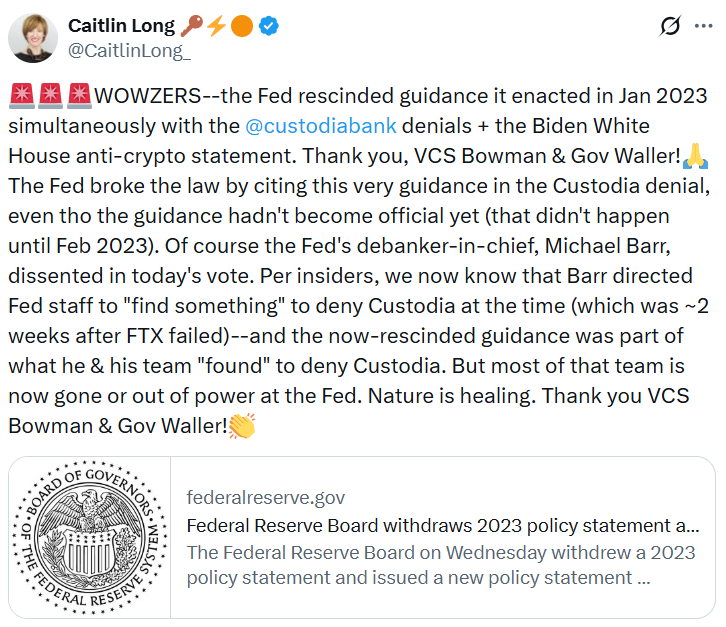
Caitlin Long, the CEO of the crypto‐focused Custodia Bank, applauded the move in an X post on Wednesday, explaining the 2023 guidance was why her institution’s application for a master account was previously denied.
Source: Cailtin Long

A master account with the Fed enables a financial institution to hold balances directly with the US central bank and access its core payment systems, allowing for payment settlement in central bank money rather than relying on another bank as an intermediary.

Related: Trump’s views on interest rates will hold ‘no weight’ at Fed: Hassett

“The Fed broke the law by citing this very guidance in the Custodia denial, even tho the guidance hadn’t become official yet, that didn’t happen until Feb 2023,” Long said.

“But most of that team is now gone or out of power at the Fed. Nature is healing. Thank you VCS Bowman & Gov Waller!” she added.

New guidance to boost bank innovation

The move on Wednesday came as the Federal Reserve issued new guidance to establish a formal pathway for both insured and uninsured Federal Reserve-supervised state member banks to pursue “innovative activities,” such as cryptocurrencies, provided risk-management expectations are met, according to a statement on Wednesday by the Fed.
Source: Federal Reserve

Fed Vice Chair for Supervision Michelle Bowman said by “creating a pathway for responsible, innovative products and services, the Board is helping ensure that the banking sector remains safe and sound while also modern, efficient, and effective.”

Fed decision wasn’t unanimous

Fed Governor Michael Barr dissented to the decision, arguing that the principle of equal treatment among banks helps maintain a level playing field and prevents regulatory arbitrage.

“This principle continues to hold true today. Therefore, I cannot agree to rescind the current policy statement and adopt a new one that would, in effect, encourage regulatory arbitrage, undermine a level playing field, and promote incentives misaligned with maintaining financial stability. I dissent,” he said.

Barr has been accused of being linked to Operation Chokepoint 2.0, a federal effort to debank crypto companies. However, he was also previously an adviser at Ripple and has pushed for responsible stablecoin regulation.

Magazine: Unstablecoins: Depegging, bank runs and other risks loom
Lecturas Relacionadas

$500 to Buy OpenAI Stock: Silicon Valley's Most Respectable Liquidity Invitation

Silicon Valley's largest venture capital platform, AngelList, has launched a new fund called USVC, allowing U.S. retail investors to buy into high-profile AI companies like OpenAI, Anthropic, and xAI with a minimum investment of $500—no accredited investor status required. Promoted by AngelList co-founder Naval Ravikant, the fund is framed as an opportunity for ordinary people to access high-growth private tech investments traditionally reserved for VCs. However, critics argue it functions more like an exit vehicle for early insiders. USVC acquires shares not through primary rounds but largely via secondary transactions—purchasing stakes from early investors, VC funds, and employees looking to cash out at peak valuations. With companies like xAI heavily weighted in the portfolio, the fund effectively channels retail money into providing liquidity for insiders who entered at much lower valuations. The fund’s structure raises concerns: shares are illiquid, with no secondary market, and buybacks are limited and discretionary. The actual annual fee reaches 3.61%, far above the advertised 1% management fee. This model parallels the "low float, high fully diluted valuation" strategy seen in crypto, where early investors profit by selling to latecomers at inflated prices. The timing—alongside similar moves by platforms like Robinhood—suggests that Silicon Valley’s sudden interest in retail inclusion may be less about democratizing access and more about securing exits for insiders.

marsbitHace 29 min(s)

$500 to Buy OpenAI Stock: Silicon Valley's Most Respectable Liquidity Invitation

marsbitHace 29 min(s)

Trading

Spot
Futuros

Artículos destacados

Cómo comprar US

¡Bienvenido a HTX.com! Hemos hecho que comprar Talus Network (US) sea simple y conveniente. Sigue nuestra guía paso a paso para iniciar tu viaje de criptos.Paso 1: crea tu cuenta HTXUtiliza tu correo electrónico o número de teléfono para registrarte y obtener una cuenta gratuita en HTX. Experimenta un proceso de registro sin complicaciones y desbloquea todas las funciones.Obtener mi cuentaPaso 2: ve a Comprar cripto y elige tu método de pagoTarjeta de crédito/débito: usa tu Visa o Mastercard para comprar Talus Network (US) al instante.Saldo: utiliza fondos del saldo de tu cuenta HTX para tradear sin problemas.Terceros: hemos agregado métodos de pago populares como Google Pay y Apple Pay para mejorar la comodidad.P2P: tradear directamente con otros usuarios en HTX.Over-the-Counter (OTC): ofrecemos servicios personalizados y tipos de cambio competitivos para los traders.Paso 3: guarda tu Talus Network (US)Después de comprar tu Talus Network (US), guárdalo en tu cuenta HTX. Alternativamente, puedes enviarlo a otro lugar mediante transferencia blockchain o utilizarlo para tradear otras criptomonedas.Paso 4: tradear Talus Network (US)Tradear fácilmente con Talus Network (US) en HTX's mercado spot. Simplemente accede a tu cuenta, selecciona tu par de trading, ejecuta tus trades y monitorea en tiempo real. Ofrecemos una experiencia fácil de usar tanto para principiantes como para traders experimentados.

522 Vistas totalesPublicado en 2025.12.11Actualizado en 2025.12.11

Cómo comprar US

Discusiones

Bienvenido a la comunidad de HTX. Aquí puedes mantenerte informado sobre los últimos desarrollos de la plataforma y acceder a análisis profesionales del mercado. A continuación se presentan las opiniones de los usuarios sobre el precio de US (US).

活动图片