U.S. Establishes 'Five-Category Law' for Crypto Assets: A Guide to the New Regulatory Framework (Essential Edition)

marsbitPublicado a 2026-03-18Actualizado a 2026-03-18

Resumen

The U.S. SEC and CFTC jointly issued a landmark 68-page regulatory framework on March 17, 2026, establishing a clear classification system for crypto assets. The new rules categorize assets into five types: Digital Commodities (e.g., BTC, ETH), Digital Securities, Regulated Payment Stablecoins, Digital Tools, and Digital Collectibles. A key innovation is the "separation" mechanism, allowing assets to transition from securities to commodities once they become sufficiently decentralized and no longer rely on managerial efforts. The framework also clarifies that activities like mining, staking, wrapping, and airdrops (under certain conditions) are not securities transactions. This guidance aims to reduce regulatory uncertainty, lower compliance costs, and reinforce U.S. leadership in crypto innovation by providing legal clarity and encouraging market transparency.

On March 17, 2026, the U.S. Securities and Exchange Commission (SEC) and the Commodity Futures Trading Commission (CFTC) jointly released an interpretive document numbered 33-11412. This 68-page regulatory framework officially declares: U.S. crypto regulation has ended a decade-long era of "regulation by enforcement" and entered a new era of clarity and harmonization driven by "Project Crypto".
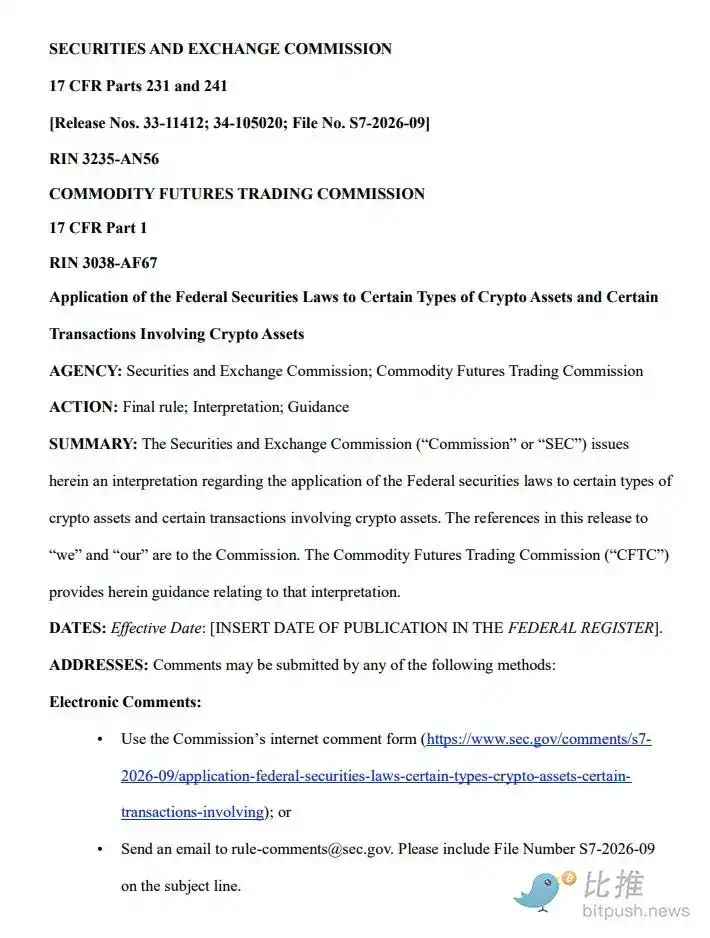
This document is not only a rare achievement of regulatory collaboration between the SEC and CFTC but also the most landmark guidance in the history of U.S. crypto regulation. The following is the full interpretation of the essential edition:

I. Background: "Project Crypto" from Conflict to Collaboration

In 2017, the SEC first applied the Howey test to crypto assets through "The DAO Report." For the next decade, regulation primarily relied on enforcement actions to define asset attributes, leaving the market in a state of uncertainty and controversy.

In early 2025, the SEC established the "Crypto Task Force," subsequently launching the "Project Crypto" initiative led by SEC Chairman Paul S. Atkins and CFTC Chairman Michael S. Selig. The initiative aimed to coordinate the authority of the two major regulatory agencies, establish a unified asset classification method, and provide a clear path for crypto innovation to remain in the U.S. In January 2026, the project was officially upgraded to a joint SEC and CFTC action.

II. Asset Classification: The Logic of the "Five-Category Law" for Crypto Assets

Based on asset characteristics,用途, and functionality, the document divides crypto assets into five major categories, providing the market with a clear classification standard for the first time:

  1. Digital Commodities

    Definition: Refers to those assets whose value stems from the programmatic operation and supply-demand dynamics of a "functionalized" crypto system, rather than relying on the managerial efforts of others.

    Core List: The document explicitly names mainstream tokens such as BTC, ETH, SOL, XRP, ADA, DOT, AVAX, LINK, etc., as digital commodities. These assets are not controlled by any single centralized entity and do not possess inherent economic rights that generate passive income.

  2. Digital Securities

    Definition:即"Tokenized Securities," referring to traditional securities represented in the form of crypto assets, or digital assets possessing the economic substance of securities (e.g., representing enterprise ownership, dividend rights).

    Regulation: Whether on-chain or off-chain, as long as they符合 economic substance, they fall under the SEC's regulatory purview.

  3. Regulated Payment Stablecoins

    Definition: Stablecoins that meet the definition of the 2025 "GENIUS Act" and are issued by authorized institutions.

    Qualification: These stablecoins are explicitly excluded from the definition of "securities" and are primarily受 specific legal constraints as payment instruments.

  4. Digital Tools

    Purpose: Tokens that only have utility functions within specific crypto systems (e.g., access rights or service payments) and are generally not considered securities.

  5. Digital Collectibles

    Definition: Assets intended to be collected and/or used, representing artworks, music, videos, in-game items, or internet memes, etc.

    Examples: CryptoPunks, Chromie Squiggles, WIF, VCOIN, etc.

    Qualification: Not securities themselves; their value stems from supply and demand relationships rather than the managerial efforts of others. However, if fragmented and sold, they may constitute securities.

III. Innovation: "Separation" and "Dynamic Conversion" of Security Attributes

This is the most groundbreaking legal innovation in the document—the SEC首次承认: The "security attribute" of a crypto asset is not permanent.

"Separation" Mechanism

  • Principle: A project may be considered a security (investment contract) during its initial financing phase if it meets the Howey test. But when the project completes its roadmap, achieves autonomous operation of open-source code, and decentralizes network power, the asset can be "separated" from the investment contract.

  • Judgment Standard: When investors no longer reasonably rely on the issuer's "essential managerial efforts" to obtain profits, but instead rely on the system's own operation and market supply and demand, the asset transforms from a "security" to a "digital commodity."

  • Separation Timing: Can occur immediately upon delivery of the asset to the purchaser, or at a future date.

Three Scenarios for Separation

  1. Issuer Fulfills Promises: After completing the essential managerial efforts, even if non-essential maintenance continues, the asset is no longer bound by the investment contract.

  2. Issuer Abandons Project: If publicly宣布放弃 development and no longer fulfills promises, the asset脱离 securities law jurisdiction (but the issuer may still bear legal liability for fraud).

  3. Secondary Market Trading: If subsequent purchasers no longer reasonably expect to rely on the issuer's efforts for profit, the transaction does not constitute a securities transaction.

Transparency Recommendation

The SEC encourages project parties to publicly disclose roadmap progress and milestone achievements to facilitate market identification of the "separation point."

IV. Qualification of On-Chain Activities: "Demining" for Decentralization

Regarding long-disputed activities such as staking, mining, wrapping, and airdrops, the document provides extremely detailed and favorable explanations:

Protocol Mining

  • Qualification: PoW mining is an "administrative or ministerial" activity that ensures network security and verifies transactions.

  • Conclusion: Whether solo mining or joining a mining pool, it does not involve securities issuance.

  • Mining Pool Operation: The activities of mining pool operators are administrative and ministerial, not constituting essential managerial efforts.

Protocol Staking

  • Qualification: Staking is an administrative activity for maintaining network operation.

  • Coverage: Includes solo staking, delegated third-party staking, custodial staking, and liquid staking.

  • Custodial Staking: If a custodian stakes on behalf of users, as long as it does not involve re-lending of assets, leverage, or discretionary trading, it does not constitute a securities activity.

  • Ancillary Services: Slash insurance, early unstaking, flexible reward distribution, asset aggregation, and other auxiliary services are all administrative and ministerial.

Staking Receipt Tokens

  • Qualification: If the underlying asset is a non-security commodity and not subject to an investment contract, the receipt itself is not a security.

  • Principle: The receipt merely exists as a "receipt," does not generate income; income stems from the underlying staking activity.

Wrapping Tokens (Wrapping)

  • Definition: Users deposit crypto assets with a custodian or跨链桥, obtaining 1:1锚定的 redeemable wrapped tokens.

  • Qualification: If the underlying asset is a non-security commodity and not subject to an investment contract, wrapping tokens are considered an "administrative function" aimed at enhancing interoperability and do not constitute a securities transaction.

  • Key Restriction: The custodian must lock the assets and cannot lend,抵押, or re-stake them.

Airdrops

  • Qualification Breakthrough: As long as the recipient does not provide money, goods, services, or other consideration, it does not meet the "investment of money" element of the Howey test.

  • Applicable Scenarios:

    Airdropping to wallets holding specific tokens, without prior announcement

    Rewarding early testnet users

    Airdropping to eligible users based on application usage

  • Red Line: If recipients need to provide services (e.g., social media promotion) in exchange for the airdrop, it may constitute securities issuance.

V. Consolidation of U.S. Leadership

The document analyzes its economic significance in detail at the end:

  1. Eliminate "Chilling Effect": By providing legal clarity, reduce business stagnation caused by compliance opacity and encourage crypto innovation to return to the U.S.

  2. Reduce Compliance Costs: Clear classification and separation paths significantly reduce corporate legal consulting and regulatory应对 costs.

  3. <极速赛车开奖直播历史记录p style="text-align: justify; font-size: 16px; font-weight: inherit; word-break: break-all; line-height: 2; font-family: PingFang SC,Helvetica Neue,Helvetica,Arial,Hiragino Sans GB,Heiti SC,Microsoft YaHei,WenQuanYi Micro He极速赛车开奖直播历史记录i,sans-serif;">Enhance Market Transparency: The new framework requires more detailed disclosure during the "investment contract" phase, better protecting investors.

  4. Promote Competition and Innovation: Clear rules will attract more issuers and entrepreneurs to enter the market.

  5. Improve Pricing Efficiency: Reduce price distortions caused by uncertainty.

VI. Historic Breakthrough in Regulatory Collaboration

Structurally, the document establishes a clear analytical path: first classify the asset, then judge the transaction structure, and finally analyze whether the investment relationship持续存在.

More importantly, this is a rare result of coordination between the SEC and CFTC on crypto regulatory issues. Previously, the two agencies had long-standing differences in defining "securities vs. commodities," and this joint framework实质上 divides the归属 of major asset categories, marking a shift in U.S. crypto regulation from the stage of "inter-agency jurisdictional competition" to a "division of labor system based on unified rules."

This 68-page document not only ends a decade of regulatory chaos but also establishes the U.S.'s leadership position in the global crypto regulatory field. For practitioners, it is a must-read "industry constitution"; for investors, it is a clear "rights protection guide"; for entrepreneurs, it is a clear "compliance roadmap".

The "Wild West" era of crypto assets has officially ended.

Original Link

Preguntas relacionadas

QWhat is the 'Five-Category Method' for crypto assets established by the SEC and CFTC in the new regulatory framework?

AThe 'Five-Category Method' classifies crypto assets into: 1. Digital Commodities (e.g., BTC, ETH, SOL, XRP, ADA, DOT, AVAX, LINK), 2. Digital Securities (tokenized traditional securities or assets with securities economic substance), 3. Regulated Payment Stablecoins (as defined by the 2025 GENIUS Act), 4. Digital Tools (tokens with utility functions within specific crypto systems), and 5. Digital Collectibles (e.g., CryptoPunks, Chromie Squiggles, WIF, VCOIN).

QWhat is the 'Separation' mechanism introduced in the SEC and CFTC's new framework, and why is it significant?

AThe 'Separation' mechanism allows a crypto asset initially classified as a security (e.g., during fundraising via an investment contract) to transition to a non-security status (e.g., a digital commodity) once the project completes its roadmap, becomes decentralized, and no longer relies on the issuer's 'essential managerial efforts.' This is significant because it acknowledges that an asset's security status is not permanent and provides a clear path for projects to achieve regulatory clarity.

QHow do the SEC and CFTC classify activities like protocol mining, staking, and airdrops under the new framework?

AProtocol mining (PoW) and protocol staking (including solo, delegated, custodial, and liquid staking) are classified as 'administrative or ministerial' activities that maintain network operations and do not constitute securities offerings. Airdrops are generally not considered securities offerings if recipients provide no consideration (money, goods, services); however, if recipients must perform services (e.g., social media promotion) to receive the airdrop, it may be deemed a securities offering.

QWhat are the economic benefits highlighted in the framework for the U.S. crypto industry?

AThe framework aims to: 1. Eliminate the 'chilling effect' of regulatory uncertainty, encouraging crypto innovation to return to the U.S.; 2. Reduce compliance costs through clear classification and separation paths; 3. Enhance market transparency with better disclosure requirements during the 'investment contract' phase; 4. Promote competition and innovation by attracting more issuers and entrepreneurs; and 5. Improve pricing efficiency by reducing price distortions caused by uncertainty.

QWhat does the joint SEC-CFTC framework signify for U.S. crypto regulatory coordination?

AThe framework marks a historic shift from a decade of regulatory ambiguity and inter-agency competition (e.g., over 'security vs. commodity' definitions) to a unified, collaborative approach. It establishes a clear analytical path: classify assets, then evaluate transaction structures, and finally assess whether an investment relationship persists. This coordination positions the U.S. as a leader in global crypto regulation and ends the 'Wild West' era of crypto assets.

Lecturas Relacionadas

Agents Take Over Traffic Distribution Power: What Are Tencent, ByteDance, and Alibaba Competing For?

In the race to dominate the AI era's entry point, China's tech giants—Tencent, ByteDance, and Alibaba—are aggressively deploying AI Agents to control the future of traffic distribution. Alibaba is pursuing a dual-track "closed loop + openness" strategy. Its Qianwen app is evolving into a super-Agent integrated across its ecosystem (Taobao, Alipay, etc.) to handle complex tasks like travel planning. Concurrently, it is opening its platform to external brands (Luckin Coffee, KFC) and has launched a B2B Agent platform, "Wukong," targeting enterprise automation. Its other flagship, Quark, aims to be an "AI super search box" for information and tasks. ByteDance is executing an omnipresent "sprawl strategy." Its Doubao app boasts over 300 million monthly active users and is evolving into a default AI entry point for daily life, with plans for paid versions and e-commerce integration. Its core weapon is the Kouzi platform, a visual "AI assembly factory" for developers to build custom Agents. ByteDance is also pushing hardware integration, collaborating on AI phones and developing smart glasses to embed Doubao everywhere. Tencent is playing its long-held "ultimate card" by quietly embedding an AI Agent directly into WeChat. This Agent, accessible via a swipe, can understand user commands and automatically execute tasks by calling upon WeChat's millions of mini-programs (e.g., finding and ordering coffee). This leverages WeChat's unparalleled 1.4-billion-user ecosystem to position the app as an AI-powered "service operating system," a move that could dramatically reshape the competitive landscape. The core battleground is shifting from competing for "user screen time" to competing to be the "default execution layer" for user intent. The business model is evolving from an "attention economy" to an "intent economy," where the Agent that can most efficiently fulfill a user's need gains control over service access and token flow. This represents a fundamental change in how users connect with digital services, making the fight for the Agent入口 (entry point) a pivotal moment for redefining industry leadership in the AI age.

marsbitHace 1 hora(s)

Agents Take Over Traffic Distribution Power: What Are Tencent, ByteDance, and Alibaba Competing For?

marsbitHace 1 hora(s)

From Banning Doubao to Embracing Honor: Why Did WeChat Suddenly 'Change Its Face'?

The article explores the sudden shift in WeChat's strategy towards AI assistants from mobile phone manufacturers, transitioning from strict opposition to active collaboration. For over a year, WeChat fiercely resisted attempts by phone AI assistants (like ByteDance's Doubao in late 2025) to control its features via GUI automation ("simulated clicking"), citing security and data control concerns. This stance created a significant barrier for system-level AI integration. Now, Tencent has initiated A2A (Agent-to-Agent) partnerships with major phone brands like Honor, Xiaomi, OPPO, and vivo. This model allows a phone's system AI (e.g., Honor's YOYO) to parse a user's voice command and send a structured request directly to WeChat's own internal AI agent via secure APIs. WeChat then executes the action (e.g., sending a message) and returns the result. The article attributes Tencent's "change of face" to strategic pressure. While leading in social app usage, Tencent trails rivals like ByteDance and Alibaba in standalone AI app popularity. WeChat, with its vast mini-program ecosystem, is Tencent's key asset for an AI comeback. The upcoming WeChat AI agent aims to handle tasks like booking and payments within the app. However, phone system assistants remain the primary AI entry point for most users. The A2A collaboration allows Tencent to extend WeChat's AI reach to this crucial system layer while maintaining control over its core functions and data. For phone manufacturers, embracing A2A is a pragmatic move. The GUI route proved unviable due to WeChat's blocks. A2A offers a compliant path to integrate a vital service, enhancing their AI assistants' usefulness. It allows them to focus on developing their own AI ecosystems for other services while cooperating on WeChat access. The collaboration is framed as a mutual, strategic necessity: Tencent gains a distribution channel, and manufacturers gain a key functionality. The partnership relies on a "dual authorization" mechanism for security, requiring both user and app consent for each action. While questions about long-term data privacy practices remain, experts note A2A is more secure and compliant than GUI automation. Ultimately, this cooperation is seen as a tentative, calculated truce. Tencent's long-term goal is to make WeChat an AI-powered "service OS." Phone manufacturers aim to make their system AI the central user interface. Their paths may converge or clash in the future, but for now, the A2A deal represents the opening chapter in the battle for the AI-era user入口, driven by necessity and strategic calculus on both sides.

marsbitHace 2 hora(s)

From Banning Doubao to Embracing Honor: Why Did WeChat Suddenly 'Change Its Face'?

marsbitHace 2 hora(s)

Trading

Spot
Futuros
活动图片

