US Crypto Policy Debate Intensifies as CLARITY Act Support Fractures

bitcoinistPublicado a 2026-01-16Actualizado a 2026-01-16

Resumen

Washington's efforts to regulate the crypto market face new uncertainty as the CLARITY Act, a key legislative proposal, encounters significant setbacks. Coinbase withdrew its support, citing concerns over restrictions on tokenized equities, crypto rewards, and expanded government data access. This prompted a pause in the Senate Banking Committee's progress on the bill, though the White House reaffirmed its backing. The debate centers on whether the SEC or CFTC should have primary oversight, with exchanges favoring the CFTC's commodity-based approach. Industry leaders are divided, with some supporting the bill as a necessary step forward despite its flaws, while others warn it could stifle innovation. Stablecoin regulation and consumer protection remain contentious issues.

Washington’s long-running effort to bring regulatory clarity to the U.S. crypto market has entered a more uncertain phase. The Digital Asset Market Clarity Act, known as the CLARITY Act, was expected to move closer to a Senate vote this week.

Instead, a sudden withdrawal of support from Coinbase and a last-minute pause by Senate leadership have exposed deep divisions within the industry and among lawmakers. While the White House insists the bill is still on track, the debate over how digital assets should be regulated is becoming more fragmented.
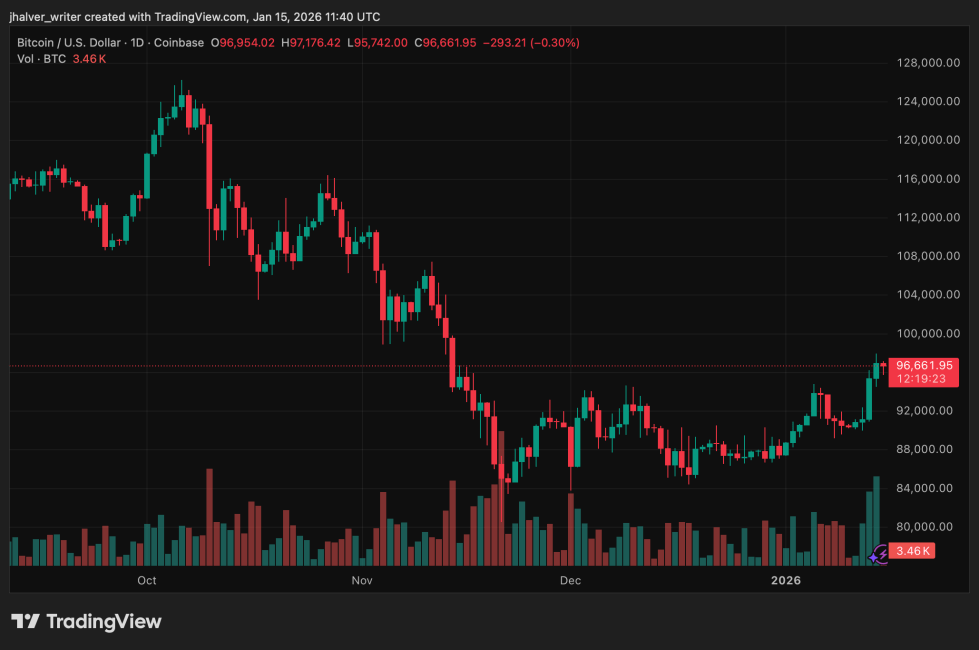
BTC's price records some gains on the daily chart. Source: BTCUSD on Tradingview

Coinbase Withdrawal Triggers Legislative Pause

The immediate turning point came when Coinbase CEO Brian Armstrong announced that the company could no longer support the current draft of the CLARITY Act.

Armstrong argued that the bill would be worse than the existing regulatory uncertainty, citing concerns over limits on tokenized equities, restrictions on crypto rewards, and expanded government access to financial data.

Shortly after, Senate Banking Committee Chair Tim Scott introduced a brief pause in the bill’s progress, cancelling a scheduled markup.

Scott described the delay as procedural rather than political, stating that negotiations were ongoing and bipartisan talks continued. A new markup date has been set for January 27, once updated bill language is released.

Despite the setback, White House AI and crypto czar David Sacks reiterated that the administration still backs the legislation. He said the pause should be used to resolve remaining issues and push forward a framework that allows innovation while strengthening oversight.

Industry Split Over SEC and CFTC Roles

At the core of the dispute is the division of regulatory authority between the Securities and Exchange Commission (SEC) and the Commodity Futures Trading Commission (CFTC) as outlined in the CLARITY Act.

Crypto exchanges generally favor the CFTC’s approach, which treats many digital assets as commodities. The SEC, by contrast, applies securities laws that impose stricter compliance requirements.

Critics argue the bill shifts too much power to the SEC, particularly over tokenized equities and certain crypto products. Coinbase has warned that the proposed rules could effectively block the development of on-chain stock trading and limit user reward programs.

Other industry leaders, including executives from Ripple, a16z, and Kraken, have taken a more cautious stance. While acknowledging flaws in the draft, they argue that passing some form of market structure legislation is better than leaving the sector in regulatory limbo.

Banks, Stablecoins, and the Broader Stakes

Another contentious issue is stablecoin regulation. The CLARITY Act would make it difficult for crypto platforms to offer yield or interest-like rewards on stablecoin holdings. Banks support these restrictions, saying they protect financial stability.

Lawmakers also point to past failures, such as the FTX collapse, as evidence that clearer rules are needed to protect consumers and national security. However, frustration is growing behind the scenes.

Senate sources indicate that some committee members were dissatisfied with Coinbase’s timing, perceiving the withdrawal as disruptive to months of negotiations.

Cover image from ChatGPT, BTCUSD chart from Tradingview

Preguntas relacionadas

QWhat was the immediate trigger that caused a pause in the progress of the CLARITY Act?

AThe immediate trigger was Coinbase CEO Brian Armstrong's announcement that the company could no longer support the current draft of the bill.

QAccording to Coinbase, what are some specific concerns they have with the proposed CLARITY Act?

ACoinbase cited concerns over limits on tokenized equities, restrictions on crypto rewards, and expanded government access to financial data.

QWhich two U.S. regulatory agencies are at the core of the dispute over the CLARITY Act?

AThe Securities and Exchange Commission (SEC) and the Commodity Futures Trading Commission (CFTC) are at the core of the dispute.

QWhat is the new date set for the markup of the CLARITY Act after the pause?

AA new markup date has been set for January 27, once updated bill language is released.

QBesides Coinbase, which other industry leaders were mentioned as taking a more cautious stance on the bill?

AExecutives from Ripple, a16z, and Kraken were mentioned as taking a more cautious stance, arguing that passing some form of legislation is better than regulatory limbo.

Lecturas Relacionadas

Bitcoin Withdrawals Continue: 8 Years of Storage in a Coldcard Cold Wallet Ended in Zero

Coldcard Hardware Wallet Hacked: Losses Mount Due to Vulnerable Seed Generation A critical vulnerability in Coldcard hardware wallets has led to a continued wave of fund thefts. According to Galaxy Research, the total stolen has reached 1,367.05 BTC (approx. $88.6 million) from 4,585 addresses, a significant increase from the initial 594.5 BTC reported on July 30, 2026. Most of the stolen funds remain on the attackers' addresses. The issue is not with the current firmware, which Coinkite has updated, but with seed phrases generated on vulnerable devices between March 2021 and the release of fixed firmware versions. Due to a programmer error, devices switched from using a hardware random number generator to the software-based Yasmarang generator, which was initialized with publicly accessible data like the chip's serial number. This made the seed phrases predictable through offline brute-force attacks, meaning wallets remain at risk until funds are moved to a new wallet generated with the patched firmware. Affected devices include Mk2/Mk3 with firmware 4.0.1–4.1.9 (and up to 5.0.3), Mk4/Mk5 up to version 5.6.0, and Q models up to 1.5.0Q. The only exceptions are seeds created with a high-entropy method like at least 50 independent dice rolls or a strong unique BIP-39 passphrase. All other owners must generate a new seed on the fixed firmware and transfer their assets. A case highlighting the human impact involves a 39-year-old long-term investor who lost 2 BTC (approx. $130,000) in minutes. He had accumulated the Bitcoin over eight years through physical labor, viewing it as a financial lifeline and a retirement plan in a country suffering from hyperinflation. His story underscores that even conservative "buy and hold in cold storage" strategies can be compromised by such underlying technical flaws. From a technical perspective, this incident echoes historical failures where weak random number generators undermined cryptographic security, challenging the assumption that offline storage is automatically foolproof.

cryptonews.ruHace 1 hora(s)

Bitcoin Withdrawals Continue: 8 Years of Storage in a Coldcard Cold Wallet Ended in Zero

cryptonews.ruHace 1 hora(s)

Trading

Spot
活动图片





