US banks could soon issue stablecoins under FDIC plan to implement GENIUS Act

cointelegraphPublicado a 2025-12-16Actualizado a 2025-12-16

Resumen

The Federal Deposit Insurance Corp. (FDIC) has proposed a framework allowing regulated U.S. banks to issue payment stablecoins through subsidiaries, as part of implementing the GENIUS Act. The proposal outlines approval requirements, including assessments of financial condition, management quality, and redemption policies. Once approved, the FDIC would serve as the primary regulator. The GENIUS Act, signed into law by President Trump in July, establishes a comprehensive regulatory framework requiring stablecoin issuers to maintain one-to-one reserves with U.S. dollars or other high-quality liquid assets. The legislation is seen as a way to strengthen the U.S. dollar's global reach, with the stablecoin market exceeding $300 billion, largely dominated by dollar-pegged tokens.

The Federal Deposit Insurance Corp. (FDIC) is moving forward with rule-making under the US GENIUS Act by proposing a framework for how regulated banks could apply to issue payment stablecoins, a key early step in implementing the law’s stablecoin provisions.

In a 38-page document posted to the FDIC’s website, the agency detailed proposed approval requirements for the issuance of payment stablecoins by subsidiaries of FDIC-supervised institutions.

As Bloomberg reported, the proposal is subject to a public consultation period before advancing to the next stage of the rulemaking process.
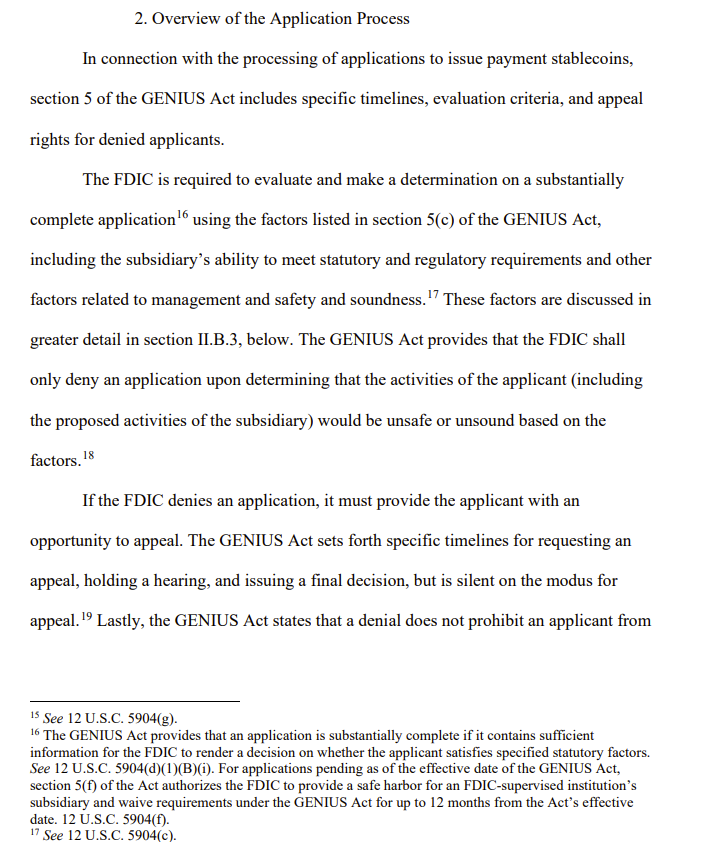
Excerpts from the FDIC’s proposed framework for bank-issued payment stablecoins. Source: FDIC

Under the proposal, banks would apply to issue payment stablecoins through a subsidiary, with the FDIC assessing both the subsidiary and its parent institution against criteria set out in the GENIUS Act. These include the ability to meet stablecoin issuance standards, the institution’s financial condition, management quality, redemption policies and other safety and soundness considerations.

Once approved, the FDIC would serve as the primary federal regulator overseeing the subsidiary’s payment stablecoin activities.

The FDIC is the US agency responsible for insuring bank deposits and supervising member institutions. In recent years, it has taken a more active role in shaping how banks engage with digital assets, including reconsidering the use of reputational risk in bank supervision. As Cointelegraph reported in October, this shift could impact how financial institutions interact with crypto-related businesses.

Related: US stablecoin rules split global liquidity with Europe, CertiK warns

Washington’s historic embrace of stablecoins

The GENIUS Act — short for Guiding and Establishing National Innovation for US Stablecoins — cleared the Senate in June and was signed into law by US President Donald Trump the following month.

The legislation establishes a comprehensive regulatory framework for payment stablecoins, including requirements that issuers maintain one-to-one reserve backing with US dollars or other approved high-quality liquid assets.
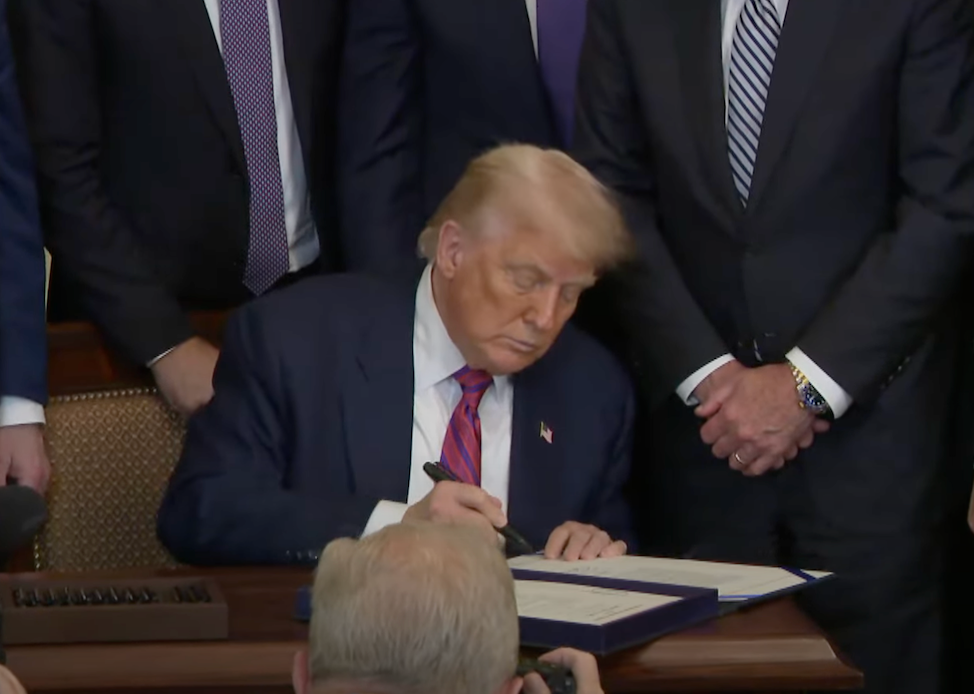
US President Donald Trump signed the GENIUS Act on July 18. Source: Associated Press

The GENIUS Act was widely welcomed by the cryptocurrency industry, with senior executives from major companies including Coinbase, Circle, Robinhood and Gemini attending President Donald Trump’s signing of the bill.

Some industry participants view the legislation as a tool to strengthen US dollar liquidity and extend the dollar’s global reach through stablecoins, a view echoed by US Treasury Secretary Scott Bessent.

The total value of stablecoins in circulation has climbed above $300 billion globally, driven almost entirely by US dollar-pegged tokens.

Related: Crypto Biz: Corporate stablecoin race heats up with Citi, Western Union at the helm

Criptos en tendencia

Lecturas Relacionadas

How to Steadily Earn Money in Blockchain Games? The Project Team Reveals the Dual Profit Logic for Both Players and Projects

**Summary:** This interview features Leo, CBO of Gamebank, discussing the challenges and future of Web3 games through the lens of their project, Pump Snake. He addresses the core questions of playability and profitability. Leo explains that Pump Snake is a multiplayer, competitive take on the classic "Snake" game, designed for mass appeal and accessibility. The primary goal is to create an engaging game first; financial and asset-based features are secondary and depend on a strong player base. The project aims to be a gateway for Web2 users into Web3, allowing them to naturally encounter blockchain concepts through gameplay rather than direct crypto education. Key mechanisms discussed include: * **"Loss-to-Mine":** Players receive redeemable points for losses, which can be used for blind boxes (containing skins, items), improving retention by offering a reward even for losing. * **Commercialization:** Plans include in-game transaction fees, subscription services (SVIP), and sales of skins/blind boxes, all designed not to compromise competitive fairness. * **Future Token:** A token launch is confirmed but will be timed based on market conditions, regulatory clarity, and product maturity to avoid a "death spiral" economy. * **Fairness:** Paid features (SVIP, ads, blind boxes) are designed to offer cosmetic or convenience benefits without granting competitive advantages. Leo acknowledges current Web3 gaming setbacks but is optimistic about the long-term convergence of engaging gameplay, blockchain-based asset ownership/value distribution, and AI integration. Pump Snake is currently in a growth phase, focusing on product iteration and user acquisition in Asia before a broader rollout.

marsbitHace 18 min(s)

How to Steadily Earn Money in Blockchain Games? The Project Team Reveals the Dual Profit Logic for Both Players and Projects

marsbitHace 18 min(s)

Trading

Spot

Artículos destacados

Cómo comprar SOON

¡Bienvenido a HTX.com! Hemos hecho que comprar SOON (SOON) sea simple y conveniente. Sigue nuestra guía paso a paso para iniciar tu viaje de criptos.Paso 1: crea tu cuenta HTXUtiliza tu correo electrónico o número de teléfono para registrarte y obtener una cuenta gratuita en HTX. Experimenta un proceso de registro sin complicaciones y desbloquea todas las funciones.Obtener mi cuentaPaso 2: ve a Comprar cripto y elige tu método de pagoTarjeta de crédito/débito: usa tu Visa o Mastercard para comprar SOON (SOON) al instante.Saldo: utiliza fondos del saldo de tu cuenta HTX para tradear sin problemas.Terceros: hemos agregado métodos de pago populares como Google Pay y Apple Pay para mejorar la comodidad.P2P: tradear directamente con otros usuarios en HTX.Over-the-Counter (OTC): ofrecemos servicios personalizados y tipos de cambio competitivos para los traders.Paso 3: guarda tu SOON (SOON)Después de comprar tu SOON (SOON), guárdalo en tu cuenta HTX. Alternativamente, puedes enviarlo a otro lugar mediante transferencia blockchain o utilizarlo para tradear otras criptomonedas.Paso 4: tradear SOON (SOON)Tradear fácilmente con SOON (SOON) en HTX's mercado spot. Simplemente accede a tu cuenta, selecciona tu par de trading, ejecuta tus trades y monitorea en tiempo real. Ofrecemos una experiencia fácil de usar tanto para principiantes como para traders experimentados.

170 Vistas totalesPublicado en 2025.05.23Actualizado en 2026.06.02

Cómo comprar SOON

Discusiones

Bienvenido a la comunidad de HTX. Aquí puedes mantenerte informado sobre los últimos desarrollos de la plataforma y acceder a análisis profesionales del mercado. A continuación se presentan las opiniones de los usuarios sobre el precio de SOON (SOON).

活动图片