US Banking Lobby Urges OCC To Delay Crypto Charter Applications Approval

bitcoinistPublicado a 2026-02-13Actualizado a 2026-02-13

Resumen

The US's largest banking lobby, the American Bankers Association (ABA), has urged the Office of the Comptroller of the Currency (OCC) to delay its approval of crypto bank charter applications. The ABA cited regulatory uncertainty, the need for greater transparency in the application process, and a lack of finalized federal oversight. This follows the OCC's conditional approval of charters for several crypto firms in December, which raised concerns about blurred regulatory lines. The ABA argues the OCC should wait until Congress finalizes new rules. Additionally, the banking industry opposes granting crypto and fintech firms direct access to the Federal Reserve's payment systems, advocating for a 12-month waiting period to ensure safety and soundness standards are met.

The US’s largest banking lobby has requested the Office of the Comptroller of the Currency (OCC) delay its approval of crypto bank charter applications, suggesting the regulator wait until regulatory uncertainty is cleared.

US Banks Call For Crypto Charter Reviews Delay

On Wednesday, the American Bankers Association (ABA) asked the OCC to pause the review of national bank charter applications for crypto firms, citing uncertainty surrounding emerging business models, the need for greater transparency in charter application and decision-making processes, and a lack of finalized federal oversight.

In a letter, the banking lobby urged the US’s top bank regulator to “ensure that robust, broadly applicable safety and soundness standards are well understood and upheld during this period of rapid innovation to provide greater transparency throughout its charter application and decisioning processes.”

As reported by Bitcoinist, the OCC approved conditional bank charters for Ripple, Circle, BitGo, Paxos, and Fidelity in December, raising concerns that the approvals could blur the lines of banking activities and lead to regulatory arbitrage.

The ABA now calls for patience as emerging crypto regulatory frameworks take shape, suggesting that the review process must be delayed until Congress finishes the rules that many recent OCC charter applicants will ultimately be subject to.

“We urge the OCC to be patient, not measure its application decisioning progress against traditional timelines, and allow each charter applicant’s regulatory responsibilities to come fully into view before moving a charter application forward,” ABA wrote.

The banking association emphasized that appropriate safety and soundness protections, including effective measures against conflicts of interest, and for compliance with other applicable consumer protection laws and regulations, must be in place from the beginning.

Notably, the Trump Family’s main crypto venture, World Liberty Financial, applied for a national trust charter in January. US Senator Elizabeth Warren sent a letter to Comptroller Jonathan Gould asking the agency to pause its review of the application until President Donald Trump divests from the crypto company, arguing that it could create a government ethics problem.

In addition, the association recommended an amendment to the OCC’s regulations to ensure new charter applicants’ names “do not misrepresent the nature of the financial services they intend to offer.”

They suggested that the agency prohibit any charter applicant that limits its activities to either fiduciary activities or trust company operations from including the word “bank” in its name.

ABA argued that “such entities would not be engaged in the business of banking and should, therefore, ‘not have a title that misrepresents the nature of the institution or the services it offers.’”

“Skinny” Accounts Clash

US banks have recently shared their opposition to granting crypto and fintech companies direct access to the Federal Reserve (Fed)’s payment systems, according to Bloomberg.

Earlier this week, the Bank Policy Institute, Clearing House Association, and Financial Services Forum sent a joint letter to the Fed, demanding a 12-month waiting period before firms are eligible to apply for payment accounts.

The banking groups argued the Fed “should block access until newly licensed stablecoin issuers prove they can operate safely.” As Bloomberg noted, crypto and fintech firms currently rely on partner banks for access and compliance infrastructure. However, the Fed’s “skinny” master accounts proposal, first introduced in October, would allow these crypto companies to bypass the intermediation.

Moreover, recent reports from Eleanor Terret claim that the tensions between the US banking sector and the crypto industry have extended from Stablecoin rewards to include the skinny master accounts proposal.

While the digital assets side was “largely positive,” Terret affirmed the banking side worried that crypto’s “less robust regulatory status could pose a problem,” with Better Markets CEO Dennis Kelleher calling the proposal “a reckless giveaway to the crypto industry that unnecessarily expands the Fed’s mandate without justification and undermines the Fed’s true mandate.”
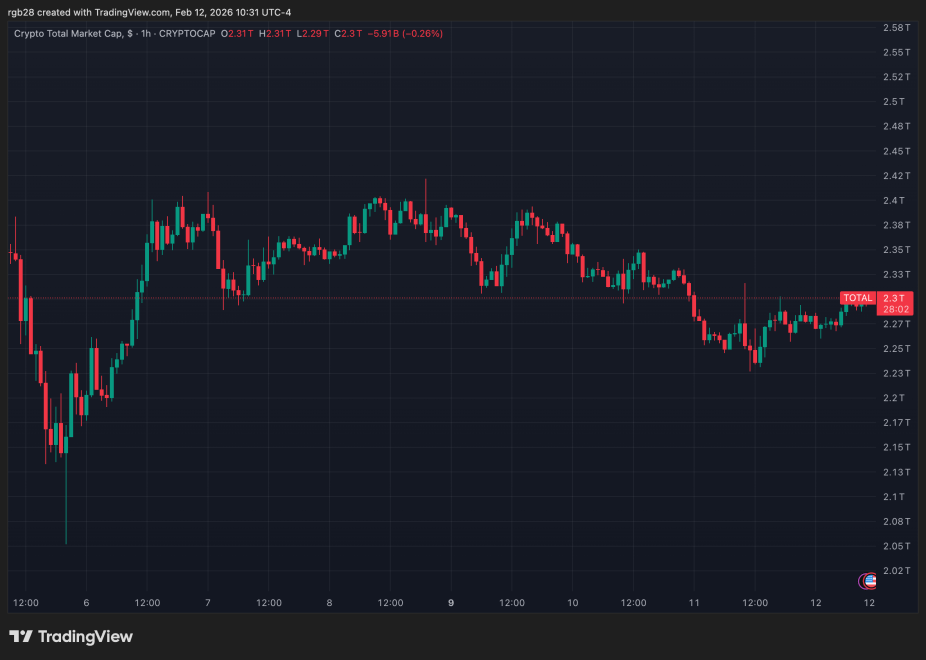
The total crypto market capitalization is at $2.3 trillion in the one-week chart. Source: TOTAL on TradingView

Preguntas relacionadas

QWhat is the main request made by the American Bankers Association (ABA) to the Office of the Comptroller of the Currency (OCC)?

AThe ABA requested the OCC to pause the review of national bank charter applications for crypto firms until regulatory uncertainty is cleared and Congress finishes establishing the rules.

QWhich crypto companies received conditional bank charters from the OCC in December, as mentioned in the article?

AThe OCC approved conditional bank charters for Ripple, Circle, BitGo, Paxos, and Fidelity in December.

QWhat specific recommendation did the ABA make regarding the naming of new charter applicants?

AThe ABA recommended that the OCC prohibit any charter applicant limited to fiduciary activities or trust company operations from including the word 'bank' in its name to avoid misrepresentation.

QWhy did US banking groups oppose granting crypto and fintech companies direct access to the Federal Reserve's payment systems?

ABanking groups argued that the Fed should block access until newly licensed stablecoin issuers prove they can operate safely, expressing concerns about crypto's less robust regulatory status.

QWhat was the concern raised by US Senator Elizabeth Warren regarding World Liberty Financial's charter application?

ASenator Warren asked the OCC to pause its review of the application until President Donald Trump divests from the crypto company, arguing it could create a government ethics problem.

Lecturas Relacionadas

US Stock Market Trend (June 16): SpaceX Rises 42% in Two Days, New Fed Chairman Takes Office Today

**U.S. Stocks Trend (June 16): SpaceX Soars 42% in Two Days, New Fed Chair Takes Office Today** Markets surged on Monday following former President Trump's social media announcement of a completed U.S.-Iran deal to reopen the Strait of Hormuz, pending a June 19 signing. The news triggered a broad risk-on rally: oil prices crashed, tech stocks soared, bond yields fell, and defensive sectors lagged. **Market Performance:** The Nasdaq jumped 3.07%, led by semiconductor stocks like Micron (+9.2%). The S&P 500 gained 1.65%, and the Dow rose 0.92% to a record high. However, the Russell 2000 small-cap index underperformed (+0.72%). SpaceX continued its hot streak, rising another 5% pre-market after disclosures of large buys by an Australian billionaire and Cathie Wood's ARK. Boeing also rallied on the transportation optimism. Conversely, energy stocks like Chevron fell over 3% on the oil price plunge, with other defensive sectors also selling off. The day's action showed a clear rotation of funds from energy/defensive plays into AI and tech narratives. **Macro & Outlook:** The VIX fear index fell 8.37%. Treasury yields declined, and WTI crude dropped over 5%. Attention now shifts to a packed schedule: the Bank of Japan is widely expected to hike rates to 1.0% on Tuesday. The Fed's June meeting concludes Wednesday, marking new Chair Wash's debut. While rates are expected to hold, his tone on stubborn inflation and the "dot plot" will be crucial for gauging the 2024 rate path. The formal Iran deal signing is set for Friday. **Trend Perspective:** While the peace deal is a genuine positive, Monday's explosive rally may have gotten ahead of itself, pricing in a swift resolution to inflation concerns. The shortened trading week faces a triple test: BoJ tightening, the Fed's policy stance, and deal implementation details. Tech and semiconductors, which led the surge, remain vulnerable to any disappointment from these key events. The real price discovery begins with the central banks' communications this week.

marsbitHace 18 min(s)

US Stock Market Trend (June 16): SpaceX Rises 42% in Two Days, New Fed Chairman Takes Office Today

marsbitHace 18 min(s)

Xiaohongshu's Second Great Voyage, This Time Sailing Towards AI

Xiaohongshu's Second Voyage: Navigating Towards AI Since ChatGPT's emergence, Xiaohongshu's founder Mao Wenchao has been acutely aware of AI's potential threat, recognizing that the life advice people seek from chatbots overlaps directly with his platform's core business. Founded in 2013 as a PDF shopping guide for Chinese tourists, Xiaohongshu evolved into a massive community where millions share authentic, personal experiences—from product reviews to travel tips. This vast repository of "I've tried this" human judgment became its most valuable asset. However, the rise of AI, which delivers instant answers, challenges the very need for users to sift through numerous personal notes. Fearing its treasure trove of lived experience could become mere training data for others, Xiaohongshu is proactively adapting. In 2026, it established a dedicated AI division (Dots), launched RED Skill to turn user experiences into usable AI tools, and acquired the AI search product "Diandian." Its investments now extend to AI firms like MiniMax and hardware startups, moving upstream to address needs before they even become search queries. The platform's commercialization strategy is also evolving. With a newly acquired payment license and tools like the AIPS model to track consumer decision journeys, Xiaohongshu aims to seamlessly integrate recommendations with transactions, embedding commerce within AI-generated answers. Yet, a critical tension remains. While building smarter machines to organize and leverage its human experiences, Xiaohongshu must prevent AI from drowning out the authentic, flawed, and trustworthy "I've tried this" voices that built its community. Its core challenge is to harness AI's power without letting the map—the machine's perfect, synthesized answer—replace the territory of genuine human experience. This balance between technological advancement and preserving human trust defines its current journey and its future.

marsbitHace 51 min(s)

Xiaohongshu's Second Great Voyage, This Time Sailing Towards AI

marsbitHace 51 min(s)

SharpLink CEO: How to Understand Ethereum Developers Just Exceeded 1 Million?

SharpLink CEO reflects on the milestone of Ethereum surpassing 1 million historical developers, emphasizing that this figure represents the largest pool of technical talent ever assembled around an open, permissionless blockchain network. While approximately 232,000 developers remain active, the key question for the crypto industry is not which chain is fastest, but where the best builders choose to build long-term. Ethereum's advantage lies in a decade-long accumulation of infrastructure, standards, tools, liquidity, and a cohesive culture, making it the default operating system for programmable finance. This developer base is tackling complex challenges: the Glamsterdam upgrade aims to enhance scalability while preserving core principles; synchronous composability seeks to unify Rollup ecosystems; and significant efforts are underway for post-quantum security. Ethereum's deeper network effects stem from composability and shared standards (like the EVM and Solidity), creating a flywheel of more developers, tools, and liquidity. Three reinforcing strengths cement Ethereum's lead: credible neutrality (secured by ~900k validators), a modular architecture with interconnected Rollups, and a culture that attracts top researchers. The ecosystem is consolidating as the trusted coordination layer for internet-native finance, favored by large institutions valuing security and liquidity. The future of Ethereum is being built by this global community of founders and architects.

链捕手Hace 1 hora(s)

SharpLink CEO: How to Understand Ethereum Developers Just Exceeded 1 Million?

链捕手Hace 1 hora(s)

A Clod of Chinese Soil Chokes Two Japanese Giants

"Chinese Soil Chokes Japanese Giants" The production of a key electronic specialty gas, tungsten hexafluoride (WF6), vital for manufacturing AI chips, was halted by two leading Japanese producers—Kanto Denka and Central Glass. Their shutdown was not due to a technological failure but a sudden, critical shortage of a raw material they had long taken for granted: ultra-high-purity (6N-grade) tungsten powder, which is almost entirely sourced from China. Following a quiet Chinese export announcement in January 2026, tungsten powder shipments to Japan dropped to zero for months. Despite frantic efforts, Japanese companies found no viable alternative; imported powder was three times more expensive and lacked the required purity. Their existing stockpiles were exhausted by mid-2026. WF6 is essential for depositing tungsten into the microscopic contact holes of High Bandwidth Memory (HBM) chips, which are crucial for advanced processors like those from Nvidia. While Japanese firms had mastered producing ultra-pure WF6 gas, their entire supply chain relied on China's 6N tungsten powder—a dependency now revealed as a fatal vulnerability. China's dominance in this "soil" results from decades of painstaking R&D by companies like Xiamen Tungsten and China Tungsten & Hightech. They overcame immense technical hurdles, such as separating chemically similar molybdenum from tungsten, to achieve mass production of the world's purest tungsten powder. With their primary suppliers gone, Kanto Denka and Central Glass announced a permanent halt to WF6 production starting July 1, 2026. This immediately created a supply crisis for major semiconductor manufacturers like Samsung and SK Hynix, forcing them to urgently seek and certify new Chinese suppliers for WF6 itself. The reversal marks a dramatic shift: China has moved from exporting low-value raw materials to controlling the high-purity foundation of a critical global tech supply chain, upending a long-established industrial hierarchy.

marsbitHace 1 hora(s)

A Clod of Chinese Soil Chokes Two Japanese Giants

marsbitHace 1 hora(s)

Trading

Spot
Futuros
活动图片