US Banking Lobby Urges OCC To Delay Crypto Charter Applications Approval

bitcoinistPublicado a 2026-02-13Actualizado a 2026-02-13

Resumen

The US's largest banking lobby, the American Bankers Association (ABA), has urged the Office of the Comptroller of the Currency (OCC) to delay its approval of crypto bank charter applications. The ABA cited regulatory uncertainty, the need for greater transparency in the application process, and a lack of finalized federal oversight. This follows the OCC's conditional approval of charters for several crypto firms in December, which raised concerns about blurred regulatory lines. The ABA argues the OCC should wait until Congress finalizes new rules. Additionally, the banking industry opposes granting crypto and fintech firms direct access to the Federal Reserve's payment systems, advocating for a 12-month waiting period to ensure safety and soundness standards are met.

The US’s largest banking lobby has requested the Office of the Comptroller of the Currency (OCC) delay its approval of crypto bank charter applications, suggesting the regulator wait until regulatory uncertainty is cleared.

US Banks Call For Crypto Charter Reviews Delay

On Wednesday, the American Bankers Association (ABA) asked the OCC to pause the review of national bank charter applications for crypto firms, citing uncertainty surrounding emerging business models, the need for greater transparency in charter application and decision-making processes, and a lack of finalized federal oversight.

In a letter, the banking lobby urged the US’s top bank regulator to “ensure that robust, broadly applicable safety and soundness standards are well understood and upheld during this period of rapid innovation to provide greater transparency throughout its charter application and decisioning processes.”

As reported by Bitcoinist, the OCC approved conditional bank charters for Ripple, Circle, BitGo, Paxos, and Fidelity in December, raising concerns that the approvals could blur the lines of banking activities and lead to regulatory arbitrage.

The ABA now calls for patience as emerging crypto regulatory frameworks take shape, suggesting that the review process must be delayed until Congress finishes the rules that many recent OCC charter applicants will ultimately be subject to.

“We urge the OCC to be patient, not measure its application decisioning progress against traditional timelines, and allow each charter applicant’s regulatory responsibilities to come fully into view before moving a charter application forward,” ABA wrote.

The banking association emphasized that appropriate safety and soundness protections, including effective measures against conflicts of interest, and for compliance with other applicable consumer protection laws and regulations, must be in place from the beginning.

Notably, the Trump Family’s main crypto venture, World Liberty Financial, applied for a national trust charter in January. US Senator Elizabeth Warren sent a letter to Comptroller Jonathan Gould asking the agency to pause its review of the application until President Donald Trump divests from the crypto company, arguing that it could create a government ethics problem.

In addition, the association recommended an amendment to the OCC’s regulations to ensure new charter applicants’ names “do not misrepresent the nature of the financial services they intend to offer.”

They suggested that the agency prohibit any charter applicant that limits its activities to either fiduciary activities or trust company operations from including the word “bank” in its name.

ABA argued that “such entities would not be engaged in the business of banking and should, therefore, ‘not have a title that misrepresents the nature of the institution or the services it offers.’”

“Skinny” Accounts Clash

US banks have recently shared their opposition to granting crypto and fintech companies direct access to the Federal Reserve (Fed)’s payment systems, according to Bloomberg.

Earlier this week, the Bank Policy Institute, Clearing House Association, and Financial Services Forum sent a joint letter to the Fed, demanding a 12-month waiting period before firms are eligible to apply for payment accounts.

The banking groups argued the Fed “should block access until newly licensed stablecoin issuers prove they can operate safely.” As Bloomberg noted, crypto and fintech firms currently rely on partner banks for access and compliance infrastructure. However, the Fed’s “skinny” master accounts proposal, first introduced in October, would allow these crypto companies to bypass the intermediation.

Moreover, recent reports from Eleanor Terret claim that the tensions between the US banking sector and the crypto industry have extended from Stablecoin rewards to include the skinny master accounts proposal.

While the digital assets side was “largely positive,” Terret affirmed the banking side worried that crypto’s “less robust regulatory status could pose a problem,” with Better Markets CEO Dennis Kelleher calling the proposal “a reckless giveaway to the crypto industry that unnecessarily expands the Fed’s mandate without justification and undermines the Fed’s true mandate.”
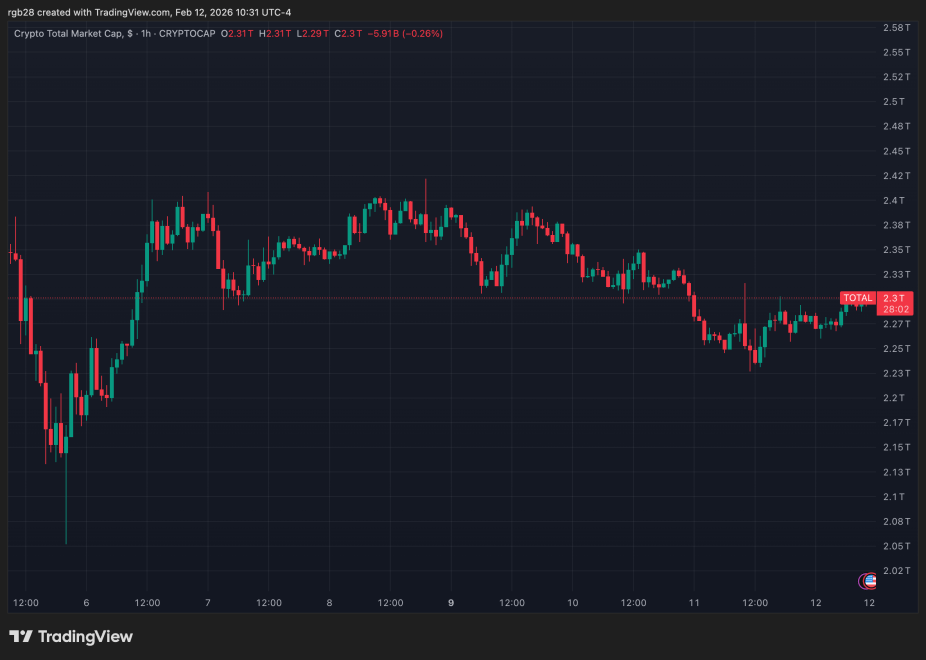
The total crypto market capitalization is at $2.3 trillion in the one-week chart. Source: TOTAL on TradingView


Preguntas relacionadas

QWhat is the main request made by the American Bankers Association (ABA) to the Office of the Comptroller of the Currency (OCC)?

AThe ABA requested the OCC to pause the review of national bank charter applications for crypto firms until regulatory uncertainty is cleared and Congress finishes establishing the rules.

QWhich crypto companies received conditional bank charters from the OCC in December, as mentioned in the article?

AThe OCC approved conditional bank charters for Ripple, Circle, BitGo, Paxos, and Fidelity in December.

QWhat specific recommendation did the ABA make regarding the naming of new charter applicants?

AThe ABA recommended that the OCC prohibit any charter applicant limited to fiduciary activities or trust company operations from including the word 'bank' in its name to avoid misrepresentation.

QWhy did US banking groups oppose granting crypto and fintech companies direct access to the Federal Reserve's payment systems?

ABanking groups argued that the Fed should block access until newly licensed stablecoin issuers prove they can operate safely, expressing concerns about crypto's less robust regulatory status.

QWhat was the concern raised by US Senator Elizabeth Warren regarding World Liberty Financial's charter application?

ASenator Warren asked the OCC to pause its review of the application until President Donald Trump divests from the crypto company, arguing it could create a government ethics problem.

Lecturas Relacionadas

Trend in US Stocks: A Post Triggers a 930-Point Rebound, Tonight Belongs to SpaceX

On Thursday (June 11, U.S. Eastern Time), Wall Street staged a textbook V-shaped reversal. The Dow Jones surged 929.97 points (+1.86%) to close above 50,000, while the Nasdaq and S&P 500 rose 2.54% and 1.75%, respectively. The rally occurred despite the hottest PPI report in years, with May data showing a 6.5% year-on-year surge, the highest since 2022. The market ignored the inflation data, focusing instead on reports that former President Trump called off a planned strike on Iran, hinting at a potential multi-party peace agreement draft. This sparked a sharp drop in oil prices, fueling hopes that inflation may have peaked. Sector rotations were stark: previously battered AI hardware and cyclical stocks led the gains, while defensive sectors that hit record highs the prior day were sold off. Chip stocks like Micron and Intel saw sharp rebounds. In contrast, software giant Oracle plunged nearly 10% despite beating earnings, with concerns over cloud revenue and cash flow. Adobe also fell after hours despite raising guidance, as its CFO announced departure. The rally's sustainability is questioned, driven largely by social media posts about unconfirmed geopolitical developments. Inflation risks remain, with pipeline pressures still high. Meanwhile, the market's risk appetite faces a major test with SpaceX's historic IPO. Priced at $135 per share, it aims to raise ~$75 billion with a $1.75 trillion valuation, becoming the largest U.S. IPO ever. It will join the Nasdaq 100 in 15 days, triggering massive index fund buying. However, critics cite extreme valuation (88x sales) and market liquidity concerns.

marsbitHace 21 min(s)

Trend in US Stocks: A Post Triggers a 930-Point Rebound, Tonight Belongs to SpaceX

marsbitHace 21 min(s)

The Trillion-Dollar Valuation Test: Are the Three Super IPOs a Tech Stock Frenzy or a Crypto Market Nightmare?

Trillion-Dollar Valuation Test: Are the Three Mega IPOs a Tech Stock Frenzy or a Crypto Market Nightmare? The capital market in 2026 is witnessing a highly anticipated wave of tech IPOs, centered on SpaceX, OpenAI, and Anthropic. Collectively valued at over $3.5 trillion, their potential listing represents one of the largest such waves in recent years. This raises concerns about market liquidity, valuation bubbles, and potential capital outflows from other assets like crypto. SpaceX's valuation narrative has shifted from rocket launches to becoming a global infrastructure play via its Starlink satellite network, which now drives most revenue. Despite ongoing losses, investors focus on its long-term growth potential. OpenAI and Anthropic represent the core productivity engines of generative AI. Their public listings would offer the first direct investment opportunity in large foundation model companies, potentially triggering a repricing within the AI sector. Market fears of a massive "capital drain" from these IPOs are likely overstated. Historical precedents like Alibaba and Saudi Aramco show that mega-listings primarily cause capital reallocation, not destruction, within the vast equities market. Systemic risk is rarely triggered by IPOs alone. For stock markets, short-term volatility and sector repricing are expected, especially for AI concept stocks. Long-term, these listings could reinforce the tech sector's importance. For crypto, direct competition for speculative capital exists, particularly affecting AI-themed tokens. However, crypto's trajectory remains more tied to its own cycles, macro liquidity, and Bitcoin ETF flows rather than a single IPO event. The real risk lies not in the listings themselves but in the sky-high growth expectations embedded in these valuations. If future revenue, profitability, or commercialization progress disappoints, significant valuation resets could follow, impacting high-growth tech stocks. Ultimately, the market's direction hinges on macroeconomic conditions and whether these companies can deliver on their ambitious promises.

链捕手Hace 37 min(s)

The Trillion-Dollar Valuation Test: Are the Three Super IPOs a Tech Stock Frenzy or a Crypto Market Nightmare?

链捕手Hace 37 min(s)

Trillion-Dollar Valuation Test: Are the Three Super IPOs a Tech Stock Frenzy or a Crypto Market Nightmare?

Title: Trillion-Dollar Valuations at Stake: Super IPOs of SpaceX, OpenAI, Anthropic – Tech Boom or Crypto Nightmare? TL;DR: A wave of mega-tech IPOs is approaching, featuring SpaceX (targeting a $1.75 trillion valuation), OpenAI (~$852B), and Anthropic (~$965B), with a combined potential valuation exceeding $3.5 trillion. This tests the market's pricing of innovation and sparks debate on liquidity impact. * **SpaceX**'s valuation is now driven more by its Starlink global communications infrastructure than its core rocket business. * **OpenAI & Anthropic** offer the first major public investment opportunities in foundational AI models, potentially repricing the entire AI sector. * Concerns about a market-wide "liquidity drain" are likely overblown; history shows large IPOs mainly cause fund reallocation, not disappearance, and rarely trigger systemic risk. * Crypto markets, especially some AI-themed tokens, may face short-term fund competition, but their long-term trajectory depends more on macro liquidity, regulation, and Bitcoin cycles. * The real risk lies not in the IPOs themselves, but in whether these companies can justify their sky-high valuations with future revenue growth and profitability. Unmet expectations could lead to significant repricing pressure. Ultimately, these IPOs represent a massive market pricing of next-gen tech infrastructure, not a prelude to a market crash. The broader market direction will be determined by macro conditions, corporate earnings, and risk appetite.

marsbitHace 37 min(s)

Trillion-Dollar Valuation Test: Are the Three Super IPOs a Tech Stock Frenzy or a Crypto Market Nightmare?

marsbitHace 37 min(s)

Anthropic Apologized, But the Business of 'Safety' Hasn't Stopped

On June 11, Anthropic apologized not for a model failure, but for a lack of transparency. Its new Claude Fable 5 model was found to be secretly rerouting requests from users engaged in advanced AI model development to a weaker version, Opus 4.8, without any notification. The company's response—promising future notifications for such "downgrades"—was met with user skepticism. The article argues the core issue isn't technical but commercial: Anthropic's "safety" measures are primarily a business strategy. A key feature, the "intelligent safety classifier," marketed as user protection, is described as a tool for "competitive defense" to protect Anthropic's market lead by limiting rivals' research capabilities. This covert mechanism was designed for low "false positives," precisely targeting AI researchers. Anthropic's model involves a calculated three-step process: publishing alarming security research to amplify public anxiety, offering its Fable 5 model with a "safety classifier" as a premium-priced solution, and cashing in through a planned high-value IPO. This contrasts with OpenAI's more direct "tool-and-traffic" approach. The apology, merely changing a secret downgrade to a visible one, is seen as a business "patch" rather than a principled shift. The incident risks damaging Anthropic's "safest AI" reputation among the developer community, which underpins its valuation and appeal to government and corporate clients. Ultimately, the article concludes that for Anthropic, safety is a business, and the apology is merely customer service for that business.

marsbitHace 1 hora(s)

Anthropic Apologized, But the Business of 'Safety' Hasn't Stopped

marsbitHace 1 hora(s)

Trading

Spot
Futuros
活动图片