Unsteady Ground, Room to Bounce

insights.glassnodePublicado a 2026-03-04Actualizado a 2026-03-04

Resumen

Bitcoin remains in a tenuous consolidation below the $70k resistance level, with weakening buy-side momentum and declining realized profits. The Percent of Supply in Profit has fallen to levels historically associated with early bear markets. Short-term holder cost basis near $70k presents a key resistance zone. However, signs of stabilization are emerging: spot and ETF selling pressure is moderating, derivatives leverage is compressing, and options markets show fading downside fear with growing upside call interest around the $75k strike. The market appears to be transitioning from a stressed regime toward a more balanced state, though a sustained recovery depends on renewed spot demand.

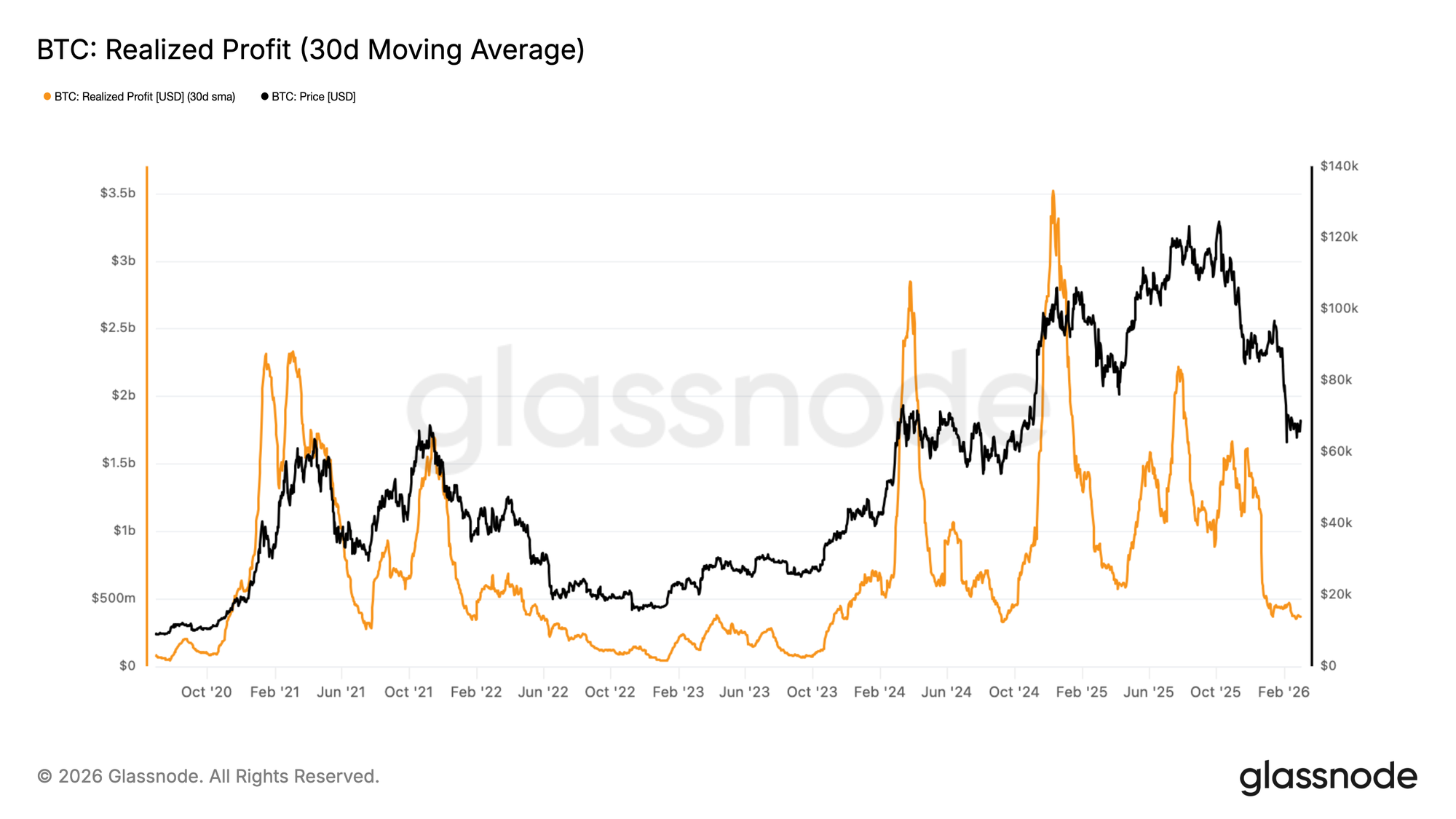
Since early February, Bitcoin has repeatedly failed to post a weekly close above $70k, establishing this region as a meaningful near-term resistance level. To assess whether this price rejection reflects a genuine deterioration in demand, we turn to the 30-day Simple Moving Average (30D-SMA) of Realized Profit, a metric that aggregates the USD-denominated profit locked in by on-chain participants at the moment coins are spent, smoothed to filter short-term noise.

As price stabilized beneath the $70K threshold, this indicator contracted sharply from above $1B per day to approximately $370M per day, a decline of roughly 63%. This compression in monthly-averaged realized profit signals that the cohort of buyers willing to transact at a premium has materially thinned, with buy-side liquidity now at its weakest since the August–September 2024 period.
Taken together, the evidence suggests that upside momentum has stalled, leaving the price in a state of directionless consolidation until fresh demand catalysts emerge.
Live Chart

Regime Detection in Bear Market

Sideways price action is a recurring structure across both bull and bear market cycles, therefore context is everything. Two periods of horizontal consolidation can carry vastly different implications depending on the underlying demand regime, making it essential to look beneath price for corroborating evidence.

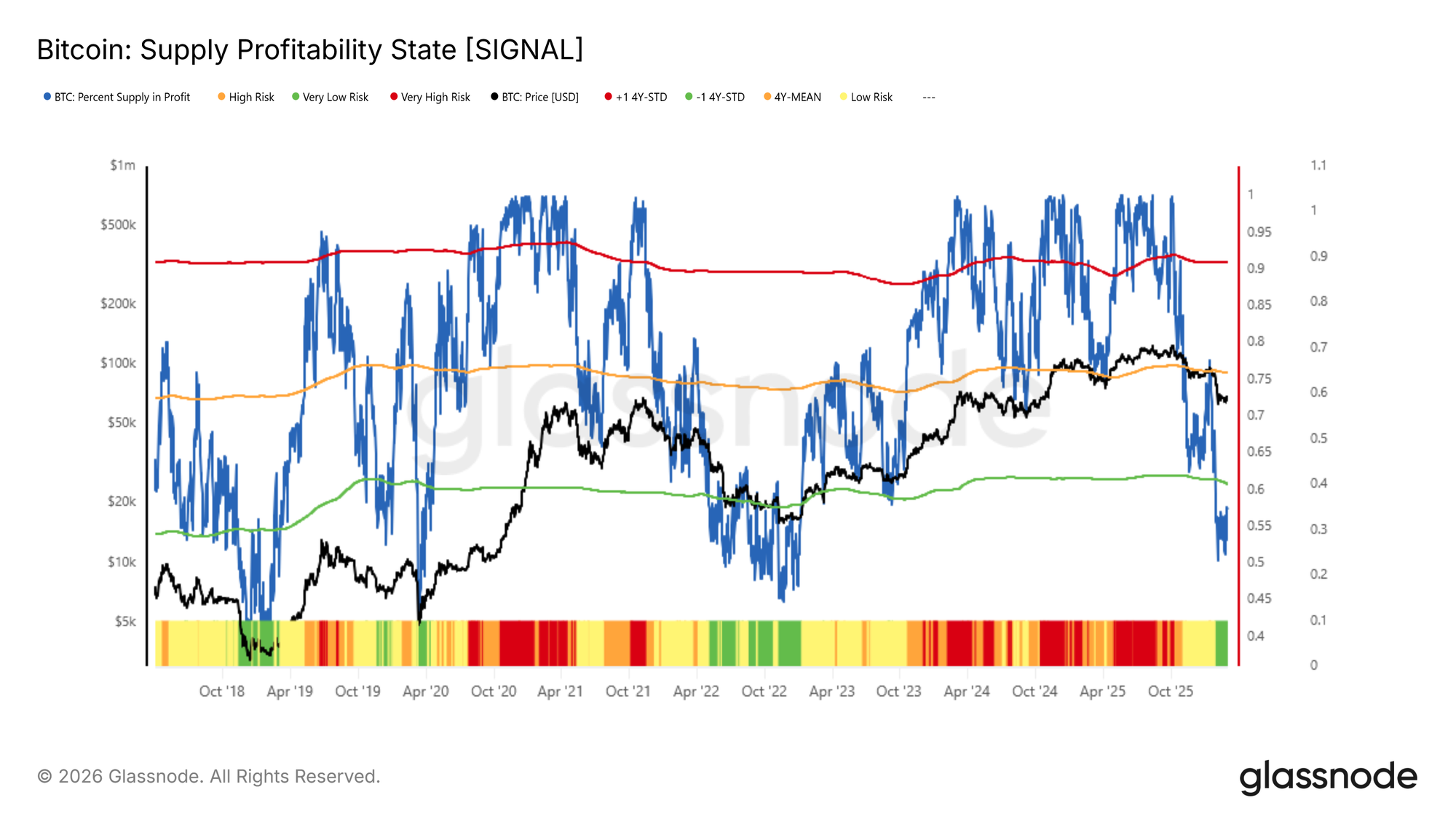
One effective lens for this purpose is the Percent of Supply in Profit, which measures the share of circulating Bitcoin supply held at an unrealized gain relative to each coin's on-chain acquisition cost.

When broadly elevated, this metric reflects widespread investor confidence; when it deteriorates, it signals a growing cohort of underwater holders, a condition historically associated with sustained selling pressure.

Since early February, this indicator has broken below its -1 standard deviation threshold near 60%, and currently sits at approximately 57%. Readings at this level have historically coincided with the early stages of deep bear markets, most notably May 2022 and November 2018. This suggests the present consolidation may be less a springboard for recovery, and more a continuation of the prevailing adverse market regime in mid-term.
Live Chart

Short-Term Relief Rallies and the Cost Basis Ceiling

Despite the headwinds posed by diminishing buy-side liquidity and a market regime starved of broad unrealized profitability, the multi-week sideways consolidation is not without a constructive interpretation. A local equilibrium of this nature can, and often does, precede short-term relief rallies.

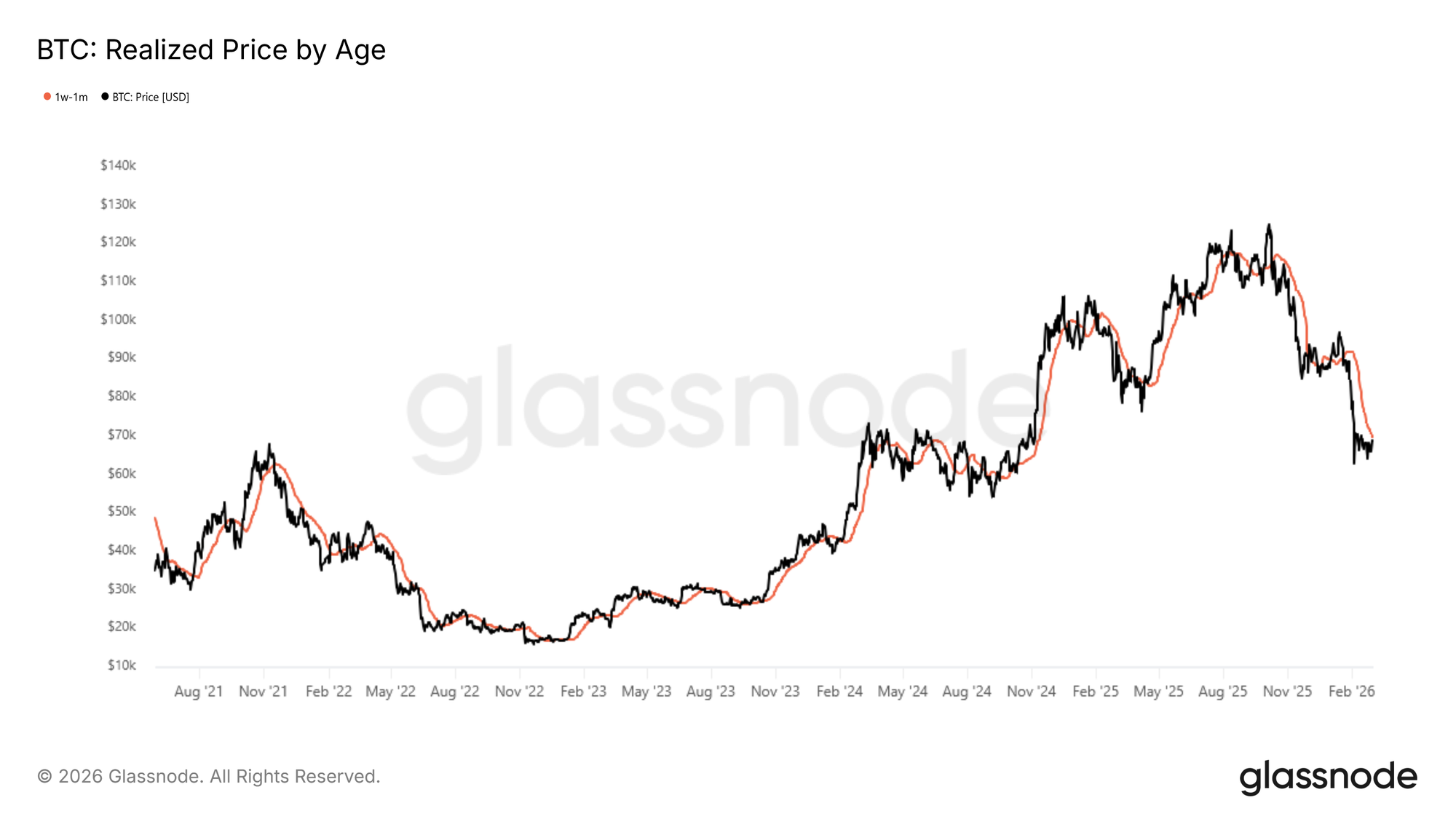
A practical on-chain tool for gauging the potential exhaustion point of such rallies is the Short-Term Holder Cost Basis, specifically for coins aged between one week and one month. This cohort represents the most recent wave of market participants, whose acquisition price acts as a key behavioral anchor: in the deeper stages of a bear market, local bounces tend to stall as these recent buyers approach breakeven, incentivizing them to exit positions or lock in thin profit margins before conditions deteriorate further.

Currently, the cost basis of this 1W–1M holder cohort sits near $70k, meaning the ±2% zone surrounding this level — roughly $68.5k to $71.5k— represents a significant potential resistance and distribution zone for any near-term price recovery.
Live Chart

Off-Chain Insights

Spot Flows Shows Signs of Recovery

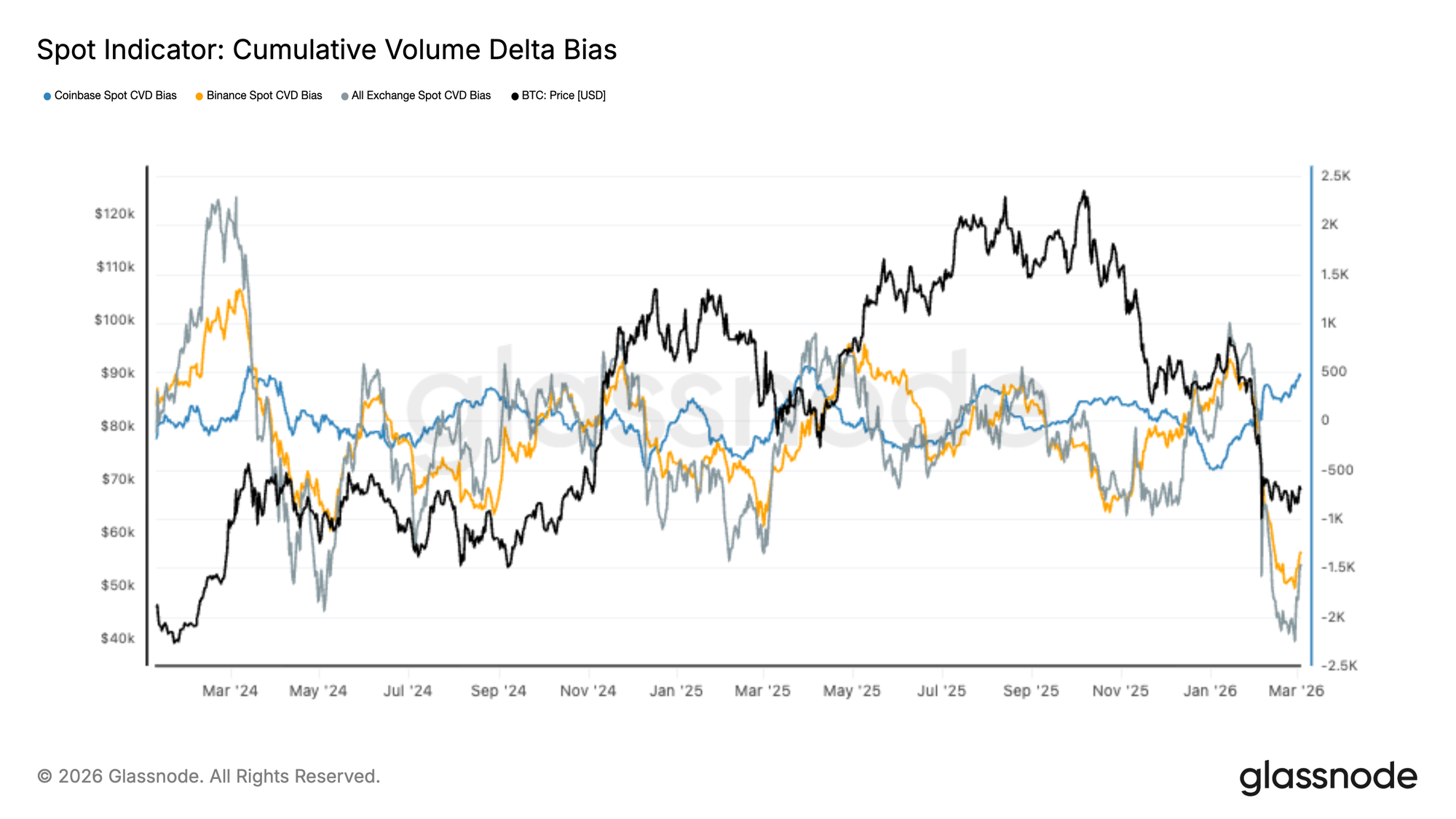
Spot markets recently experienced a sharp wave of sell-side dominance, with Cumulative Volume Delta (CVD) across major exchanges plunging to deeply negative levels as aggressive market sell orders drove the latest price drawdown.

Over the past few days, however, the pace of selling appears to be moderating. Coinbase spot CVD has begun to rebound, suggesting early signs of renewed bid-side activity, while Binance and aggregate exchange flows remain weak but are no longer accelerating lower.

This shift hints that the most intense phase of spot-driven distribution may be easing. Nevertheless, a sustained recovery will likely require broader improvement in spot bid absorption across multiple exchanges before stronger accumulation dynamics can take hold.
Live Chart

ETF Outflows Ease as Early Inflows Reappear

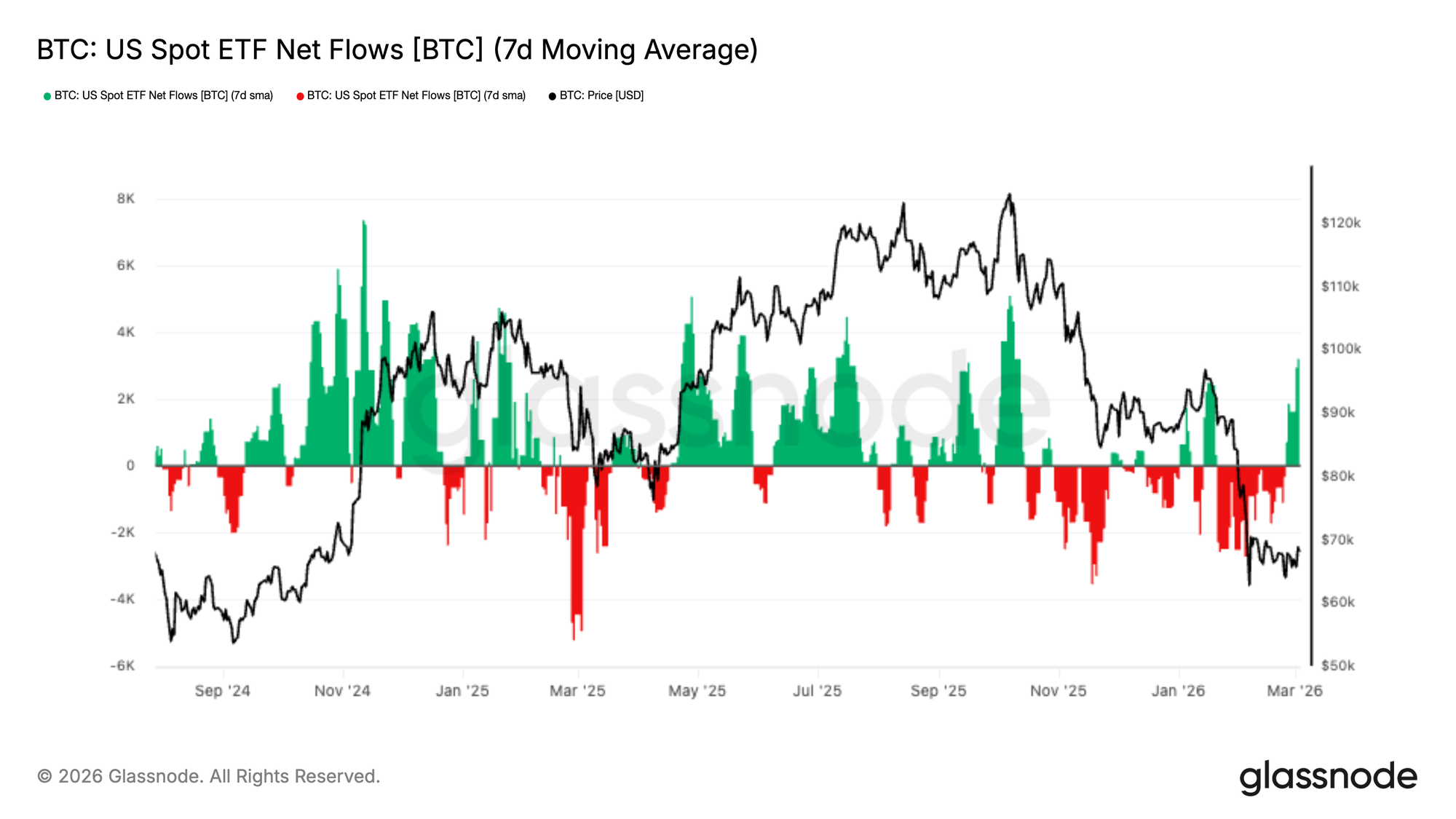
US Spot Bitcoin ETFs experienced sustained outflows during the recent market decline, reflecting persistent institutional de-risking as prices moved lower. The 7-day moving average of net flows remained negative for several weeks, reinforcing the broader risk-off environment across regulated investment channels.

Over the past few days, however, flows have begun to stabilize, with the first signs of renewed inflows emerging. This shift suggests that institutional selling pressure may be moderating as Bitcoin consolidates near recent lows.

While it is too early to confirm a durable reversal in demand, a continued recovery in ETF inflows would signal improving institutional sentiment and could provide an important source of spot-side support for the market.
Live Chart

Perpetual Premium Continues to Compress

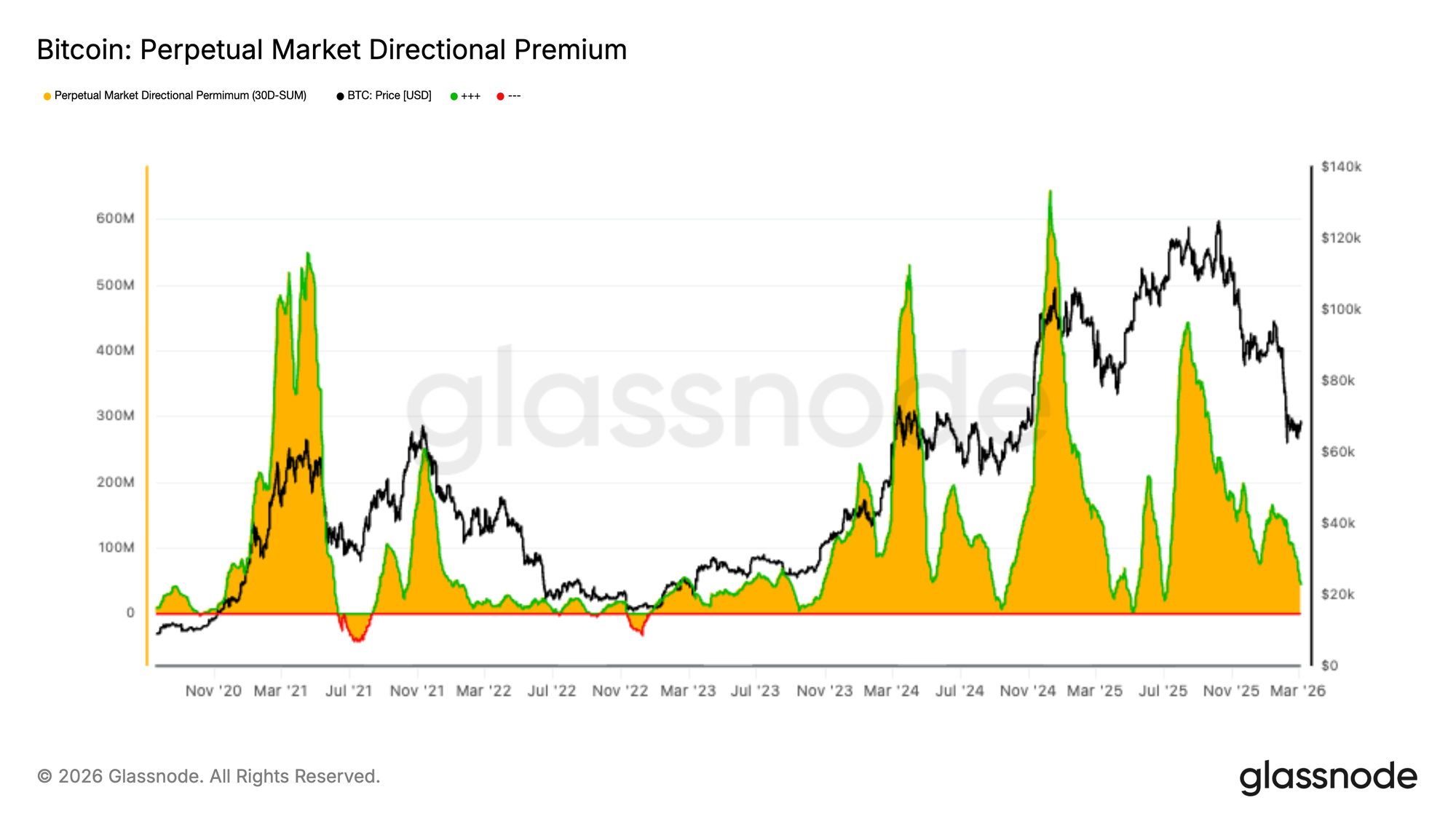
The Perpetual Market Directional Premium continues to trend lower, reflecting a sustained reduction in bullish positioning across perpetual futures markets. The metric has declined steadily in recent weeks as leverage and directional conviction have cooled alongside the broader market pullback.

Over the past few days, the premium has compressed further toward cycle lows, signalling that speculative long exposure is continuing to unwind. This dynamic suggests that derivatives traders remain cautious, with demand for leveraged upside exposure notably subdued.

While the decline reflects weakening bullish momentum, it also indicates that excess leverage is being flushed from the system. A stabilization in the premium could signal that derivatives positioning is approaching a more neutral footing.
Live Chart

Volatility Compression Signals Stabilization

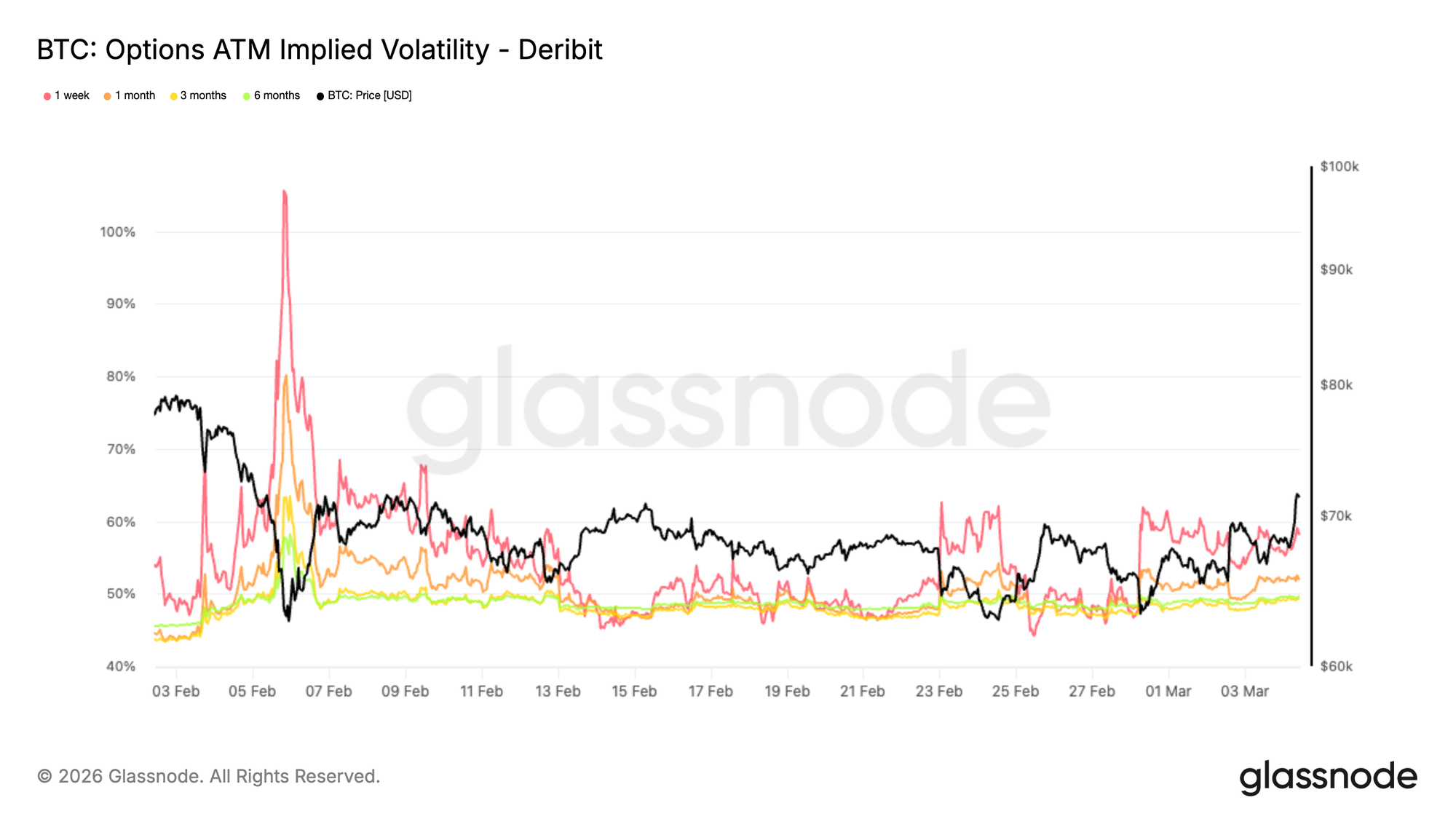
Implied volatility has continued to compress following the spike observed in early February. Across the main tenors, ATM IV has moved materially lower, indicating that traders are no longer aggressively pricing tail risk.

This shift reflects a stabilization in sentiment after a period of forced deleveraging and liquidation-driven volatility. As panic pricing fades, options markets begin transitioning from stress conditions toward a more neutral volatility regime.

Lower implied volatility also changes positioning dynamics. When volatility declines while price stabilizes, long option holders face increasing theta decay, making directional conviction more important.

For now, volatility compression suggests the market is moving away from crisis pricing and into a consolidation phase where positioning, rather than panic hedging, becomes the dominant driver of price action.
Live Chart

Skew Normalization Reflects Fading Downside Fear

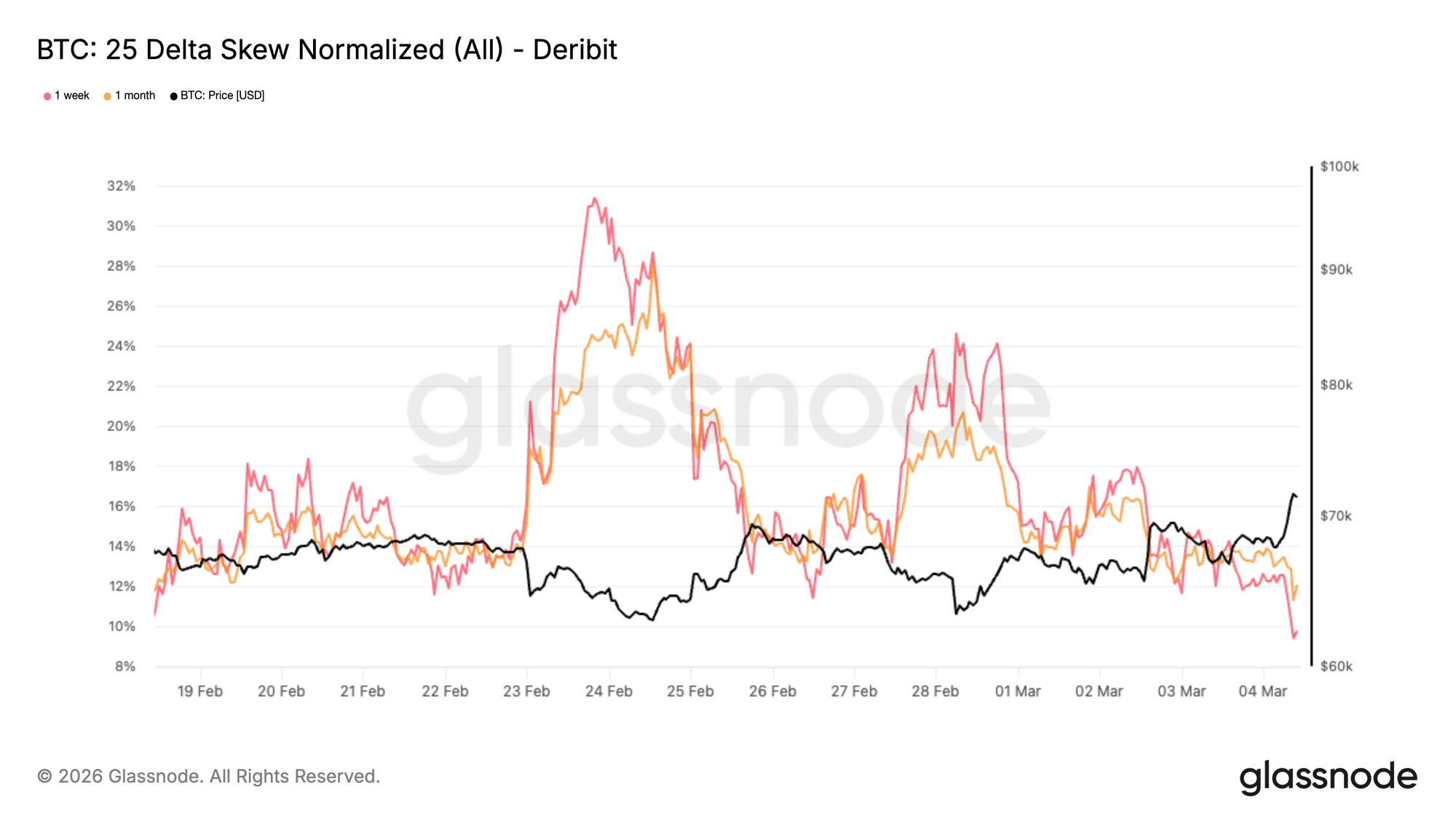
Skew has compressed materially from the extreme levels observed during the February sell-off. Over the past two weeks, as the chart shows, each move lower in BTC price has triggered a progressively milder reaction in the options market. Traders have been far less aggressive in bidding for downside protection, gradually pulling the skew lower. During the peak of the sell-off, put demand surged and pushed skew deep into put territory as traders rushed to hedge against further downside. That urgency has clearly eased.

Rather than a full normalization, what we are seeing is a repricing of risk: skew has moved from the mid-20s to the low-10s, still reflecting demand for protection but at far less stressed levels. This shift suggests that the immediate need for downside hedging is fading. Some protective positioning is being unwound, while interest in upside exposure is slowly reappearing.

Historically, this type of skew compression tends to occur when markets move out of stress phases and begin transitioning into more balanced positioning environments.
Live Chart

Options Flow Rotates Toward Upside Calls

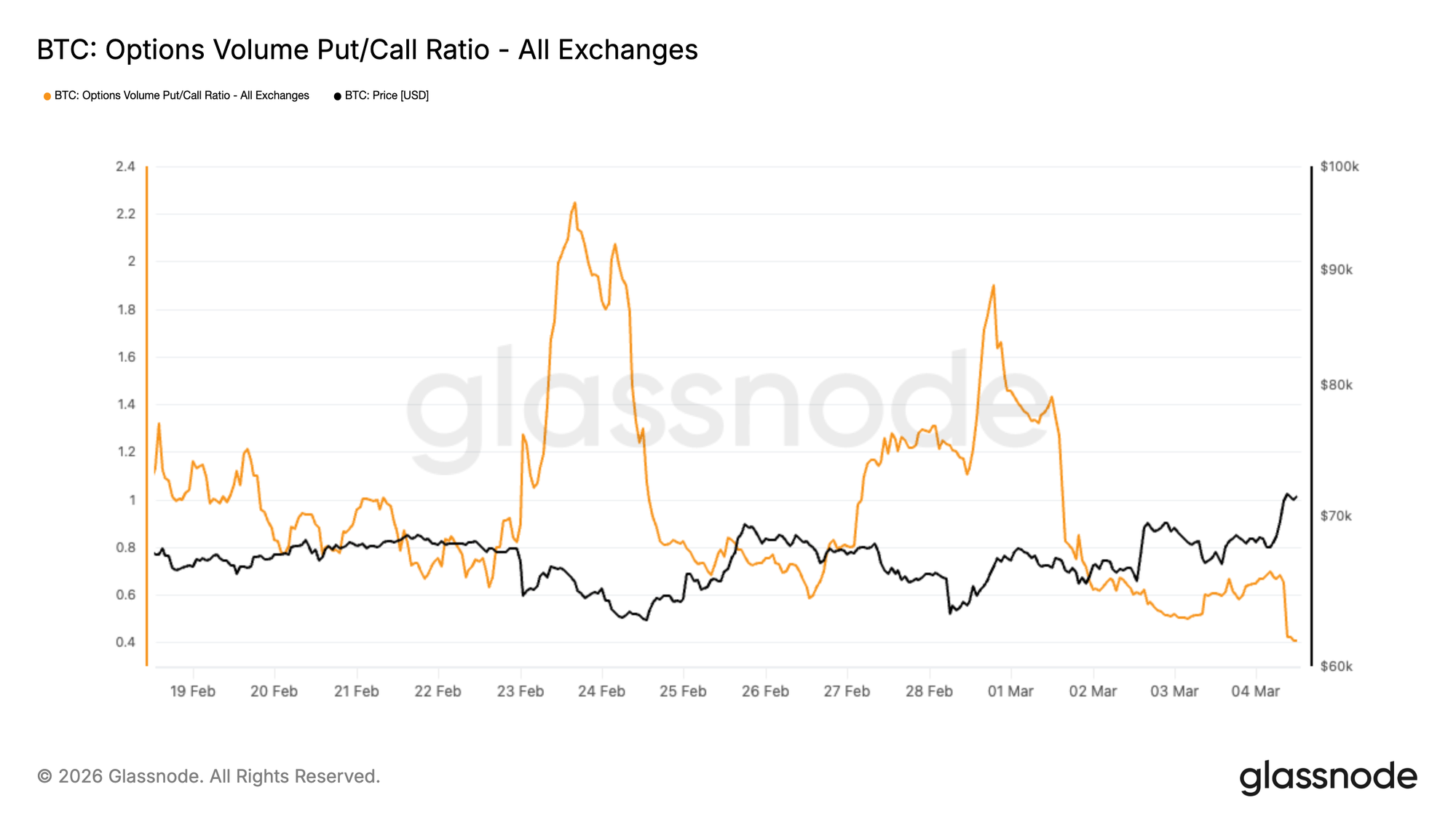
The Put/Call volume ratio measures the relative trading activity between puts and calls. When the ratio declines, it indicates that call activity is increasing relative to puts.

As implied volatility compresses, put holders face increasing theta decay and mark-to-market pressure. With downside momentum weakening, these positions become more costly to carry, prompting traders to buy back their hedges. This dynamic can create incremental spot demand as protective positions are unwound.

This environment has incentivized traders to position for a tactical upside move, a shift that is visible in the Put/Call volume ratio. Since February 28th, the ratio has moved from 1.89 to 0.4, marking a significant reversal in options flows and highlighting the growing willingness of the market to position for upside.

This shift is also reflected in the increasing interest around the $75,000 strike.

The combination of declining volatility and rising call activity suggests a market gradually transitioning away from defensive hedging toward more opportunistic upside positioning.
Live Chart

$75K Emerges as the Key Gamma Magnet

The rotation toward call activity is also visible in the growing interest around the $75,000 strike, which has become the most significant negative gamma level for dealers.

The $75,000 strike currently hosts a substantial concentration of negative gamma, estimated at around $2.3 billion across expiries, with approximately $1.8 billion concentrated in the March 27th expiry.

Negative gamma environments can amplify price movements as dealer hedging flows reinforce the prevailing trend. When price approaches these zones, hedging activity can pull the market toward the strike, creating a magnet effect. Over the past week, this magnet has effectively shifted from the $60K to $65K area up toward the $75K strike.

For now, $75K stands out as the key level where positioning and liquidity could converge in the coming sessions.

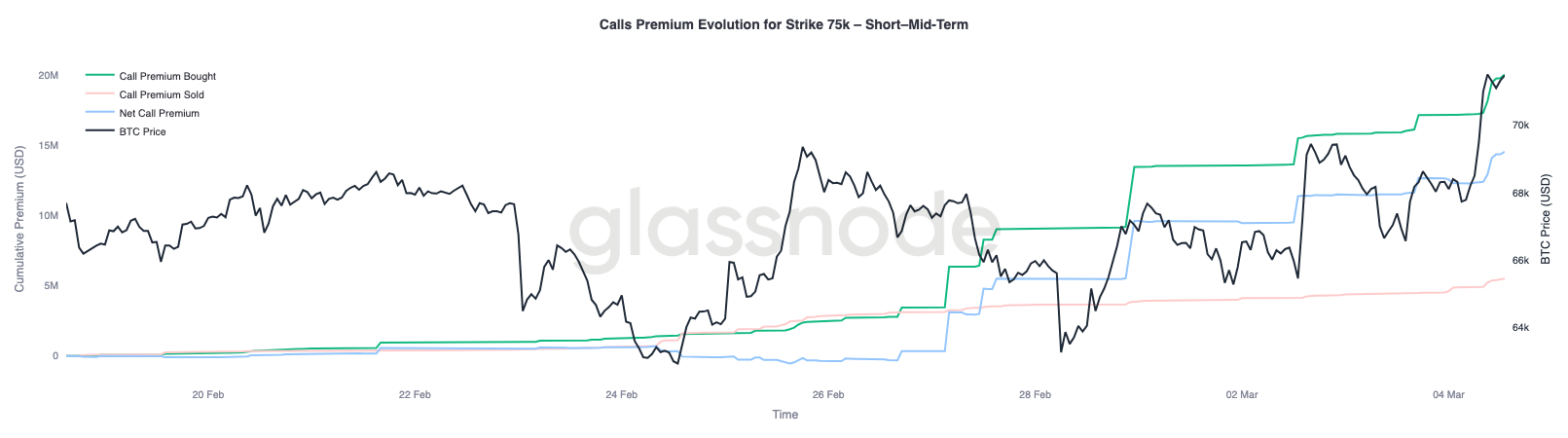
Looking at the premium dynamics for the $75K calls across the next three monthly expiries, roughly $14.5 million in net call premium has been traded. This represents the difference between premium bought and premium sold.
Notably, nearly two thirds of this net premium has been accumulated over the past week, helping fuel the current rebound.
Live Chart

Conclusion

Bitcoin remains locked in a tenuous consolidation below the $70k threshold, with several indicators suggesting that buy-side momentum has materially weakened. Realized profit has contracted sharply, highlighting reduced willingness among market participants to transact at elevated prices, while the decline in the Percent Supply in Profit places the current regime within a historical context often associated with the early stages of bear market conditions. At the same time, the cost basis of short-term holders near $70k is emerging as a key behavioural ceiling, likely acting as a distribution zone should price attempt a near-term recovery.

Beneath the surface, however, some signs of stabilization are beginning to appear. Spot selling pressure is moderating at the margin, ETF outflows are easing with early inflows returning, and derivatives leverage continues to be flushed from the system. In options markets, volatility and skew are normalizing as panic hedging fades and positioning rotates toward upside exposure. With the $75k strike emerging as a major gamma magnet, the market appears to be transitioning from stress-driven selling toward a more balanced positioning regime. Whether this evolves into a sustainable recovery will ultimately depend on the return of stronger spot demand to absorb overhead supply.


Disclaimer: This report does not provide any investment advice. All data is provided for informational and educational purposes only. No investment decision shall be based on the information provided here, and you are solely responsible for your own investment decisions.

Exchange balances presented are derived from Glassnode’s comprehensive database of address labels, which are amassed through both officially published exchange information and proprietary clustering algorithms. While we strive to ensure the utmost accuracy in representing exchange balances, it is important to note that these figures might not always encapsulate the entirety of an exchange’s reserves, particularly when exchanges refrain from disclosing their official addresses. We urge users to exercise caution and discretion when utilizing these metrics. Glassnode shall not be held responsible for any discrepancies or potential inaccuracies.


Preguntas relacionadas

QWhat key resistance level has Bitcoin repeatedly failed to close above since early February, and what does this indicate about current market momentum?

ABitcoin has repeatedly failed to post a weekly close above $70k since early February, establishing it as a significant near-term resistance level. This, combined with a sharp 63% contraction in the 30-day SMA of Realized Profit, indicates that upside momentum has stalled, leaving the price in a state of directionless consolidation.

QAccording to the 'Percent of Supply in Profit' metric, what does the current reading of approximately 57% historically suggest about the market regime?

AThe 'Percent of Supply in Profit' metric breaking below its -1 standard deviation threshold near 60% and sitting at approximately 57% suggests that the present consolidation may be less a springboard for recovery and more a continuation of the prevailing adverse market regime. Historically, readings at this level have coincided with the early stages of deep bear markets, such as in May 2022 and November 2018.

QWhat is the significance of the Short-Term Holder (1W-1M) Cost Basis being near $70k, and what zone does it create?

AThe cost basis of Short-Term Holders (coins aged between one week and one month) near $70k is significant because it acts as a key behavioral anchor. The ±2% zone surrounding this level (roughly $68.5k to $71.5k) represents a major potential resistance and distribution zone for any near-term price recovery, as these recent buyers are incentivized to exit their positions or lock in thin profits as they approach breakeven.

QWhat recent shifts in ETF flows and options market activity suggest a potential stabilization or change in sentiment?

ARecent shifts include ETF outflows easing with the first signs of renewed inflows appearing, suggesting institutional selling pressure may be moderating. In options markets, the Put/Call volume ratio has dramatically reversed from 1.89 to 0.4, indicating a significant rotation from defensive put buying to opportunistic call buying, and the $75k strike has emerged as a key gamma magnet, reflecting growing upside positioning.

QHow has implied volatility and skew changed, and what does this signal about the current market phase?

AImplied volatility has compressed materially, indicating traders are no longer aggressively pricing tail risk and that the market is moving away from crisis pricing. Skew has normalized from extreme put-heavy levels (mid-20s) to the low-10s, reflecting a fading immediate need for downside hedging. This compression suggests the market is transitioning from a stress phase into a more balanced consolidation phase where positioning, rather than panic, drives price action.

Lecturas Relacionadas

Not Speculation but a Necessity: The 4 Unique Values of Prediction Markets

Polymarket's recent $4 billion funding round and soaring valuation of $15 billion highlight the explosive growth of prediction markets, with trading volume reaching $25.7 billion in March 2026—a 10.6% monthly increase. This analysis argues that prediction markets serve critical non-speculative functions, positioning them as essential tools rather than mere gambling platforms. Prediction markets offer four unique values: entertainment consumption, insurance-like protection, risk hedging, and truth discovery. Firstly, they stimulate economic activity by engaging users in event-based betting, similar to the broader sports industry. Secondly, they act as a form of decentralized insurance, allowing users to hedge against specific, well-defined risks (e.g., weather events) transparently and without traditional overhead costs. Thirdly, institutions and individuals use these markets to hedge against geopolitical and commodity price risks, as demonstrated during the U.S.-Iran conflict and the launch of 24/7 commodity markets on platforms like Kalshi. Finally, prediction markets counter media bias by aggregating crowd-sourced information, often achieving 30% higher accuracy than surveys due to users' vested interests. Experts like Bitwise’s Jeff Park and SIG’s Jeff Yass emphasize the markets' role in risk transfer and financial innovation. As these platforms evolve, they are poised to become trillion-dollar markets, offering more reliable, decentralized mechanisms for information pricing and risk management.

marsbitHace 18 min(s)

Not Speculation but a Necessity: The 4 Unique Values of Prediction Markets

marsbitHace 18 min(s)

Interview with Jeff Hoffman: How Web3 and AI Are Reshaping the Trillion-Dollar Social Travel Market

Interview with Jeff Hoffman: Web3 and AI Reshaping the Trillion-Dollar Social Travel Market Jeff Hoffman, co-founder of Priceline, discusses how Web3 and AI are transforming the social travel industry. He highlights that the current travel market is fragmented and inefficient, dominated by traditional online travel agencies (OTAs) that act as intermediaries with opaque models. Web3 introduces direct connections, transparency, and faster settlements, shifting value back to travelers. Key trends driving this change include demand for flexible rewards, digital payments, and trust in communities over ads. Hoffman joined Staynex not for its Web3 label, but because it addresses industry inefficiencies by integrating booking, payments, AI-driven itineraries, and rewards into a single ecosystem. This Web2.5 model combines Web2 scale with Web3 incentives. He emphasizes the team’s focus on execution over hype as a key reason for his involvement. Looking ahead, blockchain will enable transparent rewards and seamless cross-border payments, while AI provides personalization. Together, they will turn travel into a continuous relationship rather than a transaction. Hoffman predicts traditional OTAs will persist, but value will shift to platforms that own payment, loyalty, and community networks. Social travel represents a significant, underestimated opportunity in Web3.

marsbitHace 48 min(s)

Interview with Jeff Hoffman: How Web3 and AI Are Reshaping the Trillion-Dollar Social Travel Market

marsbitHace 48 min(s)

Trading

Spot
Futuros

Artículos destacados

Qué es BITCOIN

Entendiendo HarryPotterObamaSonic10Inu (ERC-20) y Su Posición en el Espacio Cripto En los últimos años, el mercado de criptomonedas ha sido testigo de un aumento en la popularidad de las monedas meme, capturando el interés no solo de los comerciantes, sino también de aquellos que buscan compromiso comunitario y valor de entretenimiento. Entre estos tokens únicos se encuentra HarryPotterObamaSonic10Inu (ERC-20), un proyecto intrigante que mezcla referencias culturales en el tejido de las criptomonedas. Este artículo profundiza en los aspectos clave de HarryPotterObamaSonic10Inu, explorando sus mecanismos, ethos impulsado por la comunidad y su relación con el paisaje cripto más amplio. ¿Qué es HarryPotterObamaSonic10Inu (ERC-20)? Como su nombre sugiere, HarryPotterObamaSonic10Inu es una moneda meme construida sobre la blockchain de Ethereum, clasificada bajo el estándar ERC-20. A diferencia de las criptomonedas tradicionales que pueden enfatizar la utilidad práctica o el potencial de inversión, este token prospera en el valor de entretenimiento y la fuerza de su comunidad. El proyecto tiene como objetivo fomentar un entorno donde los usuarios comprometidos puedan reunirse, compartir ideas y participar en actividades inspiradas por diversos fenómenos culturales. Una característica notable de HarryPotterObamaSonic10Inu es su cero impuestos en las transacciones. Este atractivo elemento tiene como objetivo incentivar el comercio y la participación comunitaria, sin cargos adicionales que puedan disuadir a los comerciantes de pequeña escala. El suministro total de la moneda está establecido en mil millones de tokens, una cifra que marca su intención de mantener una circulación sustancial dentro de la comunidad. Creador de HarryPotterObamaSonic10Inu (ERC-20) Los orígenes de HarryPotterObamaSonic10Inu están algo envueltos en misterio; los detalles sobre el creador siguen siendo desconocidos. El desarrollo de este token carece de un equipo identificable o de un plan explícito, lo cual no es inusual dentro del sector de monedas meme. En cambio, el proyecto ha surgido de manera orgánica, con su progreso muy dependiente del entusiasmo y la participación de su comunidad. Inversores de HarryPotterObamaSonic10Inu (ERC-20) En cuanto a inversiones externas y respaldo, HarryPotterObamaSonic10Inu también sigue siendo ambiguo. El token no lista ninguna fundación de inversión conocida o apoyo organizacional significativo. En cambio, la savia del proyecto es su comunidad de base, que informa su crecimiento y sostenibilidad a través de la acción colectiva y el compromiso en el espacio cripto. ¿Cómo Funciona HarryPotterObamaSonic10Inu (ERC-20)? Como una moneda meme, HarryPotterObamaSonic10Inu opera principalmente fuera de los marcos tradicionales que a menudo rigen el valor de los activos. Hay varios aspectos distintivos que definen cómo funciona el proyecto: Transacciones Sin Impuestos: Sin tarifas impositivas en las transacciones, los usuarios pueden comprar y vender el token libremente sin preocuparse por costos ocultos. Compromiso Comunitario: El proyecto prospera en la interacción comunitaria, aprovechando plataformas de redes sociales para crear entusiasmo y facilitar la participación. Las discusiones, el intercambio de contenido y el compromiso son elementos cruciales que ayudan a expandir su alcance y fomentar la lealtad entre los seguidores. Sin Utilidad Práctica: Cabe señalar que HarryPotterObamaSonic10Inu no ofrece utilidad concreta dentro del ecosistema financiero. Más bien, se clasifica como un token principalmente para actividades de entretenimiento y comunitarias. Referencia Cultural: El token incorpora astutamente elementos de la cultura popular para atraer interés, conectando con entusiastas de los memes y seguidores de las criptomonedas por igual. HarryPotterObamaSonic10Inu ejemplifica cómo las monedas meme operan de manera diferente a los proyectos de criptomonedas más tradicionales, ingresando al mercado como construcciones sociales innovadoras en lugar de activos utilitarios. Cronología de HarryPotterObamaSonic10Inu (ERC-20) La historia de HarryPotterObamaSonic10Inu está marcada por varios hitos notables: Creación: El token surgió de un meme viral, capturando la imaginación de muchos entusiastas de las criptomonedas. Las fechas específicas de creación no están disponibles, subrayando su ascenso orgánico. Listado en Exchanges: HarryPotterObamaSonic10Inu ha llegado a varios exchanges, permitiendo un acceso y comercio más fácil por parte de la comunidad. Iniciativas de Compromiso Comunitario: Actividades continuas destinadas a mejorar la interacción comunitaria, incluyendo concursos, campañas en redes sociales y generación de contenido por parte de fanáticos y defensores. Planes de Expansión Futuros: La hoja de ruta del proyecto incluye el lanzamiento de una colección de NFT, mercancía y un sitio de comercio electrónico relacionado con sus temas culturales, involucrando aún más a la comunidad e intentando añadir más dimensiones a su ecosistema. Puntos Clave Sobre HarryPotterObamaSonic10Inu (ERC-20) Naturaleza Impulsada por la Comunidad: El proyecto prioriza la participación colectiva y la creatividad, asegurando que la involucración de los usuarios esté a la vanguardia de su desarrollo. Clasificación como Moneda Meme: Representa la epítome de las criptomonedas basadas en el entretenimiento, diferenciándose de los vehículos de inversión tradicionales. Sin Afiliación Directa con Bitcoin: A pesar de la similitud en el nombre del ticker, HarryPotterObamaSonic10Inu es distinto y no tiene relación con Bitcoin u otras criptomonedas establecidas. Enfoque en la Colaboración: HarryPotterObamaSonic10Inu está diseñado para crear un espacio para la colaboración y el intercambio de historias entre sus poseedores, proporcionando una vía para la creatividad y el vínculo comunitario. Perspectivas Futuras: La ambición de expandirse más allá de su premisa inicial hacia NFTs y mercancías describe un camino para que el proyecto potencialmente ingrese a avenidas más tradicionales dentro de la cultura digital. A medida que las monedas meme continúan capturando la imaginación de la comunidad de criptomonedas, HarryPotterObamaSonic10Inu (ERC-20) se destaca debido a sus lazos culturales y su enfoque centrado en la comunidad. Si bien puede no encajar en el molde típico de un token impulsado por la utilidad, su esencia radica en la alegría y la camaradería fomentadas entre sus seguidores, destacando la naturaleza en evolución de las criptomonedas en una era cada vez más digital. A medida que el proyecto continúa desarrollándose, será importante observar cómo las dinámicas comunitarias influyen en su trayectoria en el cambiante paisaje de la tecnología blockchain.

1.3k Vistas totalesPublicado en 2024.04.01Actualizado en 2024.12.03

Qué es BITCOIN

Cómo comprar BTC

¡Bienvenido a HTX.com! Hemos hecho que comprar Bitcoin (BTC) sea simple y conveniente. Sigue nuestra guía paso a paso para iniciar tu viaje de criptos.Paso 1: crea tu cuenta HTXUtiliza tu correo electrónico o número de teléfono para registrarte y obtener una cuenta gratuita en HTX. Experimenta un proceso de registro sin complicaciones y desbloquea todas las funciones.Obtener mi cuentaPaso 2: ve a Comprar cripto y elige tu método de pagoTarjeta de crédito/débito: usa tu Visa o Mastercard para comprar Bitcoin (BTC) al instante.Saldo: utiliza fondos del saldo de tu cuenta HTX para tradear sin problemas.Terceros: hemos agregado métodos de pago populares como Google Pay y Apple Pay para mejorar la comodidad.P2P: tradear directamente con otros usuarios en HTX.Over-the-Counter (OTC): ofrecemos servicios personalizados y tipos de cambio competitivos para los traders.Paso 3: guarda tu Bitcoin (BTC)Después de comprar tu Bitcoin (BTC), guárdalo en tu cuenta HTX. Alternativamente, puedes enviarlo a otro lugar mediante transferencia blockchain o utilizarlo para tradear otras criptomonedas.Paso 4: tradear Bitcoin (BTC)Tradear fácilmente con Bitcoin (BTC) en HTX's mercado spot. Simplemente accede a tu cuenta, selecciona tu par de trading, ejecuta tus trades y monitorea en tiempo real. Ofrecemos una experiencia fácil de usar tanto para principiantes como para traders experimentados.

4.6k Vistas totalesPublicado en 2024.12.12Actualizado en 2025.03.21

Cómo comprar BTC

Qué es $BITCOIN

ORO DIGITAL ($BITCOIN): Un Análisis Integral Introducción al ORO DIGITAL ($BITCOIN) ORO DIGITAL ($BITCOIN) es un proyecto basado en blockchain que opera en la red Solana, cuyo objetivo es combinar las características de los metales preciosos tradicionales con la innovación de las tecnologías descentralizadas. Aunque comparte un nombre con Bitcoin, a menudo referido como “oro digital” debido a su percepción como un refugio de valor, ORO DIGITAL es un token separado diseñado para crear un ecosistema único dentro del paisaje Web3. Su meta es posicionarse como un activo digital alternativo viable, aunque los detalles sobre sus aplicaciones y funcionalidades aún están en desarrollo. ¿Qué es ORO DIGITAL ($BITCOIN)? ORO DIGITAL ($BITCOIN) es un token de criptomoneda diseñado explícitamente para su uso en la blockchain de Solana. A diferencia de Bitcoin, que proporciona un papel de almacenamiento de valor ampliamente reconocido, este token parece centrarse en aplicaciones y características más amplias. Aspectos notables incluyen: Infraestructura Blockchain: El token está construido sobre la blockchain de Solana, conocida por su capacidad para manejar transacciones de alta velocidad y bajo costo. Dinámicas de Suministro: ORO DIGITAL tiene un suministro máximo limitado a 100 cuatrillones de tokens (100P $BITCOIN), aunque los detalles sobre su suministro circulante no se han divulgado actualmente. Utilidad: Si bien las funcionalidades precisas no están delineadas explícitamente, hay indicios de que el token podría ser utilizado para diversas aplicaciones, potencialmente involucrando aplicaciones descentralizadas (dApps) o estrategias de tokenización de activos. ¿Quién es el Creador de ORO DIGITAL ($BITCOIN)? En la actualidad, la identidad de los creadores y el equipo de desarrollo detrás de ORO DIGITAL ($BITCOIN) sigue siendo desconocida. Esta situación es típica entre muchos proyectos innovadores dentro del espacio blockchain, particularmente aquellos alineados con las finanzas descentralizadas y fenómenos de monedas meme. Si bien tal anonimato puede fomentar una cultura impulsada por la comunidad, intensifica las preocupaciones sobre la gobernanza y la responsabilidad. ¿Quiénes son los Inversores de ORO DIGITAL ($BITCOIN)? La información disponible indica que ORO DIGITAL ($BITCOIN) no tiene patrocinadores institucionales conocidos ni inversiones destacadas de capital de riesgo. El proyecto parece operar en un modelo de peer-to-peer centrado en el apoyo y la adopción de la comunidad en lugar de rutas de financiamiento tradicionales. Su actividad y liquidez se sitúan principalmente en intercambios descentralizados (DEX), como PumpSwap, en lugar de plataformas de trading centralizadas establecidas, lo que resalta aún más su enfoque de base. Cómo Funciona ORO DIGITAL ($BITCOIN) Los mecanismos operativos de ORO DIGITAL ($BITCOIN) pueden elaborarse en función de su diseño blockchain y atributos de red: Mecanismo de Consenso: Al aprovechar el único proof-of-history (PoH) de Solana combinado con un modelo de proof-of-stake (PoS), el proyecto asegura una validación de transacciones eficiente que contribuye al alto rendimiento de la red. Tokenómica: Si bien los mecanismos deflacionarios específicos no se han detallado extensamente, el vasto suministro máximo de tokens implica que podría atender microtransacciones o casos de uso nicho que aún están por definirse. Interoperabilidad: Existe el potencial de integración con el ecosistema más amplio de Solana, incluyendo varias plataformas de finanzas descentralizadas (DeFi). Sin embargo, los detalles sobre integraciones específicas permanecen no especificados. Cronología de Eventos Clave Aquí hay una cronología que destaca hitos significativos relacionados con ORO DIGITAL ($BITCOIN): 2023: El despliegue inicial del token ocurre en la blockchain de Solana, marcado por su dirección de contrato. 2024: ORO DIGITAL gana visibilidad al estar disponible para trading en intercambios descentralizados como PumpSwap, permitiendo a los usuarios comerciar contra SOL. 2025: El proyecto presencia actividad de trading esporádica y potencial interés en compromisos liderados por la comunidad, aunque no se han documentado asociaciones notables o avances técnicos hasta el momento. Análisis Crítico Fortalezas Escalabilidad: La infraestructura subyacente de Solana soporta altos volúmenes de transacciones, lo que podría mejorar la utilidad de $BITCOIN en varios escenarios de transacción. Accesibilidad: El potencial bajo precio de trading por token podría atraer a inversores minoristas, facilitando una participación más amplia debido a oportunidades de propiedad fraccionada. Riesgos Falta de Transparencia: La ausencia de patrocinadores, desarrolladores o un proceso de auditoría conocidos públicamente puede generar escepticismo sobre la sostenibilidad y confiabilidad del proyecto. Volatilidad del Mercado: La actividad de trading depende en gran medida del comportamiento especulativo, lo que puede resultar en una volatilidad de precios significativa y en incertidumbre para los inversores. Conclusión ORO DIGITAL ($BITCOIN) surge como un proyecto intrigante pero ambiguo dentro del ecosistema de Solana en rápida evolución. Si bien intenta aprovechar la narrativa del “oro digital”, su alejamiento del papel establecido de Bitcoin como refugio de valor subraya la necesidad de una diferenciación más clara de su utilidad y estructura de gobernanza previstas. La aceptación y adopción futura dependerán probablemente de abordar la actual opacidad y de definir sus estrategias operativas y económicas de manera más explícita. Nota: Este informe abarca información sintetizada disponible hasta octubre de 2023, y pueden haber ocurrido desarrollos más allá del período de investigación.

83 Vistas totalesPublicado en 2025.05.13Actualizado en 2025.05.13

Qué es $BITCOIN

Discusiones

Bienvenido a la comunidad de HTX. Aquí puedes mantenerte informado sobre los últimos desarrollos de la plataforma y acceder a análisis profesionales del mercado. A continuación se presentan las opiniones de los usuarios sobre el precio de BTC (BTC).

活动图片