Understanding x402 and MPP: Two Paths for Agent Payments

marsbitPublicado a 2026-03-20Actualizado a 2026-03-20

Resumen

The article explores two competing approaches for enabling AI agents to make payments: x402 and the Machine Payments Protocol (MPP). x402, led by Coinbase, adopts a minimalist, protocol-based design. It revives the HTTP 402 status code to enable pay-per-request microtransactions directly on-chain, without accounts or intermediaries. It is open-source, chain-agnostic (currently supporting Base, Polygon, Solana), and optimized for decentralized, permissionless systems. However, current adoption is early, with low transaction volumes. In contrast, MPP (by Stripe and Tempo) is a maximized, system-level solution. It uses sessions and streaming payments to support high-frequency transactions without per-action on-chain settlement. Built on the high-throughput Tempo blockchain, it integrates fiat payments via Stripe’s Shared Payment Tokens (SPTs) and offers built-in compliance, risk management, and enterprise-grade scalability. Key partners include Anthropic, OpenAI, Shopify, and Visa. Stripe supports both protocols, allowing merchants to accept agent payments via either method. x402 suits open, long-tail applications, while MPP targets commercial, high-scale use cases. Both are in early stages, but major infrastructure players are backing them, anticipating future agent-driven economies.

Editor's Note: Regarding the question of how agents should pay, x402 and MPP propose two almost opposite approaches.

x402 follows a minimalist protocol approach: embedding payment directly into HTTP requests, achieving pay-per-request in the simplest way. No accounts, no intermediaries, it resembles the open, permissionless design of the early internet, suitable for long-tail developers and decentralized scenarios.

MPP, on the other hand, is a maximalist system: addressing high-frequency transactions, risk control, and fiat currency integration through sessions, streaming payments, and a compliance framework. It does not pursue purity but prioritizes meeting real-world commercial needs, making it more suitable for enterprise-level and large-scale applications.

The difference between the two is essentially two solutions to the same problem: whether to make payment a part of the protocol or a layer of the system.

Precisely because of this, they are not entirely competitive but rather operate in different segments: x402 covers the long-tail needs of the open web, while MPP handles high-frequency and commercialized traffic. In an yet-to-be-formed Agent economy, this divergence is perhaps inevitable.

Below is the original text:

The HTTP status code 402, defined in the HTTP/1.1 specification since the late 1990s, has been waiting for a purpose. Its meaning is "Payment Required." The original idea was to embed payment capabilities into the protocol layer of the Web, enabling machines to purchase resources as easily as requesting a web page.

But this vision largely remained unrealized. Over the years, this status code has only occasionally appeared in edge cases, such as Shopify's rate-limiting responses or Apple Mobile Me's billing errors, but no one ever truly built the micro-payment future it hinted at. Instead, credit cards, subscription paywalls, and API Key mechanisms took over—systems essentially designed for humans who operate manually.

Today, this future has two competing implementation paths, both announced on the same day. Next, I want to outline what they are, their differences, and why Stripe is betting on both routes simultaneously.

x402: A Simpler Solution
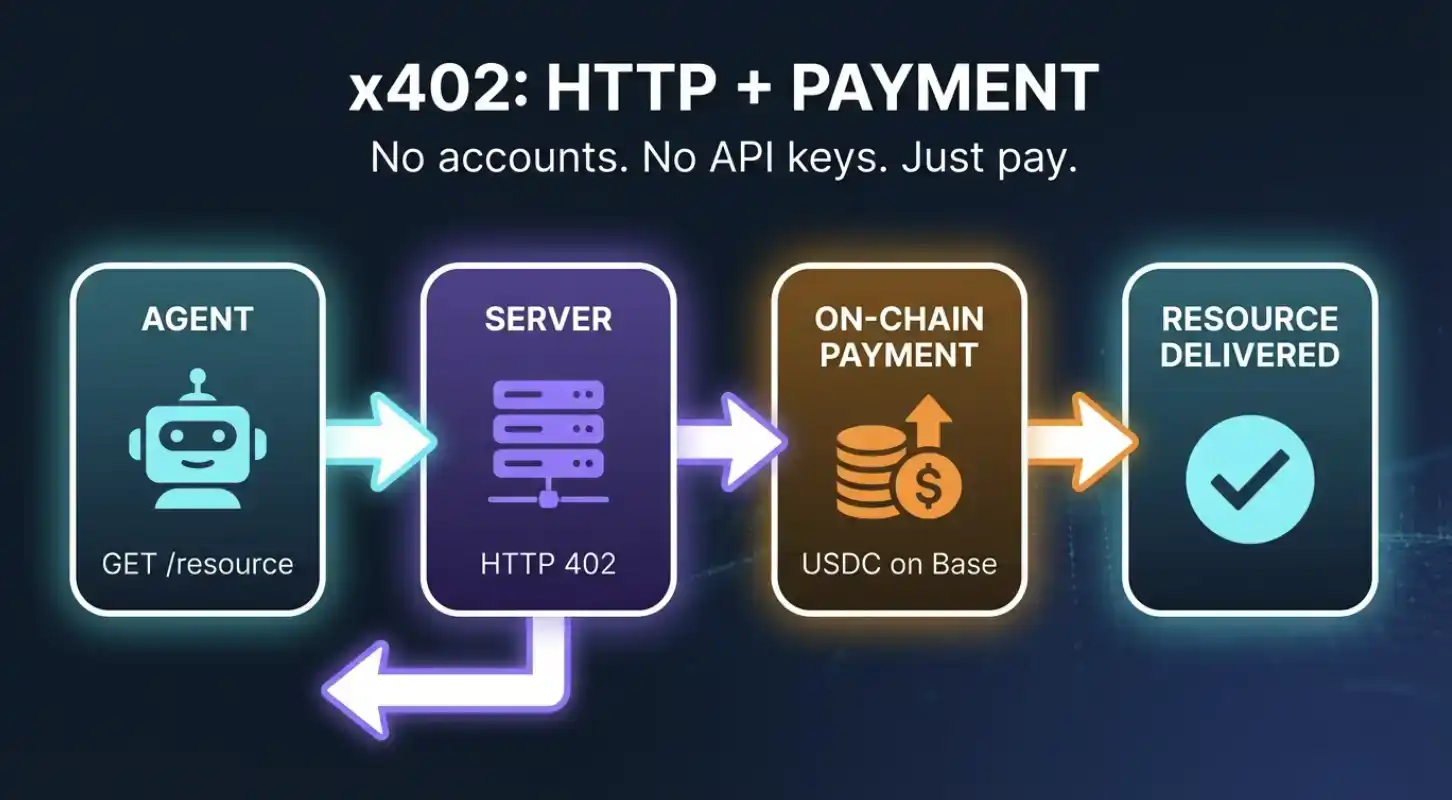
Coinbase officially launched x402 in May 2025. Its core idea is almost radically minimalist. A client requests a resource; the server returns an HTTP 402, informing the client: how much to pay, which token to use, and on which chain to complete the payment. The client completes the payment on-chain, attaches the payment proof to the re-initiated request, and the server then delivers the resource.

It's that simple. No account system, no API Key, no subscription mechanism. Just one HTTP request round trip with a payment inserted in the middle.

Now, Stripe natively supports x402 in its payment system, allowing merchants to receive such payments directly through their existing backend. However, in essence, x402 is still a protocol led by Coinbase, governed by the x402 Foundation co-founded by Coinbase and Cloudflare in September 2025. The protocol is fully open source (Apache 2.0 license) and provides multi-language SDKs including TypeScript, Go, and Python.

In terms of support, Coinbase's official documentation shows that ERC-20 payments are currently supported on Base, Polygon, and Solana. Meanwhile, the ecosystem is exploring extensions to other chains like Avalanche, Sui, and Near, but maturity varies.

As for adoption data, this part is slightly more complex. Coinbase states that x402 has processed over 50 million transactions through its Agentic Wallet infrastructure. That sounds impressive, but according to CoinDesk on March 11th, citing Artemis' on-chain analysis data: daily transaction volume is about 131,000, with a value of approximately $28,000, and the average payment per transaction is only about $0.20. About half of these appear to be test or gamified behavior rather than real commercial transactions.

But this might not be a bad thing. Because this protocol is designed for a market that doesn't truly exist yet—a world where AI agents make micro-payments (even below 1 cent) for API calls and data queries. And the merchants serving this market are just beginning to emerge.

For example, Google's Agentic Payments Protocol (AP2, part of the A2A framework) has integrated x402; Lowe's Innovation Labs demonstrated a demo where an AI agent can complete the entire process from product discovery and research to ordering in one flow. Also, World (initiated by Sam Altman) released AgentKit this week, adding human identity verification capabilities to x402 wallets.

The core assumption behind this is: if you make payment as lightweight as an HTTP request, use cases will naturally emerge. Whether this holds true remains to be seen.

MPP: The Full-Stack Solution
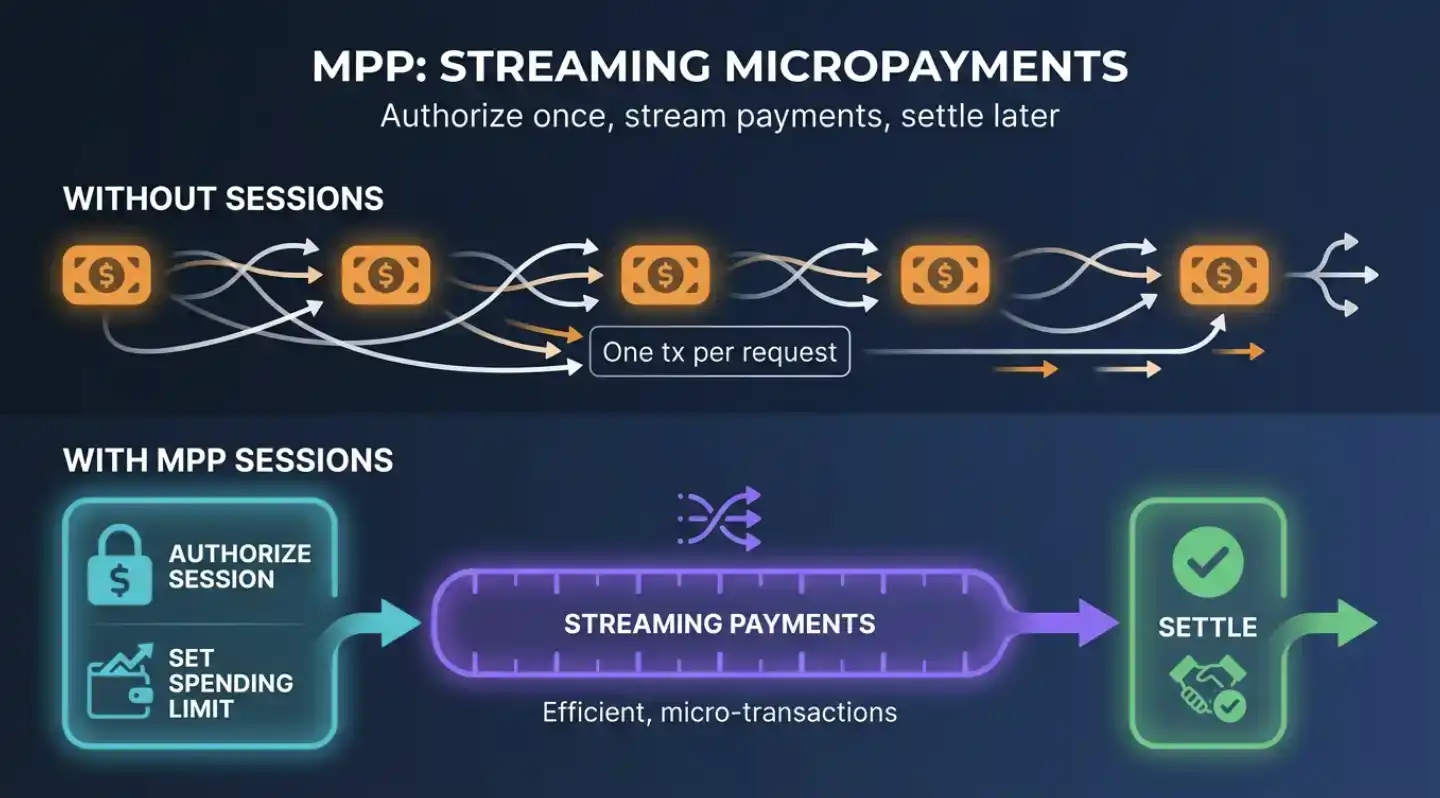
Stripe and Tempo have chosen a different path. The Machine Payments Protocol (MPP) was released today alongside the Tempo mainnet launch. Unlike x402, which is a lightweight wrapper on existing blockchains, MPP is specifically designed for the scenario of high-frequency trading by agents.

Its core mechanism is sessions. Instead of initiating an on-chain transaction for every resource request, an agent can first authorize a spending limit once and then make continuous micro-payments within that limit. If you are an AI that needs to query data sources thousands of times per hour, you absolutely do not want to sign and broadcast an on-chain transaction each time. Sessions are designed to solve this problem.

The Tempo chain is also built around this need. It supports tens of thousands of transactions per second, has sub-second confirmation times, and has no native gas token. Users can pay fees directly with stablecoins, eliminating the hassle of having to buy some random token just to make a transfer.

Another component worth understanding is: Stripe's Agentic Commerce Suite includes Shared Payment Tokens (SPTs). This is not part of MPP itself but is Stripe's extension mechanism that can work alongside it. SPTs allow an agent to securely pass a user's bank card or wallet credentials to a merchant without exposing the real data. These credentials are single-use and time-limited, essentially a programmable, self-destructing authorization. In practice, this means an agent paying via MPP can use either USDC on Tempo or the user's linked Visa card, or even a combination of both.

According to the Tempo mainnet launch blog, its partners include Anthropic, DoorDash, Mastercard, Nubank, OpenAI, Ramp, Revolut, Shopify, Standard Chartered, and Visa. The Block reported that the MPP payment directory already includes over 100 services at launch, including Alchemy, Dune Analytics, Merit Systems, and Parallel Web Systems. Matt Huang, co-founder of Tempo and Paradigm, told Fortune in an interview that this field is still in its early stages, and MPP is designed to eventually scale to environments beyond Tempo.

Why Stripe Supports Both

If you are already integrated with Stripe, the most practical answer is: you don't need to choose between them.

Stripe supports x402 and MPP through two separate integration paths, rather than abstracting them into a unified interface. For x402, its documentation mainly covers generating deposit addresses, monitoring the chain, and settling funds into Stripe accounts—you are responsible for returning the 402 response, while the underlying crypto payment infrastructure is handled by Stripe. It supports USDC on Base for now, with more to come. For MPP, merchants can receive session-based streaming payments through the same PaymentIntents API.

Stripe's Agentic Commerce Suite, released in December 2025, is built on top of these two payment rails. Merchants just need to upload their product catalog, select the AI agents they want to connect with, and Stripe handles product discovery, checkout flow, fraud prevention, and tax processing. Currently, URBN, Etsy, Coach, Kate Spade, and Ashley Furniture are already using it, and platforms like Wix, WooCommerce, BigCommerce, Squarespace, and commercetools have completed integration.

The strategy is actually quite clear: control the abstraction layer and let the underlying protocols compete freely.

Comparison

Macroscopically, these two protocols are doing the same thing: enabling machines to pay for resources via HTTP. But the real differences lie in the details.

x402 (Led by Coinbase) vs MPP (Stripe + Tempo)

Standardization
x402: Fully open source (Apache 2.0), promoted by the x402 Foundation with multi-party participation (Coinbase, Cloudflare, Visa, Google).
MPP: Open standard, co-defined by Stripe and Tempo, part of the Stripe Agentic Commerce Suite.

HTTP Mechanism
x402: Revives HTTP 402, initiates requests via PAYMENT-REQUIRED header, uses PAYMENT-SIGNATURE for retry.
MPP: Also uses a challenge-response mechanism, but employs the Payment HTTP Authentication Scheme (IETF draft), binding challenge ID via HMAC.

Payment Rails
x402: Designed to be chain-agnostic, currently supported on Base, Polygon, Solana, exploration ongoing for other chains.
MPP: Based on the Tempo blockchain—an L1 optimized for payments, supporting 10k+ TPS, sub-second confirmation, no native gas token; long-term goal is cross-chain compatibility.

Payment Methods
x402: Pure stablecoin, fully on-chain.
MPP: Supports USDC on Tempo + SPT (Stripe's mechanism), enabling crypto-fiat hybrid (bank cards, wallets, BNPL).

Settlement
x402: On-chain settlement (~200ms to several seconds), validation and settlement handled by facilitators like Coinbase.
MPP: Tempo sub-second confirmation, automatic booking and compliance handling by Stripe.

Merchant Integration
x402: Open-source middleware (Express, Hono, Next.js, etc.), can be self-built or use a facilitator.
MPP: Direct integration with Stripe's PaymentIntents API, built-in risk control, tax, refunds, reporting.

Core Innovation
x402: Extreme simplicity, no vendor lock-in, similar to the Unix philosophy for payments.
MPP: High throughput + fiat integration, streaming payments via sessions, micro-payment aggregation, and programmable spending control based on SPTs.

Key Partners
x402: Coinbase, Cloudflare, Google (A2A/AP2), Visa, World, Anthropic (MCP).
MPP: Stripe, Visa, Lightspark, Anthropic, DoorDash, Mastercard, OpenAI, Shopify, Revolut, Standard Chartered.

x402 is more like the go-to choice when building open systems: independent developer APIs, decentralized data markets, or any service that doesn't want to rely on a payment processor. Its specification can be written in a whitepaper, and integration only requires a middleware and a wallet address. This purity is attractive—although the crypto-only limitation also means its audience is narrower.

MPP is a completely different paradigm. If your agent needs to make hundreds or even thousands of transactions in a single session without going on-chain each time, then it is the more reasonable choice. The session mechanism keeps most interactions off-chain until final settlement; Stripe's compliance system handles risk and taxes; and the hybrid model allows agents to not only use stablecoins but also directly call the user's Visa and other payment methods. It's less elegant but more practical.

Interestingly, they are not entirely competitive. x402 covers long-tail open scenarios, MPP covers enterprise-level high-frequency traffic. Stripe's strategy is also clear: don't bet on a single protocol, but ensure that no matter which path wins, funds ultimately flow into Stripe's account system.

Reality Check: Where are we now?

Honestly, there is almost no real scaled transaction volume yet.

According to Coinbase's x402 release information, early partners include Hyperbolic (GPU inference payment) and Anthropic (MCP protocol integration). Stripe's blog mentions agent scenarios paying per API call (e.g., CoinGecko). Tempo's launch directory has 100+ services. Cloudflare's Agents SDK natively supports x402, and some small projects on Base L2 are trying to use x402 as a paid gateway.

But overall: transaction volume is small, the number of merchants is limited, and most activity is still in the trial phase.

This is actually not surprising. Any new payment infrastructure starts like this. So-called partner lists sometimes have a big gap between signing a letter of intent and being live in production, and these announcements usually don't distinguish particularly.

What's more noteworthy are the heavyweight players behind the infrastructure. Stripe processed $1.9 trillion in payments in 2025, with total volume growing 34% year-over-year. Meanwhile, Coinbase, Cloudflare, Visa, Google, and Tempo's entire partner network have entered the field.

In other words, the tracks are laid. The only question left is: in 2026, will AI agents really need to transact on these tracks at scale? Or is this more like laying fiber optics in 1998—the demand isn't here yet, but the infrastructure is built first.

So which one to choose?

If you are building an open, permissionless system—x402 is the more natural choice. No platform registration, no payment processor integration, just import middleware, bind a wallet, and start receiving payments. The cost is: compliance, risk control, and fiat settlement must be handled yourself.

If you are already within the Stripe ecosystem and want to接入 agent traffic—MPP is more suitable. Sessions, streaming payments, crypto+fiat hybrid, and a full compliance system are essentially more like a configuration upgrade than a system overhaul.

If you only care about one thing: no matter which protocol the agent uses, I can get paid. Then the answer is simply: use Stripe. It supports both.

HTTP 402 finally has a use. It just took about 27 years.

Preguntas relacionadas

QWhat are the core differences between x402 and MPP in terms of their approach to Agent payments?

Ax402 adopts a protocol-minimalist approach by embedding payments directly into HTTP requests, requiring no accounts or intermediaries, making it ideal for open, permissionless systems and decentralized scenarios. MPP, in contrast, is a system-maximalist solution that uses sessions, streaming payments, and compliance frameworks to handle high-frequency transactions, risk control, and fiat integration, catering more to enterprise and scalable commercial applications.

QHow does x402 handle the payment process technically when an AI agent requests a resource?

AWhen a client requests a resource, the server returns an HTTP 402 status code with details on the required payment amount, token, and blockchain. The client completes the payment on-chain, attaches the payment proof to a retried request, and the server then delivers the resource. This process involves no accounts, API keys, or subscriptions, making it a simple request-pay-response cycle.

QWhat is the role of 'sessions' in MPP, and why are they important for high-frequency agent transactions?

ASessions in MPP allow an agent to pre-authorize a spending limit once, enabling multiple micro-payments within that limit without requiring individual on-chain transactions for each request. This mechanism is crucial for high-frequency interactions, such as an AI agent making thousands of data queries per hour, as it avoids the latency and overhead of repeated blockchain transactions.

QWhy is Stripe supporting both x402 and MPP simultaneously, and what is their strategic rationale?

AStripe supports both protocols to capture the entire spectrum of agent payment needs without forcing a choice. By providing separate integration paths for x402 and MPP, Stripe ensures that it can handle payments from open, long-tail scenarios (via x402) and high-volume, enterprise traffic (via MPP), ultimately directing all funds into Stripe's account system regardless of the underlying protocol.

QWhat is the current state of adoption and transaction volume for x402 and MPP as described in the article?

AAs of the article, both protocols are in early stages with limited real-world adoption. x402 has processed over 50 million transactions via Coinbase's infrastructure, but daily volume is around 131,000 transactions totaling approximately $28,000, with half likely being tests. MPP launched with over 100 services in its payment directory and major partners like Anthropic and Shopify, but规模化 transactions are yet to materialize, indicating an experimental phase rather than full commercial deployment.

Lecturas Relacionadas

Fed's Internal Doves Flock to Hawkish Stance, Warsh's Debut "Between a Rock and a Hard Place"

U.S. Federal Reserve officials who previously advocated for rate cuts, including Governor Christopher Waller, have recently shifted their stance, with many now not ruling out the possibility of future rate hikes. This sets a challenging stage for new Fed Chair Kevin Warsh's first policy meeting. Appointed by President Trump based on his dovish views, Warsh now faces a committee where the debate has pivoted from "when to cut" to "whether to hike," driven by persistent inflation above 3%, a strong labor market, and supply-side pressures from AI infrastructure demands and geopolitical tensions. Key figures illustrate the shift. Governor Waller, once concerned about employment, now says data has pushed him toward considering rate increases. Even moderate voices like Governor Lisa Cook, while expecting inflation to ease, have indicated readiness to hike if it fails to do so. Long-time hawks such as regional Fed presidents Beth Hammack, Lorie Logan, and Neel Kashkari have grown more vocal, arguing that the real policy rate is effectively falling and that action may soon be needed. The upcoming Fed meeting is expected to keep rates steady but will likely remove the "easing bias" from its statement, signaling a neutral stance between cuts and hikes. The quarterly "dot plot" is anticipated to show most officials projecting no cuts this year, with some potentially indicating hikes. Chair Warsh, a critic of the Fed's reliance on forward guidance like the dot plot, must navigate communicating this pivot using tools he has questioned, all while steering policy in a direction counter to the preferences of the president who appointed him. The consensus suggests the Fed's next move could well be a rate increase.

marsbitHace 4 min(s)

Fed's Internal Doves Flock to Hawkish Stance, Warsh's Debut "Between a Rock and a Hard Place"

marsbitHace 4 min(s)

The Trillion-Yuan Market Cap 'Yi Zhong Tian': Who is the True Value King?

The article analyzes the three leading Chinese optical module companies, collectively nicknamed "Yi Zhong Tian": Xinyisheng, Zhongji Innolight, and TFC Optical Communication. It evaluates their "cost-performance" not by current stock price, but through three lenses: PEG ratio (growth vs. valuation), earnings quality, and premium/discount for certainty. Xinyisheng shows the most attractive PEG ratio and high profitability, but its valuation reflects discounts for risks like high customer concentration and reliance on overseas markets. Zhongji Innolight, the most expensive, commands a premium for its market leadership, dominant share in key products like 800G/1.6T modules, and higher earnings certainty, though it faces geopolitical risks. TFC Optical, as an upstream component supplier ("water seller"), has the highest gross margin and bets on the long-term CPO/NPO architecture trend, but trades at a high valuation with more stable, less explosive growth. The core argument is that while these companies dominate module assembly, the true profit pool and technological moat lie upstream in laser and switch chips, currently controlled by U.S. firms like Lumentum and Coherent. The long-term "cost-performance" for these Chinese leaders hinges on whether the domestic industry, exemplified by companies like Yuanjie Technology, can successfully move up the value chain into high-power laser chips. Otherwise, their high growth may remain confined to the lower-margin assembly segment.

marsbitHace 14 min(s)

The Trillion-Yuan Market Cap 'Yi Zhong Tian': Who is the True Value King?

marsbitHace 14 min(s)

Has the Crypto Market Bottomed? Here's What Institutions Think

The crypto market is in a period of significant debate, with leading institutions offering differing views on whether a bottom has been reached. Three prominent firms have published detailed analyses: * **Galaxy Digital** argues Bitcoin has **not yet bottomed**. Their analysis of 13 historical indicators across six dimensions (valuation, profit-taking, miner pressure, etc.) shows only four are fully met. They project a potential bottom range between $30k and $54k. * **NYDIG** states a bottom is **possible but not likely**. While metrics are close to historic bear market extremes, they note the absence of a classic panic-selling event. They also suggest increased institutional adoption may have structurally altered the market cycle, potentially leading to a shallower downturn. * **Standard Chartered Bank** asserts the **bottom has already occurred** at around $59k. They cite two key factors: potential US-Iran diplomatic progress and the anticipated SpaceX IPO, which they believe absorbed capital and caused ETF selling pressure that is now subsiding. They forecast a year-end price target of $100k. Despite the surface-level disagreement, the reports share critical common ground more valuable for long-term investors: 1. All three believe the market bottom will form **within this year**. 2. All agree the current price is **closer to the bottom than to previous highs**. 3. All maintain a **bullish long-term outlook** for Bitcoin and a new cycle. The core takeaway is that while the exact bottom price ($40k, $50k, or $60k) is debated, the consensus is that a bottom is imminent. For long-term holders, the primary focus should not be pinpointing the absolute low, but on the future potential for prices to reach $100k, $200k, or higher. The fundamental thesis for Bitcoin—sovereign debt accumulation, inflation, declining trust in centralized institutions, global digitization, and improved accessibility—remains intact and is arguably strengthening. The overall landscape is viewed as more favorable than in previous crypto winters.

marsbitHace 24 min(s)

Has the Crypto Market Bottomed? Here's What Institutions Think

marsbitHace 24 min(s)

The 'Chip' Challenge and Breakthroughs in China's Optical Industry Chain

China's Photonics Industry: Bottlenecks and Breakthroughs In the global AI race, computing chips dominate the narrative, but the underlying bottleneck increasingly defining the scale of AI clusters is light—or more specifically, optical connectivity. Optical modules, which translate electrical signals to light and vice versa, are crucial for connecting thousands of GPUs in AI data centers, preventing data congestion and ensuring efficient model training. High-speed modules (800G, 1.6T) are now standard, with performance hinging on advanced DSP (Digital Signal Processor) chips. This is where a critical dependency lies. Two US giants—Marvell and Broadcom—collectively dominate over 90% of the high-end DSP chip market. Chinese optical module leaders like Zhongji Innolight and Eoptolink rely on these chips to manufacture modules for overseas AI customers, primarily in North America. While this creates a supply chain vulnerability, complete decoupling is difficult. Marvell derives over half its revenue from Greater China, and the US firms depend on Chinese partners for chip packaging and optical components. The risk from laser chips (e.g., from Lumentum), another key component, is considered more manageable due to multiple global suppliers and faster progress in domestic alternatives from companies like YOFC and Accelink. To mitigate risks, China's industry is pursuing a multi-pronged strategy: diversifying supply chains and locking in long-term orders; fostering a domestic market ecosystem to adopt homegrown DSPs from firms like Huawei HiSilicon and CETC; accelerating R&D in high-speed DSPs and advanced packaging; and investing in next-gen technologies like silicon photonics and Co-Packaged Optics (CPO) to reduce reliance on discrete DSPs. The ultimate solution lies not in short-term博弈 but in persistent advancement of domestic high-end chip R&D and manufacturing. While challenges remain in performance, certification, and ecosystem building, China's vast domestic market and manufacturing base provide a crucial buffer, buying time for the industry to achieve greater technological independence.

marsbitHace 38 min(s)

The 'Chip' Challenge and Breakthroughs in China's Optical Industry Chain

marsbitHace 38 min(s)

Behind SpaceX's $2 Trillion Market Cap: Why Does Musk Always Have the Next Move Planned?

On June 12th, SpaceX debuted on the Nasdaq, reaching a valuation that briefly touched $2 trillion. This marked the culmination of a 24-year journey from its founding in 2002, driven by Elon Musk's frustration at the high cost of buying rockets. The company's path was defined by early failures, with its first three Falcon 1 launches ending in explosions before a successful 2008 flight opened the era of commercial spaceflight. Key to its model was a fixed-price NASA contract, incentivizing cost reduction. SpaceX mastered rocket reusability, first achieving a Falcon 9 landing in 2015, which drastically cut launch costs. This enabled its profitable Starlink satellite internet constellation, envisioned years before reusability was proven, to create an internal market for frequent launches. Similarly, the next-generation Starship rocket was in development long before its first flight, with its business case evolving from Mars colonization to supporting the emerging concept of in-orbit data centers for AI—a story now central to its valuation. The company's recent IPO, a reversal of its long-standing "no IPO" stance, is funding this ambitious "space-based compute" vision. While major tech players like Google, Blue Origin, and others are investing heavily, significant technical and cost hurdles remain. Ultimately, SpaceX's history is one of creating its own demand: first with Starlink and now with space-based AI compute, betting that its next rocket will enable its next giant market.

marsbitHace 40 min(s)

Behind SpaceX's $2 Trillion Market Cap: Why Does Musk Always Have the Next Move Planned?

marsbitHace 40 min(s)

Trading

Spot
Futuros
活动图片