Understanding $UORE in One Article: The V4 Hook Project That Packs Mining, Lottery, and NFTs into a Single Transaction

marsbitPublicado a 2026-05-08Actualizado a 2026-05-08

Resumen

The article discusses the emergence of a new Ethereum project, $UORE, which leverages Uniswap V4's "Hook" mechanism to combine multiple DeFi and NFT functions into a single transaction. $UORE integrates on-chain mining, a lottery system, and generative pixel NFTs (called Orelings) directly into its Uniswap V4 liquidity pool. Each whole UORE token held automatically generates an Oreling NFT, with its rarity and a random "Hash" value determining its "Mining Power" for staking rewards. A daily token emission, subject to a 1% decay, is distributed to stakers. The project also includes a "Motherlode" lottery triggered by purchases and a deflationary mechanism with buy/sell taxes funding automatic buybacks and burns. The project is a fork of the earlier uPEG V4 Hook project, incorporating ideas from Solana's ORE. However, it faces challenges including high transaction gas fees (2-3x a normal swap due to multiple contract actions), significant complexity for users, and a potentially narrowing attention window as it is the fourth project in a trending but possibly cooling V4 Hook narrative. The founder's message, "Read the contracts and understand the mechanics before deploying capital," underscores its experimental and high-risk nature.

Curry, Shenchao TechFlow

Still FOMOing over Slonk, the hot Ethereum on-chain project from yesterday? Actually, a new narrative has arrived:

V4 Hook.

Over the past two weeks, Uniswap V4's Hook mechanism suddenly caught fire. SATO used Hooks to create an on-chain bonding curve, pushing its market cap to $40 million. uPEG rode the viral story of an unused Uniswap name draft to over $30 million in two weeks. Slonks crammed an AI model into a smart contract to mimic CryptoPunks, achieving 586 ETH in trading volume six days after launch.

Although these three projects have different playstyles, they all leverage Uniswap's V4 mechanism.

Now the fourth one is here.
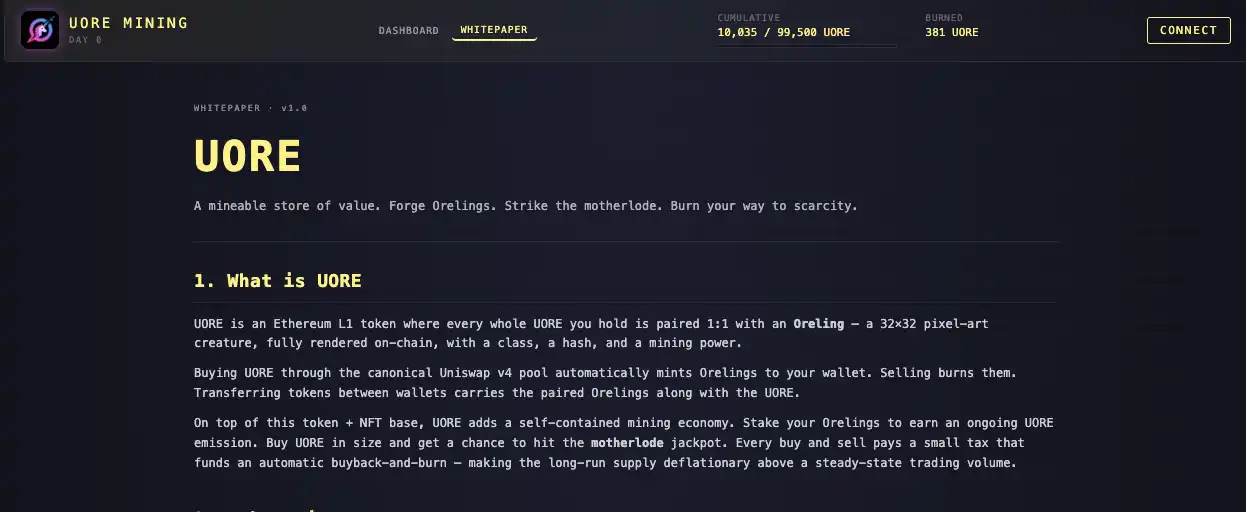
The new project is called $UORE, launched just yesterday. In one sentence, what it does is: Packaging on-chain mining, token-buying lottery, pixel NFT auto-generation, and a deflationary burn mechanism all into a single Uniswap V4 trading pool.

Because when you buy tokens in this pool, the contract will execute the aforementioned six things in the background simultaneously, the gas fee for one transaction is two to three times that of a regular swap...

Currently, if you open CT, you'll see everyone complaining about this high gas.

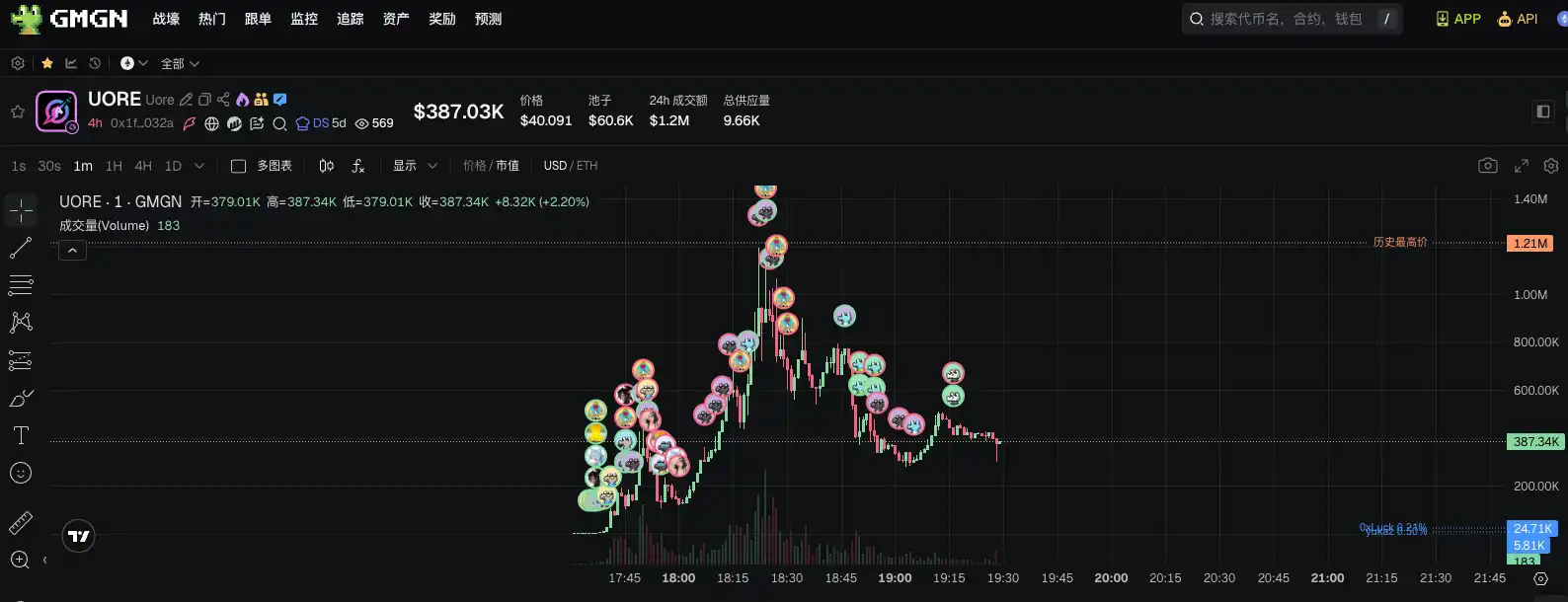
Regarding the token, according to GMGN data at the time of writing, $UORE reached a market cap of $1.2 million within hours of launch, then quickly dropped to $440k. The pool liquidity is only $64k, but the 24-hour trading volume is $1.2 million, meaning the money in the pool has turned over nearly twenty times.

However, there are only 741 holders, with a total supply of less than ten thousand tokens.
Currently, the risk appears extremely high. After some preliminary research, I personally think it's the most complex mechanism-wise among the V4 Hook ecosystem projects (the recent wave of new on-chain plays tends to make their mechanisms hard to understand...).

It is simultaneously a token, an NFT collection, a staking mine, and a lottery system. Moreover, these four things aren't independent; they are welded together.

Four-in-One Mine

For most NFT projects, the token and the NFT are separate things, bought and sold separately.

UORE is different. Its NFT is called Oreling, a 32×32 pixel miner character, embedded directly within the token. For every whole integer UORE token you hold in your wallet, you automatically have one corresponding Oreling.
The contract mints it for you when you buy tokens, burns it when you sell, and the Oreling moves with the token when transferred. You cannot buy an Oreling separately, nor can you detach it from UORE.

The traits of each Oreling are determined by the hash of the next block at the moment of minting. This means you don't know what kind of character you'll get when buying, not even the validators can see the result beforehand.

The differences between these characters aren't just about looks.

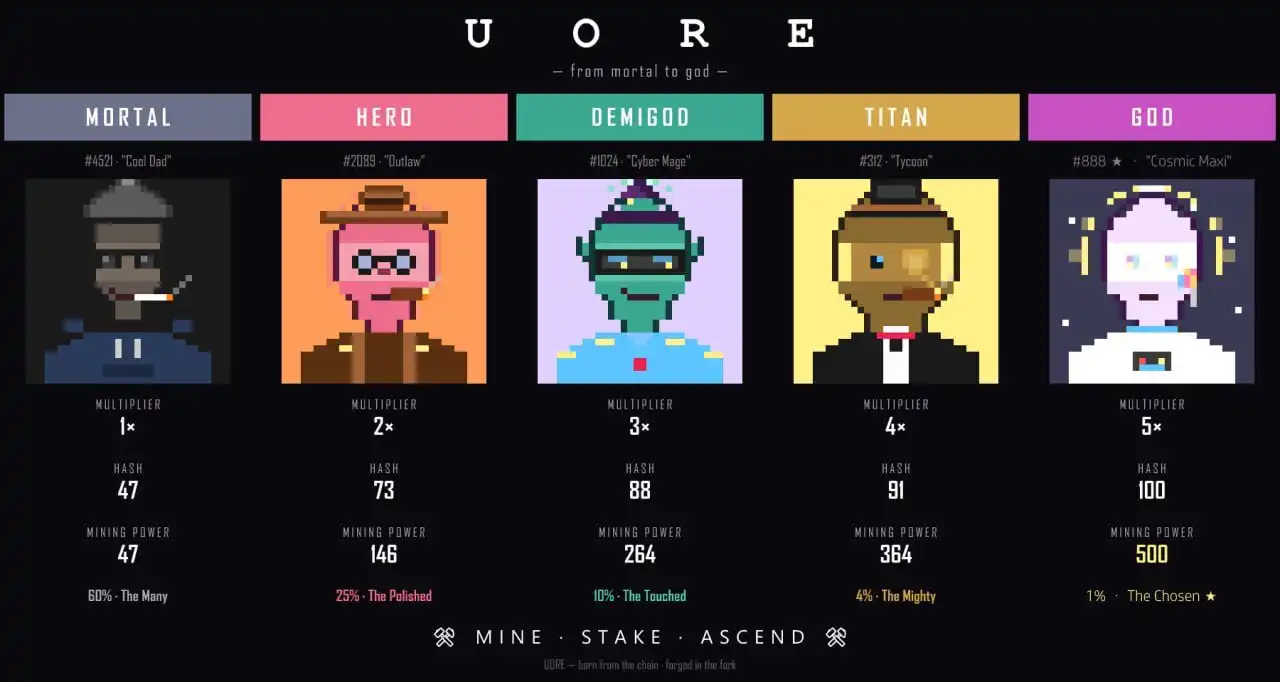
Each Oreling has a Class (rarity) and a Hash (a random number from 1 to 100). Multiplying the two gives its Mining Power.

The most common Mortal makes up 60% with a 1x multiplier; the rarest God has only a 1% chance with a 5x multiplier. If you're lucky and mint a God with Hash 100, its power is 500, over ten times that of a common miner.

What's the use of mining power? Classic play: staking.

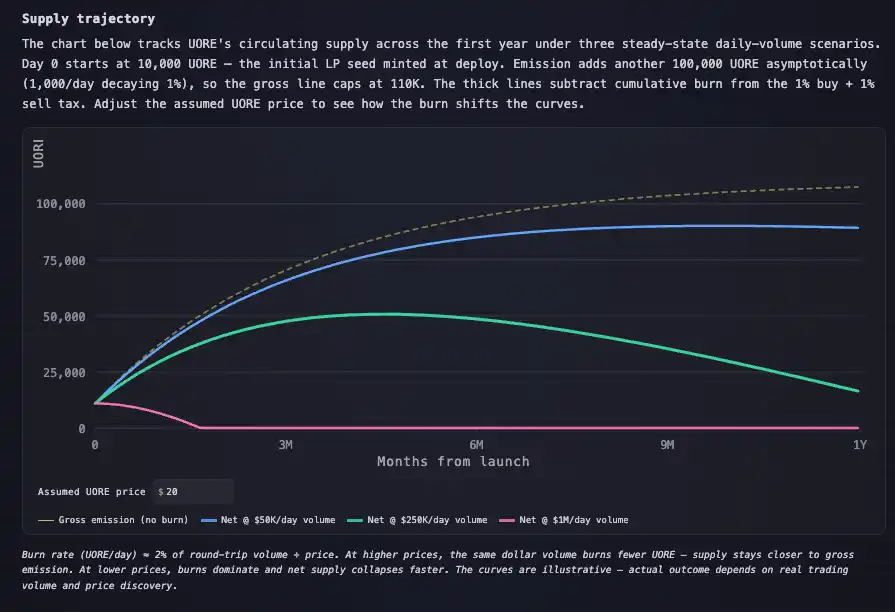
Stake your Oreling into the mine pool, and you start receiving a share of the daily UORE release proportional to your mining power. According to the project's whitepaper, 1000 UORE are released on the first day, then decaying by 1% daily, with a half-life of roughly 69 days. 80% of the release goes to stakers, 20% goes into the Motherlode prize pool.

This decay rate means 97% of the total emissions will be released within a year. The earlier you enter the mining game, the bigger your share of the pie.

There's a noteworthy design when claiming rewards: a 10% "refining tax" is deducted and redistributed to all stakers who haven't claimed yet. The whitepaper calls this the refined-ore boost.

In plain terms, those who claim later eat more of the taxes paid by others. People in a hurry to withdraw are subsidizing the patient ones.
Then there's the Motherlode, which translates to "lode prize".

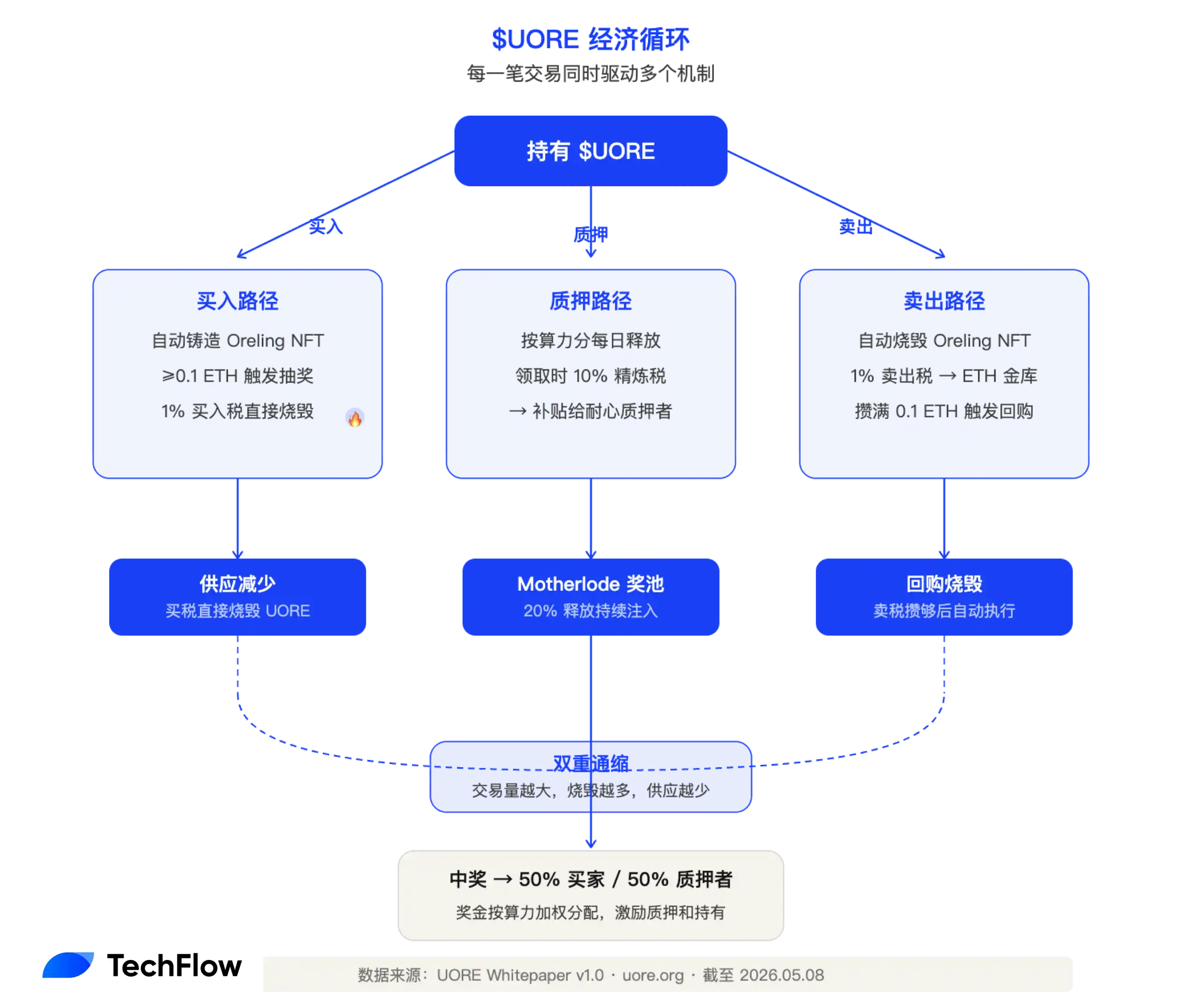
Every time you buy UORE worth ≥ 0.1 ETH through the official channel, you automatically get a lottery ticket. The winning probability is linked to the purchase amount: 0.1 ETH gives about a 1/600 chance, 0.5 ETH about 1/200, and 1 ETH caps at 1/100. Buying over 1 ETH doesn't increase the probability further, preventing whales from farming chances.

If you win, the prize pool is split in half: 50% goes directly to the buyer, and 50% is randomly distributed to one staker (weighted by mining power). As of writing, there have only been 4 wins historically, with the largest prize being 6.4 UORE.

Finally, the deflationary flywheel.

Buying incurs a 1% tax directly burned, selling incurs a 1% tax sent to a buyback treasury. When the treasury accumulates 0.1 ETH, anyone can trigger an automatic buyback, and the bought-back UORE are all burned. As of writing, 58 buybacks have been executed, cumulatively burning 358 UORE.
Looking at the entire design, it's a minor innovation in token-NFT play, an old trick for creating scarcity, yet another Ponzi in economic model design.

The Project's Code is Forked, Its Playstyle is Frankensteined

UORE wasn't written from scratch.

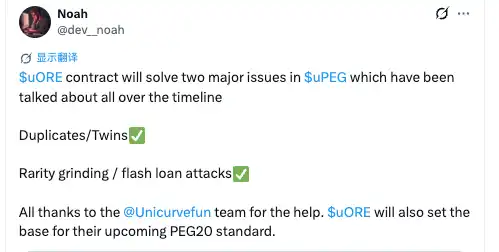
People in the community looked at the source code and found a folder named `reference/unipeg-hook-source/`. The founder, Noah, didn't hide it either. He directly stated on Twitter that UORE's contracts are forked from uPEG, and that he fixed two known issues with uPEG: duplicate NFT generation and flash loan attacks for farming rarity.
A quick look at this founder's profile shows a bio: "Ethereum dev & BAYC holder". On May 2nd, he tweeted his first post about UORE, saying the project combines the mining concept from Solana's ORE with the V4 Hook architecture of uPEG.

He also proactively @ mentioned Unicurvefun and Openpeg, asking if they could support Orelings trading once their markets go live.

From this public information, UORE's lineage is clear:

Solana ORE provided the "on-chain mining + lottery" gameplay template, uPEG provided the V4 Hook code skeleton, and Noah made improvements and assembled on top of these two.

Forking itself isn't the issue. I think the current problems are:

  1. Gas. There are reports on CT that each UORE transaction requires the Hook to execute six steps, consuming two to three times the gas of a normal swap. Swapping back and forth might leave little to no profit.
  2. Time window. The V4 Hook narrative was affected by uPEG's price drop, and subsequent projects will likely have lower ceilings. UORE is the fourth project in this wave of Hook hype, with the heat from the first three already cooling. The attention window for this sector waits for no one.
  3. Complexity. UORE is probably the most mechanically dense among these four projects. For an average user to understand the whole set of rules—Oreling rarity, mining power calculation, staking decay, refining tax, Motherlode probability, buyback trigger conditions—the barrier is high, and the official website is cryptic.

And the project's whitepaper is also interesting:
Read the contracts and understand the mechanics before deploying capital.

Translated into Chinese, this roughly means "Understand it first, don't blame me if you don't."

Combining insights from previous Hook projects, we can see this wave of on-chain trends features complex mechanism designs + massive information asymmetry. They have alpha potential, but the shelf life of that alpha is getting shorter.

SATO gave you a week, uPEG gave you a few days, and by the time it's UORE's turn, the time you have to understand the rules might be down to just a few hours...

By the time you understand it, the market move might be over.

Preguntas relacionadas

QWhat is the core innovation or 'hook' of the $UORE project on Uniswap V4?

AThe $UORE project packages multiple mechanics into a single Uniswap V4 pool transaction. With one buy or sell, the contract simultaneously handles token swapping, NFT (Oreling) minting/burning, staking power calculation, participation in the Motherlode lottery, token buyback for burning, and applying transaction taxes.

QHow does the $UORE project integrate an NFT (Oreling) with its token?

AThe Oreling NFT is directly embedded into the $UORE token. Each whole number of $UORE tokens held in a wallet automatically corresponds to one Oreling. The NFT is minted when tokens are bought and burned when tokens are sold, and it cannot be traded separately from the token.

QWhat is the 'Motherlode' mechanism in $UORE and how does it work?

AThe Motherlode is a lottery prize pool. Buying $UORE through the official pool with ≥ 0.1 ETH automatically grants a lottery ticket. The winning probability scales with purchase amount up to a 1% max chance for 1 ETH purchases. If a buyer wins, 50% of the prize pool goes to them, and the other 50% is randomly distributed to a staker, weighted by their mining power.

QWhat are the main criticisms or potential risks mentioned about the $UORE project?

AThe article highlights several risks: very high gas fees (2-3x a normal swap), a short attention window as it's the fourth V4 Hook project in a fading trend, and high complexity which creates a barrier for understanding. Additionally, its liquidity is low, token distribution is concentrated, and the economic model is described as a Ponzi.

QAccording to the article, what existing projects did $UORE fork or draw inspiration from?

A$UORE's smart contracts are forked from the uPEG project, fixing known issues. Its core 'on-chain mining + lottery' gameplay concept is inspired by the ORE project on Solana. The founder combined these two templates to create $UORE on the Uniswap V4 Hook framework.

Lecturas Relacionadas

Fei-Fei Li's Team Clarifies the Concept of 'World Models', Sora Merely a Renderer

"World Models" has become a widely used yet confusing term in AI. To address this, a team led by Fei-Fei Li and World Labs proposed a functional taxonomy based on the Partially Observable Markov Decision Process framework. This taxonomy categorizes systems called "world models" into three distinct projections: Renderers, Simulators, and Planners. Renderers, like OpenAI's Sora and other video generation models, focus on producing photorealistic visual outputs for human perception. They prioritize visual fidelity over physical accuracy. Simulators, such as NVIDIA Omniverse, aim to compute precise future environmental states for computational tasks like engineering analysis or digital twins. Planners, like Vision-Language-Action models, take in observations and goals to output executable actions for robots or agents. The article clarifies that most current "world models," including Sora, are primarily Renderers. They generate convincing visuals but lack the core ability to simulate state transitions based on actions, a key requirement for a true world model in classic reinforcement learning definitions. This conceptual confusion has practical implications, leading to potential misalignment in technology selection, investment, and public understanding of AI capabilities. Clear categorization is crucial. It helps enterprises avoid costly mistakes (e.g., using a renderer for robot training), allows investors to accurately assess markets, and enables researchers to build comparable benchmarks. While future systems may integrate these functions, recognizing current boundaries is essential for honest assessment and progress.

marsbitHace 1 hora(s)

Fei-Fei Li's Team Clarifies the Concept of 'World Models', Sora Merely a Renderer

marsbitHace 1 hora(s)

Bloomberg Uncovered: How Do China's Wealthy Circumvent the Annual $50,000 Limit to Transfer Assets?

**Summary: How Wealthy Chinese Circumvent $50,000 Annual Foreign Exchange Limits** Despite China's strict capital controls, including an annual $50,000 per person foreign exchange quota, an estimated $150 billion in funds still leaves the country annually via various gray and underground channels. This report outlines the evolution of China's "capital wall" and the methods used to bypass it. **The Evolving Capital Controls:** * **Foundation (1994):** The system of "current account convertibility with strict capital account controls" was established. * **Quota Set (2007):** The $50,000 individual annual forex purchase limit was formalized. * **Crackdown Begins (2015-2017):** Following market volatility, enforcement tightened. Banks were required to scrutinize transactions, and channels like using UnionPay cards for Hong Kong insurance premiums or buying overseas property were blocked. * **Digital & Legal Upgrades (2024-2026):** Enhanced algorithms now flag suspicious patterns (e.g., "smurfing"). The Common Reporting Standard (CRS) provides Chinese tax authorities with data on citizens' offshore accounts. Unlicensed cross-border brokers have been targeted. **Five Primary Methods for Moving Capital:** 1. **Underground Banking / "Hawala" (Duiqiao):** The largest-scale method. No money crosses borders. Clients pay RMB to a domestic account; an overseas associate deposits equivalent foreign currency into the client's offshore account. Risks include high fees, account freezes, and legal penalties. 2. **"Smurfing" or "Ant Moving":** Using multiple individuals' $50,000 quotas to pool funds for one offshore recipient. Increasingly detected by anti-money laundering algorithms. 3. **Trade Invoice Manipulation:** Businesses over-invoice imports or under-invoice exports via offshore shell companies, creating a pretext to transfer excess funds abroad under the guise of trade. 4. **Channel Migration:** After a crackdown on internet brokers, funds flow toward more compliant but costly channels like major banks' cross-border wealth management services or Qualified Domestic Institutional Investor (QDII) quotas. 5. **Structural Arrangements:** High-net-worth individuals use complex, high-cost legal structures involving offshore trusts, insurance, and investment migration programs to transfer asset ownership. **Regulatory Response: Focusing on People, Not Just Money** The current strategy extends oversight from enterprises to **individual residents**. Tools like CRS allow retroactive visibility into offshore assets. Cryptocurrencies, once seen as a potential loophole, are now actively monitored and prosecuted as an illegal channel. The underlying driver remains: with significant wealth concentrated among millions of affluent households seeking diversification amid domestic economic shifts, the incentive to move assets offshore persists despite regulatory barriers.

marsbitHace 1 hora(s)

Bloomberg Uncovered: How Do China's Wealthy Circumvent the Annual $50,000 Limit to Transfer Assets?

marsbitHace 1 hora(s)

Trading

Spot
Futuros

Artículos destacados

Cómo comprar ONE

¡Bienvenido a HTX.com! Hemos hecho que comprar Harmony (ONE) sea simple y conveniente. Sigue nuestra guía paso a paso para iniciar tu viaje de criptos.Paso 1: crea tu cuenta HTXUtiliza tu correo electrónico o número de teléfono para registrarte y obtener una cuenta gratuita en HTX. Experimenta un proceso de registro sin complicaciones y desbloquea todas las funciones.Obtener mi cuentaPaso 2: ve a Comprar cripto y elige tu método de pagoTarjeta de crédito/débito: usa tu Visa o Mastercard para comprar Harmony (ONE) al instante.Saldo: utiliza fondos del saldo de tu cuenta HTX para tradear sin problemas.Terceros: hemos agregado métodos de pago populares como Google Pay y Apple Pay para mejorar la comodidad.P2P: tradear directamente con otros usuarios en HTX.Over-the-Counter (OTC): ofrecemos servicios personalizados y tipos de cambio competitivos para los traders.Paso 3: guarda tu Harmony (ONE)Después de comprar tu Harmony (ONE), guárdalo en tu cuenta HTX. Alternativamente, puedes enviarlo a otro lugar mediante transferencia blockchain o utilizarlo para tradear otras criptomonedas.Paso 4: tradear Harmony (ONE)Tradear fácilmente con Harmony (ONE) en HTX's mercado spot. Simplemente accede a tu cuenta, selecciona tu par de trading, ejecuta tus trades y monitorea en tiempo real. Ofrecemos una experiencia fácil de usar tanto para principiantes como para traders experimentados.

251 Vistas totalesPublicado en 2024.12.12Actualizado en 2026.06.02

Cómo comprar ONE

Discusiones

Bienvenido a la comunidad de HTX. Aquí puedes mantenerte informado sobre los últimos desarrollos de la plataforma y acceder a análisis profesionales del mercado. A continuación se presentan las opiniones de los usuarios sobre el precio de ONE (ONE).

活动图片