Understanding Tokenization: Distinguishing the DTCC Model from the Direct Ownership Model

marsbitPublicado a 2025-12-22Actualizado a 2025-12-22

Resumen

The article clarifies the key differences between two distinct tokenization models in the securities market: the DTCC model and the direct ownership model. The DTCC model, recently approved by the SEC, involves tokenizing "security entitlements" within the existing, multi-layered intermediary system. It creates a digital twin of these rights on a blockchain to improve operational efficiency, enable 24/7 transfers between institutions, and reduce costs, all while preserving the core benefits of the current system, such as netting and centralized liquidity. Crucially, it does not tokenize the underlying shares themselves, and ownership remains indirect. In contrast, the direct ownership model tokenizes the shares themselves, recording ownership directly on the issuer's share registry. This approach enables self-custody, peer-to-peer transfers, and full composability with on-chain DeFi applications. While this model sacrifices the efficiency of netting and leads to fragmented liquidity, it offers unprecedented functionality and disintermediation. The article concludes that these are not competing visions but complementary paths serving different needs. The DTCC model modernizes the core of the public markets for institutional scale and stability, while the direct ownership model fosters innovation at the edge. The ultimate winner is investor choice, as both paths will coexist, offering a broader market interface with more options for all participants.

Original Title: DTCC Isn't Tokenizing Shares, Here is What's Actually Changing

Original Author: @ingalvarezsol

Original Compilation: Peggy, BlockBeats

Editor's Note: The "tokenization" promoted by DTCC is not about putting stocks on-chain, but rather a digital upgrade of securities entitlements, with the core goal of improving the efficiency and settlement capabilities of the existing market system. Parallel to this is another, more radical path: tokenizing stock ownership itself, reshaping self-custody and on-chain composability.

These two models are not opposed; they serve different purposes—stable scaling and functional innovation, respectively. This article attempts to clarify this distinction and points out that the real change is not about one replacing the other, but about investors beginning to have the right to choose between different ownership models.

The full text is as follows:

Introduction: Tokenization, But Not the Kind You Think

The Depository Trust & Clearing Corporation (DTCC) has received a no-action letter from the U.S. Securities and Exchange Commission (SEC), allowing it to begin tokenizing its securities infrastructure. This is a significant upgrade to the "plumbing" of the U.S. capital markets: DTCC custodies approximately $99 trillion in securities assets and supports annual trading volumes in the quadrillions of dollars.

But the market reaction to this news reveals a clear gap between expectations and reality. What is being tokenized is not "stocks," but security entitlements—and this difference determines the nature of almost all subsequent issues.

Current discussions about "tokenized securities" are not herald a single, monolithic future, but rather the simultaneous emergence of two different models at different levels: one is an internal改造 of the existing indirect holding system to improve how securities are held and transferred; the other is a fundamental reshaping of what it means to "own a share of stock."

Note: For ease of expression, the following text will not distinguish between DTCC's subsidiary DTC (Depository Trust Company) and its parent company DTCC.

How Securities Ownership Actually Works Today

In the U.S. public markets, investors do not directly hold shares with the listed company. Stock ownership is placed within a chain of multiple intermediaries.

At the bottom is the issuer's shareholder register, typically maintained by a transfer agent. For almost all listed stocks, this register usually records only one name: Cede & Co., the nominee holder designated by DTCC. The purpose is to avoid the issuer having to maintain records for millions of individual shareholders.

One level up is DTCC itself. It "immobilizes" the physical movement of these shares through centralized custody. DTCC's direct participants are called clearing brokers, who represent retail brokers面向终端客户, handling custody and clearing/settlement. What DTCC records in its system is: how many shares each participant "is entitled to."

At the top are the investors themselves. Investors do not hold specific, identifiable shares, but rather a legally protected security entitlement—this is their claim against their broker; and the broker, through the clearing broker, holds corresponding entitlements within the DTCC system.

What is being tokenized this time is these "entitlements" within the DTCC system, not the shares themselves.

This upgrade can indeed improve system efficiency, but it cannot solve the fundamental limitations inherent in the multi-layered intermediary structure itself.
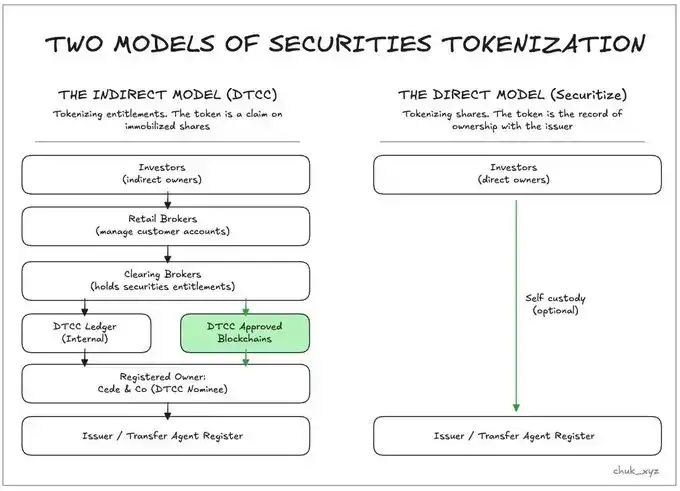
DTCC tokenizes "claims," while the direct model tokenizes "the shares themselves." Both are called "tokenization," but they solve completely different problems.

Why Upgrade?

The U.S. securities system is quite robust, but its architecture still has significant limitations. Settlement relies on processes with time delays and limited operating hours; corporate actions (like dividends, stock splits) and reconciliation are still mostly done through batch messaging rather than shared state. Because ownership is nested within a complex network of intermediaries—each layer with its own pace of technological upgrade—real-time workflows are almost impossible without simultaneous support from all levels, and DTCC is a key "choke point" in this system.

These design choices also bring capital commitment issues. Long settlement cycles require tens of billions of dollars in margin to manage risk between trade execution and final settlement. These optimization schemes were originally designed for an old world where "capital transfer was slow and expensive."

If the settlement cycle is shortened, or instant settlement is achieved for voluntary participants, the required capital scale will decrease significantly, costs will随之降低, and market competition will intensify.

Some of these efficiency gains can be achieved by upgrading existing infrastructure; but others—especially those involving direct ownership and faster innovation iteration capabilities—require a completely new model.

Tokenizing the Existing System (DTCC Model)

In the DTCC path, the underlying securities remain in centralized custody and continue to be registered in the name of Cede & Co. What actually changes is the form of expression of the entitlement records: these "entitlements," which originally existed only on proprietary ledgers, are given a "digital twin" token on an approved blockchain.

This is important because it enables modernization without颠覆 the existing market structure. DTCC can introduce 24/7 entitlement transfers between participating institutions, reduce reconciliation costs, and gradually push these entitlements towards faster collateral liquidity and automated workflows, while still retaining efficiency advantages of centralized systems like net settlement.
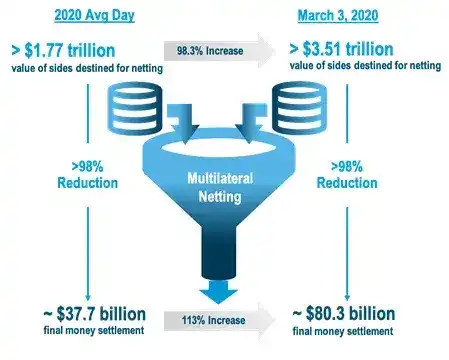
Multilateral netting can compress total trading activity worth trillions of dollars into a final settlement amount of only hundreds of billions. This efficiency is core to today's market structure, even as new ownership models are gradually emerging.

But the boundaries of this system are deliberately set. These tokens will not make the holder a direct shareholder of the company. They are still permissioned, revocable claims, existing within the same legal framework: they cannot become freely composable collateral in DeFi, cannot bypass DTC's participating institutions, and will not change the issuer's shareholder register.

In short, this approach is about optimizing the system we already have, while fully retaining the existing intermediary structure and its efficiency advantages.

Tokenizing "Ownership Itself" (Direct Model)

The second model starts precisely where the DTCC model cannot reach: it tokenizes the shares themselves. Ownership is recorded directly on the issuer's shareholder register, maintained by the transfer agent. When the token is transferred, the shareholder of record changes accordingly, and Cede & Co. is no longer in the chain of ownership.

This unlocks a range of capabilities that are structurally impossible under the DTCC model: self-custody, direct relationships between investors and issuers, peer-to-peer transfer, and programmability and composability with on-chain financial infrastructure—including collateralization, lending, and many new financial structures yet to be invented.

This model is not just theoretical. Galaxy Digital shareholders can already tokenize their equity through Superstate and hold it on-chain, directly reflected in the issuer's cap table. By early 2026, Securitize will also offer similar capabilities, with 24/7 trading supported within compliant brokerage systems.

Of course, the trade-offs of this model are equally real. Once outside the indirect holding system, liquidity becomes fragmented, and the efficiency of multilateral netting disappears; brokerage services like margin and lending need to be redesigned; operational risk shifts more to the holder themselves, rather than intermediaries.

But it is the agency brought by direct ownership that allows investors to actively choose whether to accept these trade-offs, rather than passively inheriting them. And within the DTCC framework, this choice space barely exists—because any innovation regarding "entitlements" must pass through layers of governance, operations, and regulatory processes sequentially.

There are key differences between these two models. The DTCC model has much stronger compatibility and scalability with the existing system; while the direct ownership model opens up greater space for innovations like self-custody.

Why They Are (For Now) Not Competing Visions

The DTCC model and the direct ownership model are not competing routes; they solve different problems.

DTCC's path is an upgrade to the existing indirect holding system, preserving core advantages like net settlement, liquidity concentration, and systemic stability. It targets institutional participants who need scale, settlement certainty, and regulatory continuity.

The direct ownership model meets another set of needs: self-custody, programmable assets, and on-chain composability. It serves investors and issuers who want entirely new functionalities, not just a "more efficient pipeline."

Even if direct ownership may reshape market structures in the future, this transformation will必然 be a multi-year process, requiring同步推进 in technology, regulation, and liquidity migration; it cannot happen quickly. The pace of clearing rules, issuer behavior, participant readiness, and global interoperability moves much slower than the technology itself.

Therefore, a more realistic prospect is coexistence: modernization of infrastructure on one side, and innovation in ownership on the other. Today, neither can替代 the other in fulfilling its mission.

What This Means for Different Market Participants

These two tokenization paths affect participants at different levels of the market differently.

Retail Investors

For retail users, the DTCC upgrade is almost imperceptible. Retail brokers have long shielded users from most friction (e.g., fractional shares, instant buying power, weekend trading), and these experiences will still be provided by brokers.

What真正带来变化 is the direct ownership model: self-custody, peer-to-peer transfer, instant settlement, and the possibility of using stocks as on-chain collateral. Today, stock trading has begun to appear through some platforms and wallets, but most implementations still rely on a "wrapped/mapped" form. In the future, these tokens could potentially become real shares on the register, not a synthetic layer.

Institutional Investors

Institutions will be the biggest beneficiaries of DTCC's tokenization. Their operations heavily rely on collateral movement, securities lending, ETF flows, and multi-party reconciliation—areas where tokenized "entitlements" can significantly reduce operational costs and increase speed.

Direct ownership is more attractive to some institutions, especially opportunistic trading firms seeking programmable collateral and settlement advantages. But due to liquidity fragmentation, broader adoption will start from the edges of the market.

Brokers and Clearing Institutions

Brokers are at the center of the transformation. Under the DTCC model, their role is further strengthened, but innovation moves towards them: clearing brokers who率先 adopt tokenized entitlements can differentiate themselves, and vertically integrated institutions can directly build new products.

In the direct ownership model, brokers are not "removed," but reshaped. Licensing and compliance are still necessary, but a cohort of native on-chain intermediaries will emerge, competing with traditional institutions for users who value the characteristics of direct ownership.

Conclusion: The Real Winner is "Choice"

The future of tokenized securities is not about one model winning out, but about how the two models evolve in parallel and connect with each other.

Entitlement tokenization will continue to modernize the core of public markets; direct ownership will grow on the periphery where programmability, self-custody, and new financial structures are more valued. Switching between the two will become increasingly smooth.

The end result is a broader market interface: existing tracks are faster and cheaper, while new tracks emerge for new behaviors that the existing system cannot support. Both paths will produce winners and losers, but as long as the direct ownership path exists, investors are the ultimate winners—gaining better infrastructure through competition and having the right to freely choose between different models.

Recommended Reading:

Why Isn't Asia's Largest Bitcoin Treasury Company Metaplanet Buying the Dip?

Multicoin Capital: The Era of FinTech 4.0 Has Arrived

a16z's Heavily Funded Web3 Unicorn Farcaster Forced to Pivot, Is Web3 Social a False Proposition?

Preguntas relacionadas

QWhat is the key difference between the DTCC model and the direct ownership model of tokenization?

AThe DTCC model tokenizes 'security entitlements' (the rights to securities within the existing intermediary system), while the direct ownership model tokenizes the actual shares themselves, allowing for direct registration on the issuer's shareholder ledger and enabling self-custody and on-chain composability.

QWhat is the DTCC's primary goal in tokenizing security entitlements?

AThe DTCC's primary goal is to modernize and improve the efficiency of the existing market infrastructure, including enabling 24/7 transfers between participants, reducing reconciliation costs, and improving collateral fluidity, all while preserving the core advantages of the current intermediary structure like netting and systemic stability.

QWhat fundamental limitation does the DTCC model fail to address?

AThe DTCC model fails to address the fundamental limitations inherent in the multi-layered intermediary structure itself, such as the inability to enable self-custody, direct relationships with issuers, peer-to-peer transfers, and programmable on-chain composability with DeFi.

QWhat new capabilities does the direct ownership model unlock that are structurally impossible in the DTCC model?

AThe direct ownership model unlocks capabilities like self-custody, a direct relationship between investors and issuers, peer-to-peer transfers, and programmability/composability with on-chain financial infrastructure, including using stocks as collateral for lending and other novel financial structures.

QAccording to the article, what is the ultimate 'winner' in the evolution of these two tokenization models?

AThe ultimate winner is 'choice.' Investors gain the right to choose between different ownership models, benefiting from both a faster, cheaper traditional infrastructure and new rails that enable novel functionalities not supported by the legacy system.

Lecturas Relacionadas

Stuck Polymarket: The Real Test After Riding the Traffic Boom Has Arrived

Polymarket, a leading prediction market platform, is facing significant technical challenges as its growth outpaces its current infrastructure on Polygon. Users are experiencing laggy transactions, unresponsive orders, and delayed confirmations, severely impacting the trading experience. In response, DeFi Engineering VP Josh Stevens outlined a comprehensive engineering overhaul. The plan includes reducing on-chain data delays, fixing order cancellation issues, rebuilding the central limit order book (CLOB), improving website performance, and developing a unified SDK and API. A major revelation was the ongoing "chain migration," indicating a potential move away from Polygon. The core issue is that Polymarket has evolved from a simple prediction market into a high-frequency trading platform, making Polygon's limitations—such as block space, gas fees, and block time—a ceiling for further growth. The migration is not just a simple chain switch but a fundamental rebuild of its trading system to support more complex products like perpetual contracts (Perps). This announcement has sparked competition among chains like Solana, Sui, and Algorand, all vying to host Polymarket. For Polygon, losing this key application, which contributes significantly to its gas fee revenue, would be a major setback. The real test for Polymarket is no longer attracting users but proving it can provide a stable, reliable trading environment that retains them.

Odaily星球日报Hace 53 min(s)

Stuck Polymarket: The Real Test After Riding the Traffic Boom Has Arrived

Odaily星球日报Hace 53 min(s)

Lowering Expectations for BTC's Next Bull Market

The author, Alex Xu, explains his decision to significantly reduce his Bitcoin holdings (from full to ~30% of his portfolio) during the current bull cycle, citing a lowered long-term outlook for BTC's price appreciation in the next cycle. He outlines six key reasons for this reduced expectation: 1. **Diminished Growth Drivers:** The narrative of exponential user adoption has largely played out with institutional ETF adoption. The next major growth phase—adoption by sovereign national reserves or central banks—seems unlikely in the near future. 2. **Personal Opportunity Cost:** More attractive investment opportunities have emerged in other assets, such as undervalued companies. 3. **Industry-Wide Contraction:** The broader crypto industry is struggling, with most Web3 business models (SocialFi, GameFi, DePIN) failing. This overall萧条 (depression) reduces the fundamental demand and consensus for Bitcoin. 4. **Strain on Major Buyer:** MicroStrategy, a major corporate buyer of BTC, faces rising financing expenses for its debt, which could slow its purchasing rate and create significant marginal pressure on the market. 5. **Increased Competition from Gold:** The emergence of "tokenized gold" has closed the functional gap (portability, divisibility) between physical gold and Bitcoin, offering a strong competitor in the non-sovereign store-of-value space. 6. **Security Budget Concerns:** The block reward halving continues to exacerbate the long-standing issue of funding Bitcoin's network security, with new fee source explorations like Ordinals and L2s largely failing. The author's decision to hold a significant (though reduced) position reflects a cautious, not bearish, outlook. He remains open to increasing his exposure if the fundamental reasons for his skepticism change or if new positive catalysts emerge.

marsbitHace 1 hora(s)

Lowering Expectations for BTC's Next Bull Market

marsbitHace 1 hora(s)

Can Iran 'Control' the Strait of Hormuz?

Iran has announced a comprehensive plan to assert control over the strategic Strait of Hormuz, a critical global oil shipping chokepoint. The proposed measures include requiring all vessels to obtain Iranian permission for passage, imposing fees for security, environmental protection, and navigation management—preferably paid in Iranian rials—and absolutely banning Israeli ships. Vessels from countries deemed hostile by Iran’s top security bodies may also be barred. Analysts suggest Iran’s motives are multifaceted: increasing pressure on the U.S. and Israel by leveraging control over oil transit to influence global prices and inflation; creating a new revenue stream, potentially exceeding $7.7 billion annually, to counter Western sanctions and support postwar reconstruction; and using transit permissions as bargaining chips in future negotiations, notably with the U.S. However, the plan faces significant practical and diplomatic challenges. Enforcing comprehensive interception and fee collection in the busy waterway, patrolled by international military forces, would be difficult. The U.S. has already countering with a blockade of Iranian ports and threats to intercept any ship paying fees, potentially strangling Iran’s oil exports and fee revenue. Broad international opposition, led by European and Gulf states, and legal controversies further complicate implementation. The proposal may ultimately serve more as a negotiating tactic than a feasible policy, with its execution remaining highly uncertain.

marsbitHace 2 hora(s)

Can Iran 'Control' the Strait of Hormuz?

marsbitHace 2 hora(s)

Trading

Spot
Futuros

Artículos destacados

Qué es $S$

Entendiendo SPERO: Una Visión General Completa Introducción a SPERO A medida que el panorama de la innovación continúa evolucionando, la aparición de tecnologías web3 y proyectos de criptomonedas juega un papel fundamental en la configuración del futuro digital. Un proyecto que ha atraído la atención en este campo dinámico es SPERO, denotado como SPERO,$$s$. Este artículo tiene como objetivo reunir y presentar información detallada sobre SPERO, para ayudar a entusiastas e inversores a comprender sus fundamentos, objetivos e innovaciones dentro de los dominios web3 y cripto. ¿Qué es SPERO,$$s$? SPERO,$$s$ es un proyecto único dentro del espacio cripto que busca aprovechar los principios de descentralización y tecnología blockchain para crear un ecosistema que promueva la participación, la utilidad y la inclusión financiera. El proyecto está diseñado para facilitar interacciones de igual a igual de nuevas maneras, proporcionando a los usuarios soluciones y servicios financieros innovadores. En su esencia, SPERO,$$s$ tiene como objetivo empoderar a los individuos al proporcionar herramientas y plataformas que mejoren la experiencia del usuario en el espacio de las criptomonedas. Esto incluye habilitar métodos de transacción más flexibles, fomentar iniciativas impulsadas por la comunidad y crear caminos para oportunidades financieras a través de aplicaciones descentralizadas (dApps). La visión subyacente de SPERO,$$s$ gira en torno a la inclusividad, buscando cerrar brechas dentro de las finanzas tradicionales mientras aprovecha los beneficios de la tecnología blockchain. ¿Quién es el Creador de SPERO,$$s$? La identidad del creador de SPERO,$$s$ sigue siendo algo oscura, ya que hay recursos públicos limitados que proporcionan información de fondo detallada sobre su(s) fundador(es). Esta falta de transparencia puede derivarse del compromiso del proyecto con la descentralización, una ética que muchos proyectos web3 comparten, priorizando las contribuciones colectivas sobre el reconocimiento individual. Al centrar las discusiones en torno a la comunidad y sus objetivos colectivos, SPERO,$$s$ encarna la esencia del empoderamiento sin señalar a individuos específicos. Como tal, comprender la ética y la misión de SPERO sigue siendo más importante que identificar a un creador singular. ¿Quiénes son los Inversores de SPERO,$$s$? SPERO,$$s$ cuenta con el apoyo de una diversa gama de inversores que van desde capitalistas de riesgo hasta inversores ángeles dedicados a fomentar la innovación en el sector cripto. El enfoque de estos inversores generalmente se alinea con la misión de SPERO, priorizando proyectos que prometen avances tecnológicos sociales, inclusión financiera y gobernanza descentralizada. Estas fundaciones de inversores suelen estar interesadas en proyectos que no solo ofrecen productos innovadores, sino que también contribuyen positivamente a la comunidad blockchain y sus ecosistemas. El respaldo de estos inversores refuerza a SPERO,$$s$ como un contendiente notable en el dominio de proyectos cripto que evoluciona rápidamente. ¿Cómo Funciona SPERO,$$s$? SPERO,$$s$ emplea un marco multifacético que lo distingue de los proyectos de criptomonedas convencionales. Aquí hay algunas de las características clave que subrayan su singularidad e innovación: Gobernanza Descentralizada: SPERO,$$s$ integra modelos de gobernanza descentralizada, empoderando a los usuarios para participar activamente en los procesos de toma de decisiones sobre el futuro del proyecto. Este enfoque fomenta un sentido de propiedad y responsabilidad entre los miembros de la comunidad. Utilidad del Token: SPERO,$$s$ utiliza su propio token de criptomoneda, diseñado para servir diversas funciones dentro del ecosistema. Estos tokens permiten transacciones, recompensas y la facilitación de servicios ofrecidos en la plataforma, mejorando la participación y la utilidad general. Arquitectura en Capas: La arquitectura técnica de SPERO,$$s$ apoya la modularidad y escalabilidad, permitiendo la integración fluida de características y aplicaciones adicionales a medida que el proyecto evoluciona. Esta adaptabilidad es fundamental para mantener la relevancia en el cambiante paisaje cripto. Participación de la Comunidad: El proyecto enfatiza iniciativas impulsadas por la comunidad, empleando mecanismos que incentivan la colaboración y la retroalimentación. Al nutrir una comunidad sólida, SPERO,$$s$ puede abordar mejor las necesidades de los usuarios y adaptarse a las tendencias del mercado. Enfoque en la Inclusión: Al ofrecer tarifas de transacción bajas e interfaces amigables para el usuario, SPERO,$$s$ busca atraer a una base de usuarios diversa, incluyendo a individuos que anteriormente pueden no haber participado en el espacio cripto. Este compromiso con la inclusión se alinea con su misión general de empoderamiento a través de la accesibilidad. Cronología de SPERO,$$s$ Entender la historia de un proyecto proporciona información crucial sobre su trayectoria de desarrollo y hitos. A continuación se presenta una cronología sugerida que mapea eventos significativos en la evolución de SPERO,$$s$: Fase de Conceptualización e Ideación: Las ideas iniciales que forman la base de SPERO,$$s$ fueron concebidas, alineándose estrechamente con los principios de descentralización y enfoque comunitario dentro de la industria blockchain. Lanzamiento del Whitepaper del Proyecto: Tras la fase conceptual, se lanzó un whitepaper completo que detalla la visión, los objetivos y la infraestructura tecnológica de SPERO,$$s$ para generar interés y retroalimentación de la comunidad. Construcción de Comunidad y Primeras Interacciones: Se realizaron esfuerzos de divulgación activa para construir una comunidad de primeros adoptantes y posibles inversores, facilitando discusiones en torno a los objetivos del proyecto y obteniendo apoyo. Evento de Generación de Tokens: SPERO,$$s$ llevó a cabo un evento de generación de tokens (TGE) para distribuir sus tokens nativos a los primeros seguidores y establecer liquidez inicial dentro del ecosistema. Lanzamiento de la dApp Inicial: La primera aplicación descentralizada (dApp) asociada con SPERO,$$s$ se puso en marcha, permitiendo a los usuarios interactuar con las funcionalidades centrales de la plataforma. Desarrollo Continuo y Alianzas: Actualizaciones y mejoras continuas a las ofertas del proyecto, incluyendo alianzas estratégicas con otros actores en el espacio blockchain, han moldeado a SPERO,$$s$ en un jugador competitivo y en evolución en el mercado cripto. Conclusión SPERO,$$s$ se erige como un testimonio del potencial de web3 y las criptomonedas para revolucionar los sistemas financieros y empoderar a los individuos. Con un compromiso con la gobernanza descentralizada, la participación comunitaria y funcionalidades diseñadas de manera innovadora, allana el camino hacia un paisaje financiero más inclusivo. Como con cualquier inversión en el espacio cripto que evoluciona rápidamente, se anima a los posibles inversores y usuarios a investigar a fondo y participar de manera reflexiva con los desarrollos en curso dentro de SPERO,$$s$. El proyecto muestra el espíritu innovador de la industria cripto, invitando a una mayor exploración de sus innumerables posibilidades. Mientras el viaje de SPERO,$$s$ aún se desarrolla, sus principios fundamentales pueden, de hecho, influir en el futuro de cómo interactuamos con la tecnología, las finanzas y entre nosotros en ecosistemas digitales interconectados.

72 Vistas totalesPublicado en 2024.12.17Actualizado en 2024.12.17

Qué es $S$

Qué es AGENT S

Agent S: El Futuro de la Interacción Autónoma en Web3 Introducción En el paisaje en constante evolución de Web3 y las criptomonedas, las innovaciones están redefiniendo constantemente cómo los individuos interactúan con las plataformas digitales. Uno de estos proyectos pioneros, Agent S, promete revolucionar la interacción humano-computadora a través de su marco agente abierto. Al allanar el camino para interacciones autónomas, Agent S busca simplificar tareas complejas, ofreciendo aplicaciones transformadoras en inteligencia artificial (IA). Esta exploración detallada profundizará en las complejidades del proyecto, sus características únicas y las implicaciones para el dominio de las criptomonedas. ¿Qué es Agent S? Agent S se presenta como un marco agente abierto innovador, diseñado específicamente para abordar tres desafíos fundamentales en la automatización de tareas informáticas: Adquisición de Conocimiento Específico del Dominio: El marco aprende inteligentemente de diversas fuentes de conocimiento externas y experiencias internas. Este enfoque dual le permite construir un rico repositorio de conocimiento específico del dominio, mejorando su rendimiento en la ejecución de tareas. Planificación a Largo Plazo de Tareas: Agent S emplea planificación jerárquica aumentada por la experiencia, un enfoque estratégico que facilita la descomposición y ejecución eficiente de tareas complejas. Esta característica mejora significativamente su capacidad para gestionar múltiples subtareas de manera eficiente y efectiva. Manejo de Interfaces Dinámicas y No Uniformes: El proyecto introduce la Interfaz Agente-Computadora (ACI), una solución innovadora que mejora la interacción entre agentes y usuarios. Utilizando Modelos de Lenguaje Multimodal de Gran Escala (MLLMs), Agent S puede navegar y manipular diversas interfaces gráficas de usuario sin problemas. A través de estas características pioneras, Agent S proporciona un marco robusto que aborda las complejidades involucradas en la automatización de la interacción humana con las máquinas, preparando el terreno para una multitud de aplicaciones en IA y más allá. ¿Quién es el Creador de Agent S? Si bien el concepto de Agent S es fundamentalmente innovador, la información específica sobre su creador sigue siendo elusiva. El creador es actualmente desconocido, lo que resalta ya sea la etapa incipiente del proyecto o la elección estratégica de mantener a los miembros fundadores en el anonimato. Independientemente de la anonimidad, el enfoque sigue siendo en las capacidades y el potencial del marco. ¿Quiénes son los Inversores de Agent S? Dado que Agent S es relativamente nuevo en el ecosistema criptográfico, la información detallada sobre sus inversores y patrocinadores financieros no está documentada explícitamente. La falta de información disponible públicamente sobre las bases de inversión u organizaciones que apoyan el proyecto plantea preguntas sobre su estructura de financiamiento y hoja de ruta de desarrollo. Comprender el respaldo es crucial para evaluar la sostenibilidad del proyecto y su posible impacto en el mercado. ¿Cómo Funciona Agent S? En el núcleo de Agent S se encuentra una tecnología de vanguardia que le permite funcionar de manera efectiva en diversos entornos. Su modelo operativo se basa en varias características clave: Interacción Humano-Computadora Similar a la Humana: El marco ofrece planificación avanzada de IA, esforzándose por hacer que las interacciones con las computadoras sean más intuitivas. Al imitar el comportamiento humano en la ejecución de tareas, promete elevar las experiencias de los usuarios. Memoria Narrativa: Empleada para aprovechar experiencias de alto nivel, Agent S utiliza memoria narrativa para hacer un seguimiento de las historias de tareas, mejorando así sus procesos de toma de decisiones. Memoria Episódica: Esta característica proporciona a los usuarios una guía paso a paso, permitiendo que el marco ofrezca apoyo contextual a medida que se desarrollan las tareas. Soporte para OpenACI: Con la capacidad de ejecutarse localmente, Agent S permite a los usuarios mantener el control sobre sus interacciones y flujos de trabajo, alineándose con la ética descentralizada de Web3. Fácil Integración con APIs Externas: Su versatilidad y compatibilidad con varias plataformas de IA aseguran que Agent S pueda encajar sin problemas en ecosistemas tecnológicos existentes, convirtiéndolo en una opción atractiva para desarrolladores y organizaciones. Estas funcionalidades contribuyen colectivamente a la posición única de Agent S dentro del espacio cripto, ya que automatiza tareas complejas y de múltiples pasos con una intervención humana mínima. A medida que el proyecto evoluciona, sus posibles aplicaciones en Web3 podrían redefinir cómo se desarrollan las interacciones digitales. Cronología de Agent S El desarrollo y los hitos de Agent S pueden encapsularse en una cronología que resalta sus eventos significativos: 27 de septiembre de 2024: El concepto de Agent S fue lanzado en un documento de investigación integral titulado “Un Marco Agente Abierto que Usa Computadoras Como un Humano”, mostrando las bases del proyecto. 10 de octubre de 2024: El documento de investigación fue puesto a disposición del público en arXiv, ofreciendo una exploración profunda del marco y su evaluación de rendimiento basada en el benchmark OSWorld. 12 de octubre de 2024: Se lanzó una presentación en video, proporcionando una visión visual de las capacidades y características de Agent S, involucrando aún más a posibles usuarios e inversores. Estos marcadores en la cronología no solo ilustran el progreso de Agent S, sino que también indican su compromiso con la transparencia y la participación comunitaria. Puntos Clave Sobre Agent S A medida que el marco Agent S continúa evolucionando, varios atributos clave destacan, subrayando su naturaleza innovadora y potencial: Marco Innovador: Diseñado para proporcionar un uso intuitivo de las computadoras similar a la interacción humana, Agent S aporta un enfoque novedoso a la automatización de tareas. Interacción Autónoma: La capacidad de interactuar de manera autónoma con las computadoras a través de GUI significa un salto hacia soluciones informáticas más inteligentes y eficientes. Automatización de Tareas Complejas: Con su metodología robusta, puede automatizar tareas complejas y de múltiples pasos, haciendo que los procesos sean más rápidos y menos propensos a errores. Mejora Continua: Los mecanismos de aprendizaje permiten a Agent S mejorar a partir de experiencias pasadas, mejorando continuamente su rendimiento y eficacia. Versatilidad: Su adaptabilidad en diferentes entornos operativos como OSWorld y WindowsAgentArena asegura que pueda servir a una amplia gama de aplicaciones. A medida que Agent S se posiciona en el paisaje de Web3 y criptomonedas, su potencial para mejorar las capacidades de interacción y automatizar procesos significa un avance significativo en las tecnologías de IA. A través de su marco innovador, Agent S ejemplifica el futuro de las interacciones digitales, prometiendo una experiencia más fluida y eficiente para los usuarios en diversas industrias. Conclusión Agent S representa un audaz avance en la unión de la IA y Web3, con la capacidad de redefinir cómo interactuamos con la tecnología. Aunque aún se encuentra en sus primeras etapas, las posibilidades para su aplicación son vastas y atractivas. A través de su marco integral que aborda desafíos críticos, Agent S busca llevar las interacciones autónomas al primer plano de la experiencia digital. A medida que nos adentramos más en los reinos de las criptomonedas y la descentralización, proyectos como Agent S sin duda desempeñarán un papel crucial en la configuración del futuro de la tecnología y la colaboración humano-computadora.

354 Vistas totalesPublicado en 2025.01.14Actualizado en 2025.01.14

Qué es AGENT S

Cómo comprar S

¡Bienvenido a HTX.com! Hemos hecho que comprar Sonic (S) sea simple y conveniente. Sigue nuestra guía paso a paso para iniciar tu viaje de criptos.Paso 1: crea tu cuenta HTXUtiliza tu correo electrónico o número de teléfono para registrarte y obtener una cuenta gratuita en HTX. Experimenta un proceso de registro sin complicaciones y desbloquea todas las funciones.Obtener mi cuentaPaso 2: ve a Comprar cripto y elige tu método de pagoTarjeta de crédito/débito: usa tu Visa o Mastercard para comprar Sonic (S) al instante.Saldo: utiliza fondos del saldo de tu cuenta HTX para tradear sin problemas.Terceros: hemos agregado métodos de pago populares como Google Pay y Apple Pay para mejorar la comodidad.P2P: tradear directamente con otros usuarios en HTX.Over-the-Counter (OTC): ofrecemos servicios personalizados y tipos de cambio competitivos para los traders.Paso 3: guarda tu Sonic (S)Después de comprar tu Sonic (S), guárdalo en tu cuenta HTX. Alternativamente, puedes enviarlo a otro lugar mediante transferencia blockchain o utilizarlo para tradear otras criptomonedas.Paso 4: tradear Sonic (S)Tradear fácilmente con Sonic (S) en HTX's mercado spot. Simplemente accede a tu cuenta, selecciona tu par de trading, ejecuta tus trades y monitorea en tiempo real. Ofrecemos una experiencia fácil de usar tanto para principiantes como para traders experimentados.

716 Vistas totalesPublicado en 2025.01.15Actualizado en 2025.03.21

Cómo comprar S

Discusiones

Bienvenido a la comunidad de HTX. Aquí puedes mantenerte informado sobre los últimos desarrollos de la plataforma y acceder a análisis profesionales del mercado. A continuación se presentan las opiniones de los usuarios sobre el precio de S (S).

活动图片