Understanding the Q2 Crypto Market in 5 Charts: RWA Booms, Fundamentals Continue to Improve

marsbitPublicado a 2026-07-16Actualizado a 2026-07-16

Resumen

"5 Charts to Decrypt the Crypto Market in Q2: RWA Explosion and Fundamentals Rebound" In Q2 2026, the crypto market presented a complex picture. While major cryptocurrencies fell 36% in H1, underperforming most major asset classes except gold, crypto-related equities surged 23%, doubling the S&P 500's return. This highlights diverse investment opportunities within the sector, from AI-benefiting miners to Wall Street-linked tokenization platforms. Key takeaways from five crucial charts: 1. **Divergence:** A significant performance gap emerged between crypto assets and publicly traded crypto companies. 2. **Robust Fundamentals:** The top 10 crypto applications generated $5.9B in revenue over the past year, with leaders like PancakeSwap nearing $1B, demonstrating real business traction. 3. **RWA Boom:** Tokenized real-world assets (RWA) reached a record $33B, up 12% QoQ and 45% YTD, fueled by tokenized treasuries, credit, and equities. 4. **Prediction Market Growth:** Prediction market open interest hit a new high of $1.8B, with Q2 volume reaching $43B, driven largely by sports and upcoming political events. 5. **Attractive Correlations:** The Bitwise Crypto Innovators 30 Index showed low or negative 90-day rolling correlations with most major assets (like stocks, bonds, gold), offering potential diversification benefits alongside high returns. Overall, despite bearish price action, the data reveals resilient industry fundamentals with continued growth in users, revenue,...

Written by: Ryan Rasmussen, Head of Research at Bitwise

Compiled by: Luffy, Foresight News

Each quarter, we publish the "Bitwise Crypto Market Review," a report containing over 50 charts covering market performance, on-chain fundamentals, institutional adoption, and other comprehensive data.

Data always sketches the industry's full picture. Sometimes it shows purely bullish or bearish signals; more often, bullish and bearish information intertwine, with highlights and negatives coexisting, worthy of in-depth analysis. The second quarter was such a case, with fundamentals like crypto business revenue, real-world asset adoption, and institutional deployment all improving significantly. Crypto-themed stocks surged, yet mainstream crypto asset prices declined overall. How should we understand this divergent market?

If you want to quickly grasp the core conclusions, here are the five most important charts I believe.

Crypto Stocks and Crypto Currencies Show Severe Divergence

In the first half of 2026, crypto assets fell by 36% overall; only gold fell concurrently, down 7%, while all other major asset classes rose. This is a key reason why this crypto bear market has been particularly difficult: only the crypto sector has been under pressure alone.

But in stark contrast, crypto-themed stocks rose 23% cumulatively in the first half, outperforming all mainstream assets except emerging market stocks. The Bitwise Crypto Innovators 30 Index, which tracks 30 leading publicly traded crypto companies, delivered returns more than double that of the S&P 500.

This data conveys a key signal: even in a bear market, the crypto industry is still full of investment opportunities. Bitcoin mining companies benefit from the AI industry boom; stablecoin issuers and asset tokenization platforms continue to onboard Wall Street business; the integration between traditional finance and crypto markets is deepening. I predict cryptocurrency prices will see a recovery in the second half, but the first half's performance has already confirmed one fact: crypto is not a single category of assets; the sector is diverse and dynamic, requiring a broader perspective.
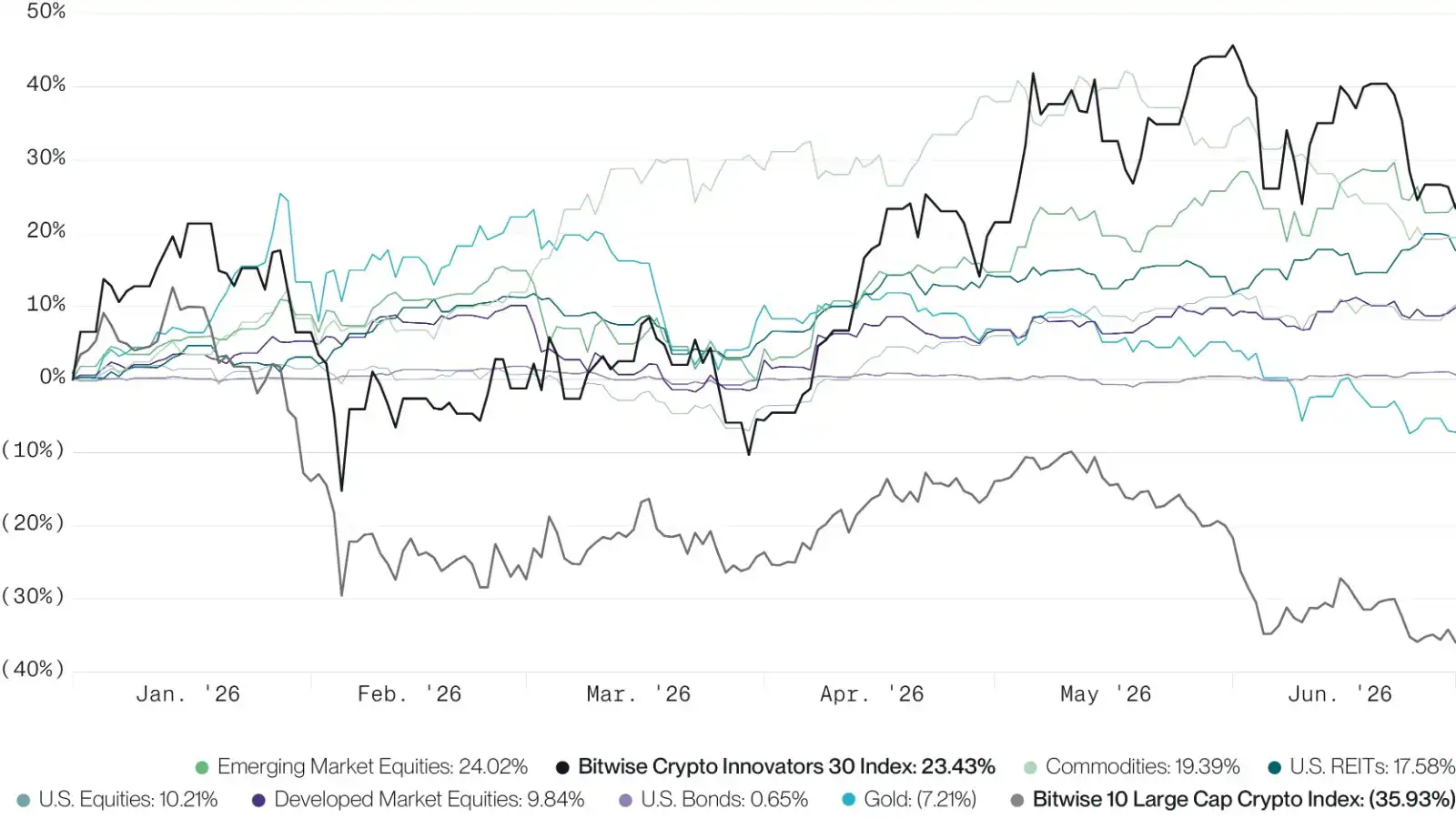
Performance Comparison: Cryptocurrencies vs. Major Asset Classes. Data source: Bitwise, Bloomberg; Statistics as of June 30, 2026.

Crypto Applications Generate Significant Revenue Scale

Over the past 12 months, the top ten crypto applications globally have generated a combined $5.9 billion in revenue; the top three—PancakeSwap, Hyperliquid, Aave—each have revenues approaching $1 billion.

Even in a bear market, these products are still commercial entities with stable cash flows, earning revenue from trading fees, lending interest, and staking rewards. Whenever someone questions whether the crypto industry has real fundamentals, I pull out this chart.
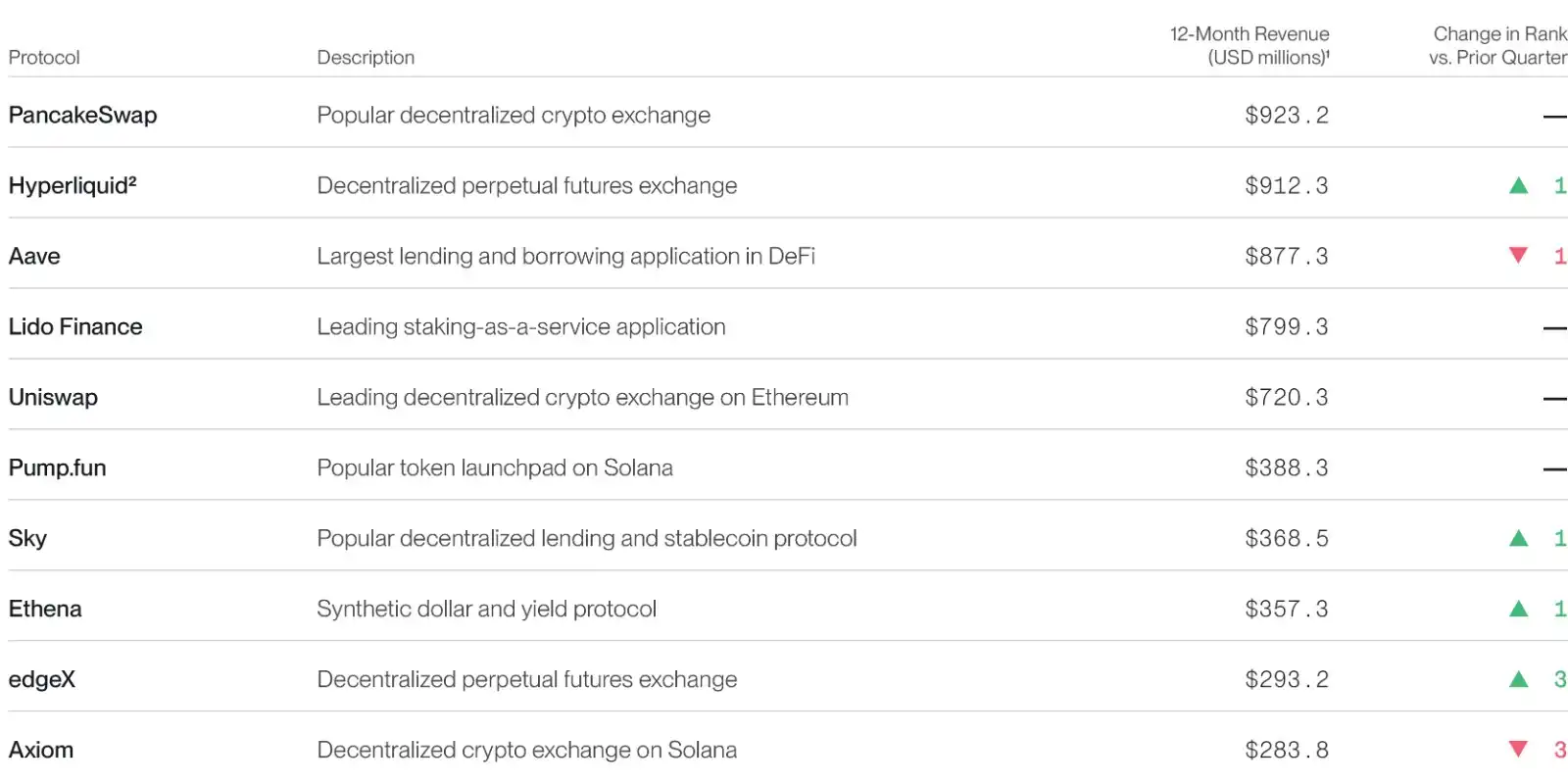
Top Ten Crypto Applications by Revenue. Data source: Bitwise, Token Terminal; Statistics timeframe: Jan 1, 2025 – Jun 30, 2026.

Real World Asset (RWA) Tokenization Enters a Bull Market

U.S. Treasury Secretary Scott Bessent publicly stated weeks ago: "Digital assets, stablecoins, asset tokenization, and new payment systems will collectively shape the future of the monetary system."

In a sense, the future he described is already here. In Q2, the total value of tokenized real-world assets reached a record high of $33 billion, up 12% quarter-over-quarter and 45% year-to-date; growth was mainly driven by tokenized U.S. Treasuries, corporate credit, stocks, and venture capital shares.

This chart clearly shows that global leading asset management firms are moving real-world assets onto the blockchain on a large scale—a trend worth continuous tracking.
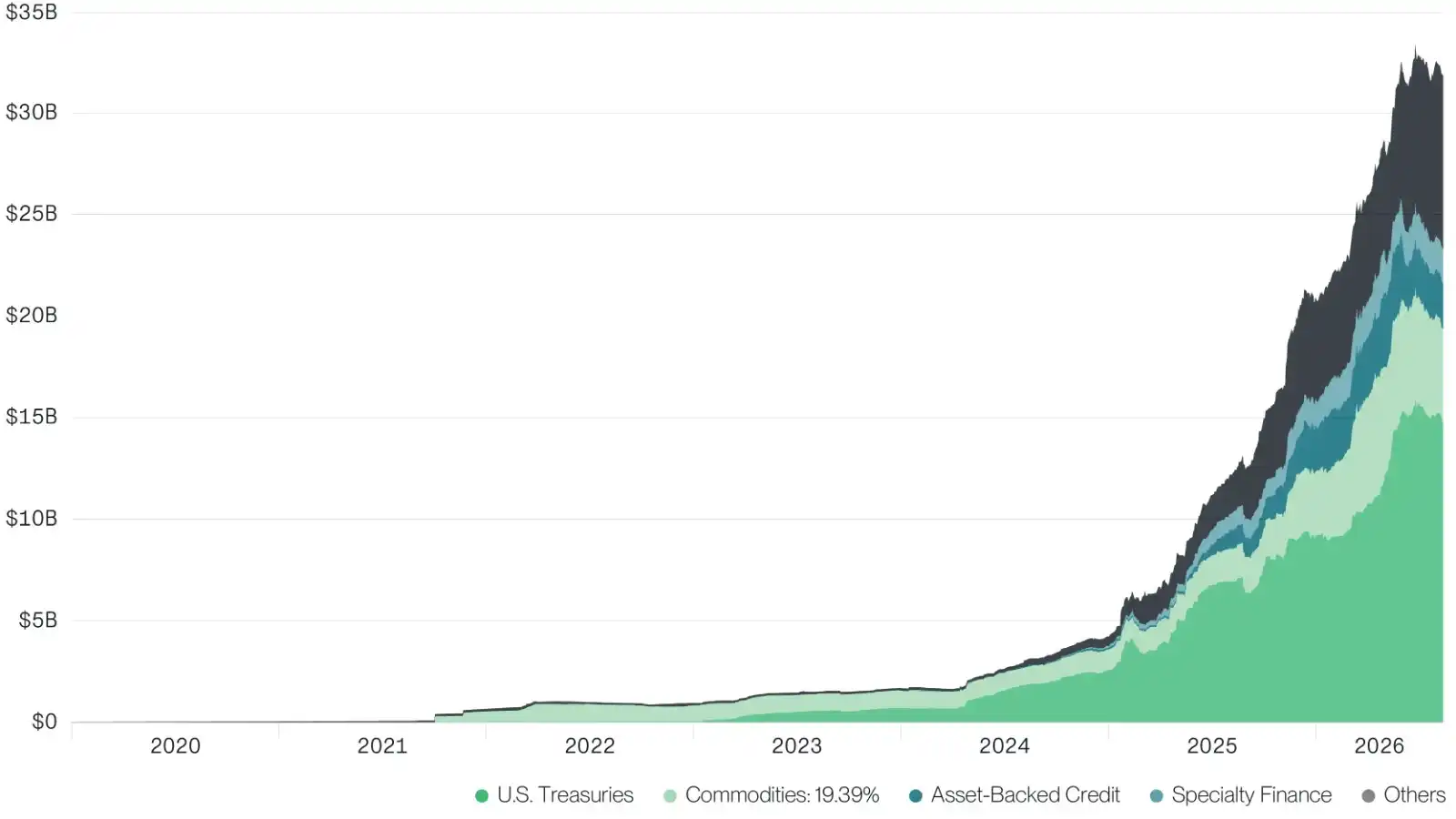
Value of Tokenized Real World Assets (RWA). Data source: Bitwise Asset Management, RWA.xyz; Statistics timeframe: Jan 1, 2020 – Jun 30, 2026.

Prediction Markets Continue to Expand

In Q2, prediction market open interest hit a record high of $1.8 billion, with sports events becoming a core trading category; total quarterly trading volume also hit a record, reaching $43 billion.

Platforms like Polymarket reflect a hidden side of crypto retail adoption: millions of users use underlying crypto tools to bet on real-world event outcomes, but the vast majority of users are unaware of and indifferent to the underlying blockchain technology.

As the U.S. midterm elections approach, I predict prediction market trading volume and open interest will hit new all-time highs multiple times this year. The 2024 election cycle brought prediction markets into the public eye, after which the industry's size directly tripled.
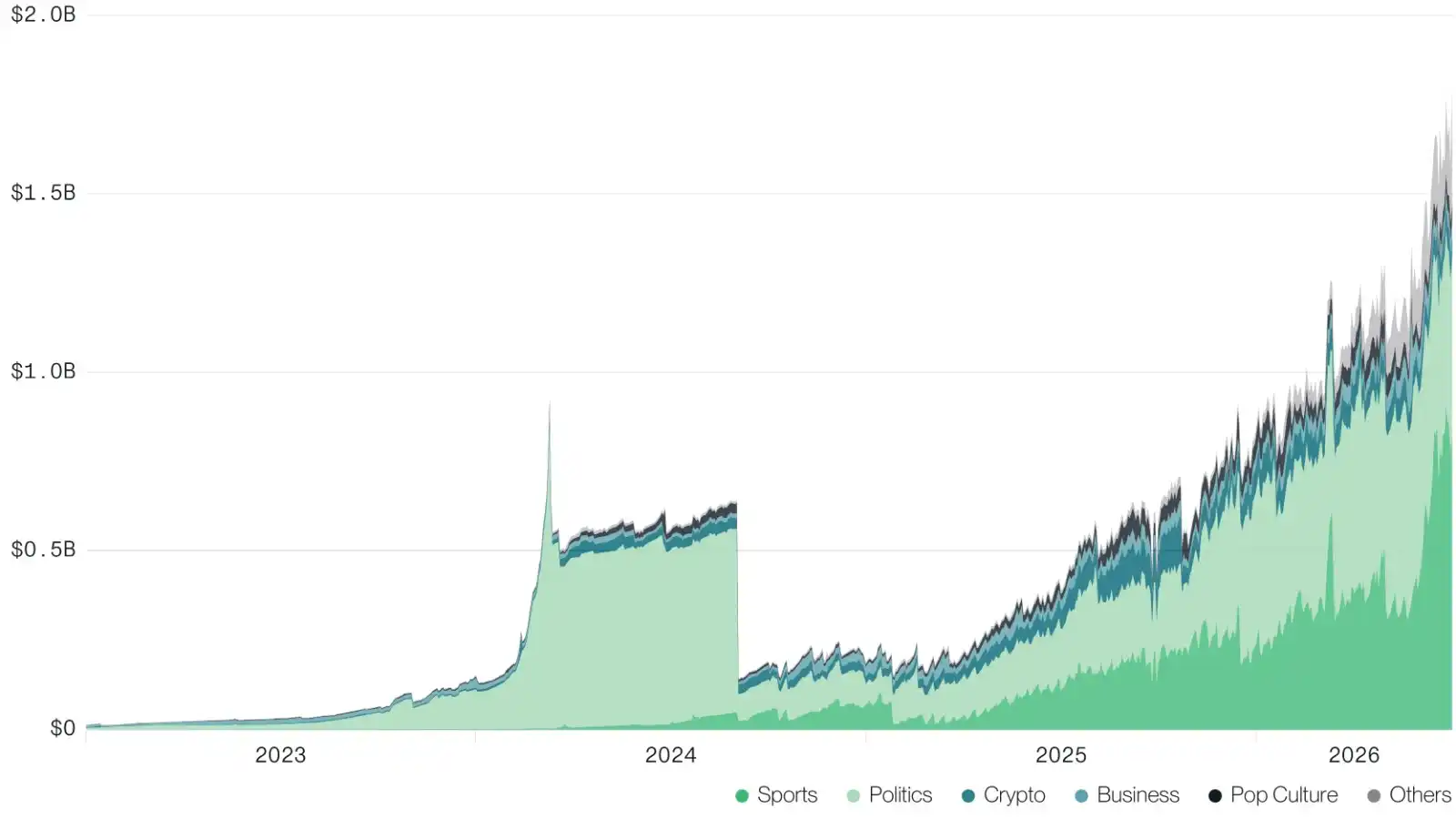
Prediction Market Open Interest Changes. Data source: Bitwise, Blockworks; Statistics timeframe: Jan 1, 2023 – Jun 30, 2026.

Low Correlation Between Crypto Stocks and Mainstream Assets

Returning to crypto-themed stocks, the most valuable chart shows the 90-day rolling correlation between the Bitwise Crypto Innovators 30 Index and various assets. The key highlight is that compared to the broader U.S. stock market, this index has a lower correlation with the vast majority of assets—developed market stocks, emerging market stocks, U.S. REITs, U.S. Treasuries, and gold are all examples. The sole exception is commodities, where correlations are negative.

In short, in the first half of 2026, crypto stock returns were double those of the U.S. stock market, while also being weakly correlated with most assets in an investment portfolio. This combination of high returns and risk dispersion is precisely what institutional investors seek in allocation targets.
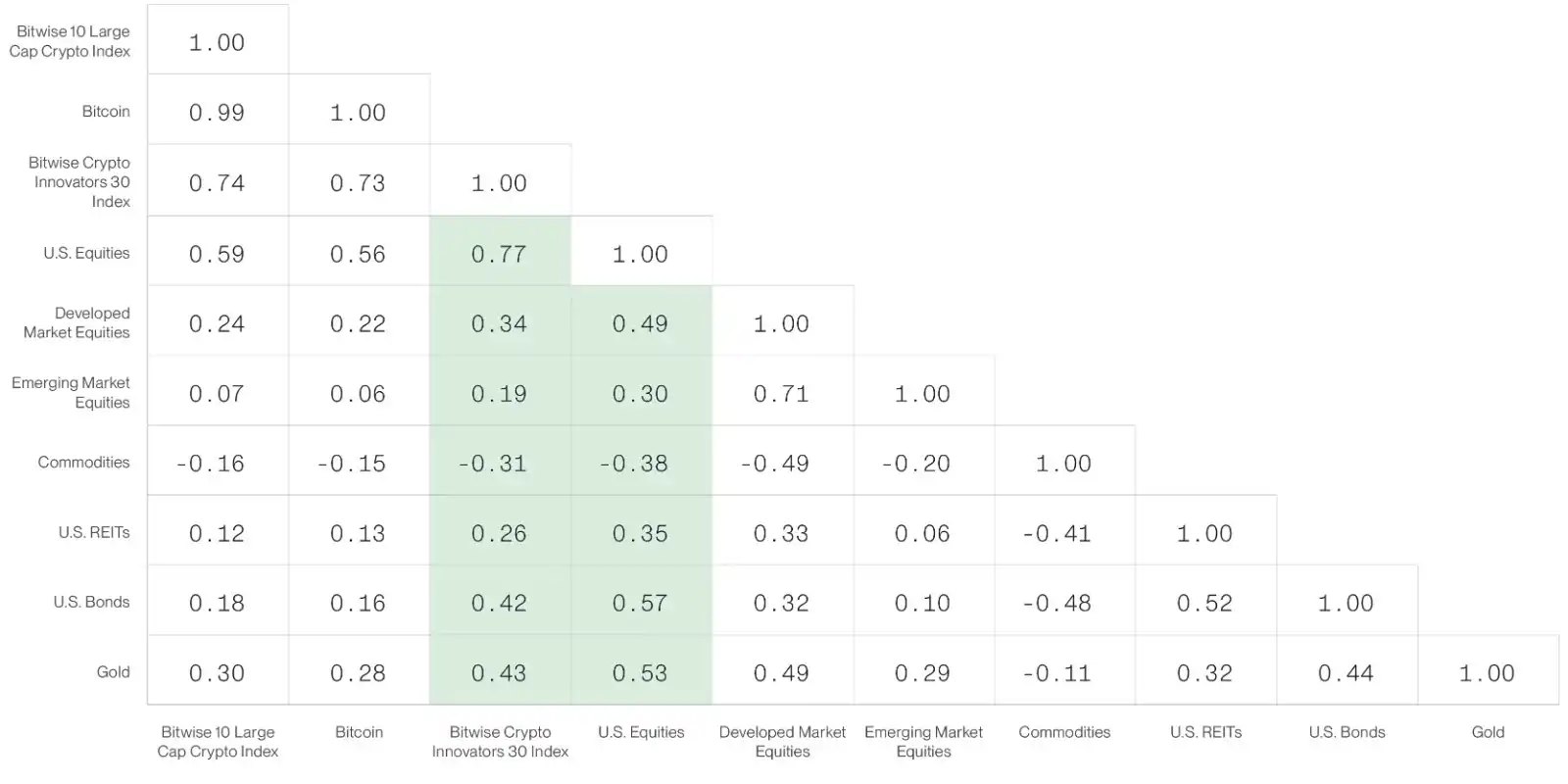
90-Day Rolling Correlation Comparison Across Asset Classes. Data source: Bitwise, Bloomberg; Statistics as of June 30, 2026.

Summary

That concludes my complete interpretation of the Q2 market. The over 50 charts in the report cannot directly answer the market's most pressing question: Have crypto prices bottomed? However, all the data collectively prove that the crypto industry's fundamentals are extremely resilient. Even during bear market cycles, user scale, business revenue, and institutional adoption continue to grow.

The current stage of the industry is highly valuable for research and forms the underlying foundation for the next bull market.


Preguntas relacionadas

QAccording to the article, what was a key signal from the significant divergence between crypto stock performance and cryptocurrency prices in H1 2026?

AThe divergence signaled that despite a bear market, the crypto industry was still full of investment opportunities, with opportunities in areas like Bitcoin mining benefiting from AI, stablecoin issuers, and tokenization platforms. It showed that crypto is not a single asset class and needs to be viewed from a broader perspective.

QWhat is the combined revenue of the top ten crypto applications over the past 12 months, and what does this data counterargue?

AThe top ten crypto applications generated a combined revenue of $5.9 billion over the past 12 months. This data is used to counter the argument that the crypto industry lacks real fundamental business activity, showing these products are profitable commercial entities.

QWhat milestone did tokenized real-world assets (RWA) reach in Q2, and what were the main drivers of its growth?

ATokenized RWA reached a record high of $33 billion in total value in Q2. The main growth drivers were tokenized U.S. Treasuries, corporate credit, stocks, and venture capital shares.

QWhat record did prediction markets set in Q2, and what upcoming event is predicted to further boost their activity?

APrediction markets set records in Q2 with $1.8 billion in open interest and $43 billion in trading volume. The upcoming U.S. midterm elections are predicted to drive activity and push these metrics to new highs.

QWhat makes the Bitwise Crypto Innovators 30 Index an attractive portfolio component for institutional investors, based on its performance and correlation data from H1 2026?

AThe index offered double the returns of the S&P 500 while exhibiting low correlation with most other major asset classes (developed/emerging market stocks, U.S. REITs, Treasuries, gold) and negative correlation with commodities. This combination of high returns and diversification benefits makes it attractive to institutional investors.

Lecturas Relacionadas

RWA's "Robinhood Moment": A Complete Overview of Early-Stage Projects

**RWA's "Robinhood Moment": An Overview of Early Projects** Robinhood's recent focus on Real-World Assets (RWAs) has sparked significant activity on its newly launched Robinhood Chain. Following CEO Vlad Tenev's public interest in projects integrating stock tokens and RWAs, several early-stage initiatives have emerged on the network. Key projects include: * **Arcus:** A DEX for stock tokens and crypto, built by dYdX Labs and Robinhood Crypto, focusing on spot and perpetual trading. Future token distribution will prioritize the dYdX community. * **Lighter:** A ZK-powered DEX for perpetual contracts and stock tokens, offering rewards in its LIT token to users, especially those trading via Robinhood Wallet. * **Rialto:** An official AMM for Robinhood Chain aiming to support crypto, stocks, ETFs, and commodities with a focus on robust quoting, market making, and settlement. * **The Index (INDEX):** A protocol that distributes stock tokens to INDEX holders, funded by transaction fees from its platform. It also offers a leveraged trading product for RWA assets. * **Arrow Finance (ARROW):** A crypto/stock token collateralized lending protocol currently on testnet, allowing users to mint aUSD stablecoin against deposited assets. * **Meridian:** A platform for RWA perpetual contracts and prediction markets, settled in USDe. It was previously known as Ethereal. * **Vimen (VIM):** Creates fully collateralized index basket tokens (e.g., "MAG7" for major tech stocks) that represent a group of underlying stock tokens or crypto assets. * **RoodFi (ROODFI):** Attempts to tokenize US municipal tax liens and tax deeds on-chain for purchase and secondary trading. * **Fletcher (FLETCHER):** A project bridging physical graded trading cards (via Solana NFTs) to Robinhood Chain as mirrored NFTs, featuring a gacha-style "loot box" mechanic. * **Sherwood Exchange (SWOOD):** Aims to provide a privacy layer for RWA trading on Robinhood Chain using zero-knowledge proofs, while utilizing public liquidity pools. * **Fletch Finance:** A yield-tokenization protocol similar to Pendle, splitting stock tokens into Principal Tokens (PT) and Yield Tokens (YT) representing future dividends. **Important Note:** The RWA ecosystem on Robinhood Chain is highly nascent. Most projects are very new, with unproven product viability, user demand, and sustainability. Mentions or features by ecosystem accounts like Virtuals do not constitute formal endorsements or guarantees. Significant risks exist, including incomplete products, low liquidity, smart contract vulnerabilities, and high volatility. Extreme caution and independent research (DYOR) are strongly advised.

Foresight NewsHace 25 min(s)

RWA's "Robinhood Moment": A Complete Overview of Early-Stage Projects

Foresight NewsHace 25 min(s)

Warsh Concludes Capitol Hill Visit! A Breakdown: What Did He Say Over These Two Days?

Walsh Concludes Capitol Hill Testimony: Key Takeaways on Independence, Inflation, and AI In his first congressional hearings as Fed Chair, Kevin Walsh faced intense scrutiny over the central bank's independence, internal reforms, and policy transparency. Over two days before House and Senate committees, lawmakers, particularly Democrats, questioned his ties to the Trump administration and recent initiatives like an AI task force led by venture capitalist Marc Andreessen. Walsh staunchly defended the Fed's independence, stating, "Trump selected an independent person to do an independent job," and vowed to ignore political pressure on interest rates. He emphasized a "zero tolerance" approach to inflation, downplaying the significance of a single favorable CPI report and signaling that rate hikes remain an option to restore price stability. He addressed criticism of the Andreessen-led AI working group by clarifying it only has an advisory role. On AI's economic impact, Walsh suggested the investment boom might not be inherently inflationary and could boost productivity and wages over time. Regarding policy, Walsh reiterated his preference to move away from detailed forward guidance, promising all decisions would be released publicly and simultaneously. He framed his internal reform efforts, including five new working groups starting "from a blank slate," as necessary because past Fed policy contributed to current inflation. The hearings ended with a mix of skepticism and a "wait-and-see" attitude from Washington. While Walsh navigated the initial challenge through hawkish rhetoric and debate skills, observers noted his credibility will ultimately depend on concrete actions to fight inflation and safeguard the Fed's autonomy.

marsbitHace 41 min(s)

Warsh Concludes Capitol Hill Visit! A Breakdown: What Did He Say Over These Two Days?

marsbitHace 41 min(s)

Bitcoin's Anti-Spam Data Soft Fork BIP110: Miner Collective Boycott, Already Doomed to Fail?

The article discusses the controversial Bitcoin Improvement Proposal (BIP) 110, a "data reduction" soft fork aimed at limiting non-monetary data, such as certain scripts, within Bitcoin transactions. Proponents argue this data violates network principles, but the author strongly disagrees. The core argument is that Bitcoin's fundamental value lies in its open-access, censorship-resistant ledger. Anyone can write data by paying fees, and attempting to police how data is interpreted externally is both impossible and contrary to Bitcoin's ethos. The author compares this to free speech and notes that Bitcoin's existing protocol limits (block size, sigops) already manage network load effectively, even spurring layer-2 innovation. Technically, BIP110 would impose significant new restrictions on script size, Taproot features, and upgradability, applying to UTXOs created within about a year of activation. Its deployment mechanism is criticized for having an unusually low 55% miner signaling threshold and a forced activation timeline, representing the most aggressive script limitations since 2010. The author finds the rationale weak, stating the "problem" it addresses is already managed, and the fork's rushed process ignores broader ecosystem consensus. Importantly, they note that users of so-called unwanted data have already adapted their software to work around the proposed rules. The conclusion is that BIP110 is destined to fail. It attempts the impossible—controlling how an open ledger is used—based on flawed reasoning and via a reckless process. The article reports that miners, developers, and the broader community have rejected it, and Bitcoin will emerge stronger by continuing its normal operation without this change.

marsbitHace 1 hora(s)

Bitcoin's Anti-Spam Data Soft Fork BIP110: Miner Collective Boycott, Already Doomed to Fail?

marsbitHace 1 hora(s)

Trading

Spot
活动图片