Understanding Bound in One Article: The "Multi-signature + Timelock" Escape Mechanism and the Off-Chain Matching Black Box

marsbitPublicado a 2026-05-25Actualizado a 2026-05-25

Resumen

**Title**: Understanding Bound: The Escape Mechanism of "Multi-Sig + Time Lock" and the Off-Chain Matching Black Box **Summary**: Bound Exchange, evolved from the earlier radFi platform, introduces a novel approach to Bitcoin trading by combining self-custody security with exchange-like speed. Its core mechanism relies on a 2-of-2 multi-signature (multi-sig) address for user deposits. One private key is held by the user via a passkey, and the other is held by Bound. This setup requires both keys to sign any transaction, preventing Bound from unilaterally accessing user funds (non-custodial). To address the risk of Bound becoming unavailable, a 3-month timelock is integrated into the Bitcoin script. After this period, users can withdraw their assets with just their single signature, ensuring an escape hatch. For trading, Bound operates a concentrated liquidity AMM. However, as Bitcoin L1 lacks smart contracts, the AMM curve, liquidity management, and trade price calculations occur off-chain in Bound's backend database. On-chain Bitcoin transactions serve only as final settlement receipts for pre-determined amounts. This creates a centralization point: the critical sequence of trade execution—which determines the exact price along the curve for each order—is managed off-chain by Bound in a non-transparent "black box." While the 2-of-2 setup protects user本金 (principal), the pricing and ordering of trades introduce potential operational MEV risks, as the order processing is inv...

Author: 798.eth

The Bound platform, currently popular in the Bitcoin ecosystem, was formerly known as Radfi. It started as a platform I began using at the end of 2025, associated with the NodeStrategy monkey strategy token, and has now upgraded and rebranded as Bound Exchange. This platform features a unique asset, essentially the monkey strategy—a flywheel for Node Monkeys with underlying asset support. The key is whether the underlying assets can sustain it.

Today, I'll mainly discuss its asset deposit/withdrawal and trading logic. But before diving into the mechanisms, let me first explain the differences between the upgraded Bound and the original Radfi.

1. Past and Present: From Radfi to Bound

Bound didn't emerge out of thin air; it's a complete rewrite and evolution of Radfi. The Radfi website now displays a line stating, "Radfi has evolved into bound.exchange." It's the same team, with the tech stack migrated from Create-React-App to Next.js—a full rewrite.

Bound's key additions are a passkey-built-in multi-chain wallet, fixed-term loans collateralized by Bitcoin for bUSD, and SODAX cross-chain. The trading engine remains Radfi's concentrated liquidity AMM; the Runes swap functionality is unchanged.

This product line features two sets of 2-of-2 plus timelock. The account layer set protects you, allowing you to bypass Bound after three months; the lending set protects lenders, allowing them to directly take your collateral after the grace period expires. (See chart for a side-by-side comparison of Radfi → Bound)
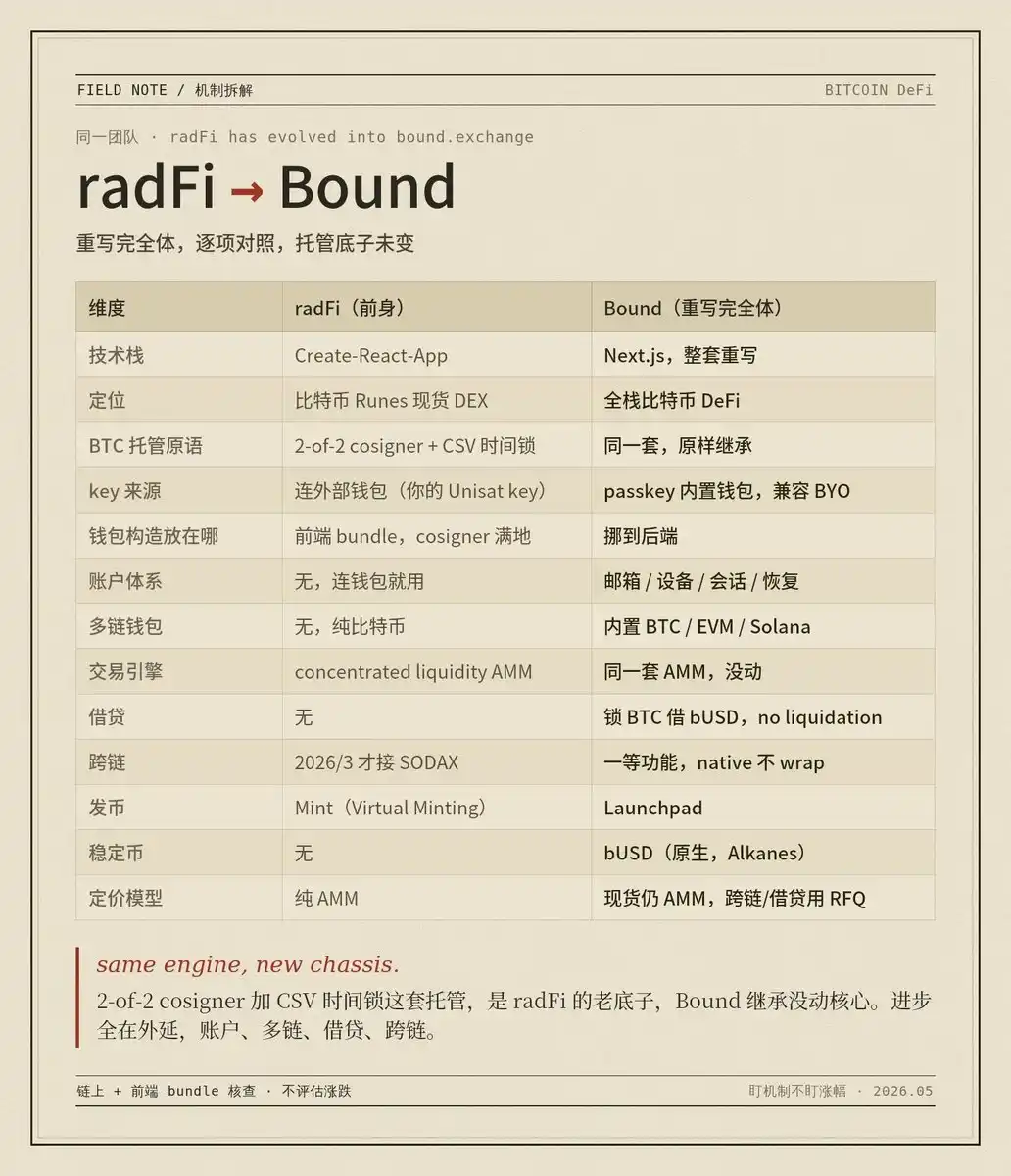
2. Core Mechanism: Asset Deposit/Withdrawal and 2-of-2 Multi-Signature Custody

Understanding its positioning, let's examine its asset management logic. There are two main points: 2-of-2 multi-signature custody, and timelock countdown protection in the event of platform abandonment or downtime.

First, set up the scenario. You have BTC and want to trade on a platform. The traditional method is to send coins to the platform's wallet, where they are held for you. The problem is the coins are no longer in your possession; if the platform runs away or is hacked, your coins are gone—FTX and Celsius failed this way. Bound aims to solve this contradiction: achieving CEX-like transaction speed without relinquishing control of your coins.

Step 1: What is a deposit?

After registering, Bound provides you with a Bitcoin address, starting with "bc1p." To trade, you first transfer BTC from your wallet to this address. This is a standard Bitcoin transfer, taking about half an hour with 3 confirmations. Up to this point, it's no different from using a regular wallet. The real design lies in the next question.

Step 2: Who holds the private key for this address?

This is the core of the entire system. There are only two naive approaches: if the private key is solely with the platform, it's custodial, reverting to the FTX problem; if it's solely with you, the platform cannot facilitate fast trades, requiring manual signing for every transaction—slow.

Bound's solution is that this address doesn't have just one key; it has two. To move coins from it, both keys must sign. This is 2-of-2 multi-signature.

Step 3: Whose keys are these?

One is yours, stored on your device, invoked via passkey, with the private key never leaving the device. The other is in Bound's backend. During daily trading, you sign with your passkey, Bound's backend automatically adds the other signature, and with both combined, settlement is near-instantaneous.

Pause here to consider this. Bound holds only one key; it cannot move your coins unilaterally, so it's not custodial and cannot lend out or misappropriate your coins. But together, you can achieve instant settlement, recovering the speed. This is the intended effect of 2-of-2—achieving both security and speed.

Step 4: What problem does the timelock solve?

2-of-2 introduces a new issue. Since two keys are required, what if Bound runs away, goes down, or is shut down? The backend key might be lost forever, leaving you with only one key. Would your coins be locked in the address forever?

Timelock plugs this hole. The rule is simple: Bound's co-signing key has a 3-month validity period. Within 3 months, moving coins requires both keys. After 3 months, you can withdraw all coins with just your single key, no longer needing Bound.

Crucially, this isn't just a promise from Bound; it's encoded into the Bitcoin script and enforced by the Bitcoin network. Bound's consent is irrelevant; when the time comes, you can single-sign and leave. This is the foundation of its claim to be self-custodial.

Step 5: Withdrawals now make sense.

For normal withdrawals, your passkey signs plus Bound's backend co-signs—both keys ready, instant arrival. For emergency withdrawals, if Bound disappears, you wait out the 3-month timelock, then use your single key to sweep the coins to any address.

Linking these five steps together, the initial four terms form a chain: you deposit coins into a 2-of-2 address (deposit); daily, you and Bound spend together (fast-path withdrawal); Bound's key expires in 3 months (timelock); after expiry, you can leave with just one key (escape-hatch withdrawal).

3. Underlying Logic: Bound Exchange's Transaction Sequencing

Having understood how assets are deposited, let's discuss Bound Exchange's transaction sequencing.

There are no smart contracts on Bitcoin. So, for a native Bitcoin DEX's AMM, where is matching done, and who decides the order of your trades? Essentially, it's a CEX-like matching backend, with the Bitcoin blockchain serving as the settlement layer. Let's break it down:

  • First, the AMM curve is not on-chain. BTC L1 lacks contracts; states like reserves, ticks, and liquidity ranges have nowhere to be stored and must reside in Bound's backend database. The UTXOs on-chain only represent the settlement outcome of LPs' funds under custody.

  • Second, on-chain transactions are merely settlement receipts. I pulled the trade history of that pool; each inflow/outflow is a fixed, predetermined amount, containing no curve calculation itself. The multiplication along the curve is completed off-chain in the backend before anything goes on-chain. The dozens of trades in a block, each spending separate UTXOs, unconnected to each other, precisely because the price was fixed off-chain; going on-chain is just about recording a set of pre-calculated numbers.

  • Third, how is a single trade priced? When you want to buy/sell on the frontend, the frontend requests a quote from the backend. The backend calculates using its maintained concentrated liquidity curve, your order consumes liquidity along the tick, fees are deducted, and it gives you a number. You sign a PSBT locking in this number, the backend verifies and co-signs/broadcasts it, simultaneously advancing its off-chain curve by one step. The curve lives only in the backend.

  • Fourth, sequencing is mathematically forced by this curve and unavoidable. The curve has state; at any moment, there's only one current position. Each incoming order consumes a segment of liquidity, pushing the curve to a new position; the next order can only execute at the new position. This means all orders inherently cannot settle simultaneously; they must be arranged in a strict sequential order. The first trade executes at the original position, pushing the curve one step; the second executes at the new position, pushing it again, and so on.

  • Fifth, but who decides this order and based on what is another matter. Distinguish between two sequences: one is the real-time timestamp when you click confirm, the other is the processing order the backend actually uses to advance the curve. Nothing on-chain or in the protocol guarantees these two match. Your order enters Bound's backend queue. Whether it declares the order, processes by arrival time, or bumps someone ahead/behind, is entirely its internal affair—you cannot see it.

  • Sixth, this is the entry point for operator MEV, even sharper than typical on-chain MEV. In general DEXes, the transaction order is at least visible in the block; front-running, sandwiching can be analyzed afterward. Bound's sequencing occurs off-chain; after results are settled in a block, even sequential traces are absent—dozens of unrelated transactions show no order on-chain. However, at the moment you click confirm, the price is already calculated based on a point on the curve. You just don't know its position within the block's sequence.

Therefore, Bound does have order; order is mathematically mandatory. It simply centralizes the power to define this order entirely within a black box. At the principal level, it is indeed self-custodial—2-of-2 plus timelock, the platform cannot move your coins. But the price and sequence at which your trade executes are accounted for off-chain by it alone. Ultimately, this is a CEX-like matching backend, interfacing with the world's largest blockchain for settlement, finalizing roughly every ten minutes with an immutable block.

4. Practical Tips and Experience Feedback

Finally, two practical details to avoid pitfalls. This 2-of-2 address only accepts BTC and Runes. Sending BRC-20, Alkanes, or coins from other chains will result in permanent loss. Alternatively, you can bypass Bound's system and directly connect your own Unisat or Xverse wallet. That means no 2-of-2 or timelock; coins remain in your single-signature wallet, but the trade-off is requiring manual signing for every transaction.

Based on current experience, there are still minor issues. I tested; a previous transaction already had two block confirmations, but the Bound frontend still showed "pending," preventing me from placing the next order. Hopefully, @Bound_Exchange official can look into this problem.


Preguntas relacionadas

QWhat is the core security mechanism of Bound exchange for user assets, and how does it work?

ABound's core security mechanism for user assets is a combination of a 2-of-2 multisignature scheme and a timelock. Users deposit assets into a bitcoin address (starting with bc1p). This address requires two private keys to sign any transaction moving funds: one is held by the user (secured by passkey on their device), and the other is held by Bound's backend. For everyday transactions, both keys sign, enabling fast execution. Crucially, Bound's key has a 3-month timelock. After this period, the user's key alone is sufficient to withdraw all funds, providing a self-custody escape hatch even if Bound becomes non-operational.

QHow does Bound's trading and price determination work, given that Bitcoin lacks smart contracts?

ABound operates as a centralized exchange (CEX) backend with Bitcoin as a settlement layer. The AMM's concentrated liquidity curve, tick states, and LP reserves are not stored on-chain but are maintained in Bound's private database. When a user initiates a trade, the frontend requests a quote from this backend. The backend calculates the execution price based on its internal liquidity curve, deducts fees, and provides a fixed amount. The user signs a Partially Signed Bitcoin Transaction (PSBT) with this amount, which Bound co-signs and broadcasts. The on-chain transaction is merely a settlement receipt of the pre-calculated result.

QWhat is a key difference between using Bound's built-in passkey wallet versus connecting an external wallet like Unisat or Xverse?

AThe key difference lies in security, convenience, and custody. Using Bound's built-in passkey wallet enables the 2-of-2 multisig and timelock mechanism, providing a balance of fast transaction execution and a self-custody safety net. If you connect an external wallet (like Unisat or Xverse), your assets remain in your single-signature (single-sig) wallet at all times. This means you have full and immediate control (no timelock), but the trade-off is that you must manually sign every single transaction yourself, which is slower.

QAccording to the article, what is the main source of potential Miner Extractable Value (MEV) in Bound's system?

AThe primary source of potential MEV (or more precisely, operator extractable value) in Bound's system is the opaque, off-chain transaction sequencing. While the mathematical AMM curve necessitates a strict sequential order for processing trades, this ordering is entirely managed within Bound's private backend. Unlike on-chain DEXs where transaction order is publicly visible in a block, Bound's internal queue is a black box. The operator could potentially reorder trades, front-run, or sandwich user transactions for profit without leaving a discernible trace on the blockchain, as the final on-chain settlements appear as unrelated, fixed-amount transactions.

QWhat is the evolution of Bound exchange, and what key features were added in the upgrade from Radfi?

ABound exchange is a complete rewrite and evolution of the previous platform Radfi. The core technology stack was switched from Create-React-App to Next.js. Key features added in the Bound upgrade include: 1) A built-in, passkey-secured multi-chain wallet. 2) A time-locked loan product allowing Bitcoin抵押 to borrow bUSD. 3) SODAX for cross-chain functionality. The original Radfi concentrated liquidity AMM engine for Runes swapping remained unchanged. The system also implements two separate 2-of-2 + timelock setups: one at the account layer to protect users and another for the lending product to protect lenders.

Lecturas Relacionadas

Three Years Later: Looking Back at My Predictions About ChatGPT in 2023

Three Years Later: Revisiting My 2023 Predictions on ChatGPT In March 2023, shortly after ChatGPT's launch, I made 20 predictions about its future. Now, in mid-2026, I've used AI agents to fact-check each one against the latest data. Overall, most major directional forecasts were correct, with only one outright error (incorrectly stating GPT-4 had 100 trillion parameters). Key successes included predicting that RAG and retrieval architectures would become the standard for handling knowledge and hallucinations, that natural language interfaces (LUI) would create a massive new industry layer beyond the models themselves, and that China would develop viable large language models, significantly closing the performance gap with Western counterparts within about three years. Predictions about the absence of mass unemployment, the rise of a new "robot network" for agent communication, and ChatGPT not possessing consciousness also held true in their core arguments. However, the "devil was in the details." Errors frequently involved specific numbers, timelines, or overlooking distributional effects. I tended to overestimate the speed of adoption (e.g., for agent networks) while underestimating the ultimate scale of capabilities or costs (e.g., AI winning IMO gold without tools, or the extreme capital required for frontier models). Other misjudgments included: underestimating how AI would reinforce, not dissolve, information filter bubbles; incorrectly assuming AI-generated content would easily circumvent copyright (it has instead triggered record-breaking settlements); and misidentifying where value would be captured (it accrued overwhelmingly to the compute layer, like Nvidia, not just the application or model layers). Key lessons from reviewing these predictions are: 1) Directional and mechanistic insights are far more reliable than precise numbers or absolute statements. 2) There's a consistent bias to overestimate short-term speed but underestimate long-term magnitude. 3) Errors often lie in missing distributional impacts within a generally correct aggregate trend. 4) Predictions phrased with nuance and caveats aged the best. 5) Some fundamental debates (e.g., on machine consciousness or the ultimate value chain) remain unresolved even after three years. This exercise is less about scoring the past and more about establishing rules for clearer thinking about the next three years of AI.

marsbitHace 4 hora(s)

Three Years Later: Looking Back at My Predictions About ChatGPT in 2023

marsbitHace 4 hora(s)

Three Years Later: Looking Back on My 2023 Predictions for ChatGPT

Looking Back After Three Years: Revisiting My 2023 Predictions on ChatGPT In March 2023, shortly after ChatGPT's debut and before GPT-4's release, I made over twenty predictions about AI's future based on limited information and intuition. Now, in May 2026, I revisited those forecasts using an AI-driven analysis with 41 Opus 4.8 agents to cross-reference them with the latest data. The assessment used symbols: ✅ Correct, 🟢 Mostly Correct, 🟡 Partially Correct, ❌ Incorrect. Overall, the directional judgments held up well, with only one major factual error regarding GPT-4's rumored parameter size (incorrectly cited as 100T). However, nuances and degrees of accuracy revealed more. **What Was Largely Correct:** Predictions about mechanisms and directions proved accurate. The rise of RAG (Retrieval-Augmented Generation) as the standard architecture for combating AI hallucination was confirmed, as was the transformative potential of LUI (Language User Interface) in creating a new industry layer atop GUIs. The emergence of "robot networks" (agent-to-agent communication protocols) and China's rapid catch-up in developing capable large models (closing the performance gap with top models to ~2.7%) were also on point. The analysis affirmed that LLMs lack consciousness and that the Turing Test merely measures perceived intelligence. **What Was Off Target:** Errors often involved specific numbers, over-optimistic timelines, or misjudged distributions. The prediction that value would primarily accrue to the application layer was half-right but missed NVIDIA's dominance as the profitable infrastructure layer. Forecasts about AI circumventing copyright issues and fostering a "global common ground" by averaging human viewpoints were incorrect; instead, major copyright settlements occurred and AI personalization is increasing. Estimates for model training costs ("$5-10 billion cap") were significantly off, underestimating frontier costs and overestimating replication costs. The notion that LLMs could never do complex math without tools was disproven by later models winning IMO gold. **Key Patterns from the Review:** 1. **Direction over precision:** Judgments about mechanisms and trends were more reliable than specific numbers or definitive statements. 2. **Timing bias:** There was a tendency to overestimate short-term speed but underestimate long-term magnitude and transformation. 3. **The distribution blind spot:** Aggregate-level correctness often masked uneven impacts (e.g., on young professionals' employment). 4. **The value of qualifiers:** Predictions framed with caution (e.g., "reportedly," "for now," "prototype in 2-3 years") aged better. 5. **Some debates continue:** Issues like the nature of "emergent abilities" or machine consciousness remain unresolved. This three-year review highlights that while seeing the big picture is crucial, humility regarding specifics, timelines, and disparate impacts is essential for future forecasting.

链捕手Hace 6 hora(s)

Three Years Later: Looking Back on My 2023 Predictions for ChatGPT

链捕手Hace 6 hora(s)

AI Bubble Warning: AI Investments Are Negative Returns for Most Tech Giants

The article issues a stark warning about a potential AI investment bubble. It notes that while the AI boom shares similarities with the TMT bubble of the late 1990s, its scale is vastly larger, currently driving 93% of U.S. GDP growth. Major hyperscale cloud providers like Microsoft, Alphabet, Amazon, Meta, and Oracle are planning to invest trillions in AI data centers over the coming years. However, calculations based on analyst projections for 2025-2030 reveal a concerning math problem: expected capital expenditure growth far outpaces projected revenue growth. Even under an extremely optimistic scenario of zero costs, the implied return on investment for most of these tech giants (except Amazon) is deeply negative. This suggests that the current trajectory could lead to one of history's largest shareholder value destruction events. The piece outlines two potential escapes: AI generating vastly more revenue than currently anticipated—a near-impossible task—or a significant cutback in the planned investment splurge. The latter scenario could trigger a domino effect, severely impacting the entire tech supply chain (from Nvidia to TSMC), potentially pushing the U.S. economy into recession, and causing a major stock market downturn. The author suggests upcoming high-profile IPOs by companies like OpenAI and Anthropic might represent a transfer of risk from early investors to public market participants. While the peak of the hype cycle might sustain investment through 2026, the fundamental financial dilemma remains unresolved, setting the stage for a potential market correction in 2027 or 2028, similar to the years following Alan Greenspan's "irrational exuberance" warning.

marsbitHace 7 hora(s)

AI Bubble Warning: AI Investments Are Negative Returns for Most Tech Giants

marsbitHace 7 hora(s)

From Tokens to Machine Labor: AI is Shifting from Tool to "Worker"

The article "From Token to Machine Labor: AI is Evolving from Tool to 'Worker'" argues that the business model for AI is shifting beyond simply selling computational resources (tokens, GPU hours) or model access. Instead, a new "machine labor market" is emerging, where the core economic transaction is the purchase of economically useful work directly performed by software. The central thesis is that AI pricing will evolve through four stages: 1) raw tokens, 2) standardized LLM capabilities (e.g., text generation), 3) industry-specific labor markets (e.g., legal review, radiology), and finally 4) a programmable results market where tasks like resolving a support ticket are bid on and priced based on outcome. In this future, buyers will care less about *which* model or GPU completes a task and more about whether the work meets specified standards for accuracy, latency, and cost. This transition reframes the impact of AI on human labor. Rather than simple replacement, it suggests a re-coordination where machines handle standardized, verifiable work, freeing humans for roles involving oversight, context management, responsibility, and final judgment. In some cases, this "last 1%" of human input becomes more valuable as it enables the other 99% to be automated. Furthermore, as AI reduces the cost of work, demand may expand, creating larger markets (e.g., 24/7 customer service) rather than just cheaper versions of existing ones. The article concludes that while infrastructure (GPUs, models, tokens) remains crucial upstream, the market is converging on a simpler, tradeable unit: machine labor that can be defined, measured, priced, and procured based on contractible specifications.

marsbitHace 7 hora(s)

From Tokens to Machine Labor: AI is Shifting from Tool to "Worker"

marsbitHace 7 hora(s)

Xiaomi MiMo's 99% Price Cut is Not Marketing! Luo Fuli Posts on X to Refute Critics

The price of Xiaomi's MiMo-V2.5 series API has been permanently reduced by up to 99%, specifically for the "Input (Cache Hit)" cost, which covers users re-reading historical context in long conversations. MiMo's head, Luo Fuli, published a detailed technical blog to clarify that this drastic price cut stems from genuine engineering breakthroughs, not a marketing stunt or a simple price war. The core of the achievement lies in six key engineering optimizations. First, the model architecture adopts a Hybrid Sliding Window Attention (SWA), reducing the memory footprint (KVCache) to 1/7th of a traditional model. Second, a dual-pool memory management system actually utilizes these savings, allowing a single GPU to handle over 5 times more concurrent users. Third, an upgraded prefix caching mechanism achieves a cache hit rate of 93-95% for repeated reads, meaning most such requests bypass GPU computation entirely. Fourth, a self-developed distributed cache (GCache) utilizes idle SSD space on existing GPU servers, eliminating additional storage costs. Fifth, an intelligent scheduling system (LLM-Router) efficiently routes requests to maximize cache reuse and performance. Sixth, Multi-Token Prediction (MTP) accelerates the model's text generation ("output") side. Together, these systemic optimizations dramatically lower the real computational cost per request, enabling the 99% price reduction for cached inputs while reportedly maintaining positive gross margins. Luo Fuli's disclosure aims to shift the narrative from "price war" to a demonstration of substantive AI engineering progress.

marsbitHace 9 hora(s)

Xiaomi MiMo's 99% Price Cut is Not Marketing! Luo Fuli Posts on X to Refute Critics

marsbitHace 9 hora(s)

Trading

Spot
Futuros

Artículos destacados

Cómo comprar ONE

¡Bienvenido a HTX.com! Hemos hecho que comprar Harmony (ONE) sea simple y conveniente. Sigue nuestra guía paso a paso para iniciar tu viaje de criptos.Paso 1: crea tu cuenta HTXUtiliza tu correo electrónico o número de teléfono para registrarte y obtener una cuenta gratuita en HTX. Experimenta un proceso de registro sin complicaciones y desbloquea todas las funciones.Obtener mi cuentaPaso 2: ve a Comprar cripto y elige tu método de pagoTarjeta de crédito/débito: usa tu Visa o Mastercard para comprar Harmony (ONE) al instante.Saldo: utiliza fondos del saldo de tu cuenta HTX para tradear sin problemas.Terceros: hemos agregado métodos de pago populares como Google Pay y Apple Pay para mejorar la comodidad.P2P: tradear directamente con otros usuarios en HTX.Over-the-Counter (OTC): ofrecemos servicios personalizados y tipos de cambio competitivos para los traders.Paso 3: guarda tu Harmony (ONE)Después de comprar tu Harmony (ONE), guárdalo en tu cuenta HTX. Alternativamente, puedes enviarlo a otro lugar mediante transferencia blockchain o utilizarlo para tradear otras criptomonedas.Paso 4: tradear Harmony (ONE)Tradear fácilmente con Harmony (ONE) en HTX's mercado spot. Simplemente accede a tu cuenta, selecciona tu par de trading, ejecuta tus trades y monitorea en tiempo real. Ofrecemos una experiencia fácil de usar tanto para principiantes como para traders experimentados.

250 Vistas totalesPublicado en 2024.12.12Actualizado en 2025.03.21

Cómo comprar ONE

Discusiones

Bienvenido a la comunidad de HTX. Aquí puedes mantenerte informado sobre los últimos desarrollos de la plataforma y acceder a análisis profesionales del mercado. A continuación se presentan las opiniones de los usuarios sobre el precio de ONE (ONE).

活动图片












