UAE Halts Trade with Iran Amidst Straits of Hormuz Crisis, Shaking Global Markets

cryptonews.ruPublicado a 2026-08-19Actualizado a 2026-08-19

Resumen

U.S. stock market weakness persisted into Tuesday, hitting the tech sector hard. The Nasdaq fell over 1.2%, led by a ~5% drop in the semiconductor index as investors reassessed lofty AI valuations amid rising long-term Treasury yields. The 30-year yield briefly hit levels not seen since 2007, pressuring assets with distant cash flows. Oil prices remained high, with Brent crude above $90. Disruptions in the Strait of Hormuz, a vital oil chokepoint, continued to strain global energy supplies. The expired U.S.-Iran temporary understanding failed to bring a long-term shipping solution, keeping a geopolitical risk premium in the market. Diesel crack spreads hit record highs, signaling severe physical market tightness. Further escalating regional tensions, the UAE announced a suspension of all trade and financial transactions with Iran, citing threats to peace and security. This move could restrict Iran's access to hard currency and imports. Traditional safe havens like gold struggled as higher bond yields increased their opportunity cost. Bitcoin traded around $64-65K, failing to stage a sustained geopolitical rally and remaining well below its 2025 highs. Markets now face a complex mix of high oil prices, rising yields, and heightened Middle East tensions, moving beyond the "cheap money" narrative to confront the costs of concurrent financial and geopolitical stress.

The weakness in U.S. indexes seen on Monday continued into the next day: Tuesday's main blow hit the technology sector amid a reassessment of the urgency of assets. The S&P 500 index lost about 0.6-0.7%, ending the day around 7,690-7,700 points, while the Nasdaq Composite fell by more than 1.2%. The Dow Jones Industrial Average remained relatively stable, declining approximately 0.15-0.22% to a level in the middle of the 53,300-point range.

Semiconductor Stock Sell-Off Hits Tech Shares

The closely watched PHLX Semiconductor index slumped about 5%, with shares of several well-known memory and chipmakers falling 7-9%. This is what happens when the market stops viewing investments in artificial intelligence (AI) as a one-way trade and starts asking what those future cash flows are worth at a much higher rate.

Long-term bond yields aren't just making financial statements look worse. They force investors to reconsider the premium being paid for companies whose payback is years down the road. Market saturation with AI-related deals is turning this reassessment into a forced sell-off.

The correction followed a powerful rally in 2026. The S&P 500 is still up more than 13% for the year, but it has fallen about 0.7-1% below its mid-August record high, close to the 7,799 mark. The energy sector held up thanks to high oil prices. The technology, communication services, and consumer staples sectors did not receive such support this week.

Long-Term Treasury Yields Call Valuations into Question

Warning signals continued to flash in the bond market on Tuesday, with seasoned traders watching them intensify for weeks. The yield on the 10-year Treasury note fluctuated in a range from 4.70% to 4.74%, approaching multi-month highs. The yield on the 30-year bond briefly reached around 5.32-5.33%—its highest level since 2007—before retreating to 5.28-5.30% by the close.
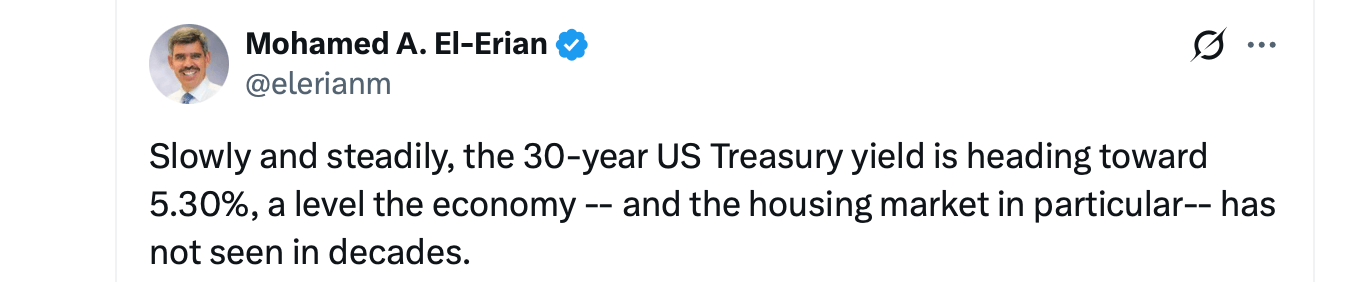
And this isn't just a technical detail. Treasury yields are the price investors demand for lending to Washington, and the long end of the curve drives mortgage rates, corporate financing, and asset valuations. When that price rises, borrowers ultimately feel it, and stocks and other assets are forced to compete with a bond market offering higher yields.

Traders are weighing the same complex mix of factors: high energy costs, significant federal deficits, and a constantly growing debt burden. A significant July budget deficit adds pressure on longer-dated bonds. Short-term bond yields, which are more closely tied to Federal Reserve expectations, remained in a range from the low to mid-4% mark and fluctuated much less.

Straits of Hormuz Disruptions Keep Oil Market on Edge

Oil remains in the spotlight this week as shipping through the Straits of Hormuz remains far from normal. West Texas Intermediate (WTI) crude traded in the $84-85 per barrel range, while Brent crude continued to hold above $90. About 20% of the world's traded oil typically passes through this narrow waterway, so any shipping disruption quickly becomes a global inflationary headache.

A 60-day U.S.-Iran memorandum of understanding aimed at restoring freer navigation expired without a long-term agreement. Shipping remained sharply curtailed at times, with new incidents sustaining a geopolitical premium in oil prices. The market is pricing not a theoretical narrowing of passage but the barrels that might not arrive when buyers need them. Furthermore, the U.S. diesel crack spread reached a record high, exceeding $102 per barrel.

"Diesel is more visible than WTI or Brent in showing the physical tightness in the global energy system," wrote the Endgame Macro account on X this week. "Benchmark crude prices are restrained by weak global demand, hopes for eventual normalization, alternative export routes from Gulf states, and ongoing strategic petroleum reserve releases."

The account added:

"Diesel has fewer 'pressure relief valves.' It must be refined from suitable crude at operating refineries, shipped along disrupted sea lanes, and delivered to trucking, agricultural, manufacturing, and heating markets. That 'pinch point' is showing up sharply right now."

This pressure extends far beyond fuel pumps. Rising oil costs push up transportation and raw material expenses, which then feed into the prices households and businesses pay. It also leaves the Federal Reserve less room to ease policy, even if other parts of the economy are slowing. This is why energy stocks found buyers while much of the market was neglected.

UAE Severs Key Trade Link with Iran

The UAE then ratcheted up tensions, announcing it had suspended all trade, commercial exchanges, and financial transactions with Iran until further notice. Afra Al-Hameli of the UAE Ministry of Foreign Affairs linked the move to escalating regional tensions threatening peace and security.

This is more than just diplomatic news. Closing this channel could make it harder for Iran to obtain hard currency, imports, and access to overseas trade networks at a time when sanctions and conflict continue to bite.

The UAE clarified that it remains committed to dialogue, regional cooperation, and the integrity of the international financial system. However, the suspension much more sharply delineates the boundaries of commercial risk and shows Gulf states are recalculating the costs of doing business amid prolonged confrontation.

Gold and Cryptocurrencies Fail 'Stress Test'

Gold and silver did not live up to the hopes of many investors who looked to them as a 'safe haven' during market panic. Spot gold fluctuated around the mid-$4,300 per ounce mark, while silver traded near $63-64. Rising Treasury yields increased the opportunity cost of holding precious metals, and that pressure from rates outweighed some protective demand.

Bitcoin traded in the $64,200 to $65,000 range, with Ethereum around $1,900. Cryptocurrencies showed mixed or modestly positive momentum by some measures but remained largely range-bound. Bitcoin failed to stage a sustained rally as a 'geopolitical haven' and remains significantly below its October 2025 record high, just above $126,000. Nevertheless, Bitcoin and cryptocurrencies have sharply diverged from the trend in stocks—an unusual decoupling that has prevented normal market correlations from holding.

Markets Brace for the Next Test

The next move largely depends on whether negotiations over the Straits of Hormuz can reach a sustainable agreement. The UAE-Iran rift adds another variable: increased pressure on Tehran and a faster splintering of trade and finance along geopolitical lines. The 'cheap money' narrative has given way to a more complex question: who bears the cost when rates, oil prices, and regional risks all rise at once?

end-content

Preguntas relacionadas

QWhat was the overall performance of the US stock market, particularly the technology sector, on Tuesday?

AThe US stock market continued its weakness from Monday. The S&P 500 lost about 0.6–0.7%, closing around 7,690–7,700 points. The technology-focused Nasdaq Composite fell more than 1.2%, driven by a sell-off in semiconductor stocks. The Dow Jones Industrial Average was relatively stable, declining roughly 0.15–0.22%.

QHow did rising long-term Treasury yields impact the market and asset valuations?

ARising long-term Treasury yields (with the 10-year yield near 4.70–4.74% and the 30-year yield briefly touching ~5.32–5.33%) forced investors to reconsider the premium paid for companies with future-dated payoffs, especially in sectors like AI. Higher yields increase borrowing costs, pressure asset valuations, and make stocks compete with bonds offering higher returns.

QWhat is the current situation in the Strait of Hormuz and how is it affecting oil markets?

AShipping through the Strait of Hormuz remains far from normal, causing ongoing disruption. About 20% of globally traded oil passes through this chokepoint. Brent crude held above $90/barrel and WTI traded around $84–$85. The expired US-Iran memorandum and new incidents maintain a geopolitical risk premium, with US diesel crack spreads hitting record highs, indicating severe physical tightness.

QWhat significant action did the UAE take regarding Iran, and what are its potential implications?

AThe UAE announced a suspension of all trade, commercial exchanges, and financial transactions with Iran until further notice. This move, linked to regional tensions, could hinder Iran's access to hard currency, imports, and foreign trade networks amid existing sanctions, signaling Gulf states are reassessing the costs of business amidst prolonged confrontation.

QWhy did traditional safe-haven assets like gold and cryptocurrencies fail to rally significantly during the market stress?

AGold and silver did not rally strongly as safe havens because rising Treasury yields increased the opportunity cost of holding non-yielding assets. Bitcoin traded between $64,200 and $65,000, failing to stage a sustained 'geopolitical hedge' rally and remaining well below its 2025 highs. These assets were pressured by rate dynamics, which outweighed some safety demand.

Lecturas Relacionadas

Analysis of 13F Holdings of Seven Major Funds: What Are Buffett, Duan Yongping, Li Lu, and Dan Bin Thinking?

A summary of Q2 2026 13F filings from seven major funds (Berkshire Hathaway, Duquesne Family Office, H&H International Investment, Himalaya Capital, ARK Investment, Oriental Harbor Investment Master Fund, Situational Awareness LP) reveals AI remains the central investment theme, with significant capital reallocation within the sector. Berkshire Hathaway, under Greg Abel, made its largest net stock purchases in years, heavily increasing its stake in Alphabet, signaling a strategic tilt towards tech while maintaining core holdings in consumer and financial stocks. Duquesne Family Office (Stanley Druckenmiller) rotated within semiconductors, selling Micron, Broadcom, and Intel but adding to positions in TSMC, STMicroelectronics, and AMD, while also reinvesting in cloud giants Alphabet and Amazon and cautiously re-entering Chinese tech via Baidu. H&H International Investment (Duan Yongping) and Himalaya Capital (Li Lu) both significantly increased their stakes in PDD, with Li Lu also concentrating his portfolio by selling out of several financial and energy holdings to focus on core positions like Alphabet and Berkshire. H&H also took profits from high-flying AI/tech names like Nvidia and Google, viewing the moves as valuation adjustments rather than a loss of conviction. ARK Investment (Cathie Wood) aggressively bought SpaceX upon its IPO and continued hunting for disruptive innovation across AI, energy, and biotech, while reducing its Tesla holding. Oriental Harbor Investment Master Fund (Dan Bin) executed a dramatic shift towards AI hardware, launching major new positions in Intel, SanDisk, AMD, and others while selling down software/platform holdings like Google and clearing out consumer names Apple and Tesla. Situational Awareness LP's filing, reflecting pre-liquidation positions, showed a story of missed hedging opportunities leading to significant losses. The consensus is that AI growth is continuing, but capital is actively rotating to identify the next profit centers within the value chain—from semiconductors and infrastructure to eventual commercialization. The filings, while lagging, offer a snapshot of how sophisticated investors are positioning for AI's next phase.

Odaily星球日报Hace 12 min(s)

Analysis of 13F Holdings of Seven Major Funds: What Are Buffett, Duan Yongping, Li Lu, and Dan Bin Thinking?

Odaily星球日报Hace 12 min(s)

Arthur Hayes Makes a High-Profile Comeback, Flop Labs Aims to Become the "Fuel" for the Agent Economy

Arthur Hayes, co-founder of BitMEX, has announced his return as head of a new project called Flop Labs, declaring "FLOP is food for your AI agent." This marks his first high-profile return to a leadership role since stepping back from BitMEX. Flop Labs aims to be a native monetary network and verifiable computation settlement layer for the AI Agent economy, distinguishing itself from existing AI Agent projects. Its core concept is "Proof-of-Useful-Inference," which seeks to integrate useful AI inference tasks into the blockchain consensus mechanism, allowing FLOP tokens to serve as the native currency for Agents to purchase computing resources and store memory. The ecosystem involves four key roles: Miners (provide GPU compute), Validators (verify services), Agents (consume services), and KOLs/Partners (community growth). The project promises a 100% fair launch with no presale or VC involvement. A large airdrop is planned for Q4 2026, with the genesis block targeted for Q1 2027. While the announcement has generated community excitement, particularly around the airdrop, the project is in an early conceptual stage. It currently lacks a published whitepaper, detailed tokenomics, technical specifics on its consensus mechanism, or smart contract audits. Arthur Hayes has defended the venture, separating his belief in the potential of the Agentic Economy from concerns about an AI stock bubble. The success of Flop Labs will hinge on its ability to deliver substantive technical progress and ecosystem development in the coming months.

Odaily星球日报Hace 28 min(s)

Arthur Hayes Makes a High-Profile Comeback, Flop Labs Aims to Become the "Fuel" for the Agent Economy

Odaily星球日报Hace 28 min(s)

World Chain Launches EIP-7928 Block Access Lists on Mainnet

World Chain has launched EIP-7928 block access lists on its Mainnet, becoming the first production layer-2 network to implement this standard. This deployment aims to significantly increase blockchain throughput without substantially raising the hardware requirements for validators. By providing access list data incrementally every 200 milliseconds through its flashblock architecture, World Chain enables validators to verify transactions in parallel and begin validation while a block is still being built, eliminating the need for sequential re-execution. Implemented via a runtime flag rather than a hard fork, this approach is an extension of the EIP-7928 standard, which Ethereum may incorporate in a future update. Internal benchmarks on World Chain test networks showed validation latency remained stable as throughput scaled up to one gigabit per second on standard cloud infrastructure, suggesting the potential for increased throughput without a proportional increase in computational resources for validators. This mainnet launch represents the first production use of streaming EIP-7928 block access lists and contributes to Ethereum's broader scaling strategy by expanding verification capacity while remaining accessible to independent validators. Built on the OP Stack and secured by Ethereum, World Chain is designed for scalability within the Superchain ecosystem. It focuses on applications like stablecoin finance, international remittances, and trading, utilizing World ID's proof-of-human system. The network aims to make blockchain technology widely accessible, starting with discovery and use through compatible wallets like World App.

TheNewsCryptoHace 33 min(s)

World Chain Launches EIP-7928 Block Access Lists on Mainnet

TheNewsCryptoHace 33 min(s)

Trading

Spot
活动图片