Two Acquisitions in One Day: OpenAI Buys 'Narrative', Anthropic Buys 'Barriers'

marsbitPublicado a 2026-04-03Actualizado a 2026-04-03

Resumen

On April 2, OpenAI and Anthropic each announced an acquisition, reflecting their divergent strategies as both target an IPO by late 2026. OpenAI acquired tech talk show TBPN to shape public AI discourse and support its revenue base, which is 60% consumer-driven from ChatGPT subscriptions. In contrast, Anthropic purchased AI biotech startup Coefficient Bio for approximately $400 million in stock, continuing its focused strategy of deepening enterprise capabilities, particularly in high-switching-cost sectors like life sciences. Over the past three years, OpenAI completed 15 acquisitions across diverse fields including hardware, media, and healthcare, spending over $7.7 billion on disclosed deals, such as the $6.5 billion purchase of Jony Ive’s AI hardware firm. Anthropic made only three acquisitions, each precisely strengthening its product stack: Bun for coding infrastructure, Vercept for autonomous agents, and now Coefficient Bio for biotech R&D pipelines. Anthropic’s enterprise-focused revenue (80% of total) drives its strategy to lock in clients with vertical integration, as seen in its sequenced moves into life sciences and healthcare. Meanwhile, with a higher reliance on consumer subscriptions, OpenAI is investing in narrative influence—TBPN aims to boost ad revenue and steer public AI conversation. Both companies are on accelerated IPO paths: Anthropic eyeing a $60+ billion offering led by Goldman Sachs and JPMorgan, and OpenAI targeting a ~$1 trillion valuation. The...

On April 2, OpenAI and Anthropic each announced an acquisition. OpenAI acquired the tech live show TBPN, while Anthropic spent approximately $400 million in stock to acquire AI biotech startup Coefficient Bio. Both companies are sprinting toward an IPO by the end of 2026, but their shopping lists point to entirely different anxieties.

15 vs. 3. This is the number of acquisitions completed by OpenAI and Anthropic, respectively, over the past three years.
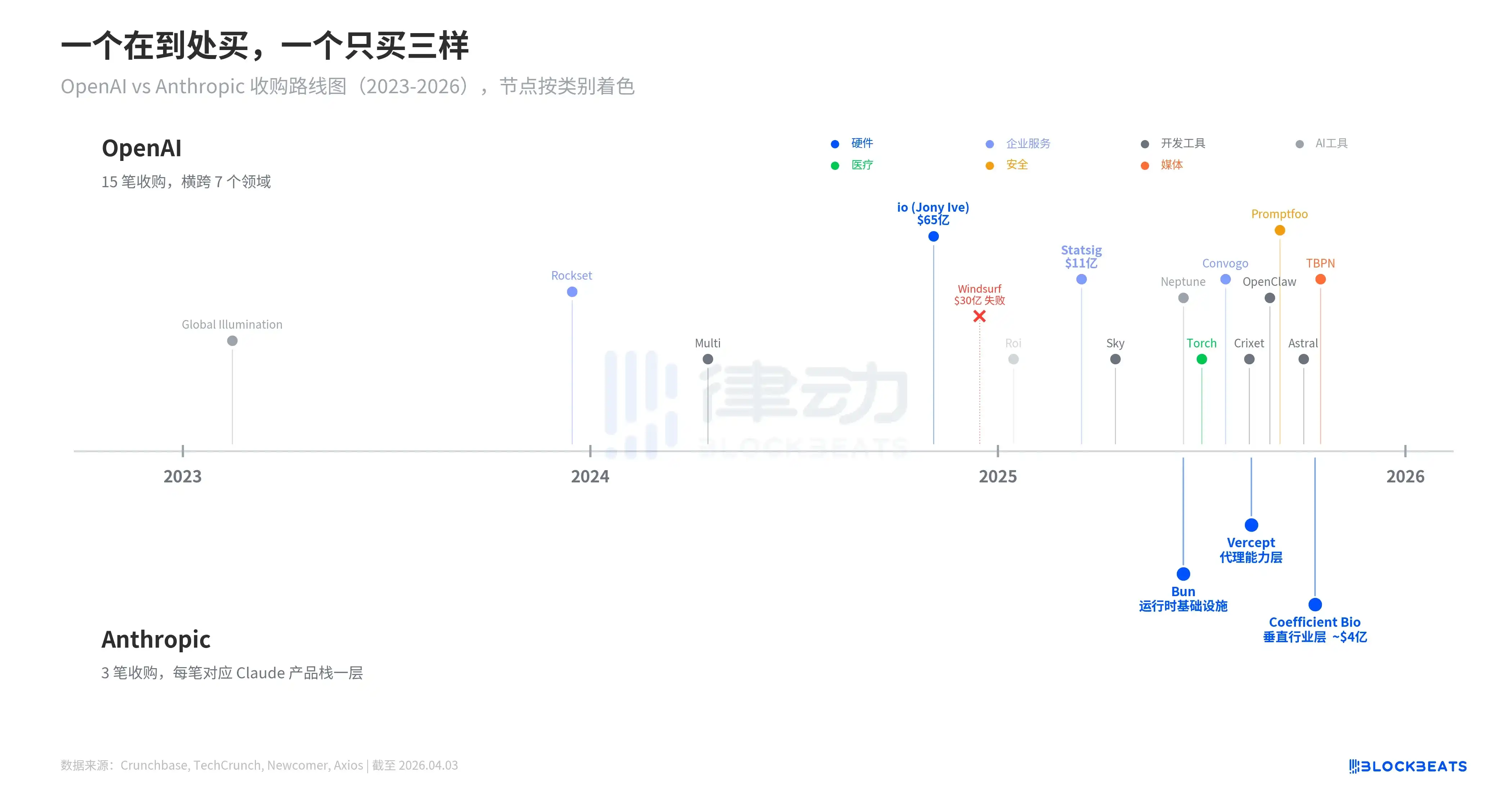
According to Crunchbase statistics, OpenAI has completed 15 acquisitions since 2023, spanning seven areas: hardware, enterprise services, developer tools, healthcare, security, media, and consumer. Six were completed in the first three months of 2026 alone. The total disclosed value of these transactions exceeds $7.7 billion, with the largest being the $6.5 billion acquisition of io, an AI hardware company founded by former Apple designer Jony Ive, in May 2025.

Anthropic has only made 3. In December 2025, it acquired the JavaScript runtime Bun to complete the underlying infrastructure for Claude Code. According to an official Anthropic announcement, the acquisition of Bun coincided with the disclosure that Claude Code had reached $1 billion in annualized revenue. In February 2026, it acquired the computer use agent startup Vercept to strengthen Claude's autonomous operation capabilities. On April 2, it acquired Coefficient Bio to enter the life sciences R&D pipeline. Each acquisition precisely corresponds to a technical layer in the Claude product stack.

It is worth noting that OpenAI also had one failed transaction. In May 2025, OpenAI reached a $3 billion acquisition intent with the code editor Windsurf (formerly Codeium). However, according to IT Pro, due to IP clauses in the Microsoft contract, OpenAI could not protect Windsurf's technology from being accessed by Microsoft, and the deal fell through in July. This failure also reflects a structural constraint of OpenAI's "broad procurement" model.

This difference in density is not accidental. It reflects the two companies' vastly different revenue structures and the resulting different anxieties.

Revenue Structure Determines Acquisition Direction

According to Sacra estimates, OpenAI's annualized revenue as of February 2026 was approximately $25 billion, with about 60% coming from the consumer end (ChatGPT subscriptions) and 40% from the enterprise end. 15.5 million paying users are the foundation of OpenAI's income. For a company about to IPO, a high proportion of consumer revenue means public sentiment directly impacts the valuation narrative.

This explains why OpenAI bought TBPN. According to Axios, TBPN is a daily live tech talk show with $5 million in advertising revenue in 2025 and a target of over $30 million for 2026. Post-acquisition, OpenAI will maintain its editorial independence while hiring former Postmates executive Dylan Abruscato to handle advertising monetization. The logic behind buying a tech podcast lies not in its revenue, but in its ability to continuously influence the public discussion framework around AI topics.
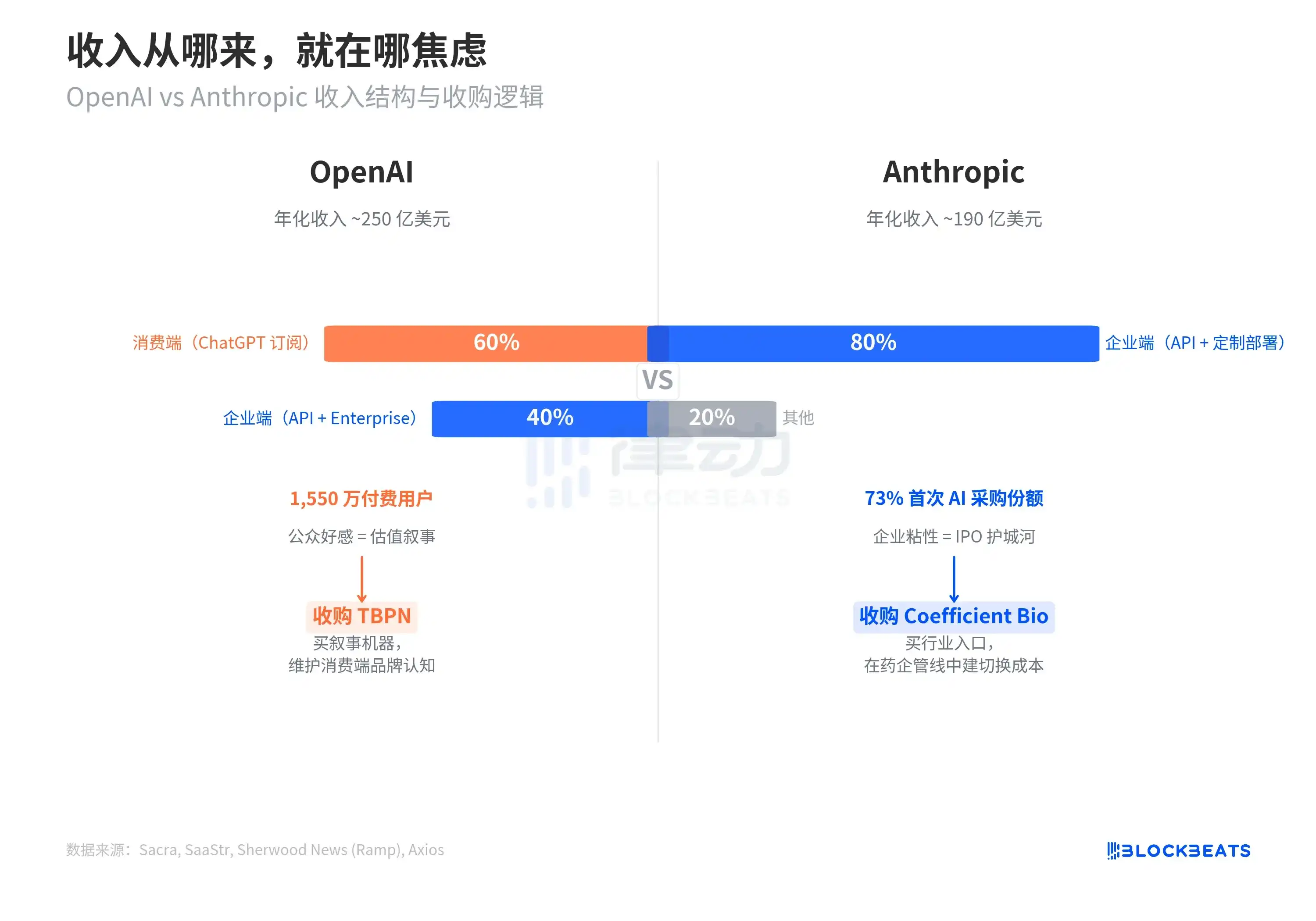
Anthropic's anxiety is entirely different. According to Ramp data cited by Sherwood News, Anthropic currently captures 73% of the market share for first-time AI procurement enterprise clients; ten weeks ago, this number was 50%. According to SaaStr, about 80% of Anthropic's revenue comes from the enterprise end. For enterprise customers, choosing an AI supplier is a decision with high switching costs. Anthropic's IPO narrative needs to prove that these enterprise customers will not leave.

Three Moves in Six Months

Coefficient Bio is not an impulsive acquisition. Viewed within the sequence of Anthropic's actions over the past six months, the logic is clear.

In October 2025, Anthropic launched Claude for Life Sciences, integrating with research databases like PubMed and UniProt, enabling Claude to assist with literature reviews and experimental design. In January 2026, at the JPM26 conference, it launched Claude for Healthcare, obtained HIPAA compliance certification, and formally entered the healthcare system. On April 2, it acquired Coefficient Bio, gaining full-cycle AI capabilities for drug R&D.
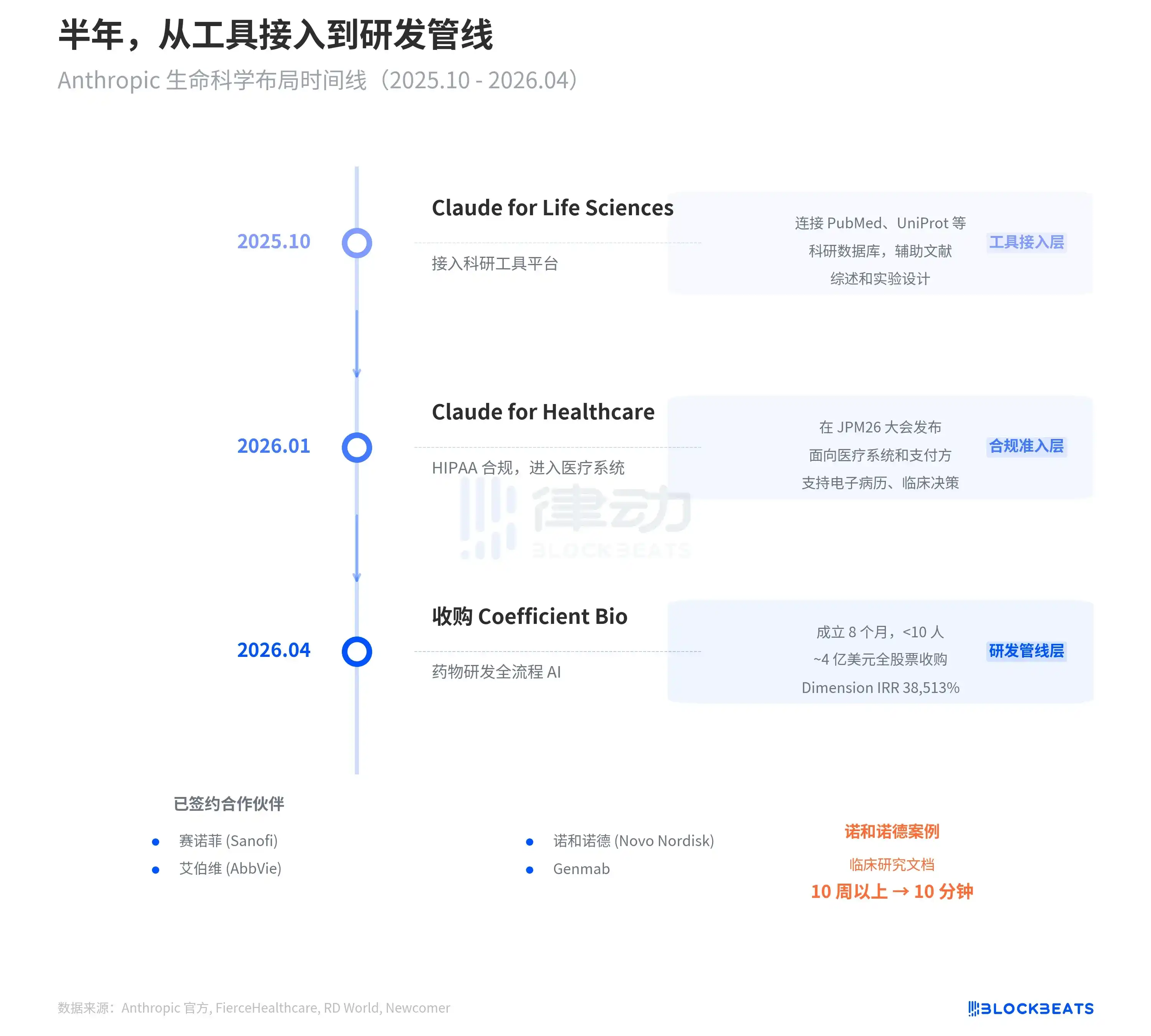
In six months, it progressed from the tool integration layer to the compliance access layer, and then to the R&D pipeline layer. According to Newcomer, Coefficient Bio was founded just 8 months ago, has fewer than 10 employees, and is about 50% owned by venture capital firm Dimension. Anthropic completed the acquisition for approximately $400 million in stock. Dimension stated in a letter to LPs that the IRR on this investment reached 38,513%.

This number itself shows that Anthropic is not buying a company's revenue or product, but rather a team plus an industry entry point. According to reports from Anthropic and RD World, pharmaceutical companies like Sanofi, Novo Nordisk, AbbVie, and Genmab are already using Claude's life science tools. The Novo Nordisk case is particularly typical, reducing clinical study document processing time from over 10 weeks to 10 minutes.

Two Balance Sheets, One Countdown

According to WinBuzzer and The Tech Portal, Anthropic has hired Goldman Sachs and J.P. Morgan to lead underwriting, targeting an IPO as early as October 2026 with a financing scale exceeding $60 billion. OpenAI is targeting Q4 2026 or Q1 2027 with a valuation nearing $1 trillion. According to Tom Tunguz's analysis, if OpenAI, Anthropic, and SpaceX all IPO in the same year, these three alone could absorb over $3 trillion in market liquidity.

Both are making final strategic adjustments before their IPOs. According to CNBC, OpenAI CEO Fidji Simo internally announced the cancellation of Sora, the Atlas browser, hardware projects, and instant checkout features, stating the company is "like entering a red alert" and needs to focus on enterprise and agent products. Anthropic's path is to continue deepening into vertical industries like life sciences, using industry switching costs to lock in enterprise customers.
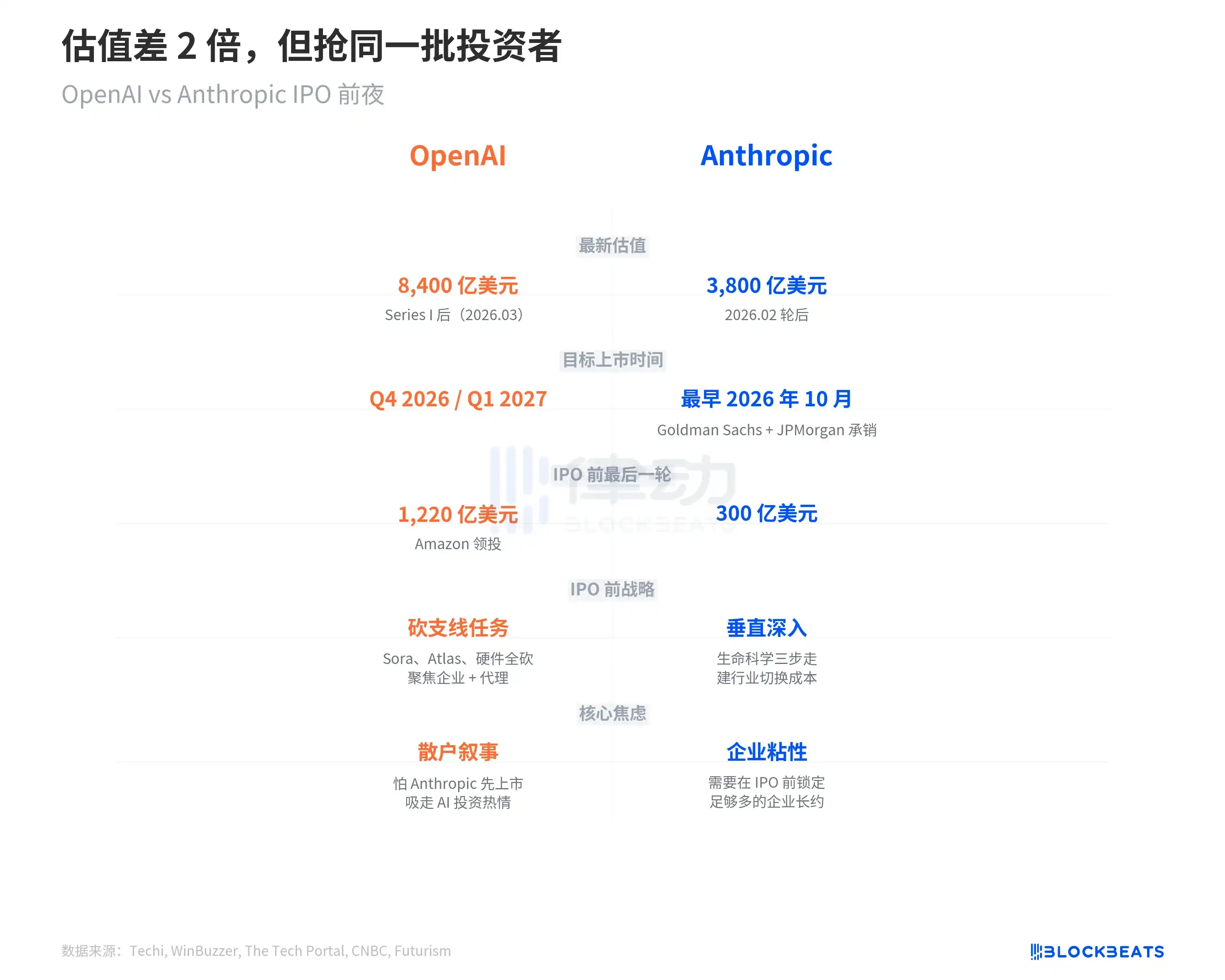
According to FinancialContent, the OpenAI board is concerned that if Anthropic goes public first, it will siphon off the retail investment enthusiasm that has been building up for AI. The valuations of the two companies differ by more than 2 times, but they are competing for the same pool of investors' money. Two acquisitions on the same day: one buying a narrative machine, the other buying an industry entry point.


Criptos en tendencia

Preguntas relacionadas

QWhat are the key differences in acquisition strategies between OpenAI and Anthropic as described in the article?

AOpenAI has pursued a broad acquisition strategy, completing 15 acquisitions across seven fields including hardware, media, and consumer services, focusing on influencing public narrative and consumer markets. Anthropic has made only 3 highly targeted acquisitions, each precisely strengthening a specific technical layer of its Claude product stack, such as infrastructure, autonomous operation, and industry-specific capabilities like biotech R&D.

QWhy did OpenAI acquire the tech broadcast network TBPN according to the article?

AOpenAI acquired TBPN, a daily tech talk show, not for its revenue but for its ability to continuously influence the public discussion framework around AI topics. This aligns with OpenAI's high reliance on consumer subscriptions and its need to manage public sentiment, which directly impacts its IPO valuation narrative.

QWhat was the strategic rationale behind Anthropic's acquisition of Coefficient Bio?

AAnthropic acquired Coefficient Bio, an AI biotech startup, to gain full-process AI capabilities for drug R&D. This was the final step in a clear six-month strategic sequence to deeply penetrate the life sciences vertical, following the release of specialized tools and achieving healthcare compliance, aiming to lock in enterprise clients with high switching costs.

QHow do the revenue structures of OpenAI and Anthropic influence their respective acquisition anxieties?

AOpenAI's revenue is ~60% consumer-based (ChatGPT subscriptions), making it anxious about public narrative affecting its IPO valuation, hence its 'narrative' acquisitions. Anthropic's revenue is ~80% from enterprise clients, making it anxious about proving client retention, hence its acquisitions focus on building technical 'moats' and deep vertical integration to increase switching costs.

QWhat are the reported IPO timelines and valuation targets for OpenAI and Anthropic?

AAnthropic aims for an IPO as early as October 2026, targeting a fundraising scale of over $60 billion. OpenAI is targeting an IPO in Q4 2026 or Q1 2027, with a valuation nearing $1 trillion. The article notes a concern that if both IPO around the same time as SpaceX, they could collectively absorb over $3 trillion in market liquidity.

Lecturas Relacionadas

From South Korea to the United States: Blue-Collar Jobs Are Becoming Increasingly Popular, Thanks to AI

AI is reshaping the labor market's value proposition. The traditional four-year college degree is losing its appeal as a guaranteed career path, while skilled blue-collar trades like electricians, welders, and plumbers are experiencing historic demand and wage premiums. This shift is driven by dual pressures: AI's displacement of certain white-collar roles and a booming need for physical infrastructure and data center construction. Data confirms the trend. In the U.S., vocational school revenue surged, and a significant portion of recent layoffs are AI-related. Surveys show a majority of Gen Z adults plan to pursue blue-collar work, citing better job security against AI automation. Vocational education interest has exploded recently. Experts cite a psychological shift as younger generations seek tangible, AI-resistant careers and avoid high student debt. In many cases, salaries for skilled trades now match or exceed those requiring a bachelor's degree. In South Korea, semiconductor vocational high schools boast near-total employment, with graduates securing high-paying roles at companies like Samsung. The shortage is structural, exacerbated by a retiring baby boomer workforce and massive infrastructure projects. Companies like JPMorgan Chase, Meta, and Lowe's are investing heavily in training programs. However, overcoming historical stigma and a "perception gap" around trade careers remains a key challenge to closing the talent gap.

marsbitHace 1 hora(s)

From South Korea to the United States: Blue-Collar Jobs Are Becoming Increasingly Popular, Thanks to AI

marsbitHace 1 hora(s)

Qualcomm: AI Hype Subsides, When Will Smartphones Emerge from the Gloom?

Qualcomm reported its Q3 FY2026 results (ending June 2026), with revenue of $9.95B, down 4% YoY but above expectations. Gross margin declined to 53.1%, pressured by rising costs across manufacturing and memory. Key business segments showed mixed performance: Handset revenue fell 19.6% YoY to $5.09B, dragged by an 11% decline in non-Apple Android shipments and weaker high-end mix. Conversely, Automotive revenue surged 61% to $1.59B, and IoT grew 9% to $1.83B. Core operating profit dropped 41% YoY due to margin compression and higher expenses. Management's Q4 FY2026 guidance projects revenue of $9.7B-$10.5B, in line with consensus, but Non-GAAP EPS guidance of $2.05-$2.25 fell short of expectations. Amidst persistent weakness in its core handset market, Qualcomm is pursuing growth in AI, focusing on Edge AI (smartphones, PCs, automotive) and Data Center AI. Its data center strategy includes four pillars: AI accelerators (e.g., AI200), commercial CPUs (Dragonfly C1000), custom silicon, and connectivity solutions. While these initiatives initially boosted its stock, concerns over AI capital expenditure sustainability have since erased those gains. The company targets $5B in data center revenue for FY2027 and $15B for FY2029. The report concludes that with the traditional handset business still under pressure, the data center opportunity is currently viewed as a longer-term option, and a more conservative valuation based on core operations may be warranted until AI contributions materialize.

marsbitHace 1 hora(s)

Qualcomm: AI Hype Subsides, When Will Smartphones Emerge from the Gloom?

marsbitHace 1 hora(s)

From TPU to Self-Evolving Agents: How Jeff Dean Predicts the Next Step in AI

At the 2026 YC Startup School, Jeff Dean outlined his vision for AI's next phase, shifting focus from simply scaling models to building intelligent, autonomous systems. He believes AI's progress is no longer just about creating smarter models, but about integrating them into systems capable of long-term, iterative work, automated experimentation, and continuous learning. This evolution moves the competition from "who has the bigger model" to "who can best organize intelligence." Dean suggests AI capabilities are now comparable to a junior engineer, enabling the automation of complex workflows. However, the true challenge and opportunity lie in managing these AI "workers" at scale. He emphasizes the importance of **context engineering**—structuring tools, memory, and feedback loops—over raw model power. For startups, this means building deep expertise in niche domains where general models currently fail (near 0-1% success rates), leveraging proprietary data, specialized tools, and domain-specific evaluators. A recurring theme is re-examining fundamental constraints. Dean's past work, like moving Google's search index to memory or creating the TPU, stemmed from questioning outdated assumptions about hardware and cost. He sees similar inflection points today, particularly in **specialized inference hardware** to drastically reduce latency and energy consumption for real-time Agent operation. Notably, he points out that in modern AI systems, the dominant cost is often not computation but **data movement**. Reliable, long-running Agents require robust system design, borrowing concepts from distributed computing like checkpointing, state management, and parallel exploration to handle failures and maintain progress over days or weeks. As AI automates execution, the scarcest human skills will shift to **defining clear specifications**, **judging what problems are worth solving** (taste), and designing effective feedback loops. Ultimately, Dean's framework prioritizes understanding the problem deeply, identifying the true bottlenecks, and systematically building closed-loop systems where AI can not only perform tasks but also improve AI itself.

marsbitHace 1 hora(s)

From TPU to Self-Evolving Agents: How Jeff Dean Predicts the Next Step in AI

marsbitHace 1 hora(s)

Trading

Spot

Artículos destacados

Cómo comprar ONE

¡Bienvenido a HTX.com! Hemos hecho que comprar Harmony (ONE) sea simple y conveniente. Sigue nuestra guía paso a paso para iniciar tu viaje de criptos.Paso 1: crea tu cuenta HTXUtiliza tu correo electrónico o número de teléfono para registrarte y obtener una cuenta gratuita en HTX. Experimenta un proceso de registro sin complicaciones y desbloquea todas las funciones.Obtener mi cuentaPaso 2: ve a Comprar cripto y elige tu método de pagoTarjeta de crédito/débito: usa tu Visa o Mastercard para comprar Harmony (ONE) al instante.Saldo: utiliza fondos del saldo de tu cuenta HTX para tradear sin problemas.Terceros: hemos agregado métodos de pago populares como Google Pay y Apple Pay para mejorar la comodidad.P2P: tradear directamente con otros usuarios en HTX.Over-the-Counter (OTC): ofrecemos servicios personalizados y tipos de cambio competitivos para los traders.Paso 3: guarda tu Harmony (ONE)Después de comprar tu Harmony (ONE), guárdalo en tu cuenta HTX. Alternativamente, puedes enviarlo a otro lugar mediante transferencia blockchain o utilizarlo para tradear otras criptomonedas.Paso 4: tradear Harmony (ONE)Tradear fácilmente con Harmony (ONE) en HTX's mercado spot. Simplemente accede a tu cuenta, selecciona tu par de trading, ejecuta tus trades y monitorea en tiempo real. Ofrecemos una experiencia fácil de usar tanto para principiantes como para traders experimentados.

404 Vistas totalesPublicado en 2024.12.12Actualizado en 2026.06.02

Cómo comprar ONE

Discusiones

Bienvenido a la comunidad de HTX. Aquí puedes mantenerte informado sobre los últimos desarrollos de la plataforma y acceder a análisis profesionales del mercado. A continuación se presentan las opiniones de los usuarios sobre el precio de ONE (ONE).

活动图片












