Two Acquisitions in One Day: OpenAI Buys 'Narrative', Anthropic Buys 'Barriers'

marsbitPublicado a 2026-04-03Actualizado a 2026-04-03

Resumen

On April 2, OpenAI and Anthropic each announced an acquisition, reflecting their divergent strategies as both target an IPO by late 2026. OpenAI acquired tech talk show TBPN to shape public AI discourse and support its revenue base, which is 60% consumer-driven from ChatGPT subscriptions. In contrast, Anthropic purchased AI biotech startup Coefficient Bio for approximately $400 million in stock, continuing its focused strategy of deepening enterprise capabilities, particularly in high-switching-cost sectors like life sciences. Over the past three years, OpenAI completed 15 acquisitions across diverse fields including hardware, media, and healthcare, spending over $7.7 billion on disclosed deals, such as the $6.5 billion purchase of Jony Ive’s AI hardware firm. Anthropic made only three acquisitions, each precisely strengthening its product stack: Bun for coding infrastructure, Vercept for autonomous agents, and now Coefficient Bio for biotech R&D pipelines. Anthropic’s enterprise-focused revenue (80% of total) drives its strategy to lock in clients with vertical integration, as seen in its sequenced moves into life sciences and healthcare. Meanwhile, with a higher reliance on consumer subscriptions, OpenAI is investing in narrative influence—TBPN aims to boost ad revenue and steer public AI conversation. Both companies are on accelerated IPO paths: Anthropic eyeing a $60+ billion offering led by Goldman Sachs and JPMorgan, and OpenAI targeting a ~$1 trillion valuation. The...

On April 2, OpenAI and Anthropic each announced an acquisition. OpenAI acquired the tech live show TBPN, while Anthropic spent approximately $400 million in stock to acquire AI biotech startup Coefficient Bio. Both companies are sprinting toward an IPO by the end of 2026, but their shopping lists point to entirely different anxieties.

15 vs. 3. This is the number of acquisitions completed by OpenAI and Anthropic, respectively, over the past three years.
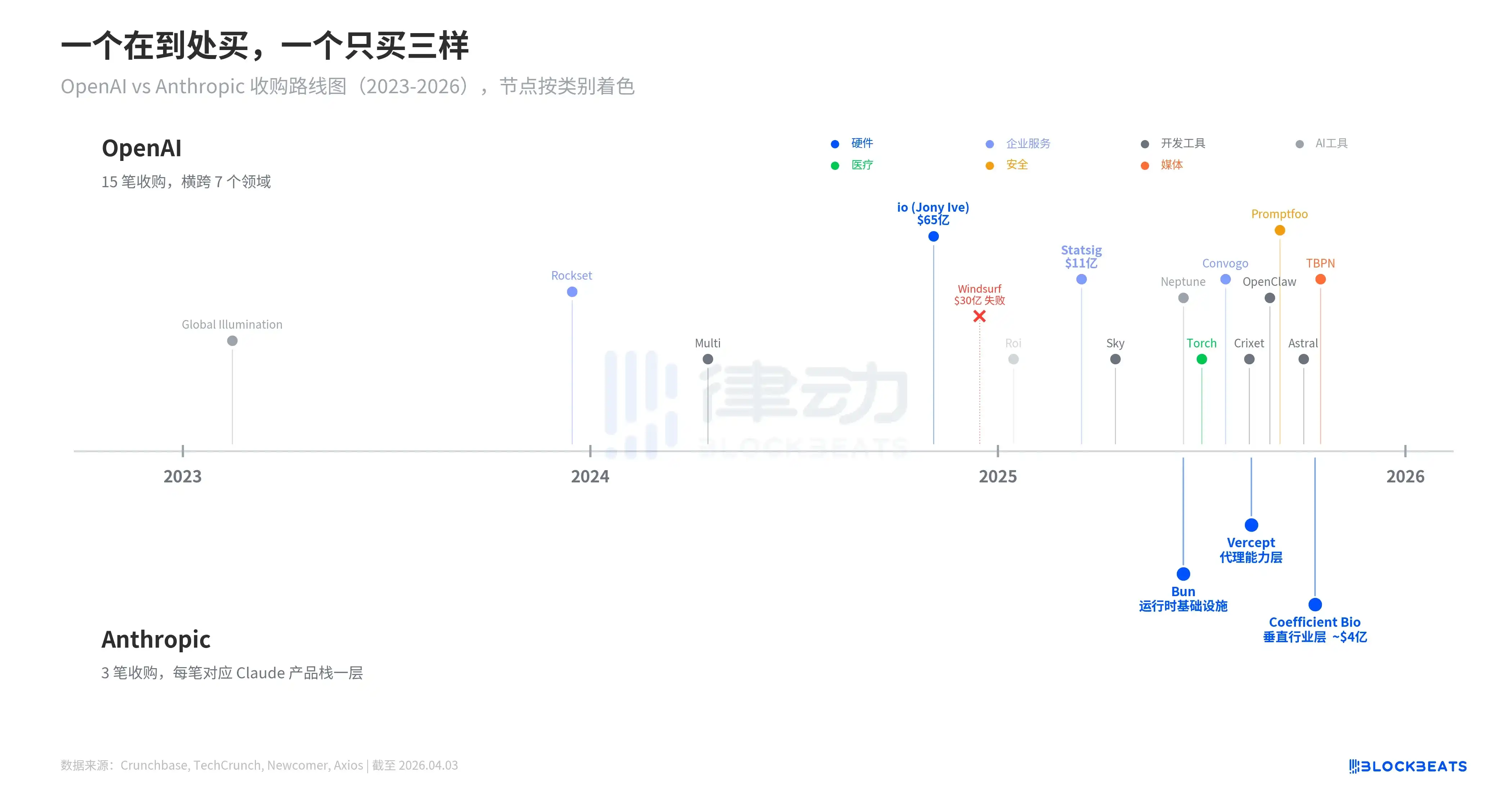
According to Crunchbase statistics, OpenAI has completed 15 acquisitions since 2023, spanning seven areas: hardware, enterprise services, developer tools, healthcare, security, media, and consumer. Six were completed in the first three months of 2026 alone. The total disclosed value of these transactions exceeds $7.7 billion, with the largest being the $6.5 billion acquisition of io, an AI hardware company founded by former Apple designer Jony Ive, in May 2025.

Anthropic has only made 3. In December 2025, it acquired the JavaScript runtime Bun to complete the underlying infrastructure for Claude Code. According to an official Anthropic announcement, the acquisition of Bun coincided with the disclosure that Claude Code had reached $1 billion in annualized revenue. In February 2026, it acquired the computer use agent startup Vercept to strengthen Claude's autonomous operation capabilities. On April 2, it acquired Coefficient Bio to enter the life sciences R&D pipeline. Each acquisition precisely corresponds to a technical layer in the Claude product stack.

It is worth noting that OpenAI also had one failed transaction. In May 2025, OpenAI reached a $3 billion acquisition intent with the code editor Windsurf (formerly Codeium). However, according to IT Pro, due to IP clauses in the Microsoft contract, OpenAI could not protect Windsurf's technology from being accessed by Microsoft, and the deal fell through in July. This failure also reflects a structural constraint of OpenAI's "broad procurement" model.

This difference in density is not accidental. It reflects the two companies' vastly different revenue structures and the resulting different anxieties.

Revenue Structure Determines Acquisition Direction

According to Sacra estimates, OpenAI's annualized revenue as of February 2026 was approximately $25 billion, with about 60% coming from the consumer end (ChatGPT subscriptions) and 40% from the enterprise end. 15.5 million paying users are the foundation of OpenAI's income. For a company about to IPO, a high proportion of consumer revenue means public sentiment directly impacts the valuation narrative.

This explains why OpenAI bought TBPN. According to Axios, TBPN is a daily live tech talk show with $5 million in advertising revenue in 2025 and a target of over $30 million for 2026. Post-acquisition, OpenAI will maintain its editorial independence while hiring former Postmates executive Dylan Abruscato to handle advertising monetization. The logic behind buying a tech podcast lies not in its revenue, but in its ability to continuously influence the public discussion framework around AI topics.
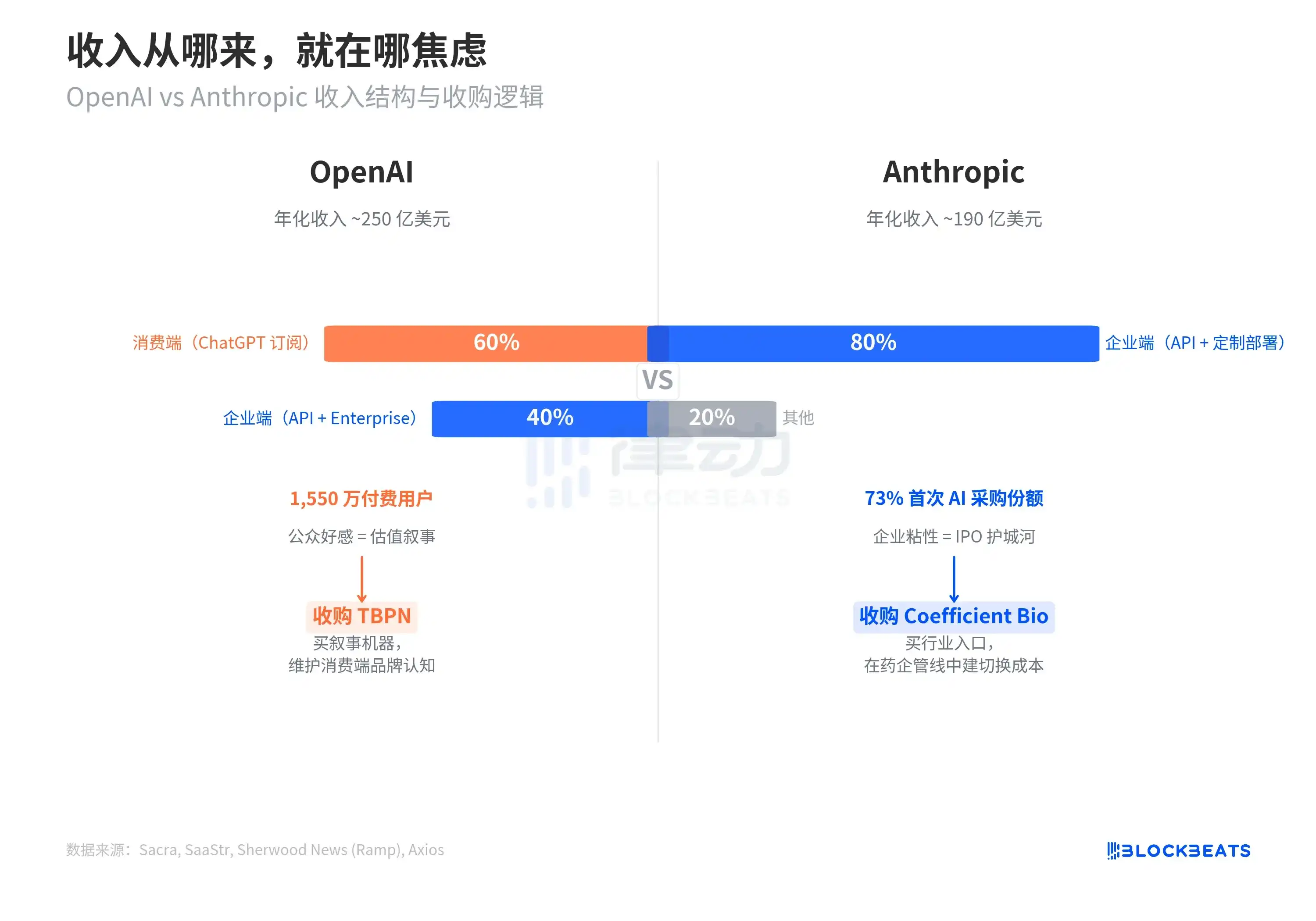
Anthropic's anxiety is entirely different. According to Ramp data cited by Sherwood News, Anthropic currently captures 73% of the market share for first-time AI procurement enterprise clients; ten weeks ago, this number was 50%. According to SaaStr, about 80% of Anthropic's revenue comes from the enterprise end. For enterprise customers, choosing an AI supplier is a decision with high switching costs. Anthropic's IPO narrative needs to prove that these enterprise customers will not leave.

Three Moves in Six Months

Coefficient Bio is not an impulsive acquisition. Viewed within the sequence of Anthropic's actions over the past six months, the logic is clear.

In October 2025, Anthropic launched Claude for Life Sciences, integrating with research databases like PubMed and UniProt, enabling Claude to assist with literature reviews and experimental design. In January 2026, at the JPM26 conference, it launched Claude for Healthcare, obtained HIPAA compliance certification, and formally entered the healthcare system. On April 2, it acquired Coefficient Bio, gaining full-cycle AI capabilities for drug R&D.
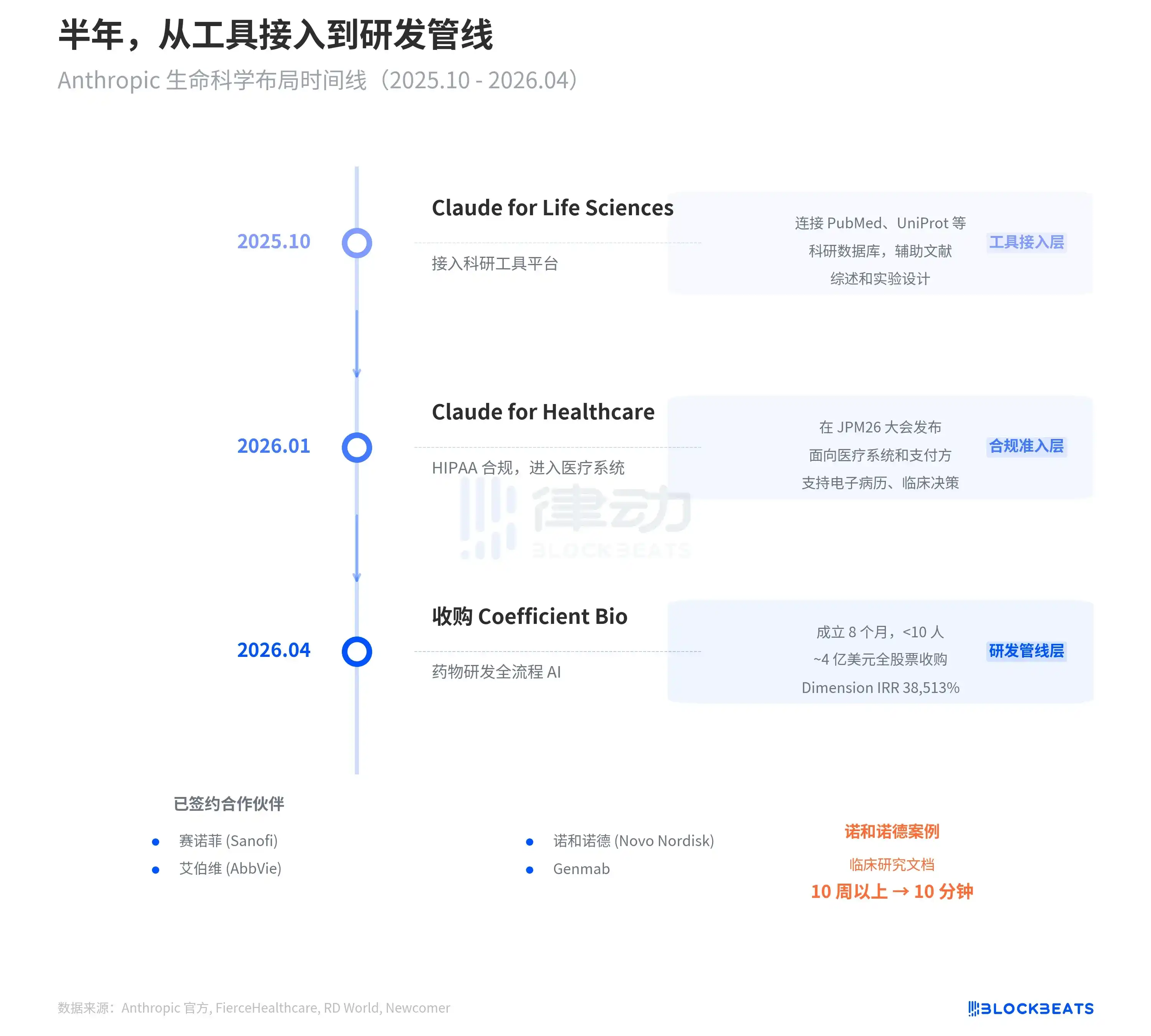
In six months, it progressed from the tool integration layer to the compliance access layer, and then to the R&D pipeline layer. According to Newcomer, Coefficient Bio was founded just 8 months ago, has fewer than 10 employees, and is about 50% owned by venture capital firm Dimension. Anthropic completed the acquisition for approximately $400 million in stock. Dimension stated in a letter to LPs that the IRR on this investment reached 38,513%.

This number itself shows that Anthropic is not buying a company's revenue or product, but rather a team plus an industry entry point. According to reports from Anthropic and RD World, pharmaceutical companies like Sanofi, Novo Nordisk, AbbVie, and Genmab are already using Claude's life science tools. The Novo Nordisk case is particularly typical, reducing clinical study document processing time from over 10 weeks to 10 minutes.

Two Balance Sheets, One Countdown

According to WinBuzzer and The Tech Portal, Anthropic has hired Goldman Sachs and J.P. Morgan to lead underwriting, targeting an IPO as early as October 2026 with a financing scale exceeding $60 billion. OpenAI is targeting Q4 2026 or Q1 2027 with a valuation nearing $1 trillion. According to Tom Tunguz's analysis, if OpenAI, Anthropic, and SpaceX all IPO in the same year, these three alone could absorb over $3 trillion in market liquidity.

Both are making final strategic adjustments before their IPOs. According to CNBC, OpenAI CEO Fidji Simo internally announced the cancellation of Sora, the Atlas browser, hardware projects, and instant checkout features, stating the company is "like entering a red alert" and needs to focus on enterprise and agent products. Anthropic's path is to continue deepening into vertical industries like life sciences, using industry switching costs to lock in enterprise customers.
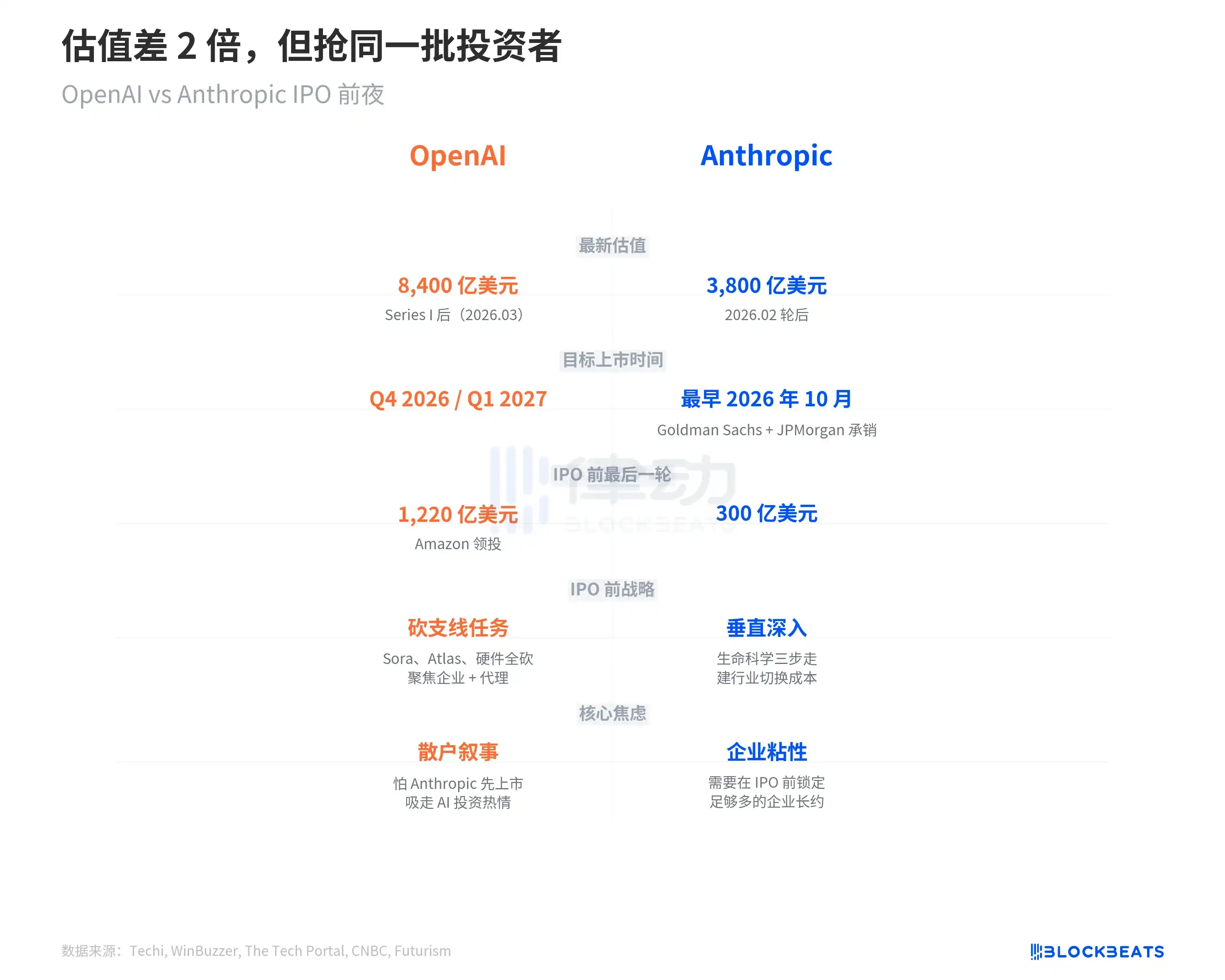
According to FinancialContent, the OpenAI board is concerned that if Anthropic goes public first, it will siphon off the retail investment enthusiasm that has been building up for AI. The valuations of the two companies differ by more than 2 times, but they are competing for the same pool of investors' money. Two acquisitions on the same day: one buying a narrative machine, the other buying an industry entry point.


Criptos en tendencia

Preguntas relacionadas

QWhat are the key differences in acquisition strategies between OpenAI and Anthropic as described in the article?

AOpenAI has pursued a broad acquisition strategy, completing 15 acquisitions across seven fields including hardware, media, and consumer services, focusing on influencing public narrative and consumer markets. Anthropic has made only 3 highly targeted acquisitions, each precisely strengthening a specific technical layer of its Claude product stack, such as infrastructure, autonomous operation, and industry-specific capabilities like biotech R&D.

QWhy did OpenAI acquire the tech broadcast network TBPN according to the article?

AOpenAI acquired TBPN, a daily tech talk show, not for its revenue but for its ability to continuously influence the public discussion framework around AI topics. This aligns with OpenAI's high reliance on consumer subscriptions and its need to manage public sentiment, which directly impacts its IPO valuation narrative.

QWhat was the strategic rationale behind Anthropic's acquisition of Coefficient Bio?

AAnthropic acquired Coefficient Bio, an AI biotech startup, to gain full-process AI capabilities for drug R&D. This was the final step in a clear six-month strategic sequence to deeply penetrate the life sciences vertical, following the release of specialized tools and achieving healthcare compliance, aiming to lock in enterprise clients with high switching costs.

QHow do the revenue structures of OpenAI and Anthropic influence their respective acquisition anxieties?

AOpenAI's revenue is ~60% consumer-based (ChatGPT subscriptions), making it anxious about public narrative affecting its IPO valuation, hence its 'narrative' acquisitions. Anthropic's revenue is ~80% from enterprise clients, making it anxious about proving client retention, hence its acquisitions focus on building technical 'moats' and deep vertical integration to increase switching costs.

QWhat are the reported IPO timelines and valuation targets for OpenAI and Anthropic?

AAnthropic aims for an IPO as early as October 2026, targeting a fundraising scale of over $60 billion. OpenAI is targeting an IPO in Q4 2026 or Q1 2027, with a valuation nearing $1 trillion. The article notes a concern that if both IPO around the same time as SpaceX, they could collectively absorb over $3 trillion in market liquidity.

Lecturas Relacionadas

Annual Salary of Millions Competing for Electricians, Meta Rushes to Open Its Own Technical School

The AI boom is facing an unexpected bottleneck: a severe shortage of skilled construction workers and electricians. As tech giants like Meta, OpenAI, and Alphabet race to build massive data centers—such as OpenAI's $16 billion "Stargate" project—they are hitting a critical labor wall. The U.S. needs an estimated 130,000 more electricians, 240,000 construction workers, and 150,000 supervisors by 2030 for AI infrastructure alone, but tens of thousands of electrician jobs go unfilled each year. While AI companies offer high premiums, with electricians earning up to $280,000 annually, worker scarcity still causes massive losses—delays on a single project can cost $14.2 million per month. The complexity of building AI data centers, which require immense power (equivalent to powering hundreds of thousands of homes), sophisticated electrical systems, and advanced liquid cooling solutions, demands highly skilled technicians who are in short supply. To combat this, companies are investing heavily in training. Meta has committed $115 million to a free training school offering tuition, housing, and stipends, targeting 5,000 new workers. OpenAI is partnering with unions to secure skilled labor. These efforts are paying off, with a significant rise in Gen Z interest in trade schools over college. However, the power demands are staggering. AI data centers are driving a rapid surge in electricity consumption, projected to account for up to 12% of U.S. power use by 2028 and raising costs for consumers. Furthermore, the construction boom is project-based, leading to a potential future glut of trained workers once building peaks, which could depress wages industry-wide. The race for AI supremacy now depends as much on skilled hands as on advanced chips.

marsbitHace 33 min(s)

Annual Salary of Millions Competing for Electricians, Meta Rushes to Open Its Own Technical School

marsbitHace 33 min(s)

OpenAI No Longer Sells Its Most Expensive Model for Profit

OpenAI is shifting its business strategy away from promoting its most expensive, flagship models for every task. Recent price cuts—80% for GPT-5.6 Luna and 20% for Terra—signal a deeper change: the company now actively advises users that many tasks don't require the most powerful model. Instead, OpenAI recommends a tiered approach: use the high-end GPT-5.6 Sol for complex planning and analysis, then delegate execution to cheaper models like Luna. This mirrors moves by Anthropic, which recently launched Claude Opus 5 at half the price of its top model, Fable 5. Both companies are de-emphasizing flagship models as primary revenue drivers, using them instead for brand prestige and technological showcases. The industry is entering a "mass-market" phase, similar to automotive, where high-volume, cost-effective models handle daily operations and drive scale. OpenAI's price reductions are partly enabled by AI models themselves optimizing underlying code and infrastructure, creating a self-reinforcing cycle of efficiency gains and cost reduction. Competition is shifting from "who is smartest" to "who offers the best value." The goal is no longer selling individual models but fostering widespread API adoption and ecosystem lock-in. By making AI calls cheap and ubiquitous, companies like OpenAI aim to become the indispensable, utility-like infrastructure powering automated workflows—the "water and electricity" of software, quietly embedded everywhere.

marsbitHace 33 min(s)

OpenAI No Longer Sells Its Most Expensive Model for Profit

marsbitHace 33 min(s)

Will the Fed Definitely Raise Interest Rates in September? How Will Crypto and U.S. Stocks Withstand the Pressure?

The market's expectation for a September Fed rate hike surged dramatically in early August, jumping from under 50% to over 80% within a week. This shift followed a contentious July FOMC meeting, where a 9-3 vote to hold rates revealed growing dissent from hawkish members advocating for an immediate hike to combat persistent inflation. The primary catalyst for this repricing is rising oil prices, driven by renewed geopolitical tensions around the Strait of Hormuz, which threaten global supply. Energy costs directly influence inflation metrics, making the upcoming July CPI report (due August 12th) a critical data point. If it shows inflation reaccelerating, the probability of a September hike will solidify. For Bitcoin and crypto assets, this is typically bearish news. Bitcoin continues to behave as a high-beta, liquidity-sensitive risk asset. A rate hike raises the opportunity cost of holding non-yielding assets and could drive capital toward money markets, pressuring crypto prices in the short term. However, historical patterns suggest that if a hike is perceived as the end of a tightening cycle rather than the start, any negative price impact may be brief. U.S. stocks, particularly crypto-linked equities like Coinbase and growth-oriented tech stocks, are also vulnerable. Higher rates increase discount rates in valuation models, putting pressure on high-multiple companies. This coincides with a pivotal tech earnings season where investor focus has shifted from massive AI capital expenditure to tangible revenue and cash flow generation. Companies with negative cash flow and weak growth narratives could face heightened volatility if borrowing costs rise in September. In summary, a September Fed hike has evolved into a mainstream market scenario. Key factors to watch are oil prices, the July CPI report, and Fed communications, which will determine the final decision and its impact on volatile crypto and equity markets.

marsbitHace 43 min(s)

Will the Fed Definitely Raise Interest Rates in September? How Will Crypto and U.S. Stocks Withstand the Pressure?

marsbitHace 43 min(s)

Trading

Spot

Artículos destacados

Cómo comprar ONE

¡Bienvenido a HTX.com! Hemos hecho que comprar Harmony (ONE) sea simple y conveniente. Sigue nuestra guía paso a paso para iniciar tu viaje de criptos.Paso 1: crea tu cuenta HTXUtiliza tu correo electrónico o número de teléfono para registrarte y obtener una cuenta gratuita en HTX. Experimenta un proceso de registro sin complicaciones y desbloquea todas las funciones.Obtener mi cuentaPaso 2: ve a Comprar cripto y elige tu método de pagoTarjeta de crédito/débito: usa tu Visa o Mastercard para comprar Harmony (ONE) al instante.Saldo: utiliza fondos del saldo de tu cuenta HTX para tradear sin problemas.Terceros: hemos agregado métodos de pago populares como Google Pay y Apple Pay para mejorar la comodidad.P2P: tradear directamente con otros usuarios en HTX.Over-the-Counter (OTC): ofrecemos servicios personalizados y tipos de cambio competitivos para los traders.Paso 3: guarda tu Harmony (ONE)Después de comprar tu Harmony (ONE), guárdalo en tu cuenta HTX. Alternativamente, puedes enviarlo a otro lugar mediante transferencia blockchain o utilizarlo para tradear otras criptomonedas.Paso 4: tradear Harmony (ONE)Tradear fácilmente con Harmony (ONE) en HTX's mercado spot. Simplemente accede a tu cuenta, selecciona tu par de trading, ejecuta tus trades y monitorea en tiempo real. Ofrecemos una experiencia fácil de usar tanto para principiantes como para traders experimentados.

404 Vistas totalesPublicado en 2024.12.12Actualizado en 2026.06.02

Cómo comprar ONE

Discusiones

Bienvenido a la comunidad de HTX. Aquí puedes mantenerte informado sobre los últimos desarrollos de la plataforma y acceder a análisis profesionales del mercado. A continuación se presentan las opiniones de los usuarios sobre el precio de ONE (ONE).

活动图片












