Turning 200,000 into Nearly 100 Million: DeFi Stablecoin Attacked Again

marsbitPublicado a 2026-03-22Actualizado a 2026-03-22

Resumen

DeFi stablecoin protocol Resolv Labs was exploited, resulting in a hacker minting 80 million USR tokens using only 200,000 USDC. The attacker’s address (starting with 0x04A2) first created 50 million USR with 100,000 USDC, and later minted another 30 million with an additional 100,000 USDC. This caused USR to depeg, dropping to around $0.25 before partially recovering to approximately $0.80. The incident also impacted related lending markets on Morpho and Lista DAO, which paused new borrowing requests. Additionally, RLP token holders, including Stream Finance—which holds over 13 million RLP tokens—face significant exposure, with estimated losses around $17 million. Initial analysis by DeFi community YAM suggests the exploit occurred because the protocol’s SERVICE_ROLE, which provides minting parameters, was compromised. The system fully trusted this role’s input without on-chain verification or minting limits, allowing the attacker to manipulate the mint amount. The project’s emergency response was also slow, taking nearly three hours to pause the protocol due to multi-signature delays. This attack highlights critical vulnerabilities in off-chain role trust and emergency mechanisms within DeFi protocols.

Written by: Eric, Foresight News

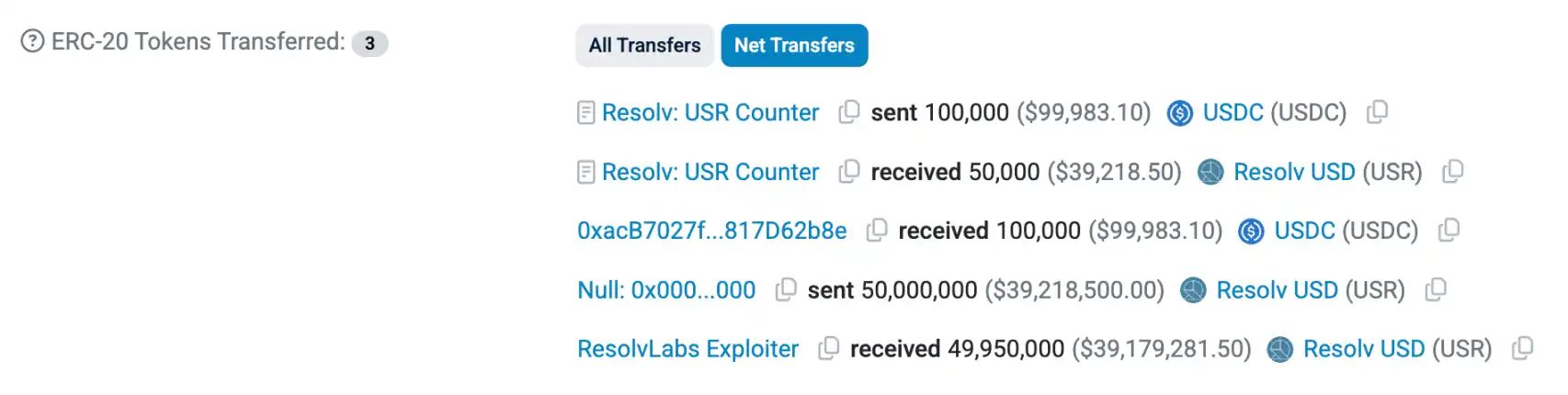
At approximately 10:21 Beijing time today, Resolv Labs, which issues the stablecoin USR using a Delta neutral strategy, was hacked. An address starting with 0x04A2 used 100,000 USDC to mint 50 million USR from the Resolv Labs protocol.
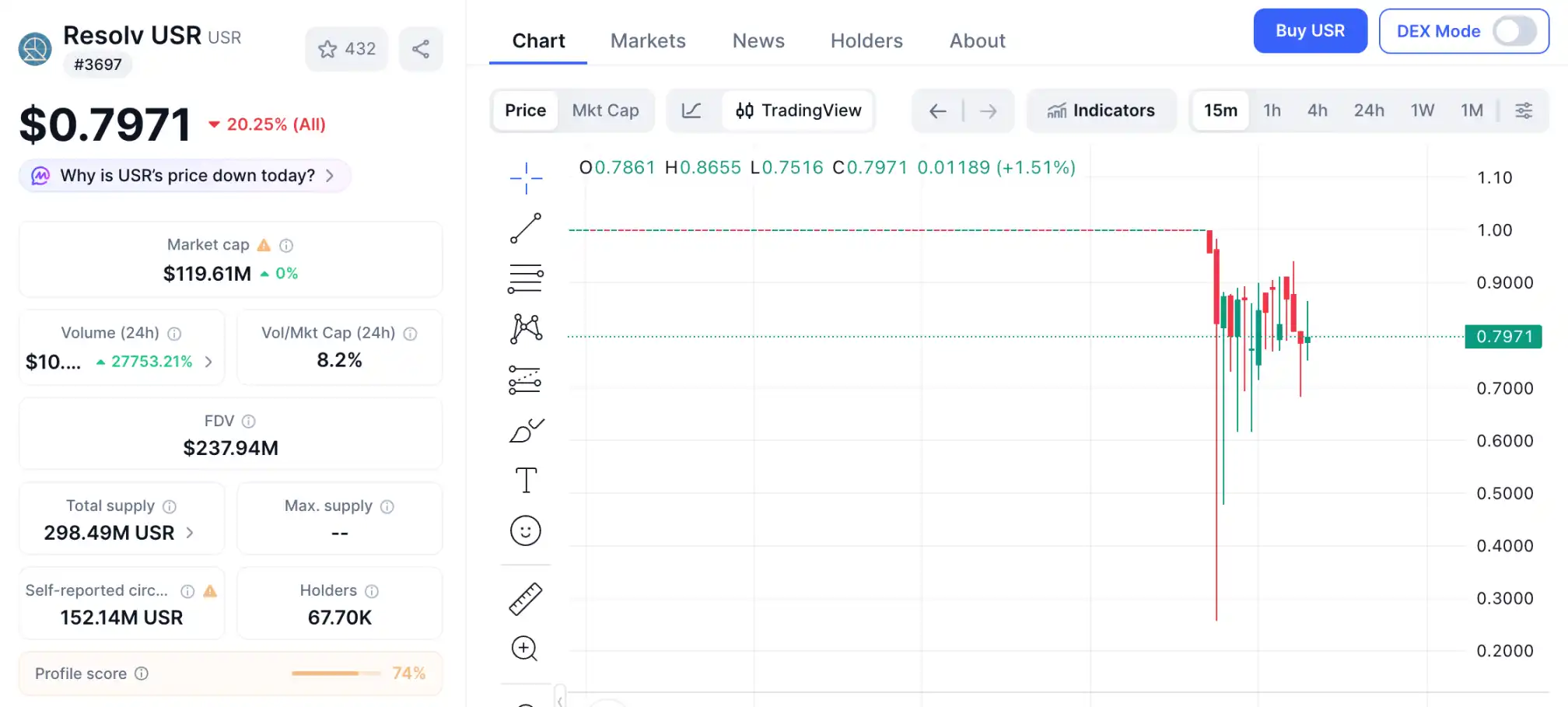
As the incident was exposed, USR plummeted to around $0.25, and as of writing, it has recovered to approximately $0.80. The price of the RESOLV token also saw a short-term drop of nearly 10%.
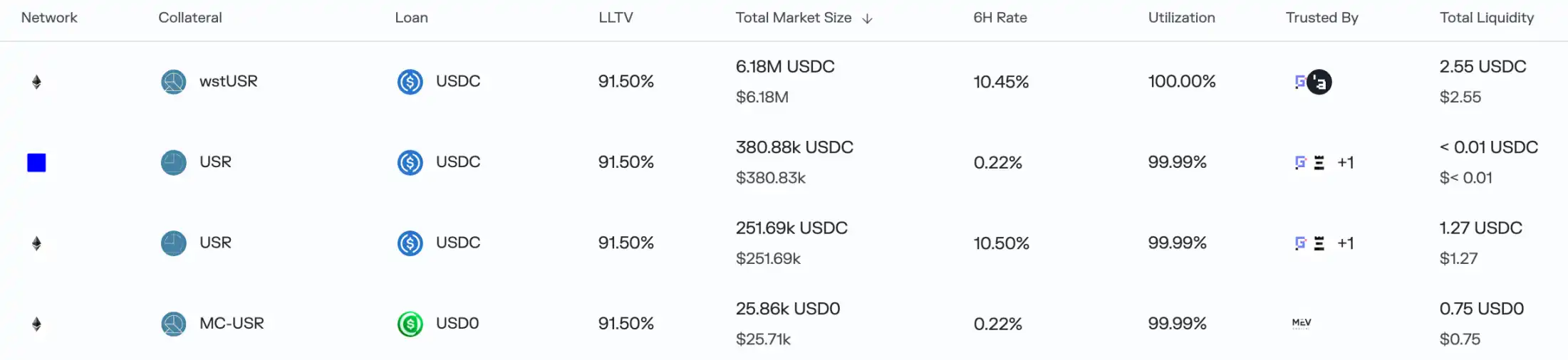
Subsequently, the hacker repeated the same method, using another 100,000 USDC to mint 30 million USR. As USR significantly depegged, arbitrage traders quickly took action. Many lending markets on Morpho that supported USR, wstUSR, and others as collateral were almost drained, and Lista DAO on BNB Chain also suspended new borrowing requests.
The impact was not limited to these lending protocols. In the Resolv Labs protocol design, users can also mint an RLP token, which has greater price volatility and higher returns but requires bearing compensation liability when the protocol incurs losses. Currently, the circulating supply of RLP tokens is nearly 30 million, with the largest holder, Stream Finance, holding over 13 million RLP, representing a net risk exposure of approximately $17 million.

Yes, Stream Finance, which was previously hit by the xUSD incident, may be hit again.

As of writing, the hacker has converted USR into USDC and USDT and continues to buy Ethereum, having purchased over 10,000 ETH so far. Using 200,000 USDC, the hacker extracted over $20 million in assets, finding their "hundred-fold coin" during the bear market.

Another Exploit Due to "Lack of Rigor"

The sharp drop on October 11 last year caused collateral losses for many stablecoins issued using Delta neutral strategies due to ADL (Auto-Deleveraging). Projects using altcoins as assets for strategy execution suffered even more severe losses, with some even directly absconding.

The attacked Resolv Labs also uses a similar mechanism to issue USR. The project announced in April 2025 that it had completed a $10 million seed round led by Cyber.Fund and Maven11, with participation from Coinbase Ventures, and launched the RESOLV token at the end of May/early June.

However, the reason for the attack on Resolv Labs was not extreme market conditions but rather a "lack of rigor" in the design of the USR minting mechanism.

No security firm or official has yet analyzed the cause of this hack. The DeFi community YAM preliminarily concluded through analysis that the attack was likely caused by the SERVICE_ROLE, used by the protocol's backend to provide parameters to the minting contract, being compromised by the hacker.
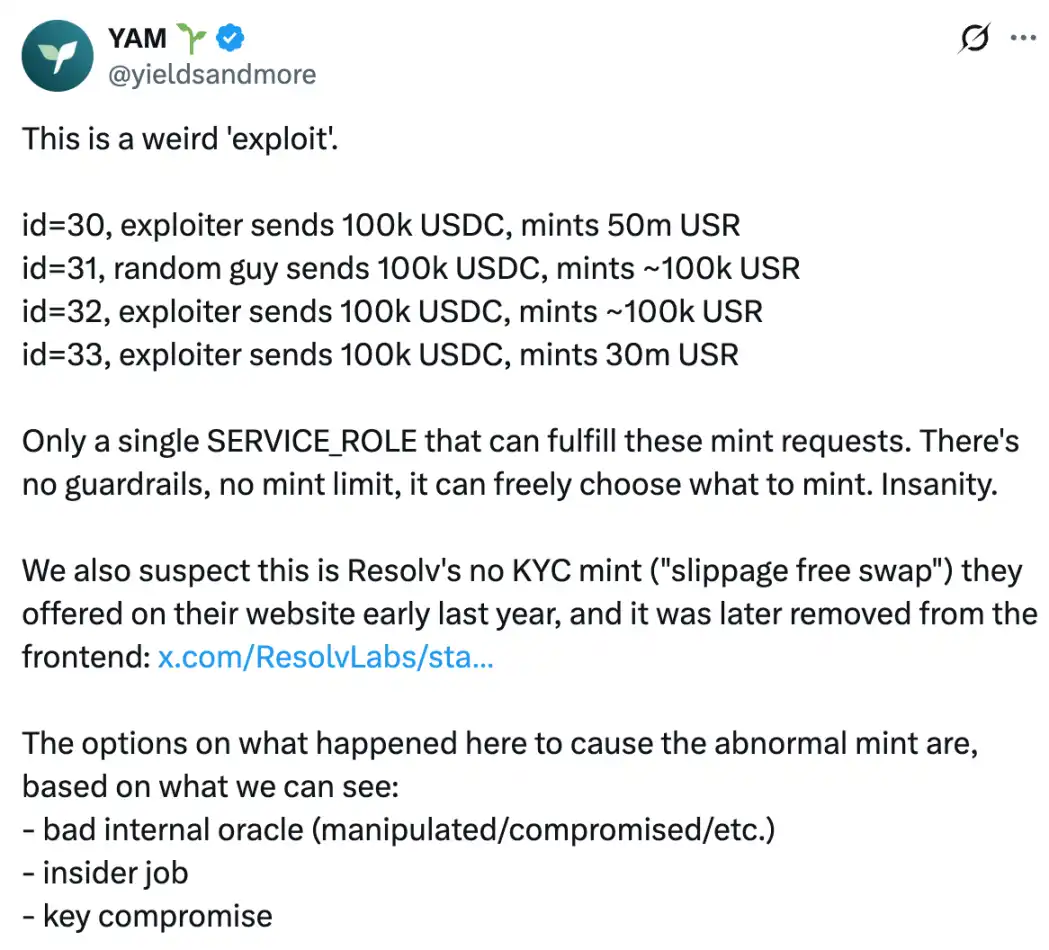
According to Grok's analysis, when a user mints USR, they initiate a request on-chain and call the contract's requestMint function, with parameters including:

_depositTokenAddress: the address of the deposited token;

_amount: the amount deposited;

_minMintAmount: the minimum expected amount of USR to receive (slippage protection).

Subsequently, the user deposits USDC or USDT into the contract. The project's backend SERVICE_ROLE monitors the request, uses the Pyth oracle to check the value of the deposited assets, and then calls the completeMint or completeSwap function to determine the actual amount of USR to mint.

The problem lies in the fact that the minting contract fully trusts the _mintAmount provided by the SERVICE_ROLE, assuming this number was verified off-chain by Pyth. Therefore, it did not set an upper limit restriction, nor did it perform on-chain oracle verification, and directly executed mint(_mintAmount).

Based on this, YAM suspects that the hacker gained control of the SERVICE_ROLE, which should have been controlled by the project team (possibly due to internal oracle failure, insider theft, or key compromise), and directly set the _mintAmount to 50 million during the minting process, achieving the attack of minting 50 million USR with 100,000 USDC.

In conclusion, Grok's assessment is that Resolv did not consider the possibility that the address (or contract) receiving user minting requests could be compromised by hackers when designing the protocol. When the USR minting request was submitted to the final USR minting contract, no maximum minting amount was set, nor did the minting contract perform secondary verification using an on-chain oracle; it simply trusted all parameters provided by the SERVICE_ROLE.

Inadequate Prevention

In addition to speculating on the cause of the hack, YAM also pointed out the project's lack of preparedness in crisis response.

YAM stated on X that Resolv Labs only paused the protocol 3 hours after the hacker's first attack was completed, with about 1 hour of delay coming from collecting the 4 signatures required for the multisig transaction. YAM believes that an emergency pause should require only one signature, and the authority should be assigned to team members as much as possible, or to trusted external operators, to increase attention to on-chain anomalies, improve the possibility of quick pauses, and better cover different time zones.

Although the suggestion of requiring only a single signature to pause the protocol is somewhat radical,确实 requiring multiple signatures across different time zones to pause the protocol can indeed cause significant delays when emergencies occur. Introducing trusted third parties who continuously monitor on-chain behavior, or using monitoring tools with emergency protocol pause permissions, are lessons learned from this incident.

Hacker attacks on DeFi protocols have long gone beyond contract vulnerabilities. The Resolv Labs incident serves as a warning to project teams: the assumption in protocol security should be to trust no single link; all parameter-related links must undergo at least secondary verification, even if it's the project's own operational backend.


Preguntas relacionadas

QWhat was the main reason behind the Resolv Labs hack according to the DeFi community YAM's analysis?

AThe hack was likely due to the SERVICE_ROLE, which provides parameters to the minting contract, being controlled by the hacker. The minting contract fully trusted the _mintAmount parameter provided by SERVICE_ROLE without setting a maximum limit or performing a secondary on-chain oracle verification.

QHow much initial capital did the hacker use, and what was the approximate value of the assets they obtained?

AThe hacker used 200,000 USDC to mint a large amount of USR and subsequently obtained assets worth over 20 million US dollars.

QWhich protocols or platforms were affected beyond Resolv Labs itself due to this attack?

AMorpho's lending markets that accepted USR and wstUSR as collateral were almost drained, and Lista DAO on BNB Chain paused new borrowing requests. Additionally, RLP token holders, like Stream Finance, faced significant risk exposure.

QWhat specific flaw in the protocol's design allowed the hacker to mint an excessive amount of USR?

AThe protocol's design did not consider the possibility that the address (or contract) receiving user minting requests could be compromised. The minting contract lacked a maximum mint amount limit and did not use an on-chain oracle for secondary verification, blindly trusting all parameters from the SERVICE_ROLE.

QWhat criticism did YAM level against Resolv Labs' emergency response measures?

AYAM criticized that it took Resolv Labs 3 hours to pause the protocol after the first attack, with about an hour of that delay attributed to collecting 4 signatures required for the multisig transaction. They suggested emergency pauses should require only one signature and be assigned to team members or trusted external operators for faster response.

Lecturas Relacionadas

Dialogue with Jia Hang | Looking Back at Two Decades of Chinese Payment Going Global

**Summary: A Conversation with Jia Hang on Two Decades of China's Payment Globalization** Jia Hang, a veteran with over twenty years in payments, reflects on China's attempts to build a global payment network through three key phases: UnionPay (card networks), Alipay+ (digital wallets), and now, stablecoins. His journey began at UnionPay International, aiming to establish China's card network abroad. While successful in following Chinese tourists ("where Chinese go, UnionPay goes"), it struggled to achieve true global scale. The core lesson: card networks like Visa/Mastercard's unassailable advantage isn't just technical standards, but their deeply entrenched **governance and profit-sharing models** that create powerful network effects. Competing as the "same species" is nearly impossible. At Ant Group, he led Alipay+, a strategy to bypass card networks by interconnecting local e-wallets worldwide. While innovative, it faced a similar ceiling. Mobile QR payments and card swipes were essentially **the same species competing for the same pie**, lacking a disruptive value proposition for users or a sustainable new incentive model to replace the card networks' established flywheel. Today, at Singapore's DCS, Jia focuses on stablecoin-based payments. He argues stablecoins represent a fundamental shift. They are not competing with Visa for consumer payments but challenging the **traditional banking and account system for value movement**. Products like "U Cards" (stablecoin-linked payment cards) are transitional, leveraging existing card networks for acceptance while building new rails. The real potential lies in stablecoins enabling seamless, low-cost global value transfer, potentially reorganizing the financial infrastructure around **accounts rather than cards**. Jia believes stablecoin adoption for local retail payments, cross-border transactions, and as high-yield savings vehicles is becoming irreversible. This could gradually reduce reliance on traditional fiat channels, especially in regions with weak currencies or capital controls. The quest for the "next global payment network" continues, now centered on whether stablecoins can successfully bridge Web2 and Web3, establish new governance, and create compelling user value beyond mere cost reduction.

marsbitHace 4 min(s)

Dialogue with Jia Hang | Looking Back at Two Decades of Chinese Payment Going Global

marsbitHace 4 min(s)

Circle's Stock Price Plunges 76%, Hong Kong Dollar Stablecoin Set to Launch Within Two Weeks

Circle's stock price has plunged approximately 76% from its 2023 peak, reflecting a major market revaluation. Despite this, Circle President Heath Tarbert emphasized the company's focus on long-term execution and its dominant position with USDC's $73 billion circulation across 34 blockchains. The competitive landscape is intensifying. A new consortium-backed stablecoin, Open USD, is attempting to challenge incumbents by sharing reserve yields with partners. More significantly, Visa's new stablecoin platform, initially supporting Open USD while also being compatible with USDC, could erode Circle's network effects. In response, Circle is expanding into real-world payments through partnerships like the one with Japan's JCB. Separately, Tether (USDT) faces a two-year compliance window under new U.S. regulations, requiring it to adjust its reserve composition away from assets like Bitcoin and loans towards cash and U.S. Treasuries. Meanwhile, in Hong Kong, Standard Chartered-backed fintech firm Dian Dian is poised to launch a licensed HKD-pegged stablecoin (HKDAP), moving the industry into a phase where the real test is integrating licensed stablecoins into actual payment flows and corporate treasury systems. The sharp decline in Circle's stock underscores a broader shift: the stablecoin market is moving from a winner-takes-all dynamic to a multi-player competitive arena where execution, compliance, and real-world utility are becoming paramount.

marsbitHace 5 min(s)

Circle's Stock Price Plunges 76%, Hong Kong Dollar Stablecoin Set to Launch Within Two Weeks

marsbitHace 5 min(s)

Amidst Capital's Encirclement, Decentralization is the Sole Defense for Public Blockchains

In a landscape dominated by power and profit motives, the author argues that decentralization is not merely one desirable feature among many in blockchain design—it is the singular, non-negotiable defense against corporate and capital capture. The article adopts a Machiavellian, realist perspective on human institutions, positing that businesses will inevitably attempt to co-opt any valuable network to protect their profits and dominance. While external attacks like 51% forks are often discussed, the greater existential risk is internal capture—the gradual erosion of a protocol’s neutrality by vested interests, as seen historically with platforms like Visa and Google. The piece critiques permissioned chains, highly centralized “permissionless” layer-1s, and layer-2s without sufficient decentralization (e.g., single sequencers) as inherently vulnerable. These compromised systems, promoted by established financial players, are framed as delaying tactics to stifle truly open networks that threaten existing high-fee, inefficient business models. Real-world examples, such as closed enterprise consortiums that exclude competitors, illustrate how such systems cement oligopolies rather than foster innovation. The author concludes that while decentralized protocols like Ethereum are imperfect and costly to operate, they represent the only viable long-term equilibrium. In a market where value naturally flows to the most secure and neutral settlement layer, only maximally decentralized public blockchains can resist being subsumed by capital and powerful incumbents.

Foresight NewsHace 15 min(s)

Amidst Capital's Encirclement, Decentralization is the Sole Defense for Public Blockchains

Foresight NewsHace 15 min(s)

Who Decides the Rules of Bitcoin? BIP-110 Ignites Governance Debate

Bitcoin's governance is once again at the center of a heated debate, this time ignited by BIP-110, the "Reduced Data Temporary Softfork." This proposal aims to curb non-monetary data (like inscriptions and Runes) by introducing seven new consensus-layer restrictions over a year, such as limiting new output scripts to 34 bytes and restoring the OP_RETURN cap to 83 bytes. The controversy stems from BIP-110's fundamental shift: it moves the battle against "spam" from node relay and miner policies to the consensus layer, rendering currently valid transactions invalid. Supporters, arguing that default policy governance has failed (highlighted by Bitcoin Core v30's relaxation of OP_RETURN limits), see this as necessary to protect node resources and Bitcoin's monetary focus. Opponents, led by figures like Michael Saylor and Adam Back, warn it dangerously centralizes governance. Saylor listed 110 reasons against it, criticizing its low 55% miner activation threshold and potential for chain splits. Back emphasized Bitcoin's "permissionless" ethos, arguing no single group should impose value judgments via consensus rules. Further complicating matters, technical critiques suggest BIP-110 may be technically circumventable, and a "BlockSlop" vulnerability in its upgrade path poses a consensus risk. The debate has drawn in diverse stakeholders: miners (with pools like Ocean signaling support and Foundry polling clients), node operators (like Bitcoin Knots), and new players like corporate treasury holder MicroStrategy (Saylor), whose market influence adds a novel dimension. Ultimately, BIP-110 acts as a governance stress test, exposing the unresolved question: who decides Bitcoin's rules? It pits the authority of miners, node operators, developers, and capital holders against each other, with each side claiming to defend Bitcoin's core principles of neutrality and security.

marsbitHace 32 min(s)

Who Decides the Rules of Bitcoin? BIP-110 Ignites Governance Debate

marsbitHace 32 min(s)

Who Decides Bitcoin's Rules? BIP-110 Ignites Governance Debate

Title: Who Decides Bitcoin's Rules? BIP-110 Ignites Governance Debate A new technical proposal, BIP-110 (Reduced Data Temporary Softfork), has sparked a fundamental governance debate within the Bitcoin community. It aims to impose new consensus rules for one year to limit non-financial data (like inscriptions and Runes) on-chain, moving beyond simple node and miner policy filters to invalidate currently valid transactions. Supporters argue that default policies have failed due to workarounds, necessitating consensus-layer changes to protect Bitcoin's core monetary function from data spam. Critics, including Michael Saylor and Adam Back, contend this dangerously centralizes judgment, undermines permissionlessness, and sets a risky governance precedent. They advocate for market-based solutions like fees or Layer 2s instead. The debate exposes deeper tensions: miners are divided on activation; node operators assert their sovereignty; Bitcoin Core developers influence defaults without direct accountability; and large corporate holders like MicroStrategy now wield narrative influence. Technically, BIP-110 may not fully block data and carries a disclosed consensus bug risk. Ultimately, BIP-110 acts as a stress test, forcing the community to confront the unresolved question: who legitimately decides what Bitcoin is and how it evolves, amidst competing claims from miners, nodes, developers, and capital holders.

链捕手Hace 44 min(s)

Who Decides Bitcoin's Rules? BIP-110 Ignites Governance Debate

链捕手Hace 44 min(s)

Trading

Spot
活动图片