Turkey & Tether Freeze $544M: Why $BMIC Is The Safe Haven

bitcoinistPublicado a 2026-02-09Actualizado a 2026-02-09

Resumen

Turkish authorities, in collaboration with Tether, froze approximately $544M in assets linked to a money laundering network. This event highlights the power centralized stablecoin issuers have to blacklist addresses, challenging crypto's censorship-resistant narrative and exposing the fragility of centralized infrastructure. This vulnerability, combined with the looming threat of quantum decryption, is shifting the value proposition toward unbreakable security. BMIC ($BMIC) is presented as a solution, offering a quantum-secure finance stack with features like 'Zero Public-Key Exposure' to protect against both regulatory overreach and future quantum attacks. Its ongoing presale, having raised over $444K, is attracting investors seeking a safe haven in defensive, next-generation infrastructure.

The clash between centralized enforcement and decentralized speculation hit a fever pitch this week. Turkish authorities, working alongside Tether, executed one of the largest asset freezes in recent memory. The operation targeted a massive money laundering network, resulting in the seizure and freezing of roughly $544M in value. Originally, the authorities did not disclose which crypto company was involved, but Tether CEO Paolo Ardoino confirmed it was Tether to Bloomberg.

It’s a stark reminder of the reach centralized stablecoin issuers actually possess. While Tether ($USDT) remains the liquidity backbone of the crypto economy, its ability to blacklist addresses at the request of law enforcement, like Turkey’s Interior Ministry, shows that the wild west era of digital finance is closing fast.

That challenges the censorship-resistance narrative many early adopters cling to. While the seizure targets illicit actors, a net positive for industry legitimacy, it also exposes the fragility of relying on centralized infrastructure.

Smart money, however, is watching this closely. The juxtaposition of a half-billion-dollar freeze and retail exuberance suggests a massive blind spot in the market. As centralized vectors like Tether become more compliant and quantum computing threats loom, the real value proposition is shifting.

It’s moving toward genuine, unbreakable security. This is where the conversation pivots from simple price speculation to infrastructure that can actually withstand both regulatory overreach and future tech assaults. Right in that gap, between the desire for safety and the reality of vulnerable legacy tech, BMIC ($BMIC) is emerging as a critical solution for the post-quantum era.

CHECK OUT BMIC ON ITS OFFICIAL PRESALE PAGE

Quantum-Proofing Finance In An Era of Centralized Vulnerability

While the Turkey-Tether collaboration highlights legal vulnerabilities in current crypto holdings, a far more dangerous technical threat is quietly developing: the quantum decryption crisis. Most current blockchain cryptography (including the keys securing those very frozen wallets) relies on math that quantum computers will eventually trivialize.

Industry veterans call this the ‘Harvest Now, Decrypt Later’ threat. Bad actors are collecting encrypted data today to unlock it once quantum processing power matures.

BMIC addresses this existential risk by introducing a Full Quantum-Secure Finance Stack. Unlike legacy wallets that leave public keys exposed on-chain, making them sitting ducks for future quantum algorithms, BMIC uses post-quantum cryptography combined with ‘Zero Public-Key Exposure.’ This approach ensures that even if the underlying network is scrutinized or attacked by advanced computational power, the user’s assets remain mathematically invisible to unauthorized decryption.
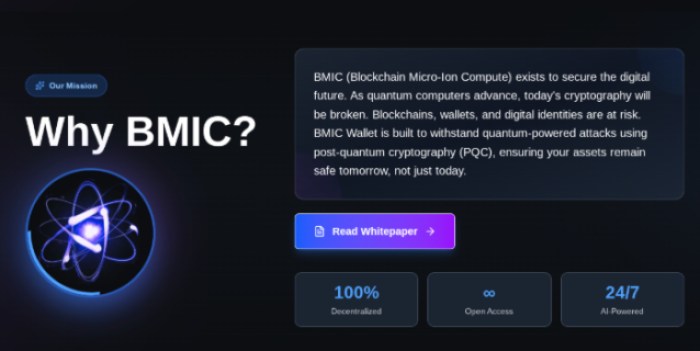
The platform integrates these defenses directly into a usable ecosystem, featuring ERC-4337 Smart Accounts and AI-Enhanced Threat Detection. This isn’t just about paranoia; it’s about future-proofing. If a centralized issuer can freeze $544M with a keystroke, and a quantum computer can eventually crack a standard private key in seconds, the only safe harbor is an architecture built explicitly to resist both.

BMIC’s ‘Burn-to-Compute’ model and Quantum Meta-Cloud extend this utility further, offering a decentralized alternative to the fragile infrastructure currently dominating the headlines.

Smart Money Pivots to BMIC as Presale Metrics Climb

The market’s appetite for defensive infrastructure is showing up in the BMIC capital raise. Sophisticated allocators are positioning themselves in protocols that solve fundamental security flaws. $BMIC has already raised over $444K, a significant figure for an early-stage infrastructure play.

With the token sitting at $0.049474, early participants are entering at a valuation that reflects the project’s development phase rather than its fully realized utility. The appeal lies in the dual-layer value proposition: $BMIC serves as both a governance token for the Quantum Meta-Cloud and the fuel for a wallet ecosystem that enterprises and privacy-conscious individuals desperately need. It’s not surprising that $BMIC made our list of best crypto to watch.

The risk here is inaction. History suggests that security solutions are often undervalued until a catastrophic event, like a major exchange hack or a cryptographic breakthrough, forces a repricing of ‘safety.’ By combining quantum-secure staking with no exposed keys, BMIC offers a yield-bearing asset that doesn’t compromise on security. As the presale continues to draw liquidity away from purely speculative assets, the window to acquire allocation at sub-five-cent levels is narrowing.

SEE HOW THE QUANTUM FUTURE IS BEING BUILT BEFORE LEGACY SYSTEMS FAIL

This article is for informational purposes only and does not constitute financial advice. Cryptocurrency investments carry high risks, including the potential loss of all invested capital. Always conduct independent research before investing.


Preguntas relacionadas

QWhat was the amount frozen in the joint operation between Turkish authorities and Tether, and what was the stated reason?

ATurkish authorities, working with Tether, froze approximately $544 million. The operation targeted a massive money laundering network.

QAccording to the article, what does the Tether ($USDT) asset freeze demonstrate about centralized stablecoin issuers?

AIt demonstrates that centralized stablecoin issuers possess the ability to blacklist addresses at the request of law enforcement, showing that the 'wild west era' of digital finance is ending and challenging the censorship-resistance narrative.

QWhat is the 'Harvest Now, Decrypt Later' threat mentioned in the article?

AThe 'Harvest Now, Decrypt Later' threat is a strategy where bad actors collect encrypted data today with the intention of decrypting it once quantum computing power becomes advanced enough to break current cryptographic standards.

QHow does BMIC ($BMIC) claim to protect against the quantum decryption crisis?

ABMIC uses a Full Quantum-Secure Finance Stack featuring post-quantum cryptography and 'Zero Public-Key Exposure.' This ensures a user's assets remain mathematically invisible to unauthorized decryption, even from future quantum algorithms.

QWhat is the dual-layer value proposition of the $BMIC token as described in the article?

AThe $BMIC token serves as both a governance token for the Quantum Meta-Cloud and as the fuel for a wallet ecosystem designed for enterprises and privacy-conscious individuals.

Lecturas Relacionadas

From Theft to Re-entry: How Was $292 Million "Laundered"?

A sophisticated crypto laundering operation was executed following the $292 million hack of Kelp DAO on April 18. The attack, attributed to the North Korean Lazarus group, began with anonymous infrastructure preparation using Tornado Cash to fund wallets untraceably. The hacker exploited a vulnerability in Kelp’s cross-chain bridge, stealing 116,500 rsETH. To avoid crashing the market, the attacker used Aave and Compound as laundering tools—depositing the stolen rsETH as collateral to borrow $190 million in clean, liquid ETH. This move triggered a bank run on Aave, causing an $8 billion drop in TVL. After consolidating funds, the attacker fragmented them across hundreds of wallets to evade detection. A major breakpoint was THORChain, where over $460 million in volume—30 times its usual activity—was processed in 24 hours, converting ETH into Bitcoin. This shift to Bitcoin’s UTXO model exponentially increased tracing complexity by shattering funds into countless untraceable fragments. The final destination was Tron-based USDT, the primary channel for illicit crypto flows. From there, funds were cashed out via OTC brokers in China and Southeast Asia, using unlicensed underground banks and UnionPay networks outside Western sanctions scope. Ultimately, the laundered money supports North Korea’s weapons programs, which rely heavily on crypto hacking for foreign currency. The incident underscores structural challenges in DeFi: its openness, composability, and lack of central control make such laundering not just possible, but inherently difficult to prevent.

marsbitHace 52 min(s)

From Theft to Re-entry: How Was $292 Million "Laundered"?

marsbitHace 52 min(s)

Google and Amazon Simultaneously Invest Heavily in a Competitor: The Most Absurd Business Logic of the AI Era Is Becoming Reality

In a span of four days, Amazon announced an additional $25 billion investment, and Google pledged up to $40 billion—both direct competitors pouring over $65 billion into the same AI startup, Anthropic. Rather than a typical venture capital move, this signals the latest escalation in the cloud wars. The core of the deal is not equity but compute pre-orders: Anthropic must spend the majority of these funds on AWS and Google Cloud services and chips, effectively locking in massive future compute consumption. This reflects a shift in cloud market dynamics—enterprises now choose cloud providers based on which hosts the best AI models, not just price or stability. With OpenAI deeply tied to Microsoft, Anthropic’s Claude has become the only viable strategic asset for Google and Amazon to remain competitive. Anthropic’s annualized revenue has surged to $30 billion, and it is expanding into verticals like biotech, positioning itself as a cross-industry AI infrastructure layer. However, this funding comes with constraints: Anthropic’s independence is challenged as it balances two rival investors, its safety-first narrative faces pressure from regulatory scrutiny, and its path to IPO introduces new financial pressures. Globally, this accelerates a "tri-polar" closed-loop structure in AI infrastructure, with Microsoft-OpenAI, Google-Anthropic, and Amazon-Anthropic forming exclusive model-cloud alliances. In contrast, China’s landscape differs—investments like Alibaba and Tencent backing open-source model firm DeepSeek reflect a more decoupled approach, though closed-source models from major cloud providers still dominate. The $65 billion bet is ultimately about securing a seat at the table in an AI-defined future—where missing the model layer means losing the cloud war.

marsbitHace 6 hora(s)

Google and Amazon Simultaneously Invest Heavily in a Competitor: The Most Absurd Business Logic of the AI Era Is Becoming Reality

marsbitHace 6 hora(s)

Trading

Spot
Futuros
活动图片